
Great Sand Dunes National Park: The Complete Visitor Guide
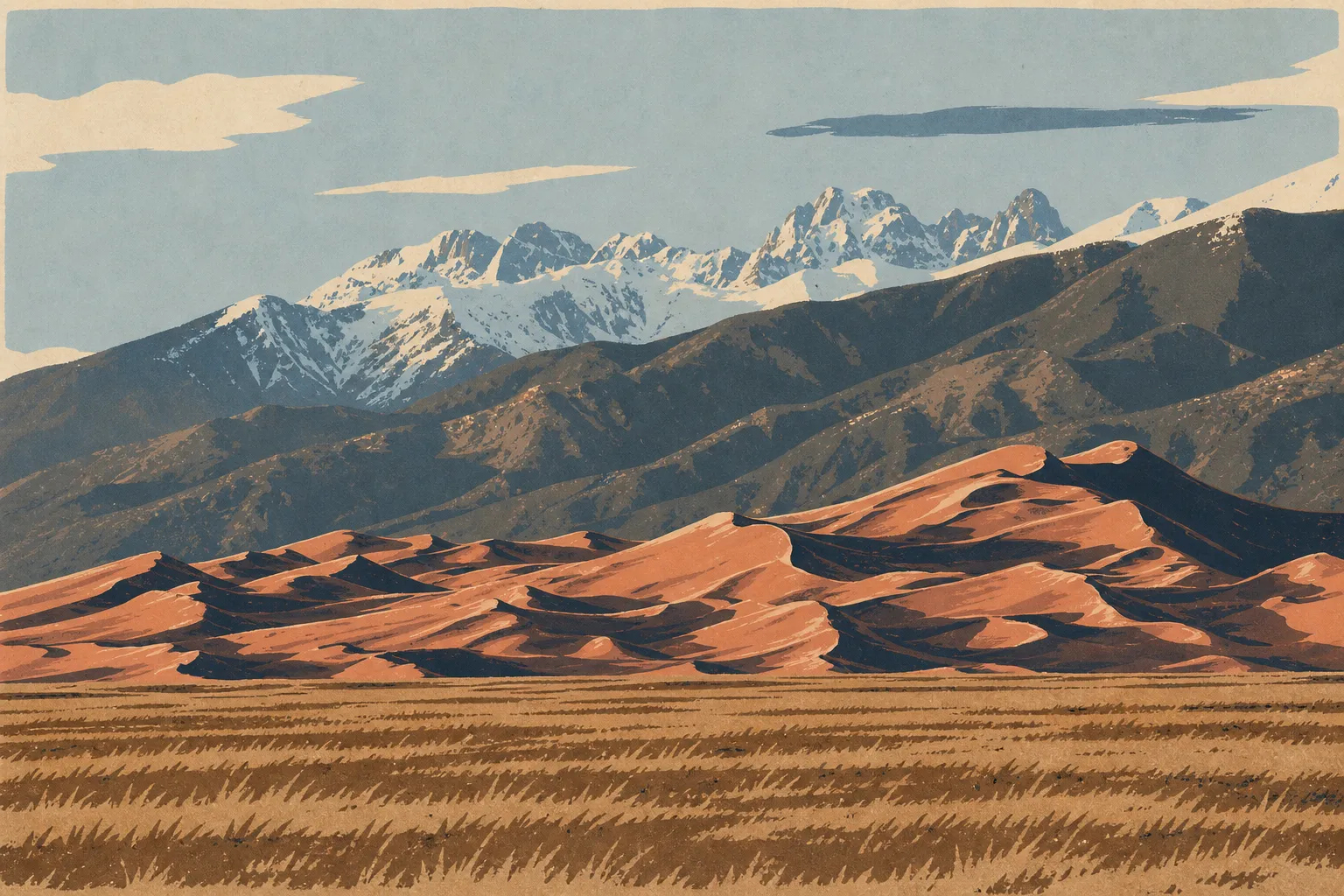
Picture an ocean of sand rising hundreds of feet high at the foot of snowcapped peaks more than 13,100 feet above sea level. That's Great Sand Dunes in southern Colorado, home to North America's tallest dunes, tucked between the San Luis Valley and the Sangre de Cristo Mountains. People come to climb the dunes barefoot, ride down the slopes on a sandboard, and wade through a seasonal creek that flows across the sand. Plan on a half day to a full day for the essentials, or two days if you want to hike in the mountain section or spend the night. The park is open 24 hours a day, year-round.
This guide gives you the big picture: where the park is, how to get there, what it costs, what to see, and how much time to allow. Each question has its own detailed guide, so follow the links as you read.
Great Sand Dunes at a Glance: Where the Park Is and How to Get There
Great Sand Dunes National Park and Preserve is in Colorado (CO), in the San Luis Valley in the south-central part of the state. The dunes built up where winds moving up the valley run into the wall of the Sangre de Cristo Mountains. The result is a dramatic field of sand backed by peaks that hold their snow late into the season.
You can reach the park only by car. There is no shuttle or public transportation. To reach the main area, including the Dunes Parking Lot, Visitor Center, and Piñon Flats Campground, take one of two routes:
- From the south: Take US 160, then head north on CO 150.
- From the west: Follow CO 17, then Lane 6, and then CO 150.
The heart of the park lies at the northern end of CO 150. The base elevation is around 7,900 feet, so take it easy if you're coming from sea level.
For driving times from Denver, Colorado Springs, or the airports, as well as conditions on secondary roads, some of which require 4WD, see our Great Sand Dunes access guide. To plan everything on a map, the detailed park map brings together points of interest and parking areas.
Entrance Fees, Passes, and Reservations
Admission is valid for 7 days and is charged per vehicle, not per person:
- Private vehicle: $25
- Motorcycle: $20
- Pedestrian, cyclist, or noncommercial group: $15 per person
If you're visiting several national parks during the year, you have two worthwhile options: the $45 park-specific annual pass or the America the Beautiful pass, which covers all federal recreation sites. Great Sand Dunes doesn't use timed entry reservations. You can enter whenever you want, including at night.
Our Fees & Passes page explains entrance fees and passes. And if you collect stamps, the park has its own. See our Passport & Stamps page.
Reservations, Permits, and Rules to Follow
Camping
Piñon Flats Campground is the only campground inside the park. Sites are booked through recreation.gov, often several weeks ahead from May through September. A few walk-in sites may be available early in the morning, but in peak season you could end up without a site. Our camping guide and RV guide cover available facilities and access rules for larger vehicles.
Hiking and Backcountry Camping Permits
You don't need a permit for day hikes, including climbing the dunes wherever you like. To spend the night outside Piñon Flats Campground, in the backcountry, you need a free wilderness permit. Pick it up the same day at the Visitor Center. The official park map shows the areas where camping is allowed.
Sandboarding and Sledding
You can bring your own sandboard or sand sled without any special restrictions. Rentals are available in Alamosa and at a few shops near the park entrance. No permit is required.
Essential Rules
- Pets are allowed but must remain on a leash, no longer than 6 feet. They are not allowed in the Preserve's backcountry areas.
- Collecting sand, rocks, or plants is prohibited within the national park.
- Drones are prohibited without prior written authorization from park management.
- Campfires are allowed only at designated sites in Piñon Flats Campground.
Getting Around Great Sand Dunes
You explore the park in your own car. There is no shuttle. Park at the Dunes Parking Lot, the main starting point, then walk to the dune field across the bed of Medano Creek, depending on the season.
To go farther, Medano Pass Primitive Road leads into the mountain section of the Preserve. Be careful: this isn't a regular road. It requires a high-clearance 4WD vehicle, you need to air down your tires for stretches of soft sand, and you'll cross the creek several times. Don't attempt it in a rental sedan.
Distances on the sand can be deceptive. Walking across loose material on a slope takes a lot of energy. Our guide to getting around Great Sand Dunes explains which parking area to use, how to handle creek crossings, and what to know before taking the primitive road.
How Much Time Do You Need to Visit Great Sand Dunes?
To walk on the dunes, climb to an initial summit, and enjoy the light, a well-planned half day is enough. Add sandboarding and a picnic along Medano Creek, and you've got a full day that feels relaxed rather than rushed.
If you want to climb Star Dune, hike through the Preserve's forest, or photograph sunrise and sunset, the two best times of day, plan on two days and one night in or near the park. That's also the ideal pace for a family visit, without turning the climb through the sand into an ordeal.
To fit the park into a larger itinerary and decide what to do hour by hour, our Itinerary & Time page offers half-day, one-day, and two-day plans.
Plan your visit
What to See and Do at Great Sand Dunes
The park doesn't have a scenic drive connecting a series of overlooks. Here, the attraction is the sand, and you explore it on foot. These are the main areas to know.
Road trip journal · 4 areas
The Dune Field and the Climb to the Summits
This is the heart of the visit. From the parking lot, you walk straight into the dune field. High Dune, the one visible from the Visitor Center, is the classic goal. The climb is steep and the sand shifts underfoot, but the view from the top across the entire dune field and the mountains beyond makes the effort worthwhile. Farther on, Star Dune vies for the title of North America's tallest dune, rising more than 655 feet from its base. The round trip is long and strenuous, best suited to strong hikers.
Here's a practical safety rule: in summer, the surface of the sand can reach 160°F in the middle of the day. That's scorching for bare feet and dogs' paws. Climb early in the morning or late in the afternoon, wear closed-toe shoes, and carry water because there's no shade on the dunes.
Medano Creek, the Creek That Flows Across the Sand
In spring and early summer, snowmelt spreads Medano Creek across the foot of the dunes. Flow usually peaks in late May and early June, then declines. Families lay out their towels as if they're at the beach. The water is shallow, the bottom is sandy, and there is no danger from a strong current. Depending on the year and the snowpack, the creek may be flowing generously or reduced to a trickle. We track these seasonal changes on our Weather page.
Sandboarding and Sand Sledding
Riding down the dunes on a sandboard or sand sled is the park's signature activity. One important detail: regular snow equipment doesn't glide on dry sand. You need boards designed for it, available for rent outside the park, since the park doesn't sell them. Our guide to park activities explains where to find equipment and which slopes to ride.
The Preserve, the Forest, and the High Country
Beyond the sand, the Preserve climbs into the forest and toward the Sangre de Cristo peaks. This is where you'll find high-elevation hikes and trails to mountain lakes and waterfalls, far removed from the dune environment. It feels like another park within the park: greener, cooler, and wilder.
Three pages offer more detail:
- Our detailed hiking guides, from the sand to the high-elevation forests.
- Our Wildlife page, for what to look for and when.
- Our Family page, if you're traveling with kids.
Explore the park
The Best Hikes at Great Sand Dunes
There are no marked trails on the dunes. You make your own way toward whichever summit you choose, so the hiking feels open-ended but physical. In the Preserve, by contrast, forest trails climb toward waterfalls and mountain lakes. The two settings are sharply different: loose-sand effort on one side, elevation gain at altitude on the other.
Distances, elevation gains, times, and difficulty levels are collected on our Hiking page, along with tips for avoiding heat and altitude problems.
The detailed guide Great Sand Dunes Hiking Guide: Best Trails for Every Ability The best hikes at Great Sand Dunes, from dune climbs to forest trails, with… Read the guide →Wildlife and Plants to Look For
Despite its desert-like appearance, Great Sand Dunes is home to wildlife adapted to these extreme environments. Endemic insects found nowhere else, elk and deer in the meadows, and birds along Medano Creek: life gathers wherever water and vegetation reclaim the edges of the sand and the Preserve's forest. Dawn and dusk are still the best times for wildlife viewing, when animals emerge and the sand turns red.
Our Wildlife page has the details on species and where to find them.
The detailed guide Wildlife at Great Sand Dunes: What You'll See and Where to Look Pronghorn, elk, black bears, and Ord's kangaroo rats Read the guide →When to Visit Great Sand Dunes
The park is open year-round, but each season completely changes the experience. Temperatures stay cool at this elevation, with cold summer nights and freezing winter nights. The sand, however, gets scorching in the middle of summer days, reaching 160°F at the surface. Explore in the morning or evening. Spring brings wind, but it also brings Medano Creek at its highest.
In short, late spring and early summer are best for the creek and wading, fall for light and quiet, and winter for a dune field dusted with snow and almost empty. Our When to Visit page and Weather page cover the details month by month, including bloom and high-water windows.
The detailed guide When to Visit Great Sand Dunes: The Best Time, Month by Month The best times to visit Great Sand Dunes are May and September-October Read the guide →Where to Stay at Great Sand Dunes: Hotels and Campgrounds
On-site, Piñon Flats Campground operates overnight inside the park, just steps from the dunes, with reservations recommended during peak season. Outside the park, you'll find private campgrounds, lodges, and motels around Mosca and Alamosa. Alamosa is the closest town for hotels and services.
Here are the main options. Use our dedicated guides to choose:
- Our Where to Stay guide, for the big picture.
- Our Hotels & Lodges guide for the valley.
- Our Camping page for tent camping.
- Our RV page for sites and hookups.
As for meals, on-site options are limited. Our Where to Eat page lists what's available in and around the park.
Stay in the park
Around Great Sand Dunes: Things to Do Nearby
The park pairs well with the surrounding region. Zapata Falls, tucked into a gorge a few miles south, offers a short, refreshing walk and a beautiful view of the valley. Farther afield, the San Luis Valley, the Cumbres & Toltec Scenic Railroad, and the town of Alamosa are easy additions to a two- or three-day trip.
To include Great Sand Dunes in a longer Colorado road trip, explore our regions and our road trips.
Our Take: Is Great Sand Dunes Worth the Trip?
Yes, as long as you know what you're looking for. Great Sand Dunes isn't a park of overlooks that you check off in an hour from the car. It's a physical, sensory playground where you walk, climb, slide, and get dirty. When we visited late in the day, the low light sculpting the ridges and the silence on the sand made the detour worthwhile all on their own.
The park is best experienced early in the morning or in the evening, away from the midday heat, and it fits perfectly into a one- or two-day trip around the region. On a road trip through southern Colorado, it's a distinctive stop unlike any other.
Frequently Asked Questions
Are the Great Sand Dunes Worth the Trip?
The Great Sand Dunes are worth the trip if you enjoy unusual landscapes and outdoor activities. They're North America's tallest dunes, set below mountains more than 13,100 feet high, with sandboarding, seasonal wading in Medano Creek, and hiking. It's an experience, not just a viewpoint.
How Much Time Should You Spend at the Sand Dunes?
Plan on a half day for the essentials, including climbing a dune, enjoying the light, and having a picnic. Allow a full day if you add sandboarding and Medano Creek. Two days give you time to climb Star Dune and explore the mountain Preserve. Our Itinerary & Time page lays out these plans in detail.
How Much Is Admission to Great Sand Dunes?
Admission to Great Sand Dunes costs $25 per private vehicle and is valid for 7 days. The fee is $20 for a motorcycle and $15 per person entering on foot, by bicycle, or as part of a noncommercial group. A park-specific annual pass costs $45. See our Fees & Passes page for details.
Can You Visit Great Sand Dunes by Car?
You can drive to the Dunes Parking Lot, but you explore Great Sand Dunes on foot once you reach the sand. There is no shuttle. The only road open to vehicles is Medano Pass Primitive Road, and it requires a suitable 4WD vehicle. See our Getting Around page.
When Is the Best Time to Visit Great Sand Dunes?
The best time depends on your plans: late spring and early summer for Medano Creek and wading, fall for light and quiet, and winter for a snowy, empty landscape. Since the sand gets scorching in the middle of summer days, visit in the morning or evening. See our When to Visit page for details.
The American Parks shop
Bring Great Sand Dunes home
Our park-inspired creations, made to order and shipped to your door.
Latest park news
- Great Sand Dunes: Three Deep Creek Crossings on Medano Pass RoadCreek crossings 3, 4, and 5 on the Medano Pass Primitive Road are running deep right now, so use caution and bring a capable vehicle.
- Great Sand Dunes: Flood Watch in Effect, Plan Your Visit CarefullyA flood watch covers Great Sand Dunes and the San Luis Valley. Here's what it means for your visit.
- Great Sand Dunes: What to Know About Fire Restrictions Before You CampGreat Sand Dunes is under Stage 1 fire restrictions right now, and here's what that actually means for your overnight camp.