
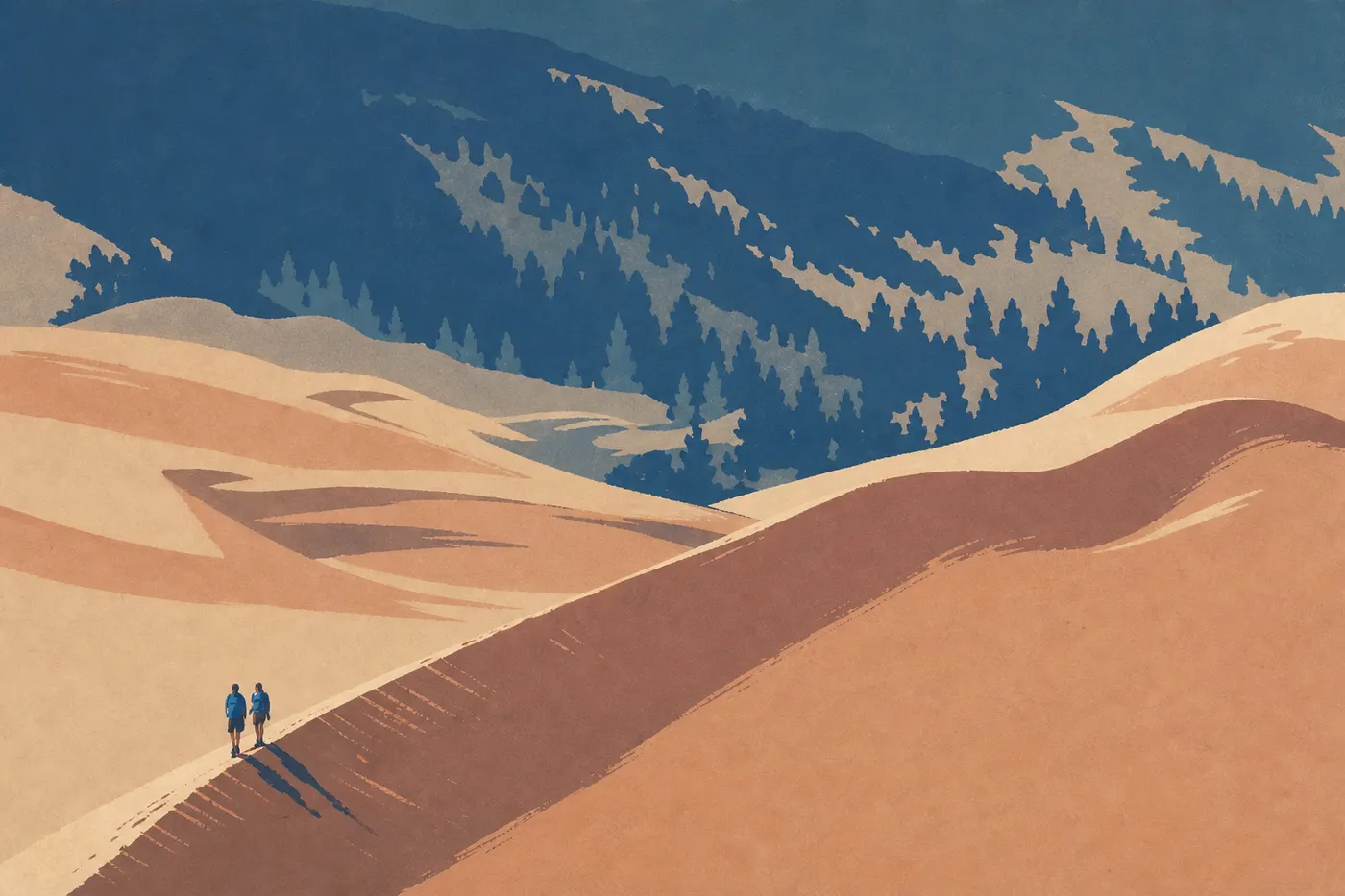
Great Sand Dunes Hiking Guide: Best Trails for Every Ability
Quick answer. If you only do one hike, make it the climb to High Dune: about 1.9 miles round-trip across deep sand, with 500 feet of elevation gain and sweeping views of the entire dune field. If you want to reach the highest point, Star Dune (5 miles round-trip, difficult) takes a full day. For a mountain experience beyond the sand, the Medano Lake Trail climbs above 11,500 feet in the Sangre de Cristo Mountains, covering 7.5 miles and gaining 2,130 feet.
What sets Great Sand Dunes apart from every other national park is its lack of marked trails across the dune field. You choose your own route through sand that gives way under every step, navigate by sight between the ridges, and can lose your bearings in the middle of the field while still being within 1.2 miles of the parking lot. Around the edges, Great Sand Dunes National Preserve opens onto classic forest trails, with spruce forests and glacial lakes. Two radically different worlds share one pass. Our complete Great Sand Dunes guide gives you the big picture if you're still planning your visit.
How to Prepare for a Hike at Great Sand Dunes
Permits. You don't need a permit for a day hike, either on the dunes or in the Preserve. Only overnight camping in the dune field requires a free wilderness camping permit, which you can pick up at the Visitor Center before setting out.
Hot sand is the number-one danger. The park sits at 7,900 feet, under high-altitude sun that hits hard. In midsummer, the sand's surface can exceed 158°F by noon. That's hot enough to cause severe burns to your feet within minutes. From June through August, start before 9 a.m. or after 4 p.m. No exceptions. This rule applies to adults and kids alike.
Footwear. Closed-toe shoes with thick soles are essential. Flip-flops, sandals, and lightweight athletic shoes with thin soles won't protect you from overheated sand. Avoid going barefoot on the dunes in the middle of the day, too.
Water. There are no water sources on the dunes. Carry at least 2 liters per person for a half day, and 3 to 4 liters if you're aiming for Star Dune. Medano Creek, which runs along the edge of the dune field, isn't potable.
Summer thunderstorms. From July through September, violent thunderstorms can build in the early afternoon, sometimes in less than an hour. If you're exposed on the dunes when dark clouds move in, descend immediately. Don't stay on high ground. The dunes have no cover and are fully exposed to lightning.
Dogs. Dogs are allowed on leash on marked trails. They're prohibited in the dune field because the hot sand can severely burn their paws within a few steps.
Wildlife. The Preserve's forest trails are home to elk, deer, and, occasionally, mountain lions. Make your presence known in wooded areas, keep your distance, and never leave food unattended during breaks.
For month-by-month temperatures and detailed weather conditions, check the Great Sand Dunes weather guide.
The Best Hikes, Area by Area
On the Dunes: Unmarked, Self-Guided Climbs
There are no cairns, signs, or established paths here. You navigate by sight between the sand ridges and the valleys carved between the dunes. The first steps can feel disorienting. Without fixed landmarks, the dune field looks uniform. As you gain elevation, though, the landscape opens up and your direction becomes clear. You won't find this kind of hiking anywhere else in the U.S. national park system.
- Distance
- Distance: ~1.9 miles round-trip
- Elevation gain
- Elevation gain: +500 feet
- Duration
- Time: 1.5 to 2 hours
- Difficulty
- Difficulty: moderate
- Type
- Type: self-guided out-and-back across the dunes
High Dune is the first ridgeline visible from the parking lot. It isn't the park's highest point, but it offers unobstructed 360-degree views across the entire dune field, the San Luis Valley, and the Sangre de Cristo Mountains. The elevation gain is modest, but loose sand doubles the effort compared with a regular trail. Your feet sink with every step, keeping your ankles and calves working nonstop. Allow 1.5 hours for a relaxed climb.
Start at the Dunes Parking Lot. In spring, from April through June, Medano Creek flows below the parking lot and requires a knee-deep, cold-water crossing. This detail may seem minor in summer, but for kids it can become the most delightful surprise of the visit.
- Distance
- Distance: ~5 miles round-trip
- Elevation gain
- Total elevation gain: ~720 feet (in reality, more because of the ups and downs between dunes)
- Duration
- Time: 4 to 6 hours
- Difficulty
- Difficulty: difficult
- Type
- Type: self-guided out-and-back across the dunes
Star Dune is the tallest dune in North America, rising about 750 feet above the surrounding plain. To reach it from the parking lot, you first cross High Dune, then descend into the interdunes, the quiet hollows between the large sand formations, before climbing back toward the summit. The distance looks reasonable on paper. The effort isn't. Four to six hours on loose sand work muscles you don't use on a standard hike, and the wind at the top can catch you off guard.
Plan on a full day. Bring a picnic, a light windbreaker, and sunglasses, which are essential because the glare off the white sand is intense. Start at the Dunes Parking Lot. Avoid this hike after 9 a.m. in midsummer.
In the Sangre de Cristo Mountains: Forest Trails in the Preserve
The national preserve next to the park opens onto high-elevation forest trails that feel completely different from the dunes. They're shaded and cool, with water running between the rocks. In less than an hour of hiking, you can go from a desert-like landscape to an alpine one.
- Distance
- ~7.5 miles
- Elevation gain
- +2,130 feet
- Duration
- 5 to 7 hours
- Difficulty
- difficult
- Type
- out-and-back
This trail climbs from a forest of pinyon and spruce to Medano Lake, surrounded by Sangre de Cristo peaks above 11,500 feet. The grade is steady through the first two-thirds, on a well-defined forest trail, then the final section becomes rockier and more exposed. When you reach the lake, the contrast with the dunes you saw that morning is striking: cold water, alpine meadows, and snowcapped peaks reflected in the lake.
Start beyond Piñon Flats Campground via Medano Pass Primitive Road, an unpaved road where a high-clearance vehicle is recommended. Seasonal tip: snow can block access into June and return as early as October. Check conditions at the Visitor Center before setting out. Bring a warm layer. Wind by the lake can be biting even in midsummer.
Sand Creek Lakes (advanced backcountry) For hikers who want to go farther into the Preserve, Sand Creek Lakes can be reached by a long, lightly traveled route. This outing is for experienced hikers, ideally with overnight gear. Road access to this area varies by season, so be sure to ask at the Visitor Center about current road and route conditions.
Easy, Family-Friendly Hikes
Great Sand Dunes isn't just for seasoned hikers. Two short, flat marked trails work well for families, beginners, and anyone who wants to enjoy the park without committing to a demanding outing.
- Distance
- 0.6 miles
- Elevation gain
- minimal elevation gain
- Duration
- 20 to 30 minutes
- Difficulty
- easy
- Type
- loop
This loop winds among junipers and pinyons along the edge of the dune field, with a few open views of the dunes and valley. It's ideal for stretching your legs after arrival, getting to know the local vegetation, or taking an end-of-day walk with the kids. Start near the Visitor Center.
- Distance
- 1.5 miles one way
- Elevation gain
- nearly flat
- Duration
- 45 minutes to 1 hour
- Difficulty
- easy
- Type
- out-and-back
This flat trail follows an old agricultural irrigation ditch at the foot of the dunes. Views of the dune field and the Sangre de Cristo Mountains stay open the entire way. It's suitable for all-terrain strollers. Start at the Dunes Parking Lot.
Free-form exploration at the foot of the dunes. For families with young children, the first sandy slopes beyond the parking lot are perfect for spontaneous exploration. Climb, slide, and dig. When Medano Creek flows, usually from April through early June, a small sandy beach forms below the dune field. At 7,900 feet, the scene feels almost like a beach vacation.
To go farther with your kids, the Great Sand Dunes family activities guide lays out the options by age.
Challenging and Full-Day Hikes
Star Dune remains the ultimate challenging outing on the dunes. There are no marked trails, the route stays on loose sand, and sun, wind, and altitude are constant factors. Together, they make the hike much more demanding than the listed 5 miles suggest. It's also a physical experience unlike anything else in the NPS system.
Medano Lake Trail is the park's demanding mountain outing. With 2,130 feet of elevation gain and a final elevation above 11,500 feet, it's best left to hikers used to long days. Visitors arriving from low elevations may get winded sooner than expected. Drink more water than usual and slow your pace if needed instead of trying to push through.
To spot elk and deer along the way, the Great Sand Dunes wildlife guide identifies the Preserve's best areas and the species to watch for.
Access, Trailheads, and Parking
Dunes Parking Lot. Every hike across the dune field, including High Dune, Star Dune, and free-form exploration, starts at this large main lot just beyond the Visitor Center. The $25 park entrance fee per vehicle includes access to the lot. On spring weekends and in July and August, it's often full before 9 a.m. Arrive before 8 a.m. or come back after 4 p.m. to find a spot without waiting.
Getting to the park. Reach Great Sand Dunes via CO 150, from the south on US 160, or from the west on CO 17 and Lane 6. The Visitor Center, Dunes Parking Lot, and Piñon Flats Campground are all at the north end of CO 150.
Preserve trails. Reach the Medano Lake Trailhead via Medano Pass Primitive Road, an unpaved road that begins in the Piñon Flats area. A high-clearance vehicle is recommended. For Sand Creek Lakes, in the eastern part of the Preserve, the access route varies by season. Check at the Visitor Center. The park has no shuttle.
Fees. Entrance costs $25 per vehicle, $20 for a motorcycle, and $15 for noncommercial groups. The park's annual pass costs $45. The America the Beautiful pass is accepted.
When to Hike at Great Sand Dunes
The park is open 24 hours a day, year-round. The best hiking windows run from late April through early June, then from September through October.
In spring, the dunes are cool and Medano Creek flows along the edge of the sand field. It's the most photogenic season and the most comfortable for physical exertion.
In summer, from July through August, you need to hike the dunes early in the morning. Monsoon thunderstorms mean you should be back down by 1 p.m. The Preserve's more shaded forest trails remain usable for much of the day.
In winter, the dunes beneath the snow are striking and visitors are few. Access roads into the Preserve may be closed.
Find month-by-month conditions, temperatures, precipitation, and seasonal alerts in the guide to the best times to visit Great Sand Dunes.
Which Hike Fits Your Profile?
You have two hours and you're in good shape. High Dune. The effort-to-view ratio is excellent, and 1.9 miles in sand will leave you more tired than a regular hike twice as long. You won't be disappointed.
You want the full experience. Start for Star Dune at dawn, have a picnic in the interdunes, and return before the afternoon thunderstorms. Plan on a full day and bring traction-focused footwear.
You're traveling with kids. Choose Montville Nature Trail or Wellington Ditch Trail for an easy walk, then let the kids play freely at the foot of the dunes. If Medano Creek is flowing, usually from April through June, take advantage of it. Few parks offer a surprise like this.
You're looking for a mountain hike, not sand. Medano Lake Trail offers a classic alpine profile, with the unusual bonus of starting in a dune park. Plan on a full day and check access to the road.
You're a photographer. Go to High Dune during the morning golden hour. The play of light and shadow across the sand ridges, with the Sangre de Cristo Mountains in the background, is the park's most spectacular sight. Our Wildlife page also identifies the areas and times to watch elk in the Preserve.
Frequently Asked Questions
What's the best hike at Great Sand Dunes?
The climb to High Dune is the essential hike: about 1.9 miles round-trip, 500 feet of elevation gain, and sweeping views of the dune field. For hikers who want to go farther, Star Dune (5 miles, difficult) is the park's big challenge.
Is hiking at Great Sand Dunes difficult?
Hiking on the dunes is more demanding than it looks on paper. Loose sand doubles the physical effort compared with a regular trail with the same elevation gain. Most fit visitors can manage High Dune. Star Dune and Medano Lake are best left to hikers accustomed to long outings.
Is it safe to hike at Great Sand Dunes?
The main risks are hot sand, which can reach 158°F in summer, dehydration, afternoon thunderstorms in July and August, and elevation, with the parking lot at 7,900 feet. An early start, proper footwear, plenty of water, and attention to the weather make these risks manageable.
Do I need a permit for a day hike at Great Sand Dunes?
No. You don't need a permit for a day hike, whether you're on the dunes or in the Preserve. Only overnight camping in the dune field requires a free permit, available at the Visitor Center before you leave.
Are there easy or family-friendly hikes at Great Sand Dunes?
Yes. Montville Nature Trail (a 0.6-mile loop) and Wellington Ditch Trail (1.5 miles and flat) are accessible to everyone. Free-form exploration at the foot of the dunes works for kids of any age and requires no special equipment.
Can I hike with my dog at Great Sand Dunes?
Dogs are allowed on leash on the park's marked trails. They're prohibited in the dune field, where hot sand can severely burn their paws within minutes.
When is the best time to hike at Great Sand Dunes?
The best periods are late April through early June and September through October. In summer, hike the dunes early in the morning. Our When to Go page details conditions month by month.
Are there loop hikes at Great Sand Dunes?
The dune field has no marked trails, so you create your own route and can easily make a free-form loop. Montville Nature Trail is the park's only official marked loop, at 0.6 miles.
How do I reach the trailheads at Great Sand Dunes?
All dune hikes start at the Dunes Parking Lot, reached from CO 150 just beyond the Visitor Center. For Medano Lake, take Medano Pass Primitive Road, an unpaved road where high clearance is recommended. The park has no shuttle.
Which trails are best for seeing wildlife at Great Sand Dunes?
The Preserve's forest trails, especially Medano Lake Trail, offer the best chances of seeing elk and deer. Wildlife is scarce in the dune field itself. Our Wildlife page lists the species found here and the best areas for viewing them.