
Great Sand Dunes Itinerary: What to See in 1, 2, or 3 Days
Picture sand dunes as tall as a 70-story building, set at the foot of snowcapped peaks rising to 13,000 feet in a semi-arid Colorado plain. That's exactly what Great Sand Dunes National Park and Preserve is: a landscape unlike anything else in the United States, and one that can surprise even well-prepared visitors. One day covers the essentials. Two days let you add mountain trails. Three days open the door to the Preserve and the surrounding San Luis Valley.
How Long Do You Need to Visit Great Sand Dunes?
One day is enough for the core experience: hiking to the top of High Dune (690 feet of elevation gain), walking along Medano Creek when it's flowing, and trying sandboarding. It's the minimum itinerary, and it's already physically demanding.
Two days let you add a mountain trail the next morning, such as Mosca Pass, before the heat sets in, then take it easy around the park in the afternoon. This works well for most visitors.
Three days are needed to explore Medano Pass by 4WD, visit Zapata Falls, and include Great Sand Dunes in a longer road trip toward Mesa Verde or Pikes Peak.
One important detail: the park is open 24 hours a day, 7 days a week, year-round. Nothing stops you from arriving at dawn to beat the crowds and the heat radiating from the sand. In midsummer, the dune surface can reach 160°F in the middle of the day. This is no joke. Plan to climb the dunes before 9 a.m. or after 5 p.m. between June and August.
Starting Point
Great Sand Dunes sits 35 miles northeast of Alamosa, in southern Colorado. Alamosa is the closest service town for gas, groceries, and sandboarding gear. From Denver, plan on about a 4-hour drive. For access roads, Medano Pass conditions, and traffic in the park, the Great Sand Dunes access guide covers the essentials.
The Areas of Great Sand Dunes
Great Sand Dunes breaks down into four distinct areas. Understanding them before you arrive changes the experience.
The Dune Field
This is the heart of the park: a 32-square-mile dune field bordered by the Sangre de Cristo Mountains to the east and the plain to the west. There are no marked trails here. You walk across the sand and climb wherever you like. High Dune, at 690 feet, is the classic and reasonable goal. Star Dune, the tallest at 755 feet, takes about 4 to 5 hours round-trip from the Dunes Parking Lot.
Moving through the dunes is strenuous because the sand gives way under your feet with every step. Allow twice as much time as you would for a trail of the same distance on firm ground.
Medano Creek and the Entrance Area
At the foot of the dunes, Medano Creek flows seasonally from about March through July. In spring, it creates a rare phenomenon called surge flows: waves a few inches high that roll across the sand about every 20 seconds, caused by pressure changes in the underlying sediment. The result is a mountain beach at 7,900 feet, with kids playing in the water and adults staring in disbelief. It's one of Colorado's most unexpected experiences.
The Visitor Center sits right at the entrance to this area. You can pick up maps, ask rangers questions, and check the creek level and dune conditions there.
The Sangre de Cristo Trails
The mountains begin behind the dunes. Three main trails climb into the Sangre de Cristo Mountains from the park.
Montville Nature Trail: A flat, 1-mile loop that's ideal for understanding the geology before you head into the dunes.
Mosca Pass Trail: A 6.8-mile round-trip hike with 2,200 feet of elevation gain, pine forests, and sweeping views down over the dunes. Start this trail early so you're back down before the afternoon thunderstorms that are common in summer.
Wellington Ditch Trail: A less crowded alternative in the shoulder seasons.
These trails lie entirely within the National Preserve, next to the National Park, which means different rules apply. Hunting is allowed there, and you can access the mountain-side Preserve trails without paying an entrance fee.
Medano Pass Primitive Road and the Preserve
This 23-mile road crosses the eastern side of the Preserve, connecting the park to the Wet Mountain Valley and ending in Gardner. It's a pure 4WD adventure, with repeated crossings of Medano Creek, rough roads, and canyons. Creek crossings are not recommended during high water. If you don't have a high-clearance vehicle, skip it. For those with the right vehicle, it's a way to see the park from an angle that 95% of visitors miss.
Day-by-Day Itinerary
Day 1: The Dunes, the Creek, and Sandboarding
Arrive at the Dunes Parking Lot when it opens, or just after dawn in summer. The soft morning light is also beautiful for photos.
Morning (7:30 to 11 a.m.): Head toward High Dune. You'll gain 690 feet over about 0.9 miles. You move faster by staying on the dune ridges instead of walking through the hollows. From the top, the view across the San Luis Valley and the Sangre de Cristo Mountains is striking. Bring water, high-SPF sunscreen, and closed-toe shoes, even in summer.
Before noon: Head back down before the sand's surface becomes dangerously hot. If Medano Creek is flowing, usually from April through early July, cool your feet at the base of the dunes. It's an ideal spot for families with kids.
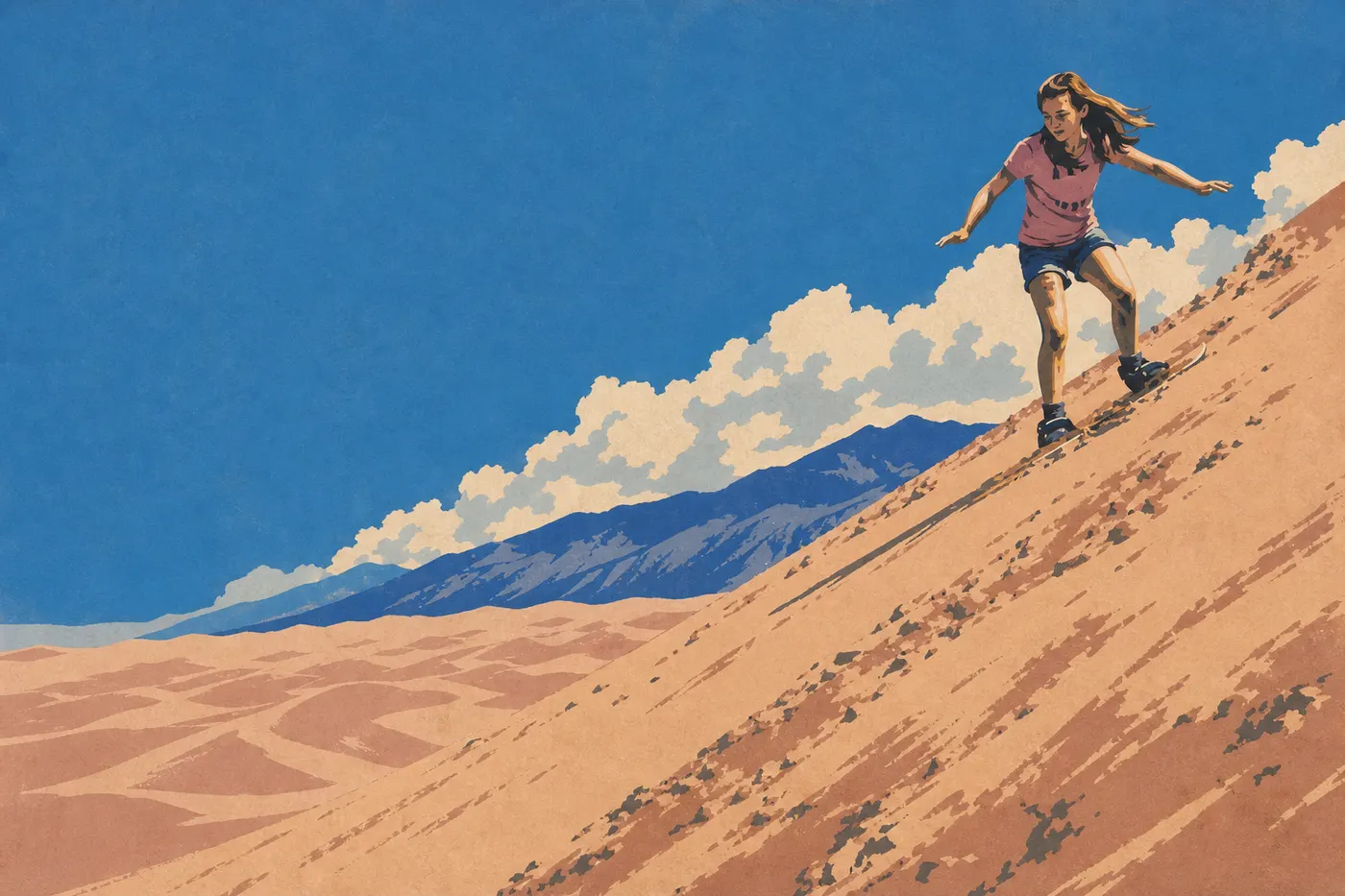
Afternoon (3 to 6 p.m.): Try sandboarding or sand sledding. You can rent boards in Alamosa and in the village of Mosca, about 9 miles from the entrance. It takes a few runs to get the hang of it, but it's the kind of activity people still talk about ten years later. The best slopes are on the dunes' northwest sides, which get less afternoon sun.
Evening: The park stays open at night, and Colorado's skies are unusually clear. The San Luis Valley is one of the southern American Southwest's areas with the least light pollution. Head out after 9 p.m. with a red flashlight and stay on the ridges for an impromptu stargazing session. Park rangers sometimes lead guided evening programs, so ask at the Visitor Center.
Day 2: Mosca Pass Trail and Zapata Falls
Morning (7 a.m. to noon): Start early on Mosca Pass Trail. The trail climbs steadily through ponderosa pines and spruce, with no technical difficulties, to the pass at 9,954 feet. The view of the dunes from above completely changes your perspective. You only grasp their scale from up there. Head back down before the afternoon thunderstorms, which often roll in between 1 and 3 p.m. in summer.
Afternoon: Head south on CO 150, then take US 160 toward Zapata Falls. These 89-foot falls are hidden at the end of a short trail, about 0.5 miles, with some scrambling over the final stretch, in a canyon of crystalline rock. The waterfall plunges into a narrow cleft and brings welcome coolness. Allow 1.5 hours for the round trip from the parking area.
Late afternoon: Head to Alamosa for dinner. The town isn't particularly charming, but it offers a good selection of restaurants and services.
Day 3: Medano Pass or a Regional Extension
If you have a high-clearance 4WD vehicle, spend the morning on Medano Pass Primitive Road. Leave early, lower your tire pressure, and take time to stop at the viewpoints overlooking Sangre de Cristo. The full drive to Gardner takes 3 to 4 hours in good conditions.
If you don't have the right vehicle, explore the San Luis Valley. Options include Great Sand Dunes Oasis, a complex with a hot-spring pool and campground at the park entrance, the nearby San Luis Lakes State Wildlife Area, or the drive to Taos, New Mexico, 2.5 hours away, to continue your road trip south.
Variations by Trip Length
Express (1 day): Dunes Parking Lot at dawn, climb High Dune, Medano Creek, a picnic at the Visitor Center, and head back before 2 p.m. in summer. You'll see the essentials.
Classic (2 days): Day 1 as described above. Day 2: Mosca Pass Trail in the morning, Zapata Falls in the afternoon. It's the ideal format for anyone including Great Sand Dunes in a Colorado road trip.
Immersive (3 days or more): The full itinerary above, with a night under the stars on Day 1. Plan to camp at Piñon Flats Campground, just steps from the dunes. Getting up at 6 a.m. to see the first light on the dune field is an experience in itself. The Great Sand Dunes camping guide covers reservations and available amenities.
Itinerary Map
The NPS publishes an official Unigrid map as a PDF. It's available at the Visitor Center and for download from nps.gov/grsa. It covers the dune field, the Preserve trails, Medano Pass Primitive Road, and the two campgrounds. Print it before you leave. It's the reference document you need because there's no cell service in the park.
Mark the key locations before you arrive: Dunes Parking Lot, the starting point for the dunes and creek; Visitor Center, 1,000 feet farther south; Piñon Flats Campground, right next door; and the Mosca Pass Trailhead, north of the campground. The park's entire central area fits within a 1.2-mile radius.
The Great Sand Dunes map offers a simplified view of the areas and the distances between points of interest.
Where to Stay Along the Itinerary
There are two options inside the park itself: Piñon Flats Campground, for tents and RVs, with reservations recommended from April through September, or the backcountry, which requires a wilderness permit issued free of charge at the Visitor Center. Outside the park, Alamosa has most of the hotels and motels at reasonable rates. The Great Sand Dunes lodging guide and hotel and lodge picks cover the options in detail based on your budget and the level of comfort you want.
Extend Your Trip: What to See Around Great Sand Dunes
Great Sand Dunes fits naturally into a longer Colorado road trip. Mesa Verde National Park, 3 hours west, is the logical stop if you're continuing toward Utah. Black Canyon of the Gunnison, 2.5 hours northwest, sees fewer visitors and is just as impressive.
To the south, New Mexico opens up quickly. Taos and its art galleries are 2.5 hours away, while White Sands National Park is 4 hours away. It's another dune field, this time white, with a completely different character.
The Ideal Itinerary for Your Time
Two days remain the best compromise for most visitors: one full day on the dunes and one day for the mountains and Zapata Falls. Anyone with just one day can still have a memorable experience, as long as they leave early and don't underestimate how hot the sand gets in summer. Those with three days reach a much quieter side of the park than the main parking area suggests.
What really changes the experience is arriving the night before, camping at Piñon Flats, and heading into the dunes before the sun gets high. The park at 7 a.m. is a different park from the one at 11 a.m.
Frequently Asked Questions
How many days do you need to visit Great Sand Dunes?
Two days let you cover the dunes, Medano Creek, and a mountain trail in good conditions. One day is enough for the essentials if you arrive early. Three days are needed to add Medano Pass by 4WD and the surrounding valley.
What's the best route for visiting Great Sand Dunes?
The classic route starts at the Dunes Parking Lot, climbs High Dune, follows Medano Creek, then continues the next morning on Mosca Pass Trail and in the afternoon to Zapata Falls. That's the itinerary laid out in detail above.
Can you drive across Great Sand Dunes?
CO 150 crosses the park from south to north and is accessible to all vehicles. Medano Pass Primitive Road crosses the Preserve from east to west, but requires a high-clearance 4WD vehicle with deflated tires. Standard vehicles can't make it.
What's the best time to visit Great Sand Dunes?
Spring, from April through June, is ideal. Medano Creek is flowing, temperatures are mild, and crowds remain manageable. September and October bring remarkable light and fewer people. The Great Sand Dunes seasons guide details the benefits and drawbacks month by month.
How much does it cost to enter Great Sand Dunes?
For entrance fees and annual passes, see the National Parks fees and passes page.
Is Great Sand Dunes worth the trip?
Yes, and often more than people expect. Most visitors expect pretty dunes. Instead, they find a science-fiction landscape with mountains behind them, the creek in front, and an unusually intense high-altitude sky. It's one of Colorado's most surprising parks.
Where should you stay when visiting Great Sand Dunes?
Alamosa, 35 miles south, is the natural base for supplies and has the widest range of lodging. Camping at Piñon Flats remains the most immersive option. You're a 10-minute walk from the dune field. Our Where to Stay guide compares the two options.