
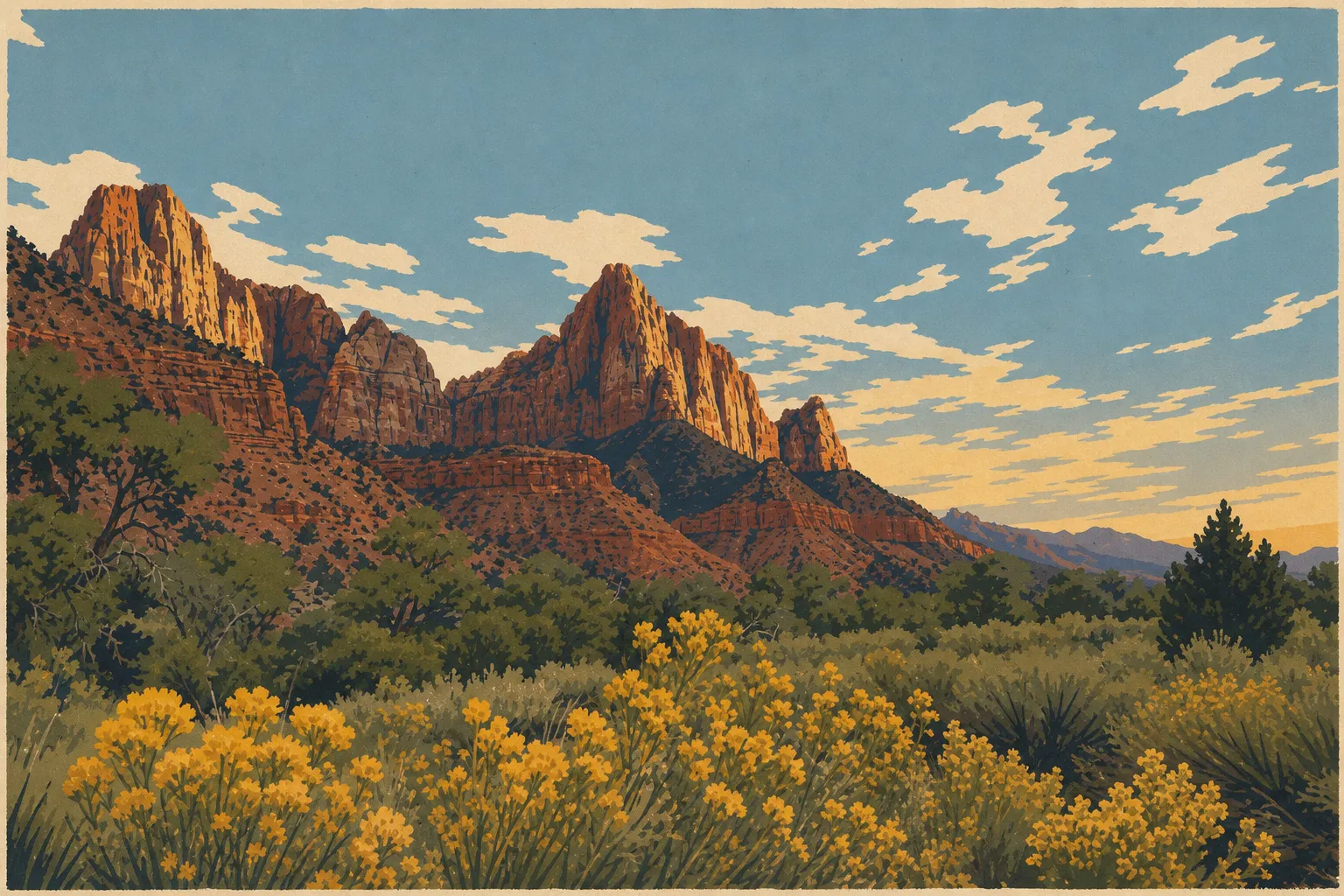
Zion National Park: The Complete Visitor Guide
Zion is a red sandstone canyon carved by the Virgin River in southwestern Utah. Visitors come to walk between cliffs several hundred feet high, wade up a river through a narrow gorge, and climb to overlooks above the entire canyon. Plan on two full days to see the highlights, or three if you want to hike without rushing.
The short answer: Most visitors enter from Springdale through the park's south entrance. The heart of the canyon is served by a free shuttle for much of the year. Admission costs $35 per vehicle for seven days, and two days are enough for a first visit. The rest of this page covers each point in detail, with a link to a dedicated guide when you want to go deeper.
Zion at a Glance: Where the Park Is and How to Get There
Zion is in southwestern Utah. The main entrance to the south sits next to the town of Springdale, where you'll find most of the hotels, restaurants, and shops. The park's administrative offices and main visitor center are here as well.
The classic road-trip starting points for Zion are Las Vegas, about 160 miles and a 2.5-hour drive away, and Salt Lake City, about 310 miles away. Many travelers combine Zion with Bryce Canyon, Grand Canyon, or Monument Valley. Zion is a natural stop on a tour of the American West.
One useful route detail: you can also enter from the east via scenic UT-9 and its historic tunnel, or through a separate northwest entrance for the Kolob Canyons area. These entrances don't serve the same parts of the park. We cover every entrance, distance, and drive time in our guide to getting to Zion.
Entrance Fees, Passes, and Reservations
Admission to Zion is valid for seven consecutive days. The official fees are:
- $35 per private vehicle (car, up to 15 people);
- $30 per motorcycle;
- $20 per person entering on foot or by bicycle.
If you're planning to visit several parks in the West, the America the Beautiful pass ($80 for one year) quickly pays for itself. It covers admission to all federal national parks. Zion also offers a park-specific annual pass for $70, which only makes sense if you're visiting Zion alone and returning during the year. For entrance fees and annual passes, see the National Parks Fees & Passes page.
The park is open every day of the year. You don't need an entrance reservation for a specific date. Unlike parks that require a timed entry reservation, Zion can be visited without a timed ticket. Two things do need to be booked well in advance, however: lodging, covered below, and a permit for the Angels Landing hike, awarded through a lottery.
Reservations, Permits, and Park Rules
Required Reservations and Permits
Angels Landing has required a paid permit, awarded by lottery, since 2022. Two lotteries are held: a seasonal lottery that opens several months ahead, and a day-before lottery with results at 6 a.m. The permit costs $6 per person and is nonrefundable. Without a permit, you can't continue past Scout Lookout on the final section of the trail.
The Narrows, when hiking from top to bottom from Chamberlain's Ranch, requires a wilderness permit for an overnight trip. The day hike from the bottom, starting at Temple of Sinawava, is free and doesn't require a permit.
The Subway, in Left Fork, requires a permit year-round. You get it through a lottery on recreation.gov.
The park campgrounds, Watchman Campground and South Campground, can be reserved in advance on recreation.gov, especially from March through October. Watchman Campground fills up several months ahead for peak-season weekends.
Park Rules
Pets are allowed in the park but not on trails, except for Pa'rus Trail, on shuttles, or in wilderness areas. You must use an approved crate to take them into picnic areas.
You may not feed or approach wildlife, including deer, California condors, and squirrels. Zion's deer are used to people and may seem tame, but they're still wild animals.
Collecting plants, rocks, fossils, or any natural object is prohibited.
Drones are prohibited throughout the national park.
Fires are prohibited in wilderness areas outside designated sites. Check the restrictions in effect on your visit date, which are posted at the Visitor Center.
Getting Around Zion (Shuttles, Scenic Roads, and Areas)
This is the point that confuses the most visitors, so let's be clear. You can drive your vehicle on every park road that's open, except Zion Canyon Scenic Drive, the road that runs up the heart of the canyon. For much of the year, roughly from spring through fall, private vehicles aren't allowed on this road. You can travel it only by free shuttle. The shuttle leaves from the visitor center, stops at the main trailheads, and runs frequently. In winter, when crowds thin out, the road reopens to private vehicles.
This system solves a real problem. At the height of the season, the canyon couldn't handle all those vehicles. The tradeoff is that you need to plan ahead for parking in Springdale, where spaces fill up early in the morning. A second shuttle line also connects the town with the park.
Scenic UT-9, meanwhile, is always open to your car. It crosses the park from west to east, passes through the Zion-Mount Carmel Tunnel, built in the 1920s, and climbs toward landscapes of striated rock that look very different from the canyon. Be careful: the tunnel is narrow, and large vehicles such as RVs and tall vans must pay an escort fee to drive through in the opposite direction, at designated times. Our Getting Around and RV Camping pages explain the shuttle, parking, and vehicle-size logistics.
How Much Time Do You Need to Visit Zion?
For a first visit, two full days offer a good balance: one day in Zion Canyon for the shuttle, one or two hikes, and overlooks, plus one day for UT-9, Canyon Overlook, and, if time allows, Kolob Canyons.
- 1 day: doable if you're passing through. Focus on the canyon, an easy walk along the river, and one overlook.
- 2 days: the format we recommend for a first stay.
- 3 days or more: enough time to add a major hike such as The Narrows or Angels Landing, explore Kolob Canyons and the Kolob Terrace area, or simply slow down.
Your ideal schedule depends on the season, your fitness level, and the crowds. We lay out three ready-to-use itineraries in our Itinerary & Length of Stay guide.
Plan your visit
What to See and Do in Zion
The park is divided into four distinct geographic areas. Mixing them up can leave you underestimating the distances. Getting from one area to another means getting back in the car, sometimes for an hour-long drive. Our Things to Do in Zion guide covers each activity, and our Map guide puts it all in visual context.
Road trip journal · 4 areas
Zion Canyon, the Heart of the Park
This is the Zion everyone pictures: the main valley, rust-colored cliffs, and the Virgin River below. You get there by shuttle. The highlights unfold along the scenic road: Court of the Patriarchs, with its three aligned peaks; the lawn at Zion Lodge; the trailhead for Emerald Pools; Grotto; Big Bend; and, at the very end, Temple of Sinawava, where Riverside Walk begins toward The Narrows. This is where you'll spend most of your time.
Scenic UT-9 and Canyon Overlook
As you leave the canyon to the east, UT-9 changes the scenery completely, with striped sandstone domes, formations sculpted by erosion, and hairpin turns. Just beyond the tunnel, a short but spectacular trail leads to Canyon Overlook, a natural balcony above the main canyon. It's one of the park's best effort-to-viewpoint ratios.
Kolob Canyons, in the Northwest
This separate area has its own entrance off the highway, about an hour's drive from the main canyon. You'll find intensely red sandstone cliffs, a short scenic road, and less crowded trails. It's ideal if you want to get away from the crowds without leaving the park.
Kolob Terrace, the High Plateau
This is the wildest and least visited area. A mountain road climbs to a cooler plateau landscape in summer. It's the starting point for challenging hikes such as the full top-down traverse of The Narrows, which requires a permit and careful preparation.
Explore the park
Zion's Best Hikes
Zion is best experienced on foot. Three hikes come up in every conversation, each with its own character:
- The Narrows: Hike up the Virgin River through a gorge where the walls close in, sometimes with your feet in the water. This iconic hike depends on water levels and is never safe when thunderstorms threaten. See the safety section below.
- Angels Landing: A dizzying ridge with chains and sweeping views down into the canyon. The final section requires a lottery-issued permit. Not recommended if heights make you uncomfortable.
- Emerald Pools and Riverside Walk: Gentler, family-friendly walks along the river to pools and seasonal waterfalls.
We cover distances, elevation gain, difficulty levels, and permit requirements in our Zion Hiking Guide.
The detailed guide Zion Hiking Guide: Best Trails for Every Ability The best hikes in Zion National Park by area, including Angels Landing, The… Read the guide →Wildlife and Plants to Look For
Zion is home to desert-canyon and river wildlife. Mule deer and squirrels that are very used to visitors are common, but don't feed them. It's prohibited and dangerous. The park is also a California condor reintroduction site. These are some of North America's largest birds, and lucky hikers may spot them soaring above the cliffs. Wild turkeys and, more elusive, coyotes and foxes round out the list.
Water creates hanging gardens where seeps emerge from the rock and mosses and plants cling to the cliffs, as at Weeping Rock. Our Wildlife page covers the species, the best times to see them, and the rules for sharing the park.
The detailed guide Zion Wildlife: Which Animals to See and Where to Find Them California condors, desert bighorn sheep, mule deer, mountain lions, and more Read the guide →When to Visit Zion
In short, spring from April through June and fall from September through November offer the best balance of mild weather and manageable crowds. Summer is hot, very hot. Temperatures in the canyon often top 100 °F, and monsoon season arrives from mid-July through September, bringing a real risk of flash floods. Winter is generally mild and quieter, with the canyon road open to private vehicles again, although some trails may be icy.
One number is worth remembering: depending on elevation, the temperature difference between day and night can exceed 31 °F. Bring several layers. We break down the climate month by month on our Weather page, along with the best times to visit for your priorities, whether crowds, heat, or hiking, on our When to Visit page.
The detailed guide When to Visit Zion: Best Times, Seasons, and Month-by-Month Guide The best times to visit Zion are April-May and September-October Read the guide →Where to Stay in Zion (Hotels and Campgrounds)
You have three main options:
- Inside the park: Zion Lodge, the only lodging inside the park, right in the canyon. It's in high demand, so reserve several months ahead.
- In Springdale: the town at the south entrance, with a wide range of hotels and restaurants, connected to the park by shuttle. It's the most convenient choice.
- Camping: two main campgrounds near the south entrance, plus private options nearby. For RVs, plan ahead for the tunnel and campsite requirements.
We compare these options in detail, including prices, distances, and reservations, in our Where to Stay, Hotels & Lodges, Camping, and RV Camping guides. For food, our Where to Eat page lists places in Springdale and the park.
Stay in the park
Around Zion: Things to Do Nearby
Zion is part of the West's Grand Circle of national parks. Less than two hours away, Bryce Canyon and its orange hoodoos offer a dramatically different landscape. Farther south, the North Rim of the Grand Canyon and the town of Kanab, a convenient base for Antelope Canyon and Horseshoe Bend, extend the trip. Springdale is also worth exploring in the evening.
Our Take: Is Zion Worth the Trip?
Yes, without a doubt, as long as you embrace the way the park works. Zion isn't a park where you lazily drive from one overlook to the next. You earn the heart of the canyon on foot and by shuttle. That's exactly what makes it special. Few places put you this close to rock, river, and exposure. During our visit, what stayed with us most was the first morning light on the cliffs, before the crowds arrived. The main challenge is the summer crowds. Come early, and visit outside July and August if you can. Zion will deliver.
Frequently Asked Questions
How Do You Visit Zion National Park?
Most visitors enter Zion from the south, through Springdale, combining the free shuttle, which is required in the canyon for much of the year, with their own car on scenic UT-9. The park is divided into four areas: Zion Canyon, UT-9, Kolob Canyons, and Kolob Terrace. Plan on two days for the essentials, and book your lodging early.
How Much Time Do You Need to Visit Zion?
Plan on two full days for a first visit: one day in Zion Canyon and one day for UT-9 and the nearby areas. One day is possible if you're passing through, as long as you stick to the canyon. Three days or more give you time to add a major hike such as The Narrows or Angels Landing.
Can You Visit Zion by Car?
Yes and no. That's the nuance of Zion. You can drive freely on scenic UT-9 and every open road, but Zion Canyon Scenic Drive, which runs up the heart of the canyon, is closed to cars for much of the year and served by free shuttle. The canyon road reopens to private vehicles in winter.
How Much Does It Cost to Enter Zion Canyon?
Admission costs $35 per private vehicle and is valid for seven days. The fee is $30 for motorcycles and $20 per person entering on foot or by bicycle. If you're visiting several parks, the America the Beautiful pass costs $80 for a year and covers all federal national parks.
The American Parks shop
Bring Zion home
Our park-inspired creations, made to order and shipped to your door.
Latest park news
- Zion: Zion-Mt. Carmel Highway Closed After Rockfall, No Reopening DateThe east-west crossing on SR-9, from Canyon Junction to the east entrance, has been closed since September 30, 2026; UDOT gives no reopening date.
- Zion: Mount Carmel Highway Still Closed as of September 30, 2026The Zion-Mount Carmel Highway stays closed in both directions between Canyon Junction and the east entrance, with no known reopening date, per FOX 13 News Utah.
- Zion: Road Construction Underway on the Zion Mount Carmel HighwayRoad construction is underway on the Zion Mount Carmel Highway, with possible slowdowns and closures. Here's what it means for your visit.