
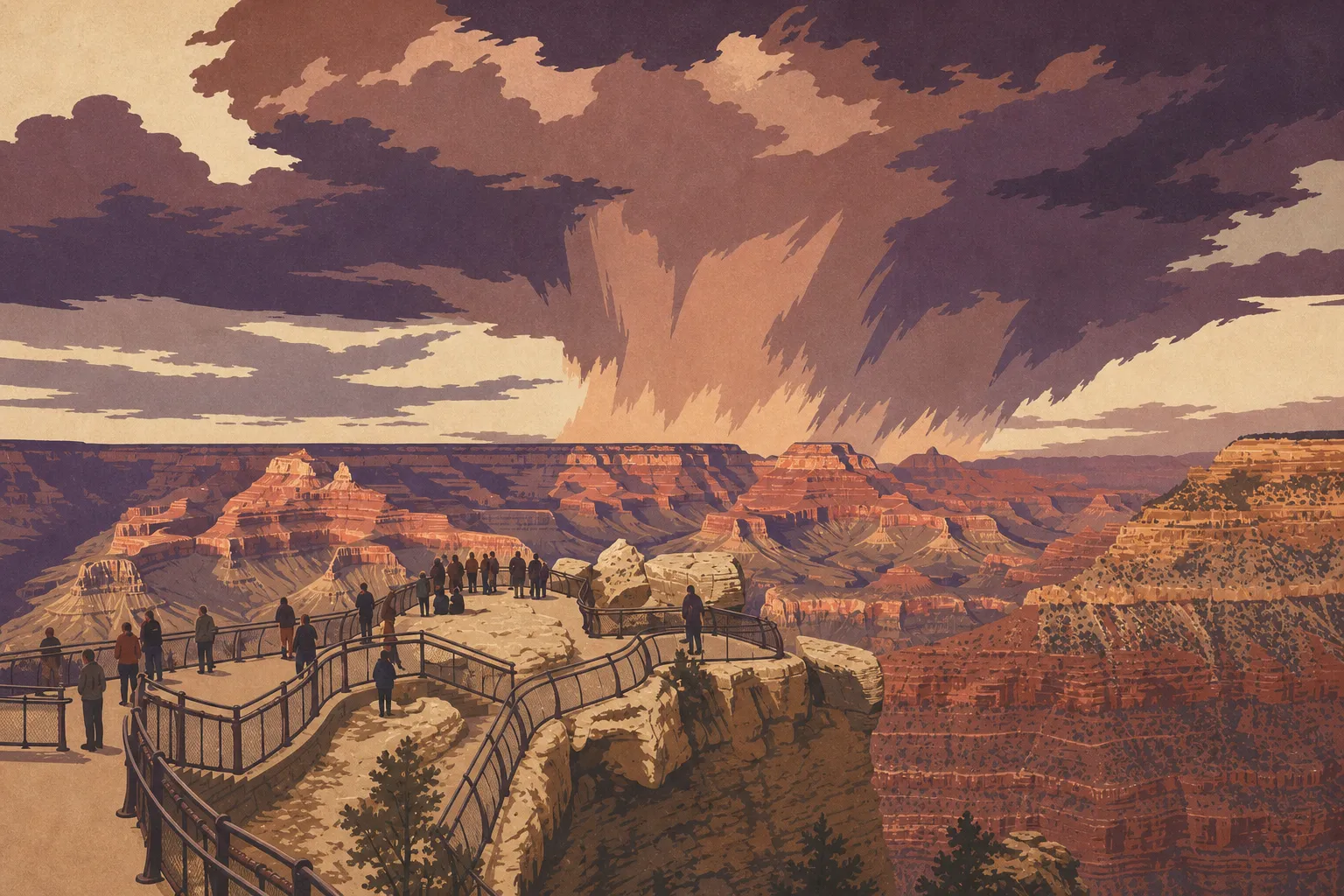
Grand Canyon National Park: The Complete Visitor Guide
A 1-mile-deep gorge carved by the Colorado River through layers of rock nearly two billion years old. That's what awaits you at the edge of the Grand Canyon in Arizona. The site is as impressive as it is difficult to navigate, because you can't see it all in one go. Two main rims separated by hours of driving, a climate that changes with elevation, and mandatory shuttles during the busy season all make it worth knowing where you're headed before you leave.
The quick answer. Grand Canyon National Park is in northern Arizona. The South Rim is open year-round, easy to reach, and home to most of the viewpoints. That's where most visitors go. Plan on a full day for a first look, or two to three days if you want to do some walking and catch a sunrise or sunset. The North Rim is higher and wilder, and it only reopens during the warmer months.
The Grand Canyon at a Glance: Where the Park Is and How to Get There
The park lies entirely in Arizona. You can reach the South Rim from Williams, about 59 miles south via Route 64 from Interstate 40, or from Flagstaff, about 81 miles southeast via Route 180. These two towns make the best bases for spending the night before an early start.
Two entrances serve the South Rim, and both are open 24 hours a day, 7 days a week:
- South Entrance, near Tusayan, is the busiest. Between 9:30 a.m. and 4 p.m., the line can stretch to a two-hour wait. Arriving before 9 a.m. or in the late afternoon helps you avoid the bottleneck.
- Desert View Entrance is reached through the Navajo Nation via US 89. At Cameron, turn west onto Route 64 and drive 25 miles to the park. This entrance gives you a first view of the canyon and the Colorado River at Desert View, and it eases congestion when South Entrance is backed up.
Here's one thing to know: the entrances no longer accept cash. Bring a credit card or an America the Beautiful pass.
The North Rim is more than 217 miles by road from the South Rim, even though the two rims face each other as the crow flies. Don't try to improvise a round trip between them in a single day.
Entrance Fees, Passes, and Reservations
Admission is valid for 7 days and covers both rims. Official rates are:
- $35 per private vehicle;
- $30 per motorcycle;
- $20 per person arriving on foot, by bicycle, or by shuttle.
If you're visiting several Western parks, an annual pass quickly becomes the better deal. The park annual pass costs $70, but the America the Beautiful interagency pass, valid for one year at all federal national parks, pays for itself after two or three sites. Unlike Arches or Zion, Grand Canyon doesn't require a timed entry reservation. You show up, pay, and go in.
For entrance fees, free-entry options, and the different passes, our National Park Fees and Passes page lays out the essentials. And if you collect park stamps, the Passport and Stamps page tells you where to get yours stamped.
Reservations, Permits, and Rules to Follow
You don't need a reservation to enter the park. Unlike Zion and Rocky Mountain, which have adopted timed-entry reservation systems, Grand Canyon requires no advance booking. You pay at the entrance and head in.
Backcountry permit for camping below the rim: required for every night spent below the rim, whether at a designated campground such as Bright Angel Campground or Cottonwood Campground, or in a wilderness area. Applications open up to four months before your preferred date. Summer slots fill within days. If you're aiming for a night at Bright Angel Campground in July, submit your application on the first day the window opens.
Rules to know before you enter:
- The speed limit is 45 mph on the park's main roads, with lower limits in village areas.
- Pets are allowed on the Rim Trail and in campgrounds, but prohibited on every trail descending into the canyon.
- Don't feed wildlife, especially squirrels, which are responsible for more visitor bites at Grand Canyon than any other species, and California condors.
- Drones are prohibited throughout the park, without exception.
- Some single-use plastic packaging may not be sold inside the park.
Our Practical Information, Rules, and Safety page covers legal requirements and special permits, including commercial flights and professional photography.
How to Get Around the Grand Canyon
On the South Rim, you barely need your car once you arrive. The busiest area, around Grand Canyon Village and Hermit Road, runs free shuttles during the busy season. Hermit Road is closed to private vehicles for much of the year, so the shuttle becomes the only way to visit the western viewpoints in succession. Parking is concentrated around the village and visitor center. Park once and let the buses do the rest.
To the east, Desert View Drive remains open to your vehicle for about 25 miles to the Desert View Watchtower, with a series of viewpoints you can visit on your own. It's the ideal route if you want to drive at your own pace and stop wherever you like.
Our Getting Around page describes the different shuttle routes, their frequency, and which sections are open or closed to cars depending on the season.
How Long Do You Need to Visit the Grand Canyon?
How long do you need to visit the Grand Canyon? One full day on the South Rim is enough to take in the essentials: a few viewpoints, a stretch of trail along the edge, and, if possible, a sunset. When we visited, the low evening light did the best job of sculpting the layers and bringing out the colors.
For time to breathe and descend a little into the canyon, plan on two to three days. That gives you time for a serious hike, a sunrise, and a drive to Desert View without rushing. Adding the North Rim requires another full day of driving, so save it for a trip between May and October if you have the time.
Our selection of Grand Canyon itineraries offers ready-to-use plans ranging from half a day to several nights, with the most logical sequences of stops.
Plan your visit
What to See and Do at the Grand Canyon
The park first reveals itself through its rims. Each one has its own character, access, and atmosphere.
Road trip journal · 3 areas
The South Rim
This is the park's beating heart, open year-round. Here you'll find the classics: Mather Point, often the first jaw-dropping view after leaving the visitor center; Yavapai Point and the Yavapai Geology Museum, which explains how the canyon formed; Grand Canyon Village and its historic architecture; and the long line of viewpoints along Hermit Road to the west and Desert View Drive to the east, ending at the Desert View Watchtower. Between viewpoints, the Rim Trail follows the edge for miles. It's nearly flat and accessible to everyone. For a first trip, the South Rim checks every box.
The North Rim
Higher, at up to about 8,400 feet compared with 2,500 feet at the bottom of the canyon, more heavily forested, cooler, and far less crowded. People come here for the quiet and a different perspective from Bright Angel Point or Cape Royal. The trade-off is that it's open only part of the year, with snow closing the roads during the rest. Check the opening dates before building your itinerary around it.
Grand Canyon West
Be careful not to confuse them. Grand Canyon West, managed by the Hualapai Tribe, lies outside the national park and operates with a separate ticketing system. This is where you'll find the famous Skywalk, a glass bridge suspended over the void. Closer to Las Vegas, it appeals to visitors with only half a day, but it has neither the viewpoints nor the trails of the South Rim.
Explore the park
The Best Hikes in the Grand Canyon
Two kinds of hiking coexist here. Along the rim, the Rim Trail is easy and strings together one panorama after another. It's perfect for families and shorter days. In the canyon, trails drop quickly and steeply. Bright Angel Trail and South Kaibab Trail descend toward the Colorado River. You can hike only part of either one, but keep one rule in mind: the descent is deceptive, and the climb back up takes about twice as long and requires hard work in the heat. Never aim to reach the river and return on foot in the same day.
Detailed trail guides, with elevation gains, durations, and difficulty ratings, are on our Hiking page.
The detailed guide Grand Canyon Hiking: The Best Trails for Every Skill Level Bright Angel, South Kaibab, and Rim Trail Read the guide →Wildlife and Plants to Look For
The park is home to a wide range of wildlife that you'll often see along the trails, including mule deer, squirrels, and especially the California condor, a huge reintroduced raptor with a wingspan far wider than an eagle's. You can regularly spot these condors gliding above the South Rim viewpoints. One firm rule applies: don't feed any animal, even the most persistent squirrel, or you risk a bite and a fine.
Our Wildlife page covers the species and the best places to observe them without disturbing them.
The detailed guide Grand Canyon Wildlife: Which Animals to See and Where to Find Them California condors, elk, bighorn sheep, and pink rattlesnakes Read the guide →When to Visit the Grand Canyon
Climate depends on elevation. On the rims, winters are cold and snowy, while summers bring bursts of heat. At the bottom of the canyon, temperatures are 18 to 27°F higher than at the rim. A summer descent can quickly turn into a furnace. Spring and fall offer the best balance, with mild temperatures on the South Rim and fewer visitors than in midsummer.
The South Rim is open year-round; the North Rim closes in winter. Conditions change quickly, so always check the weather the day before.
The detailed guide When to Visit the Grand Canyon: A Month-by-Month Guide April, May, and October are the best times to visit Grand Canyon Read the guide →Where to Stay at the Grand Canyon
You have three basic options. Stay inside the park, on the South Rim, in the village's historic lodges. It's unbeatable for being at the rim at sunrise, but you need to book several months ahead. Stay at the park entrance, in Tusayan, a few minutes from the South Entrance. Or stay farther away, in Williams or Flagstaff, where prices are lower and evenings are livelier, at the cost of a longer morning drive.
Our dedicated pages offer the full comparison: Where to Stay for an overview, Hotels and Lodges for traditional accommodations, Camping for tents, and RV Camping for RVs and suitable sites.
Stay in the park
Around the Grand Canyon: Things to Do Nearby
The canyon is part of one of the American West's most beautiful road trips. To the east, the road toward the Navajo Nation leads to Monument Valley and Page, including Antelope Canyon and Horseshoe Bend. To the south, Williams leans into its Route 66 atmosphere, while Flagstaff makes a cultural base. Many travelers continue on to Utah's parks, especially Zion and Bryce Canyon.
To help you build your loop, our Regions and Road Trips guides connect the Grand Canyon with nearby stops.
Our Take: Is the Grand Canyon Worth the Trip?
Yes, without reservation, as long as you give it more than a quick photo stop. The Grand Canyon rewards people who take their time: a short walk below the rim, the light at the end of the day, and a real stop at Yavapai to understand what you're looking at. Rushed through in thirty minutes from a parking lot, it remains a beautiful postcard. Experienced over a full day, it becomes a lasting experience. Our advice fits in one sentence: choose the South Rim for a first trip, arrive early, and stay for sunset.
Frequently Asked Questions
How long do you need to visit the Grand Canyon?
Allow at least one full day to visit the Grand Canyon and enjoy the South Rim viewpoints, ideally with a sunset. Two to three days give you time to add a hike and drive to Desert View without rushing.
What is the best place to visit the Grand Canyon?
The best place for a first trip is the South Rim. It's open year-round, easy to reach, and full of viewpoints such as Mather Point, Yavapai Point, and Desert View. The North Rim is a good fit for those seeking quiet between spring and fall.
How much does a visit to the Grand Canyon cost?
Admission costs $35 per vehicle for 7 days, or $20 per person arriving on foot or by shuttle. A $70 park annual pass, or the America the Beautiful interagency pass, quickly pays off if you're visiting several parks.
How do you get to the Grand Canyon?
To visit the Grand Canyon, drive to the South Rim from Williams, about 59 miles away, or Flagstaff, about 81 miles away, both in Arizona. South Entrance near Tusayan and Desert View Entrance are open 24 hours a day, and cash is not accepted.
The American Parks shop
Bring Grand Canyon home
Our park-inspired creations, made to order and shipped to your door.
Latest park news
- Grand Canyon: $100 More Per Person for International VisitorsSince early 2026, every non-U.S. visitor pays a $100 surcharge to enter the Grand Canyon, according to knpr.org.
- Grand Canyon: North Rim Closes Services and Access Road for the WinterStarting October 15, 2026, the North Rim loses its services (information, general store, campground); the gas station is already closed and the North Kaibab Trail remains impassable.
- Canyonlands: Hiker Missing at Horseshoe Canyon, Search UnderwayA 71-year-old hiker remains missing near the Horseshoe Canyon trailhead, in a remote stretch of Canyonlands, according to FOX 9 Minneapolis-St. Paul.