
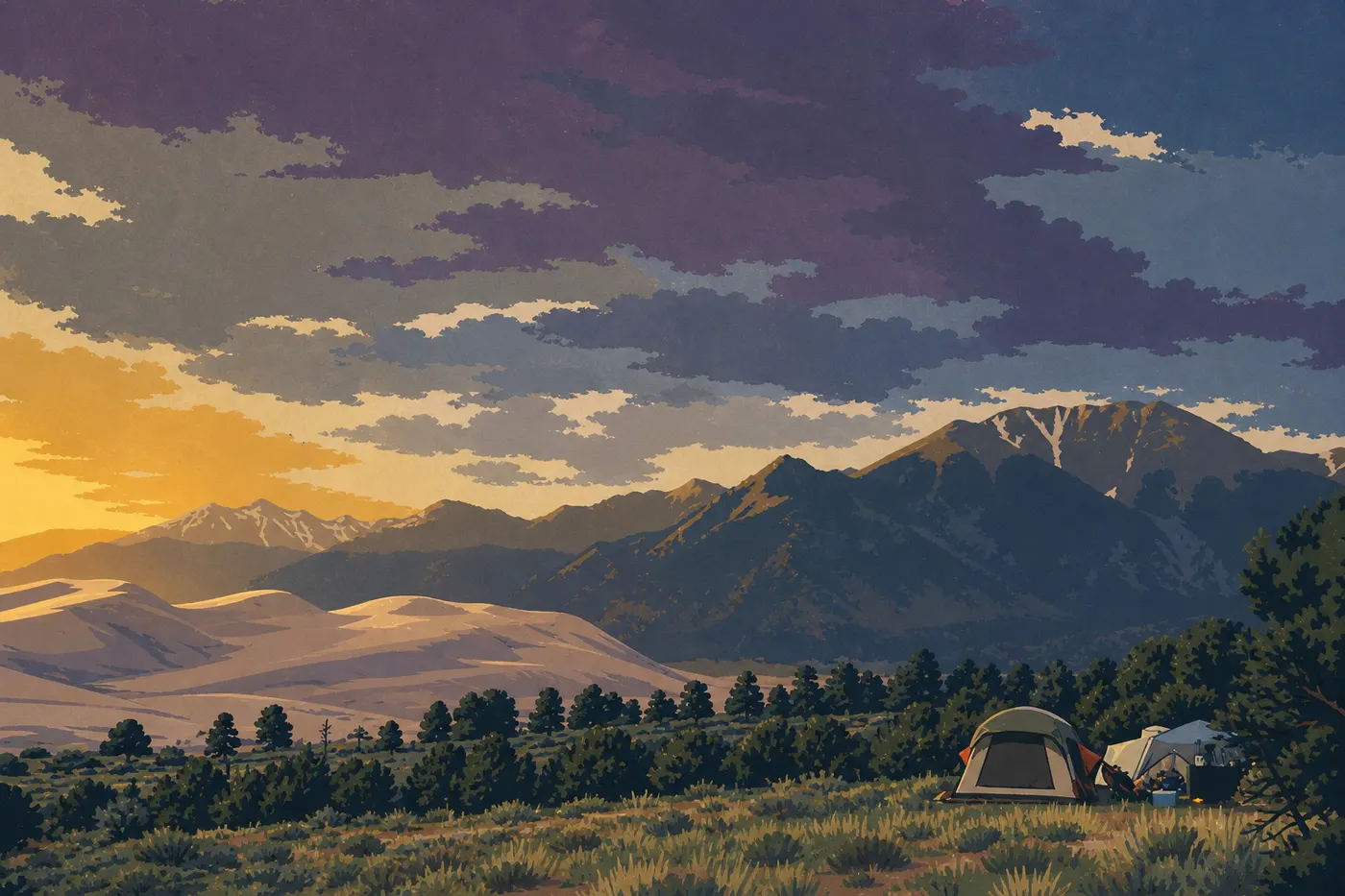
Camping at Great Sand Dunes: 3 Campgrounds, Reservations, and Fees
Great Sand Dunes National Park has three NPS-managed campgrounds with 139 sites in all. Two options require reservations through recreation.gov; the third is first come, first served. Expect to pay $20 a night at Piñon Flats, $6 for backcountry sites, and nothing to access Medano Pass Primitive Road without a reservation.
Campgrounds in the park (3)
- Campground Piñon Flats Campground recreation.gov · 91 sites Directions ↗
- Campground Medano Pass Primitive Road Campsites first come, first served · 21 sites Directions ↗
- Campground Backpacking Campsites in the Dunes or Forest recreation.gov · 27 sites Directions ↗
 Base map © OpenStreetMap · © CARTO
 Great Sand Dunes campgrounds by the numbers
3 official campgrounds inside the park, 139 campsites in total, 118 of them reservable.
| Campground | Sites | Booking | Fee / night | Open | Amenities |
|---|---|---|---|---|---|
| Piñon Flats Campground | 91 (3 group) | Reservation | from $20 | Closed Nov 1 to Mar 31 | toilets*, potable water*, dump station*, camp store*, firewood*, bear lockers*, cell service |
| Backpacking Campsites in the Dunes or Forest | 27 (27 tent only) | Reservation | from $6 | toilets, potable water*, cell service | |
| Medano Pass Primitive Road Campsites | 21 (21 tent only) | First come, first served | Free | toilets, potable water*, bear lockers* |
Source: National Park Service (NPS API), retrieved October 6, 2026. Fees and dates change: check the campground page before you go.
Can You Camp Inside Great Sand Dunes?
Yes, in three different ways: the developed Piñon Flats Campground, backcountry sites on the dunes or in the forest (for a fee), and primitive sites along Medano Pass Primitive Road. Camping outside these designated areas isn't allowed. The park is open 24 hours a day, 365 days a year, so you can arrive at night.
Campgrounds Inside the Park
Piñon Flats Campground
Piñon Flats is Great Sand Dunes' only developed campground, with 91 sites, including 3 group sites. Set at the edge of the dunes, a few hundred yards from the main parking lot, it offers the park's most complete range of services: restrooms, drinking water, a dump station for RVs, a store, firewood for sale, bear-proof storage lockers, and cell service. RVs up to 33 feet are allowed, but there are no electrical hookups.
The campground is open from April through October and closes from November through March. Reservations are required through recreation.gov, at $20 a night.
Backpacking Campsites in the Dunes or Forest
These 27 sites are tent-only and sit directly on the dunes or in the forest. Reservations are required through recreation.gov, at $6 a night. Restrooms, water, and cell service are available nearby. This is the park's most unusual camping option: no RVs, no structures, just sand and sky.
Medano Pass Primitive Road Campsites
These 21 tent-only sites are along Medano Pass Primitive Road, on the east side of the park. The road is open to high-clearance vehicles, and may require four-wheel drive depending on conditions. Sites are first come, first served, with no reservations available. Restrooms, water, and bear-proof storage lockers are available on site. The NPS does not publish the exact fee.
RV or Tent: Which Site Should You Choose?
Piñon Flats welcomes both. The maximum permitted vehicle length is 33 feet. The lack of electrical hookups is the main limitation for RVs and camper vans, but a dump station is available on site, covering the main need for a short stay. If you need water, electricity, and full hookups, the closest option is still Great Sand Dunes Oasis, a private campground right on CO 150 at the park entrance. The Great Sand Dunes RV camping guide covers options around the park.
Generators are allowed at Piñon Flats during the hours posted at the campground entrance. Follow them closely. Violations can result in a fine and removal from the campground.
Camping Nearby: Options Outside the Park
When Piñon Flats fills up, which happens quickly in July and August, several private campgrounds are located around Alamosa, about 25 miles south. Great Sand Dunes Oasis, mentioned above, is the most convenient choice for a quick return to the dunes in the morning. Public campgrounds in the Rio Grande National Forest, to the northwest, offer a wilder alternative less than an hour away.
For lodging without a tent, including hotels and lodges, see the Great Sand Dunes lodging guide.
Dispersed Camping and Backcountry Camping
This is one of Great Sand Dunes' distinctive features: you can camp directly on the dunes or in the forest. A $6-per-night permit is required and must be reserved through recreation.gov before your trip. The 27 sites are tent-only; RVs are not allowed.
Here are the rules to know before setting up camp:
- Campfires are prohibited in the backcountry.
- Set up outside the parking area and well away from the banks of Medano Creek.
- Water: there are no sources on the dunes, so plan on at least 3 to 4 liters per person for the night.
- Pack out everything you bring in.
Sleeping under the stars on top of a dune at 7,900 feet, in near-total silence, is an experience all its own. The Great Sand Dunes hiking guide covers the best routes for climbing with an overnight pack.
How and When to Reserve a Campsite at Great Sand Dunes
Two of the three campgrounds require reservations through recreation.gov: Piñon Flats and the Backpacking Campsites, with a rolling 6-month booking window. In practice, July and August dates disappear within minutes of opening. For a summer trip, log on at exactly 7 a.m. Denver time on the day reservations open, exactly 6 months before your target date.
Medano Pass Primitive Road does not accept reservations, so arrive early in the morning to secure a site. Piñon Flats closes from November through March; during that period, only Medano Pass remains accessible to hikers and properly equipped drivers.
To choose the right time of year based on weather, compare this information with the best times to visit Great Sand Dunes guide.
Fees: How Much Does a Night of Camping Cost at Great Sand Dunes?
| Item | Fee |
|---|---|
| Park entrance (private vehicle) | $25 |
| Entrance (motorcycle) | $20 |
| Entrance (noncommercial groups) | $15 |
| Park annual pass | $45 |
| Piñon Flats site (per night) | $20 |
| Backpacking Campsites (per night) | $6 |
| Medano Pass Primitive Road | free or unpublished |
The $45 annual pass pays for itself after two visits during the season. The $80 America the Beautiful Pass, valid at all U.S. national parks, is an even better deal for a multi-park road trip. National park fees and passes provides an overview of entrance fees and annual passes.
Camping Safety and Best Practices
Great Sand Dunes has specific hazards that first-time visitors often underestimate.
Hot sand. In midsummer at noon, the dune surface can reach 160°F, hot enough to cause a third-degree burn within seconds on bare feet. Climb the dunes before 10 a.m. or after 5 p.m. in July and August. Closed-toe shoes are required for children.
Thunderstorms and lightning. Summer afternoons can produce severe thunderstorms over the San Luis Valley. There is no shelter on the dunes. Head back down as soon as the sky darkens to the west.
Black bears. Black bears live in the park and the surrounding forest. Store all food, sweet drinks, and scented products in an approved container or a locked vehicle. Always use the bear-proof storage lockers provided at Piñon Flats and along Medano Pass. Don't leave anything in your tent.
Medano Creek. This seasonal stream runs alongside the campground. During high water, from May through early July, it can reach 20 inches deep and have unpredictable currents. Watch children closely when crossing.
Elevation. The park sits at about 8,000 feet. If you're coming from low elevation, plan an acclimatization day before carrying a heavy backcountry pack.
Which Campground Is Right for You?
| Traveler | Recommendation |
|---|---|
| Family with children | Piñon Flats (full facilities, right next to the dunes) |
| RV without hookups | Piñon Flats (dump station available, RVs up to 33 feet) |
| RV with hookups | Great Sand Dunes Oasis, right at the park entrance |
| Hiker seeking solitude on the dunes | Backpacking Campsites (permit required, $6/night) |
| Four-wheel-drive or self-sufficient adventurer | Medano Pass Primitive Road (first come, first served) |
| Off-season stay (November through March) | Medano Pass or outside the park (Piñon Flats closed) |
Before you finalize your plans, find all the park's resources in the Great Sand Dunes guide.
Frequently Asked Questions
Can you camp inside Great Sand Dunes?
Yes. Great Sand Dunes has 3 campgrounds with 139 sites in all. Piñon Flats is the developed campground, the Backpacking Campsites allow camping on the dunes or in the forest with a permit, and Medano Pass Primitive Road is first come, first served with no reservations.
Which campground should you choose at Great Sand Dunes?
Piñon Flats, with 91 sites, $20 a night, and full services, is the most comfortable choice for families and RV travelers. The Backpacking Campsites, with 27 sites at $6 a night, are for hikers who want to spend the night on the dunes. Medano Pass Primitive Road, with 21 tent-only sites, suits motorized or self-sufficient adventurers.
When should you reserve a campground at Great Sand Dunes?
Reservations open 6 months ahead on recreation.gov for Piñon Flats and the Backpacking Campsites. For July and August, log on at 7 a.m. Denver time exactly 6 months before your date; sites go within minutes. Medano Pass Primitive Road does not accept reservations.
How do you camp in Great Sand Dunes?
Reserve Piñon Flats or the Backpacking Campsites through recreation.gov before you leave. For Medano Pass Primitive Road, arrive early in the morning because sites go to the first person who arrives. Camping outside these three areas isn't allowed.
How much does a night at a Great Sand Dunes campground cost?
Piñon Flats costs $20 a night. The Backpacking Campsites in the Dunes or Forest cost $6 a night. Medano Pass Primitive Road is free or has a fee the NPS does not publish. Add the $25 park entrance fee per vehicle to these amounts.
Are there bears at the Great Sand Dunes campgrounds?
Yes. Black bears live in the park and the surrounding forest. Bear-proof storage lockers are available at Piñon Flats and along Medano Pass, so use them for all food, sweet drinks, and scented products. When camping on the dunes, carry an approved container and leave nothing in your tent.