
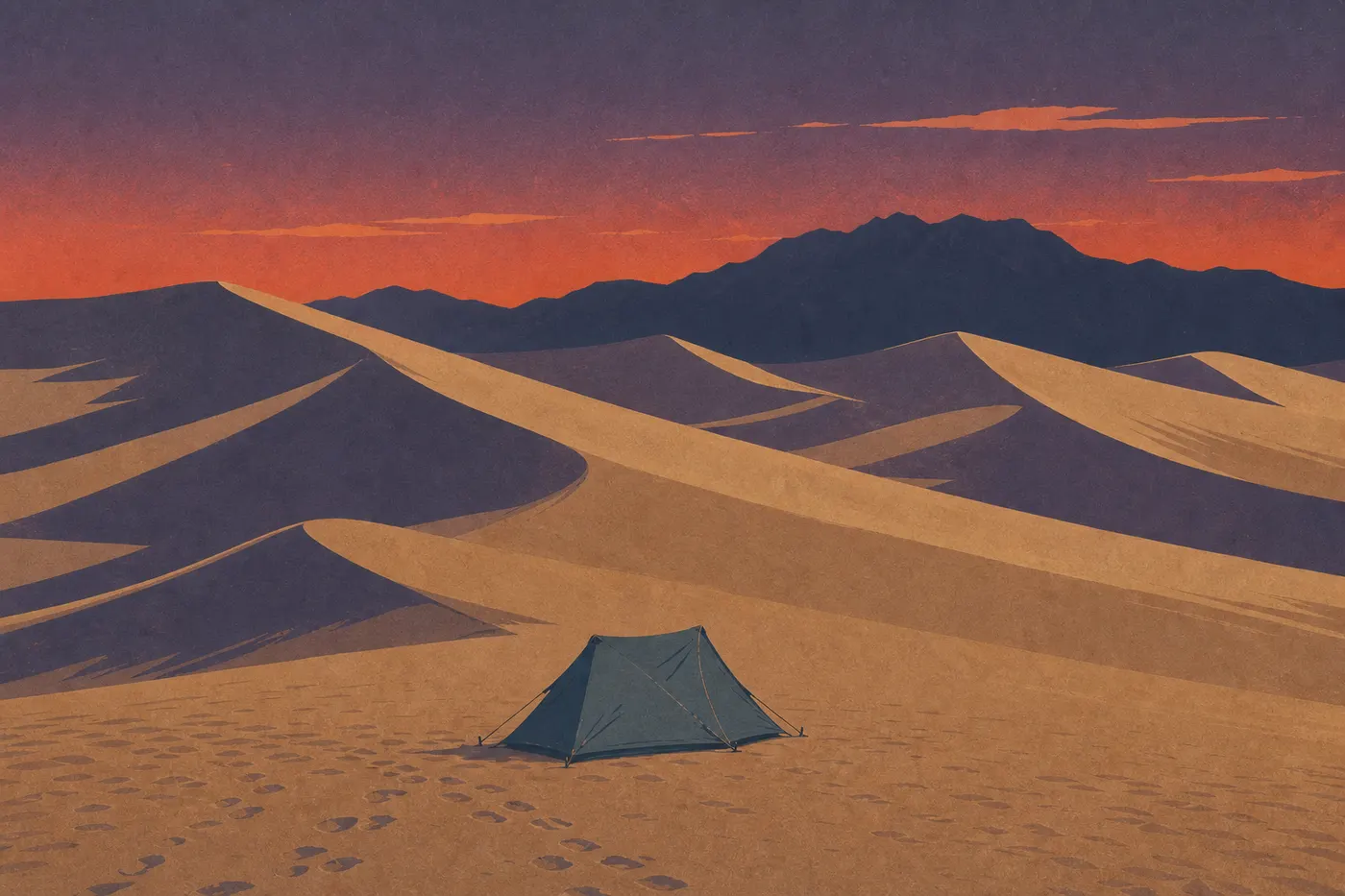
Where to Stay at Great Sand Dunes: In the Park, Nearby Towns, and Campgrounds
Great Sand Dunes presents a unique logistical challenge: there's one NPS campground, a private lodge a few miles from the entrance, and the first full-service town is more than 30 miles away. Your options can be counted on two hands, which makes the choice easier as long as you plan ahead. Our quick recommendation is to camp at Piñon Flats Campground if you're after the full experience, including sunrise and dark skies, or stay in Alamosa if you'd rather have a bed and a guaranteed hot shower. Either way, plan on at least two nights. The dunes deserve an early-morning outing, a daytime crossing, and, if possible, an evening under the stars. To build your itinerary, our complete Great Sand Dunes guide brings together all of the park's guides.
Where to stay: towns, lodges and campgrounds (8)
- Gateway town Alamosa entrance Main entrance CO-150 (~22 miles) · hotels, supermarket, gas station Directions ↗
- Gateway town Monte Vista entrance Main entrance CO-150 (~37 miles) · hotels, supermarket, gas station Directions ↗
- Gateway town Blanca entrance Main entrance CO-150 (~14 miles) · gas station, restaurants Directions ↗
- Gateway town Fort Garland entrance Main entrance CO-150 (~24 miles via US-160 West) · gas station, restaurants Directions ↗
- Gateway town Crestone entrance Main entrance CO-150 (~16 miles south) · hotels, gas station, restaurants Directions ↗
- Campground Piñon Flats Campground recreation.gov · 91 sites Directions ↗
- Campground Medano Pass Primitive Road Campsites first come, first served · 21 sites Directions ↗
- Campground Backpacking Campsites in the Dunes or Forest recreation.gov · 27 sites Directions ↗
 Base map © OpenStreetMap · © CARTO
 ⚠ Gateway town & Lodge data is undergoing editorial review.
Should You Stay in the Park or Outside It?
This is the central trade-off, and it depends on what you're looking for.
Want the full experience? Stay in the park. At dawn, the dunes are empty, low light shapes every sand ridge, and you can set out from the campground within five minutes. At night, the San Luis Valley is one of the least light-polluted areas in Colorado, so the Milky Way is remarkably clear. That combination of sunrise and starry skies is reason enough to camp.
Need some comfort, or traveling with young kids? Head for Alamosa. The town has everything you need, including chain hotels, restaurants, a pharmacy, and a supermarket, and the drive to the park takes about 45 minutes. You give up the nighttime immersion, but you gain peace of mind.
Traveling in an RV? Piñon Flats Campground accepts RVs, but sites with electrical hookups are limited and fill up quickly. Our Great Sand Dunes RV camping guide covers vehicle-size restrictions and recommended sites.
Visiting in winter, from November through March? Check Piñon Flats' status before you leave. The campground may close temporarily during the most severe cold snaps. Alamosa is your only dependable base during those periods.
Camping in the Park: Piñon Flats Campground
Piñon Flats Campground
Piñon Flats is the park's only NPS campground. It's just past the Visitor Center, a few hundred yards from the dunes. Its name comes from the piñon trees scattered across the site. Demand is high: during peak season, sites disappear from Recreation.gov as soon as reservations open, several months in advance.
The campground offers standard tent sites and sites with electrical hookups for RVs. Restrooms are functional, although not every building has hot water. One important detail is the elevation, which tops 7,900 feet. Overnight temperatures can drop below 41°F even in midsummer. Bring a sleeping bag rated for the conditions, whatever the season.
What we especially like here is getting up before 7 a.m. and heading straight onto the dunes before the heat sets in. By noon in summer, the sand can reach 160°F, making barefoot travel impossible and the climb exhausting. An early start from the campground makes all the difference. Our Camping page covers reservation details, fees, and campground rules.
Pets are allowed in the campsites, on a leash, but not in the adjacent national preserve.
Backcountry Camping in the Preserve
The preserve bordering the national park allows backcountry camping with no camping fee, but you need a free permit from the Visitor Center. It's reserved for hikers without vehicles. This is an option for anyone who really wants to get away from the crowds: no neighbors, no lights, just the dunes and the Sangre de Cristo Mountains on the horizon.
At the Park Entrance: Great Sand Dunes Lodge
A few miles from the entrance station on CO 150, you'll find Great Sand Dunes Lodge, a privately owned lodging property that's independent of the National Park Service. It's the only roofed lodging immediately near the park if you aren't camping.
Don't expect a resort. It's a modest property designed for travelers who want to stay close to the dunes without pitching a tent. Still, the view from the rooms, with the Sangre de Cristo Mountains in the background, makes the stay worthwhile. The lodge has an on-site restaurant, which matters because alternatives along CO 150 are almost nonexistent.
Book directly, and well in advance for spring and summer. When we visited, the lodge was fully booked two months ahead for a June weekend. Our selection of hotels and lodges at Great Sand Dunes brings together contact information and availability.
Where to Stay Near the Park: Gateway Towns
Alamosa (about 35 miles south)
Alamosa is the main city in the San Luis Valley and the natural base for visiting Great Sand Dunes. You'll find national hotel chains, independent motels, short-term rentals, a range of restaurants, a grocery store, and the region's medical services. It's also the starting point the NPS recommends for reaching the park from the south, via US 160 and then north on CO 150.
The road is quick and well signed. Allow about 45 minutes from downtown Alamosa to the Dunes Parking Lot. The drive crosses the flat San Luis Valley, with the dunes and the Sangre de Cristo Mountains gradually appearing on the horizon. It's already a sight in its own right.
Alamosa isn't a postcard tourist town, but it is practical and welcoming. Its local food scene has grown in recent years, shaped by a longstanding Hispanic community that gives the town a character distinct from mountain Colorado. Who it's for: travelers who prioritize comfort, anyone without camping gear, families with young children, and people continuing on to other destinations, such as Taos in New Mexico, Colorado Springs, or Pueblo.
Mosca (about 8 miles south of the entrance station)
Mosca is a small agricultural community on CO 150, about 9 miles from the park entrance. A few bed-and-breakfasts and ranch-style rentals are available, but there are no restaurants or stores. If you find a good deal, the location is excellent for early risers. Avoid it if you need a supermarket or a doctor nearby.
Other Options in the San Luis Valley
Monte Vista, about 43 miles west via CO 17, is similar to Alamosa, though slightly smaller, with a few hotels. It's useful if Alamosa is fully booked during peak season. Fort Garland, east on US 160, offers very little lodging and no particular logistical advantage for this park.
When to Book Your Great Sand Dunes Lodging
The park draws the most visitors from May through September, with two peaks: Memorial Day weekend in late May and Labor Day weekend in early September. Piñon Flats Campground is especially busy throughout this period, particularly on weekends.
Here's the practical rule for an NPS campground: check Recreation.gov as soon as reservations open for your date, usually six months out, and book within the first few hours. For Great Sand Dunes Lodge, plan on booking at least two to three months ahead during the season. Alamosa hotels handle demand better, but their rates also rise in summer.
Outside the main season, from October through April, things ease up considerably. You'll find sites available in the park and lower hotel rates. Our guide to the best times to visit Great Sand Dunes examines seasonal weather and crowds to help you choose the right time.
Lodging Budget: What Does Great Sand Dunes Cost?
| Lodging type | Approximate nightly rate |
|---|---|
| Tent camping, Piñon Flats | About $20 to $25 |
| Site with electricity, Piñon Flats | About $35 to $45 |
| Great Sand Dunes Lodge | $120 to $180, depending on the season |
| Budget motel in Alamosa | $80 to $110 |
| Midrange hotel in Alamosa | $110 to $160 |
| Bed-and-breakfast or ranch in Mosca | $100 to $150, depending on availability |
Add park entrance fees to these amounts: $25 per vehicle. The America the Beautiful annual pass costs $80 and covers entrance fees for one year at all federal recreation sites. It pays for itself after visiting two or three parks in a year. For entrance fees and annual passes, see the National Park Fees & Passes page.
Our Recommendation Based on Your Travel Style
First visit, no camping gear. Spend two nights at a midrange hotel in Alamosa. Leave before 8 a.m. each morning to reach the dunes when they open. You miss the nighttime experience in the park, but you return each evening to a comfortable bed.
Full immersion, photography, or stargazing. Piñon Flats Campground is the place for you. Book six months ahead, bring a warm sleeping bag because nights can be chilly even in August, and plan at least two nights so you have a clear evening set aside for the stars. Our Things to Do page lists recommended spots for nighttime views.
Family with young children. Stay at a hotel in Alamosa and plan a well-organized day in the park. Kids love Medano Creek, the seasonal stream that runs at the foot of the dunes, but they tire quickly on hot sand. Start early, head back before noon in summer, and bring plenty of water. Our Family page details age-appropriate activities.
Tight budget. Piñon Flats Campground remains the most affordable option in the entire area. If the campground is full, look for private rentals around Mosca or a motel deal in Alamosa.
Hikers and wilderness lovers. Backcountry camping in the preserve offers an extraordinary night far from everything. Pick up your free permit at the Visitor Center the day before, carry at least 3 liters of water per person, and see our Hiking page for routes that reach the more remote areas.
For the rest of your trip, our complete Great Sand Dunes guide brings together all the guides, including activities, weather, access, maps, and custom itineraries.
Frequently Asked Questions
Can you spend the night in Great Sand Dunes National Park?
Yes, you can absolutely spend the night at Great Sand Dunes. The park has Piñon Flats Campground, which is open most of the year, with sites for tents and RVs. Backcountry camping is also allowed in the adjacent preserve with a free permit obtained from the Visitor Center.
Where is Great Sand Dunes National Park?
Great Sand Dunes is in southern Colorado, in the heart of the San Luis Valley, between the agricultural plain to the west and the Sangre de Cristo Mountains to the east. The main approach from the south follows US 160 from Alamosa, then CO 150 north. From Denver, allow about four hours of driving.
What is the closest town to Great Sand Dunes?
The closest community to the park entrance is Mosca, about 8 miles south. For a full range of services, including hotels, restaurants, and stores, Alamosa is the main gateway town. It's about 35 miles south via US 160 and CO 150.
What is the best town to stay in for visiting Great Sand Dunes?
For most visitors, the best base is Alamosa. It's the closest town with several hotels, restaurants, and stores. For a more immersive experience, Piñon Flats Campground inside the park offers direct access to the dunes, an unmatched nighttime setting, and a major time savings in the morning.
How many nights should you plan for Great Sand Dunes?
Two nights are a good starting point. They allow for an early-morning outing on the dunes, time to explore Medano Creek, and ideally an evening under the dark sky. For an itinerary that includes hiking in the preserve or a night of backcountry camping, plan on three nights. Our Itinerary & Trip Length page offers detailed plans based on how much time you have.