
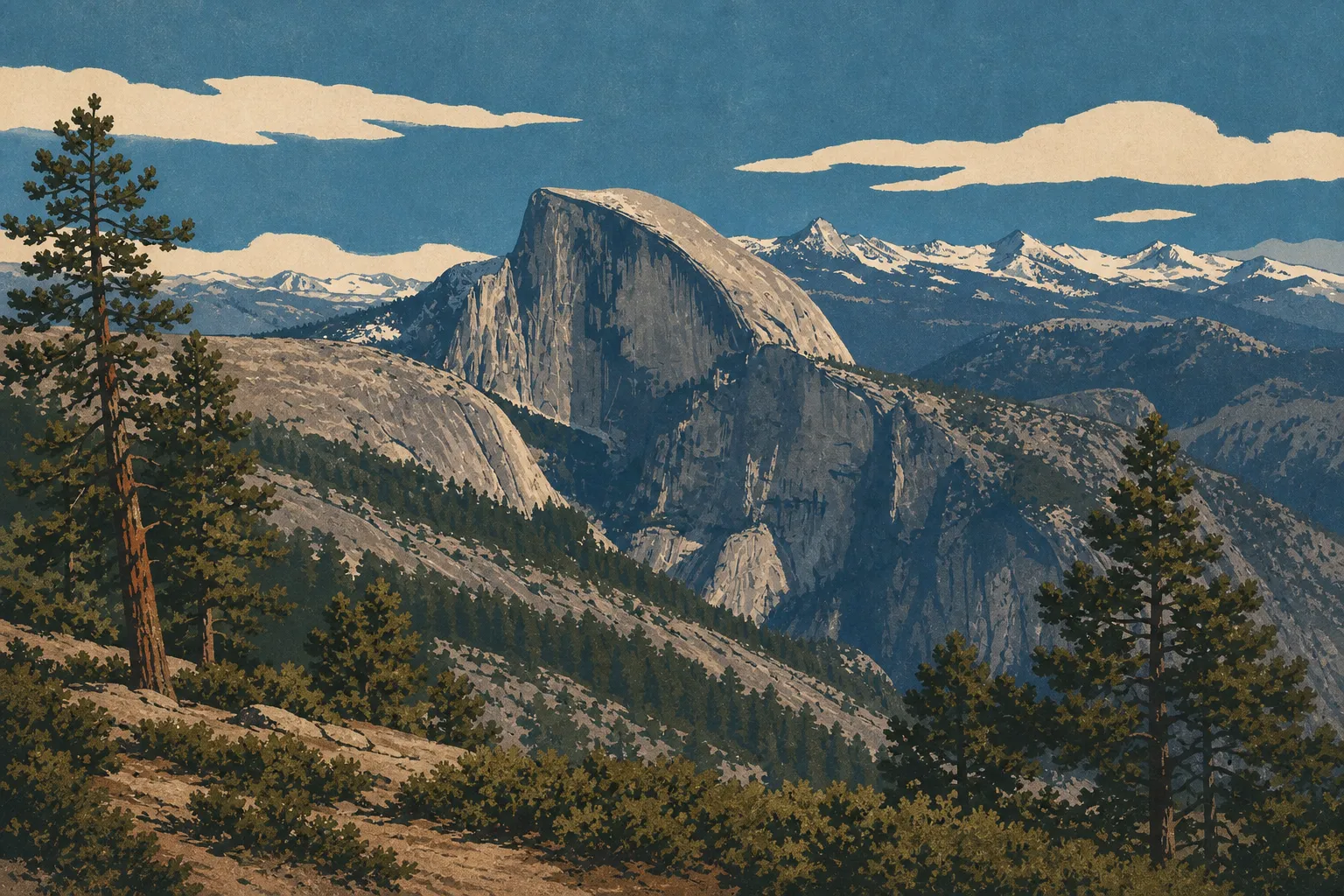
Yosemite National Park: The Complete Visitor Guide
Yosemite is a granite-walled glacial valley in the heart of California's Sierra Nevada, about 186 miles east of San Francisco. People come for sheer cliffs rising straight up from the valley floor, including El Capitan and Half Dome, waterfalls dropping hundreds of feet in spring, and groves of giant sequoias. Plan on at least one full day for the valley, and two to three days if you want to slow down and reach the higher overlooks. The park is open 24 hours a day, 365 days a year, but Tioga Road, which provides access to the east and the high-country meadows, stays closed by snow from November through late May or June. That's the first thing to check before setting your dates.
This page gives you the big picture of Yosemite. Each question has its own detailed guide, so follow the links as you read.
Yosemite at a Glance: Where the Park Is and How to Get There
The park covers nearly 1,200 square miles in California's Sierra Nevada, with elevations ranging from about 2,000 feet on the valley floors to nearly 13,100 feet along the ridges. In other words, the climate and accessibility can change dramatically depending on where you are and what time of year you visit.
Three entrances bring you in from the west and stay open year-round:
- Arch Rock (Highway 140 from Merced): the lowest-elevation access, which makes it the most reliable in winter, and the most direct route to Yosemite Valley.
- Big Oak Flat (Highway 120 from the west): the entrance from the San Francisco area.
- South Entrance (Highway 41 from Fresno): the route to Mariposa Grove and its sequoias, then on to the valley.
A fourth entrance, Tioga Pass (Highway 120 from the east), crosses the Sierra at nearly 9,800 feet. It opens only from late spring through fall, generally from late May or June until the first major snowfalls. If your itinerary connects Yosemite with Death Valley or Mammoth Lakes, this pass is your gateway, and its opening date determines the whole road trip.
There is no airport in the park, so you'll arrive by car. The most convenient airports are San Francisco and Oakland, about a four-hour drive away, or Fresno, which is closer to the south entrance. Our dedicated guide covers access, distances, and public transportation in detail.
Entrance Fees, Passes, and Reservations
You pay the entrance fee once, and it remains valid for seven consecutive days. The park's official rates are:
- $35 per private vehicle (the most common option: one car and its occupants).
- $30 per motorcycle.
- $20 per person entering on foot, by bicycle, or by shuttle.
If you're visiting several parks in the West, two passes can change the math. The Yosemite annual pass costs $70 and covers only this park. The America the Beautiful interagency pass covers all federal recreation sites for one year. It pays for itself after three or four fee-charging parks. Our Fees & Passes page explains entrance fees and passes.
One crucial point: in some seasons, Yosemite introduces a timed entry reservation during the busiest periods, typically summer and events such as February's Firefall. The details change from year to year. Always check the rule in effect for your dates before you leave. Without a valid reservation on a day when one is required, you'll be turned away at the entrance. Our Practical Information, Rules & Safety page keeps track of this requirement.
Reservations, Permits, and Rules to Follow
High-Season Entry Reservations
During high season, generally May through September, with exact dates varying each year according to NPS decisions, access to Yosemite Valley in a private vehicle requires a timed entry reservation through recreation.gov. Reservations open several months ahead and disappear within minutes when new availability is released. Don't leave this until the last week.
Outside this period, no entry reservation is required.
Permits for Regulated Hikes
Half Dome: access to the final cables requires a day hike permit awarded by lottery in spring for the entire summer season. Without a permit, rangers prohibit access to the cables, with no exceptions.
Wilderness permit: required for any overnight stay in the wilderness, including backpacking. Permits are awarded through an online lottery or on a walk-up basis that same morning at Yosemite Village's Wilderness Center, with a strict daily quota.
Our Hiking page explains the process for each permit and how far ahead to plan.
Rules to Follow
- Speed limits: 35 mph on the main roads and 15 mph in the valley. Rangers regularly issue tickets, so don't count on tourist leniency.
- Wildlife: feeding animals, including squirrels and jays, is prohibited. Store all food in the bear boxes provided at campgrounds, or in an approved canister when backpacking.
- Campfires: allowed only in designated campground fire rings, depending on weather conditions. They may be completely banned during dry weather or when fire danger is high.
- Drones: prohibited throughout the park, with no exceptions or waivers.
- Trash: the wilderness has a pack-it-in, pack-it-out policy. Whatever you bring in, you must take back out.
Getting Around Yosemite: Shuttles, Scenic Roads, and Areas
Think of Yosemite in terms of separate areas, not one single block. Yosemite Valley contains most of the iconic viewpoints and is easy to explore on foot or with the free shuttle, which serves the main stops in a loop. During high season, park once at Yosemite Village or Half Dome Village and leave your car there. The valley fills up fast, and finding a parking spot takes patience.
Outside the valley, you'll need your car again. Glacier Point Road climbs to overlooks in the south. Tioga Road (Highway 120) crosses the park from west to east for about 37 miles, passing high-country lakes and meadows when it's open. Mariposa Grove runs its own shuttle from the south entrance during busy periods. Hetch Hetchy, in the west, is reached by a separate road and is open only from sunrise to sunset.
How Long Should You Spend in Yosemite?
People ask this all the time, and the honest answer depends on what you want to do.
- One day is enough for a fast tour of Yosemite Valley: Tunnel View, Bridalveil Fall, the base of El Capitan, Yosemite Falls, and a viewpoint of Half Dome. It's packed and frustrating, but doable if Yosemite is a stop on a California road trip.
- Two days let you enjoy the park properly: one day in the valley and a second at Glacier Point and Mariposa Grove.
- Three days or more let you add Tioga Road, Tuolumne Meadows, and a major hike, such as the Mist Trail or the climb to Half Dome for well-prepared hikers.
Our advice is to spend two full days. That's the best balance between covering the must-sees and avoiding a visit spent waiting in line. Our Itinerary & Length of Stay page lays out the schedule hour by hour.
Plan your visit
What to See and Do in Yosemite
Here's the heart of the park, area by area. For more detail on each activity, follow our guide to things to do in Yosemite and our Hiking page.
Road trip journal · 5 areas
Yosemite Valley: The Heart of the Park
This is where Yosemite becomes the image you have in your head. The valley stretches for about 6 miles and lines up one granite landmark after another. El Capitan rises more than 3,000 feet above the valley and draws climbers from around the world. You can spot them with binoculars as tiny colored dots on the cliff. Half Dome closes off the valley with its glacier-sculpted, split dome. Among the waterfalls, Yosemite Falls ranks as one of the tallest in North America, and Bridalveil Fall greets you as soon as you enter on Highway 41.
Two viewpoints give you the classic scene with almost no effort. Tunnel View, just outside the tunnel on Highway 41, offers the full postcard view: El Capitan on the left, Bridalveil on the right, and Half Dome in the distance. Valley View, along the Merced River, frames the river and the cliffs. One useful detail: the waterfalls are spectacular in spring, when the snow melts, but often shrink to a trickle or dry up by late summer.
Glacier Point and the South Area
An hour's drive from the valley along Glacier Point Road, which opens in summer and closes in winter, Glacier Point puts you at more than 6,600 feet, facing Half Dome and the waterfalls, with the valley 3,300 feet below. Sunset here is memorable. In the same area, Taft Point, with its dizzying fissures, and Sentinel Dome offer 360-degree panoramas.
Mariposa Grove and the Giant Sequoias
At the south entrance, Mariposa Grove contains several hundred giant sequoias, including the venerable Grizzly Giant. These trees are among the largest living things on the planet. Flat, shaded trails make for an easy walk and a welcome break from the valley's granite and crowds.
Tioga Road and Tuolumne Meadows: High Elevation
When Tioga Road is open, from late May or June through fall, it reveals a different Yosemite, one of high meadows and alpine lakes. Tuolumne Meadows, a broad meadow more than 8,500 feet above sea level, serves as a base camp for hikers. Tenaya Lake and Olmsted Point mark the road with photogenic stops. The air is cool and clear, and the area is far less crowded than the valley.
Hetch Hetchy: The Twin Valley
In the west, Hetch Hetchy is a valley that has been submerged beneath a reservoir since the 1920s. Less visited than the main valley, it draws hikers with its spring waterfalls and quiet. Keep in mind that the area is open only from sunrise to sunset, and you must leave before dark.
Explore the park
Yosemite's Best Hikes
Yosemite has hikes for every level. To stretch your legs, the Mist Trail climbs alongside Vernal Fall and Nevada Fall. In spring, spray leaves you soaked, which explains the name. For a major objective, the climb to Half Dome runs from the valley to the summit along cables installed for the season. It requires a permit won through a lottery, excellent physical condition, and careful planning. For an easy outing, Mirror Lake and the loop around Cook's Meadow work for everyone.
Distances, elevation gains, permits, and difficulty levels are all covered on our Hiking page.
The detailed guide The Best Yosemite Hikes for Every Ability The best Yosemite hikes by area and ability, including the Mist Trail, Half… Read the guide →Wildlife and Plants to Look For
Yosemite is home to black bears, which you should never confuse with grizzlies, since none live in the park, mule deer, marmots at high elevations, coyotes, and abundant birdlife. Black bears come with one firm rule: never leave food or scented products in a car or tent. Use the bear boxes provided and keep your distance. A bear that associates people with food eventually gets killed. The rule protects the animal as much as it protects you.
Plant life changes with elevation too: oaks and mixed forests at lower elevations, Sierra pines and firs higher up, and, most famously, the giant sequoias of Mariposa Grove. Our Wildlife page covers the species, locations, and best seasons for viewing them.
The detailed guide Yosemite Wildlife: Animals to See and Where to Find Them Black bears, mountain lions, mule deer, and marmots Read the guide →When to Visit Yosemite
The short version is this: spring (April through June) brings full waterfalls and a green valley; summer is the season for Tioga Road and high elevations, although the valley is hot and crowded; fall brings good light and quieter trails; and winter brings snow and a hushed atmosphere, with high-elevation roads closed. The park gets 95% of its precipitation between October and May, and snow covers most of the park from about November through May.
Your choice comes down to your priorities: waterfalls, high-country hiking, or peace and quiet. Our When to Visit page breaks it down month by month, while our Weather page covers temperature and snowfall trends.
The detailed guide When to Visit Yosemite: Best Time, Weather, and Seasons When to visit Yosemite Read the guide →Where to Stay in Yosemite: Hotels and Campgrounds
Staying in the park changes everything. You're there at sunrise, when the valley is still waking up. Options range from the legendary Ahwahnee, with its historic setting and matching prices, to Yosemite Valley Lodge and the canvas cabins of Half Dome Village, along with campgrounds in the valley and along Tioga Road. Demand far exceeds supply, so book months ahead as soon as reservations open.
Outside the park, the towns of Mariposa, Oakhurst, Groveland, and El Portal offer more affordable options, at the cost of an hour's drive each way morning and evening. Our lodging guides include the full comparison.
Stay in the park
Around Yosemite: Things to Do Nearby
Yosemite rarely stands alone in a trip. To the east, once Tioga Road opens, you can continue to Mono Lake and its limestone formations, then Mammoth Lakes and the eastern Sierra, toward Death Valley. To the west, the road leads back to San Francisco and the California coast. To the south, Sequoia and Kings Canyon national parks extend the giant-sequoia experience.
To build a cohesive itinerary through several parks, our Road Trips and Regions guides, including California and the Sierra Nevada, place Yosemite in a broader route.
And if the idea of a stamped souvenir appeals to you, the park takes part in the passport stamp program. See our editorial page, Passport & Stamps.
Our Take: Is Yosemite Worth the Trip?
Yes, without a doubt, provided you manage the crowds. Yosemite Valley in the middle of July can turn into a traffic jam if you arrive without a reservation or a plan. But an early start, two well-planned days, and smart use of the shuttle can transform the visit. The payoff is exceptional: few parks pack so many natural landmarks into such a small area. On our visit, what stayed with us most was the morning light on El Capitan, before the buses arrived.
Our recommendation is to come in spring for the waterfalls or fall for quieter conditions, book your lodging well in advance, and check the entry reservation rules for your dates. Everything else follows.
Frequently Asked Questions
How Long Should You Spend in Yosemite?
Plan your visit around your goals: one day to skim Yosemite Valley, two days to comfortably cover the valley, Glacier Point, and Mariposa Grove, and three days or more to add Tioga Road and a major hike. Our recommendation is two full days.
What Is the Best Time to Visit Yosemite?
The best time depends on your priorities: spring, from April through June, for full waterfalls; summer for high elevations via Tioga Road; fall for good light and quiet; and winter for snow. Our When to Visit page has the details month by month.
How Do You Visit Yosemite National Park?
Drive to Yosemite, then explore the busy Yosemite Valley on foot and by free shuttle. Outside the valley, you'll still need a car for Glacier Point, Tioga Road, and Mariposa Grove. During some seasons, you'll need a timed entry reservation, so check before you leave.
What Is the Most Beautiful Viewpoint in Yosemite?
The most iconic viewpoint is Tunnel View on Highway 41. It frames El Capitan, Bridalveil Fall, and Half Dome in a single glance. Glacier Point in summer and Valley View round out the top three.
How Much Does It Cost to Enter Yosemite?
The entrance fee is $35 per private vehicle, valid for seven days, or $20 per person entering on foot or by bicycle. The park's annual pass costs $70. If you're visiting several parks, compare it with the interagency pass on our Fees & Passes page.
Do You Need a Reservation to Enter Yosemite?
You may need a timed entry reservation during the busiest periods, including summer and February's Firefall event. Rules change each year, so check the requirements in effect for your dates on our Practical Information, Rules & Safety page.
The American Parks shop
Bring Yosemite home
Our park-inspired creations, made to order and shipped to your door.
Latest park news
- Yosemite: Dome Fire picks up activity, firefight underway on the east flankCrews are strengthening the handline on the Dome Fire's east side and addressing spot fires after heat and dry conditions fueled a spike in activity.
- Yosemite Turns 136: The 1890 Law That Sealed It AllYosemite National Park marks the 136th anniversary of its official creation by Congress, signed into law on October 1, 1890, according to WHSV.
- Yosemite: Rabies at Curry Village, Three Months Between the Positive Test and Its AnnouncementThe infected bat was found on May 18, 2026, but wasn't made public until September 2. No closures at Curry Village, and the safety guidance stays the same.