
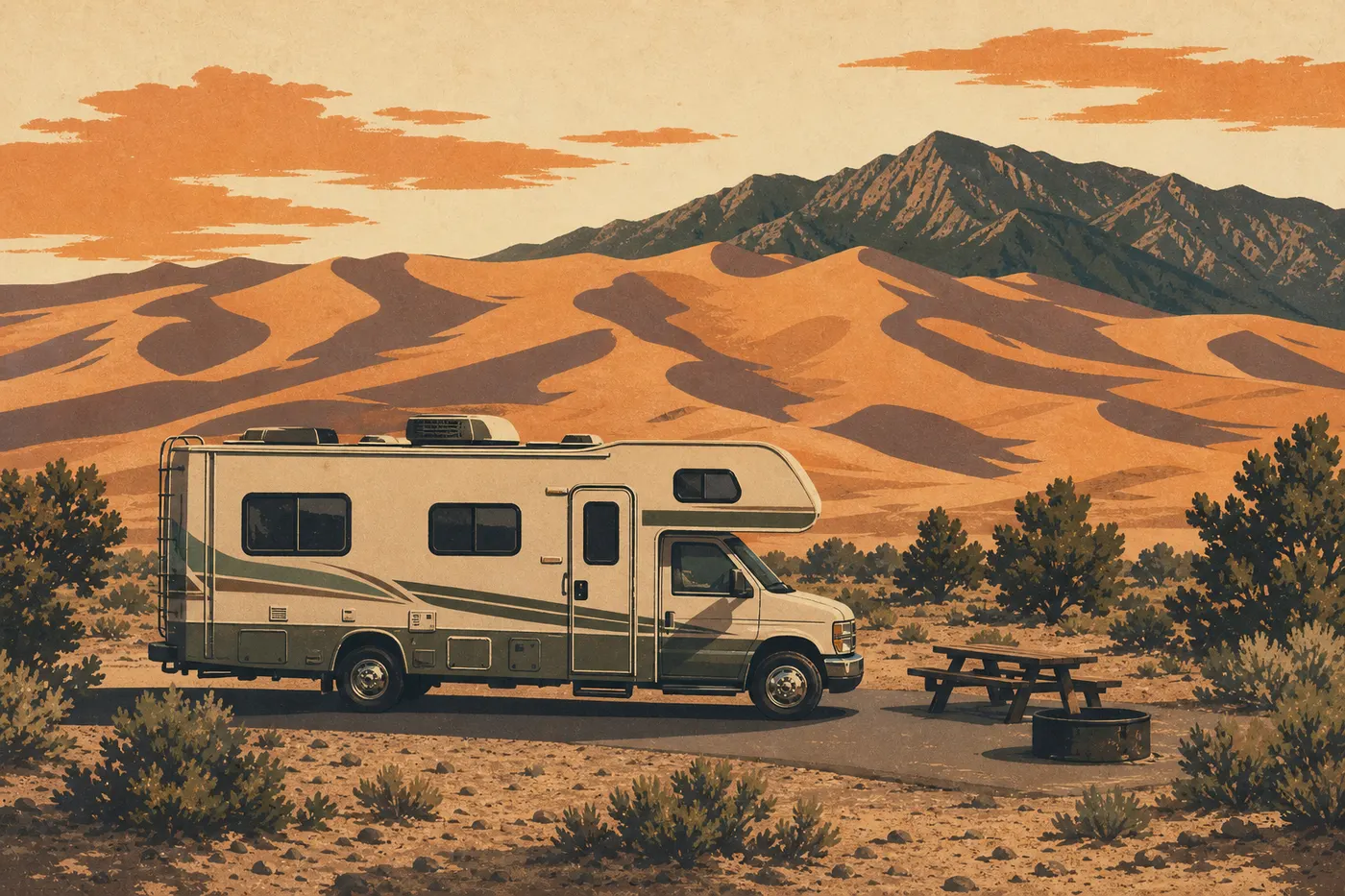
Great Sand Dunes by RV: Campgrounds, Rules, and Tips
North America's tallest dunes, set against the Sangre de Cristo Mountains at 8,000 feet: Great Sand Dunes is an extraordinary playground for RV campers. The short answer is yes, you can stay here in an RV. The park has an official campground with RV sites, and the main road has no major vehicle-size restrictions. Here's what you need to know before you arrive: sites have no electric or water hookups. Come prepared to be self-sufficient.
Can You Drive and Camp at Great Sand Dunes by RV?
Yes, with no notable restrictions on the main road network. The usual approach follows CO 150 from US 160 to the south, or CO 17 via Lane 6 from the west. This paved road leads directly to the Dunes Parking Lot, the Visitor Center, and Piñon Flats Campground. Any standard RV can make the drive.
The park is open 24 hours a day, 365 days a year. Admission costs $25 per private vehicle, valid for 7 days, and $20 for a motorcycle. If you're visiting several national parks on your road trip, the park's $45 annual pass pays for itself on your second visit.
RV Restrictions and Regulated Roads
The good news is that Great Sand Dunes has no tunnels or overhangs that limit vehicle height on the main road. You don't need a special permit to reach the campground.
The road to watch is Medano Pass Primitive Road. This 11-mile dirt road climbs toward the pass in the direction of Westcliffe. It's unpaved, corrugated, and crossed by repeated stream fords, so it's reserved for high-clearance 4WD vehicles. All RVs are prohibited, whether they're Class A, B, or C, regardless of length. Don't take your vehicle onto it.
Parking spaces at the Dunes Parking Lot and the Visitor Center are standard size. Vehicles longer than 33 to 36 feet may have trouble maneuvering through some sections. Arrive early during peak season to find a suitable space.
Official Park Campgrounds
Piñon Flats Campground
Piñon Flats is the only campground managed by the NPS within the park. It's a few hundred yards from the Dunes Parking Lot and the Visitor Center. The location is ideal for reaching the dunes at sunrise, which we strongly recommend in summer. See our Great Sand Dunes weather guide to understand why timing matters here.
RV sites: The campground welcomes RVs. The recommended maximum length is about 35 feet. Beyond that, maneuvering along the forested lanes becomes difficult. Check your vehicle's length before booking.
Hookups: None. Sites have no electricity, water, or sewer connections. This is dry camping. Your fresh-water tank and battery should be full when you arrive.
Reservations: Use recreation.gov for reservable sites. During the busy season, from May through September, sites can sell out within hours of the reservation window opening, usually 6 months ahead. Set an alarm.
Rate: About $20 per night for a standard site. Check recreation.gov, since NPS rates are reviewed annually.
Season: Part of the campground stays open year-round. Winter conditions at 8,000 feet are severe, with overnight freezes guaranteed and possible snow from November through April. Our guide to the best seasons at Great Sand Dunes explains which periods are most comfortable for a stay.
Shared amenities: Restrooms, central drinking-water spigots, picnic tables, and bear boxes at every site. Bear boxes are required for all food and scented products, no exceptions.
Backcountry Camping on the Dunes
The park allows backcountry camping in the dune field and in the Preserve on the national forest side, with a free permit available at the Visitor Center. This option isn't for RVs. No vehicle can drive onto the sand. Backcountry camping is for hikers only.
Boondocking and Camping Areas Around the Park
The San Luis Valley is a great option for boondockers. Bureau of Land Management (BLM) lands stretch west and north of the park, offering free dispersed camping for up to 14 days per site, under the standard BLM rule. To find permitted areas, the iOverlander app and the official BLM Colorado portal are your best references.
The town of Alamosa, about 34 miles south, has several private RV parks with full hookups. They're useful for recharging batteries and filling tanks before or after visiting the park. You'll also find large grocery stores and gas stations there.
Dump Stations, Water, and Services
A dump station is available at Piñon Flats Campground. It's generally accessible to campground guests. If you're staying outside the park, ask at the Visitor Center about access conditions.
For drinking water, central spigots serve the campground. Outside the park, Alamosa and Mosca have RV service stations. Plan your water supply ahead of time. At 8,000 feet, water consumption increases noticeably.
Piñon Flats, Boondocking, or Alamosa: Which Option Fits You?
You're traveling with a family or a large Class A RV: Piñon Flats is your only option inside the park. Book several weeks ahead, check your vehicle's length, with 35 feet recommended as the maximum, and forget about Medano Pass Primitive Road.
You're looking for solitude and immersion: Boondocking on BLM lands west of the park offers unobstructed views of the dunes from outside the park, without neighbors. With a self-contained camper van or Class B RV, it's a solid, free option.
You need electric hookups or running water: Full-hookup RV parks in Alamosa are the answer. Allow about 40 minutes to drive from town to the park entrance.
See our guide to lodging at Great Sand Dunes to compare with conventional accommodations if an RV isn't your only option.
Renting an RV to Visit Great Sand Dunes
If you don't have your own RV, Denver, about a 4-hour drive away, is home to the main rental companies. Cruise America, the go-to company for Class C motorhomes, is a good fit for this kind of itinerary. Peer-to-peer platforms such as Outdoorsy and RVshare offer newer or more unusual vehicles, including camper vans.
Choose a vehicle shorter than 33 feet to keep more flexibility in the park's parking areas and at Piñon Flats.
Pets, Budget, and Reservations: What to Know
Pets: Dogs are allowed in the campground and on the park's paved roads, but they must be leashed, with a maximum leash length of 6 feet. They are not allowed on the dunes or on Preserve trails. Wildlife, including deer, pronghorn, and elk, is everywhere. Stay alert.
Site budget: Plan on about $25 for admission plus $20 per night for camping, or $45 a day just to stay in the park. Add fuel, food, and any activities to refine your overall budget.
When to book: As soon as the recreation.gov reservation window opens, usually 6 months ahead. July and August weekends sell out within hours. In September or October, sites may still be available at the last minute during the week, and the park is less crowded.
Elevation: 8,000 feet. If you're not used to this altitude, plan on spending a night acclimating in Alamosa, at 7,500 feet, before entering the park. Headaches and fatigue are common during the first few days.
In Summary: Our Great Sand Dunes RV Plan
Great Sand Dunes works very well for an RV trip, as long as you're comfortable with dry camping at Piñon Flats or BLM boondocking nearby. Book on recreation.gov several weeks ahead if you're aiming for July or August. Make sure your vehicle is no longer than 35 feet. Avoid Medano Pass Primitive Road. Most of all, plan your dune outings for early morning. The sand can reach 160°F in the middle of a summer day. Two or three nights at Piñon Flats, with the dunes within walking distance at dawn, is the format we recommend without hesitation.
Frequently Asked Questions
Can you camp for free at Great Sand Dunes National Park?
You can't camp for free inside the park. Piñon Flats Campground costs about $20 per night, plus the $25 admission fee per vehicle. On adjacent BLM lands in the San Luis Valley, dispersed camping is free, with a maximum of 14 days per site. For admission and annual pass prices, see the National Parks Fees and Passes page.
Can you park an RV anywhere in the park?
No. RV parking is limited to designated sites at Piñon Flats Campground and developed parking areas, including the Visitor Center and Dunes Parking Lot. Camping outside designated areas is prohibited within the park.
Can you bring your dog onto the dunes?
Dogs aren't allowed on the dunes or on Preserve trails. They're allowed in the campground, on roads, and in parking areas, but must be leashed, with a maximum leash length of 6 feet.
What's the best time to camp at Great Sand Dunes in an RV?
May, June, September, and October offer the best conditions, with mild daytime temperatures and moderate crowds. July and August bring the heaviest visitation and afternoon thunderstorms. Our When to Visit page explains the advantages of each season so you can plan your trip.