
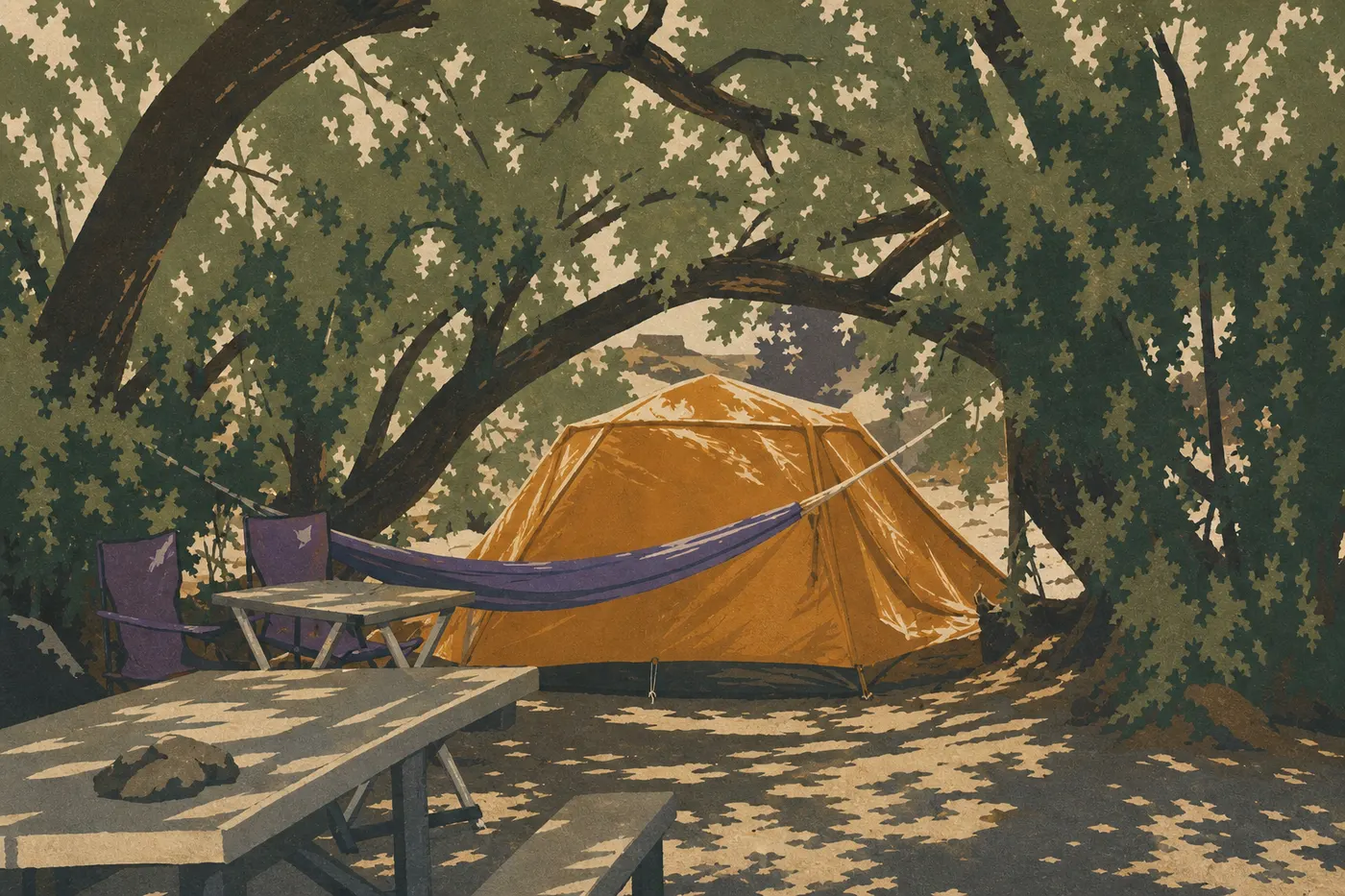
Camping in Death Valley: A Guide to 12 Campgrounds, Fees, and Reservations
Death Valley has 12 campgrounds managed by the National Park Service, with 782 sites in all. Furnace Creek is the only one that accepts reservations (from October through mid-April); the other 11 operate on a first-come, first-served basis. Backcountry camping is also allowed free of charge, as long as you follow NPS rules.
The park is open 365 days a year. In July, temperatures on the valley floor regularly rise above 118°F. More than anywhere else, choosing the right campground and season is about more than comfort.
Campgrounds in the park (12)
- Campground Emigrant Campground first come, first served · 10 sites Directions ↗
- Campground Texas Springs Campground first come, first served · 106 sites Directions ↗
- Campground Sunset Campground first come, first served · 230 sites Directions ↗
- Campground Stovepipe Wells Campground first come, first served · 190 sites Directions ↗
- Campground Wildrose Campground first come, first served · 23 sites Directions ↗
- Campground Furnace Creek Campground recreation.gov · 136 sites Directions ↗
- Campground Mesquite Spring Campground first come, first served · 40 sites Directions ↗
- Campground Thorndike Campground (Primitive) first come, first served · 6 sites Directions ↗
- Campground Mahogany Flat Campground (Primitive) first come, first served · 9 sites Directions ↗
- Campground Eureka Dunes Campground (Primitive) first come, first served · 7 sites Directions ↗
- Campground Homestake Campground (Primitive) see NPS · 10 sites Directions ↗
- Campground Saline Valley Campground (Primitive) first come, first served · 15 sites Directions ↗
 Base map © OpenStreetMap · © CARTO
 Death Valley campgrounds by the numbers
12 official campgrounds inside the park, 782 campsites in total, 136 of them reservable.
| Campground | Sites | Booking | Fee / night | Open | Amenities |
|---|---|---|---|---|---|
| Sunset Campground | 230 | First come, first served | from $9 | Closed Apr 27 to Oct 14 | toilets*, potable water*, dump station*, camp store |
| Stovepipe Wells Campground | 190 (28 tent only) | First come, first served | from $9 | Closed Apr 20 to Oct 14 | toilets*, potable water*, dump station*, camp store, firewood |
| Furnace Creek Campground | 136 (45 tent only, 18 electric hookups, 5 group) | Reservation | from $30 | Year round | toilets, potable water, dump station, camp store |
| Texas Springs Campground | 106 (26 tent only) | First come, first served | from $10 | Closed Apr 13 to Oct 14 | toilets*, potable water*, dump station* |
| Mesquite Spring Campground | 40 | First come, first served | from $20 | Year round | toilets, potable water, dump station |
| Wildrose Campground | 23 | First come, first served | Free | Year round | toilets |
| Saline Valley Campground (Primitive) | 15 | First come, first served | Free | Closed Sep 16 to Oct 16 | |
| Emigrant Campground | 10 (10 tent only) | First come, first served | Free | Seasonal | toilets, potable water |
| Homestake Campground (Primitive) | 10 | First come, first served | Free | Year round | toilets |
| Mahogany Flat Campground (Primitive) | 9 | First come, first served | Free | Seasonal | toilets* |
| Eureka Dunes Campground (Primitive) | 7 | First come, first served | Free | Year round | toilets |
| Thorndike Campground (Primitive) | 6 | First come, first served | Free | Seasonal | toilets* |
Source: National Park Service (NPS API), retrieved October 6, 2026. Fees and dates change: check the campground page before you go.
Can you camp inside Death Valley?
Yes, and it's one of the best ways to explore the park. At 5,270 square miles, Death Valley is the largest national park in the contiguous United States. Camping in the park saves you from daily drives from Las Vegas (about 175 miles) or Los Angeles (about 280 miles).
Free camping on the valley floor is prohibited. Outside the official campgrounds, backcountry camping is allowed under strict conditions. You must stay away from paved roads and natural water sources, and pick up a free permit at a visitor center before setting out.
Campgrounds in the park
Death Valley is large enough that your choice of campground can genuinely shape your trip. The 12 official sites are spread across four geographic areas. The table above provides detailed information about sites, fees, reservations, services, and opening dates.
Furnace Creek area (central valley)
Furnace Creek Campground is the park's main campground and the only one that accepts reservations. Its 136 sites include tent sites (45), sites with electrical hookups (18), and group sites (5). A visitor center, grocery store, and gas station are just a few minutes away on foot. Reservations open on recreation.gov for stays from October 15 through April 15. Outside that window, the campground remains open, although some loops close depending on the season.
Sunset Campground, right next door, is the park's largest campground, with 230 sites for tents and RVs (RVs up to 60 feet). Water, restrooms, a dump station, and a store are available on site. It's first-come, first-served, at $9 per night. It closes from late April through mid-October.
Texas Spring Campground has 106 sites (26 reserved for tents), at $10 per night on a first-come, first-served basis. RVs are allowed up to 35 feet. Water, restrooms, and a dump station are available, but there's no store. It closes from mid-April through mid-October.
Stovepipe Wells area (central west)
Stovepipe Wells Campground sits next to the village of the same name, with its gas station and saloon. Its 190 sites (including 28 reserved for tents) are first-come, first-served, at $9 per night. It's the only campground in the park that sells firewood. It also has restrooms, water, a dump station, and a store. It closes from late April through mid-October. This is the natural starting point for Mesquite Flat Sand Dunes, just a few miles away.
Northern park
Mesquite Spring Campground is open year-round in the northern part of the park, with 40 first-come, first-served sites at $10 per night. Water, restrooms, and a dump station are available. The NPS notes that summer nights can be very hot, with low temperatures above 90°F. In winter and spring, it's one of our favorite areas.
Eureka Dunes Campground (Primitive) offers seven free sites in the far north of the park, with restrooms, on a first-come, first-served basis. It's open year-round but not recommended in summer because of extreme temperatures.
Saline Valley Campground (Primitive) has 15 free sites with no listed services, open year-round. It's one of the park's most isolated sites, so bring all the water and food you'll need.
High-elevation campgrounds (Panamint Range)
On the slopes of the Panamint Range in the western part of the park, five campgrounds offer valuable relief in summer, with temperatures well below those in the valley.
Wildrose Campground (about 4,265 feet in elevation) is accessible by a regular passenger car, free, and open year-round. Only basic restrooms are available, but the quiet is remarkable. RVs are allowed up to 25 feet.
Thorndike Campground (Primitive) (six sites, free, restrooms) is accessible only by a high-clearance 4WD vehicle. It's open from mid-April through December, depending on snow conditions.
Mahogany Flat Campground (Primitive) (nine sites, free, restrooms) sits even higher, around 8,530 feet. It's accessible only by 4WD and closes in winter because of snow and ice. In return, the views from this high up are well worth the difficult drive.
Homestake Campground (Primitive) has 10 free sites with restrooms, open year-round on a first-come, first-served basis.
Emigrant Campground (10 sites reserved for tents, free) is currently closed indefinitely after storms damaged its water infrastructure. Check the table for its status at the time of your visit.
RV vs. tent: Which site should you choose?
You can visit Death Valley in an RV with a little preparation. Furnace Creek has 18 sites with electrical hookups, and Sunset allows RVs up to 60 feet. An RV with built-in air conditioning is a real advantage in the shoulder seasons, when nights stay warm without turning cool.
The high-elevation campgrounds at Thorndike and Mahogany Flat, however, are inaccessible to RVs. The rocky road requires substantial ground clearance and a compact vehicle. Some rental companies prohibit driving on unpaved roads under their contracts, regardless of the vehicle. Check your contract before taking these roads. For model-specific restrictions and dump stations in the park, the Death Valley RV camping guide has all the details.
For tent campers, the high-elevation sites are by far the most pleasant from June through August. Sleeping above 6,560 feet while the valley bakes at 122°F completely changes the experience.
Camping nearby: Options outside the park
When the park is full (weekends in March and April fill up quickly), you have a few alternatives nearby. Panamint Springs Resort, just outside the western entrance, has a tent and RV campground. Around Beatty, Nevada, to the east, several private campgrounds take overflow visitors. For nearby lodges, hotels, and private campgrounds, the Death Valley lodging guide lists all the options.
Backcountry camping
Backcountry camping is allowed across almost the entire park. These rules are non-negotiable:
- Pick up a free permit at a visitor center or from a ranger before setting out.
- Camp away from paved roads and heavily visited areas such as campgrounds and visitor centers.
- Stay a minimum distance from all natural water sources. The permit form gives the exact distances.
- Ground fires are not allowed in the valley. Gas stoves are permitted.
- Follow Leave No Trace principles completely. Pack out all trash and, in areas without restrooms, human waste as well. WAG bags are available at the visitor center.
For multi-day backcountry routes, see the Death Valley hiking guide.
How and when to reserve a campsite in Death Valley
Reservations are made through recreation.gov, up to six months in advance. Take this window seriously. Furnace Creek sites for March and April can sell out within hours of reservations opening.
For the 11 campgrounds without reservations, arrive early in the morning. Campers must leave by 11 a.m., and newly available sites are assigned right away.
Our recommendation is simple: choose spring (March through May) or fall (October through November) for most campgrounds. In summer, stick to the high-elevation campgrounds. The month-by-month climate calendar explains the best time to go for your travel style.
Fees: How much does a night of camping cost in Death Valley?
The park offers a wide range of options, from free sites to campgrounds with full services:
- Fee campgrounds (Furnace Creek, Sunset, Stovepipe Wells, Texas Spring, Mesquite Spring): $9 to $30 per night. Furnace Creek is the most expensive ($30, with reservations); Sunset and Stovepipe Wells are the least expensive ($9 each).
- Free campgrounds (Wildrose, Thorndike, Mahogany Flat, Homestake, Saline Valley, Eureka Dunes): no camping fee, but services are very limited or nonexistent.
The park entrance fee applies in every case: $30 per vehicle, $25 per motorcycle, or $15 per person arriving on foot or by bicycle. The park-specific annual pass costs $55. The America the Beautiful Pass ($80), valid at all U.S. national parks for 12 months, pays for itself after visiting two parks in a year. The Fees and passes page explains entrance fees and pass options.
Camping safety and best practices
Death Valley is where logistical mistakes can cost you the most. The points below are requirements, not suggestions.
Water. Bring at least 4 liters per person per day outside the valley, and more in summer. Fill-up points are scarce: the Furnace Creek visitor center, Stovepipe Wells Village, and Panamint Springs. The primitive campgrounds in the north, including Saline Valley and Eureka Dunes, have no water on site. Check availability before heading into the backcountry.
Food. Death Valley doesn't require bear canisters because there are no bears in the park. Coyotes and desert foxes, however, are opportunistic and completely comfortable around campsites. Store food in your vehicle or in the metal lockers provided at the sites.
Heat. Never leave a child or pet in a closed vehicle, even for a few minutes. Pavement can exceed 176°F in July, so check your tire pressure before driving in extreme heat. In the backcountry, tell someone your route and expected return date.
High-elevation nights. Even in August, temperatures at Mahogany Flat can drop below 50°F. A suitable sleeping bag remains essential, including in summer.
Which campground is right for you?
| Profile | Our recommendation |
|---|---|
| First visit, comfort, and services | Furnace Creek Campground |
| Traveling with children | Furnace Creek or Stovepipe Wells |
| RV with electrical hookups | Furnace Creek (18 sites with electricity) |
| Quiet and nature, tent camping | Mesquite Spring or Wildrose |
| Summer without the valley heat | Wildrose, Thorndike, or Mahogany Flat (4WD for the last two) |
| Zero-budget camping | Wildrose, Thorndike, Mahogany Flat, Homestake, Saline Valley, or Eureka Dunes |
For lodge or hotel accommodations in the park, see the Death Valley hotels and lodges guide. For an overview of trip logistics, the Death Valley guide links to every section about the park.
Frequently asked questions
Where should you stay when visiting Death Valley?
To stay in the park, you can choose among its 12 campgrounds (782 sites in all), the lodges at Furnace Creek and Stovepipe Wells, or hotels in gateway towns such as Beatty, Nevada, or Ridgecrest, California. Our Where to stay page compares all these options and their price ranges.
Can you camp for free in Death Valley?
Yes. Six campgrounds are completely free, all on a first-come, first-served basis: Wildrose, Thorndike, Mahogany Flat, Homestake, Saline Valley, and Eureka Dunes. Backcountry camping is also free (the permit costs nothing), as long as you follow NPS rules. Note that Emigrant Campground, which used to be free, is currently closed indefinitely.
How much does camping cost in Death Valley National Park?
The five fee campgrounds charge $9 to $30 per night. Furnace Creek is the most expensive ($30, with reservations); Sunset and Stovepipe Wells are the least expensive ($9 each). Six campgrounds are completely free. The park entrance fee ($30 per vehicle) applies in every case.
What is the entrance fee for Death Valley National Park?
The fee is $30 per private vehicle, $25 per motorcycle, or $15 per person arriving on foot or by public transportation. The park-specific annual pass costs $55. The America the Beautiful Pass ($80), valid at all U.S. national parks, is a better value once you've visited two parks in a year.