
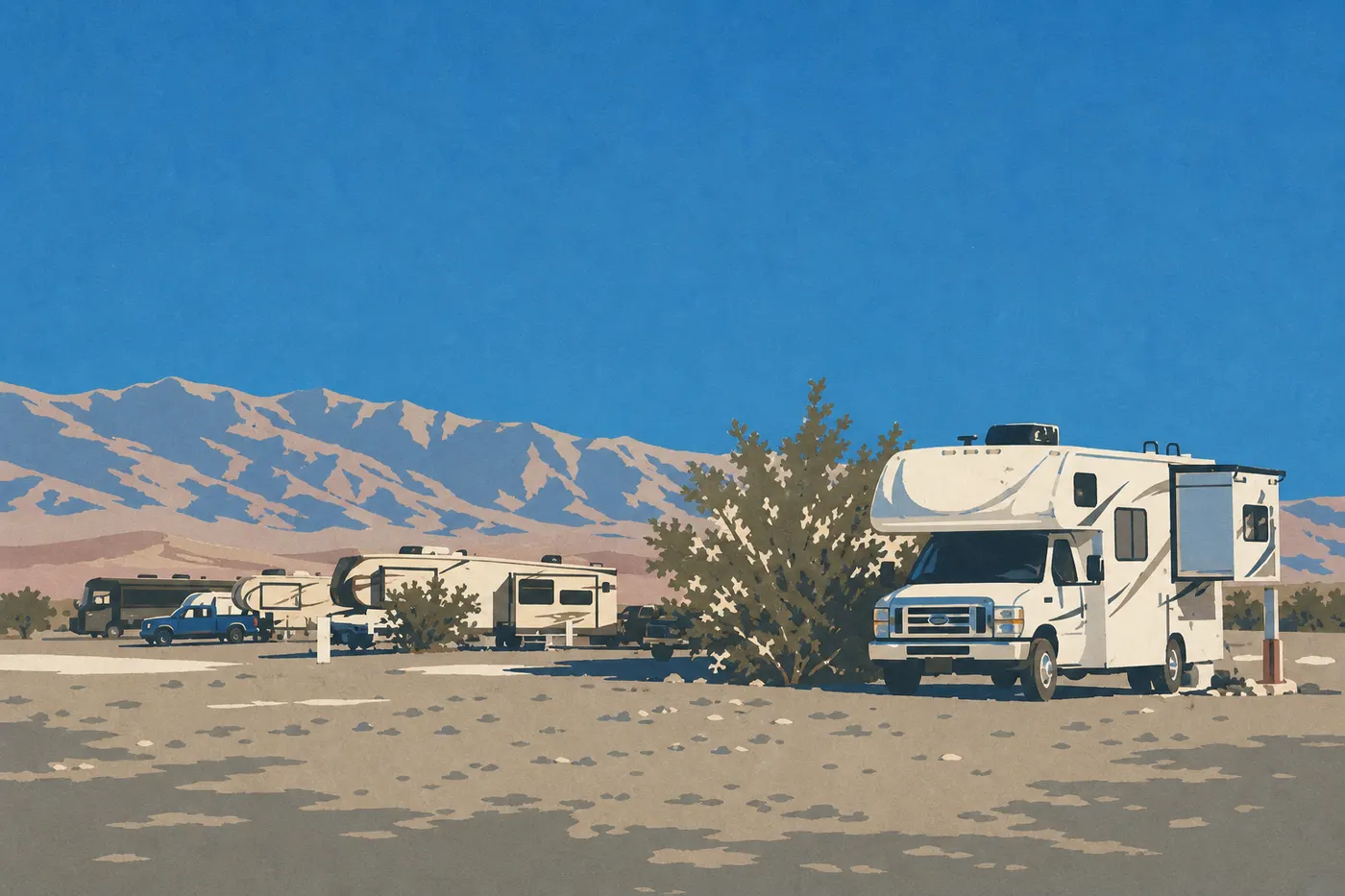
Death Valley by RV: Campgrounds, Rules, and Tips
You can visit Death Valley by RV, and the park is genuinely well suited to larger vehicles: wide roads, campgrounds sized for RVs, and scenery worth slowing down for. The main challenge isn't regulations. It's the heat. In summer, the valley can approach 122 °F in the shade, and an overheating engine halfway to Badwater Basin can derail your day fast. Plan your trip between October and April, and the logistics become almost routine.
In short: yes, you can drive and camp in an RV at Death Valley. The main roads are paved and accessible to almost any RV. A few secondary routes are closed to larger vehicles. Five official campgrounds offer RV sites, with or without hookups.
Can You Drive and Camp in an RV at Death Valley?
The park's main routes, including California Route 190, Badwater Road, and Scotty's Castle Road, are well-maintained two-lane roads that pose no difficulty for an RV or a vehicle with a trailer. The large parking areas at the main attractions, including Zabriskie Point, Badwater Basin, and Artists Palette, can accommodate long vehicles.
The entrance fee is $30 per vehicle and is valid for 7 days. A park-specific annual pass is available for $55. Our National Parks Fees and Passes guide explains entrance fees and multi-park passes. The park doesn't require an entry reservation and remains open 365 days a year, 24 hours a day.
RV Restrictions and Regulated Roads
You can't get everywhere in an RV. Here are a few things to check before you unfold the map.
Artists Drive (11.2 miles, one-way): the maximum permitted height is 14 feet. Most Class C motorhomes fit without a problem, but measure your total height, including the roof-mounted air conditioner, before heading in.
Titus Canyon Road: this is a one-way dirt road reserved exclusively for four-wheel-drive vehicles and light vehicles. RVs aren't allowed.
Racetrack Road, Saline Valley Road, and other backcountry roads: these routes are accessible only to high-clearance four-wheel-drive vehicles. Your rental agreement almost certainly prohibits taking the RV on them, and damage sustained off pavement is expressly excluded from the coverage.
For current access conditions, check the alerts posted on the NPS website and our Death Valley access guide.
Official Park Campgrounds
Death Valley has five main campgrounds accessible to RVs. Opening seasons vary considerably with elevation and temperatures. Our Death Valley campgrounds guide includes the full table.
Furnace Creek Campground
This is the park's best-equipped campground. Just steps from the Visitor Center, it offers sites with electrical hookups, a rarity in Death Valley. It's open year-round. Reservations are required from October through April on recreation.gov. In the middle of summer, the hookups let you run the air conditioning at night. That's almost a necessity rather than a luxury. Furnace Creek is also the logical base for exploring Badwater Basin and Zabriskie Point, both less than 20 minutes away.
Sunset Campground
Next to Furnace Creek, Sunset is a large campground with no hookups. Sites are first come, first served. It opens from fall through spring, generally October through April. The sites are spacious and well sized for long vehicles. The setting is bare-bones, but the nearby services at Furnace Creek more than make up for it.
Stovepipe Wells Campground
In the heart of the park, across from the Mesquite Flat Sand Dunes, this campground is open year-round. There are no hookups, but restrooms are available, and the village of Stovepipe Wells is a few minutes away on foot, with fuel, a grocery store, and a restaurant. Sites are first come, first served. It's a good base for the dunes and Artists Drive.
Panamint Springs Campground
At the park's western entrance in Panamint Valley, Panamint Springs is open year-round. A private resort next door offers gas, a restaurant, and a few basic amenities. It's a logical stop if you're reaching Death Valley from Los Angeles via CA-395 or US-395.
Mesquite Spring Campground
In the north of the park, at around 2,950 feet in elevation, Mesquite Spring is noticeably cooler than the valley floor. It's open year-round, with no hookups, and operates on a first-come, first-served basis. It's especially appealing in April or October, when the lower campgrounds are already full.
Dispersed Camping and Areas Around Death Valley (Boondocking)
Death Valley allows backcountry camping under certain conditions. You must stay at least 1 mile from paved roads and far enough from springs and protected areas. In practice, these rules work for four-wheel-drive vehicles and compact vans, but rarely for large RVs whose size rules out unpaved roads.
The Bureau of Land Management (BLM) lands surrounding the park, particularly in Panamint Valley and around Ridgecrest, offer legal boondocking options for self-contained RVs. There is no water and no electricity, so plan your tank and battery capacity down to the last drop. Our guide to the regions of the American Southwest explains these BLM areas.
Dump Stations, Water, and Services
Dump station: Furnace Creek Campground has a dump station available to campers in the park. Check the hours and access requirements at the campground entrance.
Drinking water: available at Furnace Creek and Stovepipe Wells. Outside these two locations, water isn't guaranteed along the road. Always leave with full tanks.
Fuel: there are three gas stations in the park, at Furnace Creek, Stovepipe Wells, and Panamint Springs. Prices are considerably higher than outside the park. Fill up before entering, especially if you plan to explore the remote areas to the north or west.
Mechanical help: there is no repair shop in the park. A tow from the valley floor is expensive and can take several hours. Check your roadside assistance coverage before you leave.
Which Campground Is Right for You
Here's how we'd point you toward a campground based on your situation.
Traveling with kids: Furnace Creek, thanks to its hookups for nighttime air conditioning, proximity to the Visitor Center, and restroom facilities.
For the must-see sites: Stovepipe Wells for the dunes and Artists Drive; Furnace Creek for Badwater Basin and Zabriskie Point.
For cooler temperatures: Mesquite Spring, at higher elevation, is regularly 9 to 18 °F cooler than the valley in spring and fall.
For your first night after Los Angeles: Panamint Springs, right at the western entrance, means you won't have to cross the entire park when you arrive.
For travelers who prefer a real bed, our Death Valley lodging guide covers the lodges and hotels available in the park.
Renting an RV to Visit Death Valley
Los Angeles is the natural hub for renting an RV before heading to Death Valley, about 205 miles from Furnace Creek and a 3.5-hour drive. Las Vegas is a closer alternative, about 171 miles away and 2.5 hours by car, and rentals are often cheaper there.
Three vehicle sizes cover nearly every type of trip in the park:
- Class B (campervan, 16 to 23 feet): the easiest to maneuver, able to go almost anywhere, and ideal for two people.
- Class C (motorhome, 23 to 30 feet): a good balance of living space and access, suitable for small families.
- Class A (large motorhome, 30 feet or longer): avoid it if you plan to drive Artists Drive or park in the tight lots at secondary attractions.
Always check the off-pavement policy in your rental agreement. Nearly all rental companies explicitly prohibit it, and damage on dirt roads isn't covered.
RVs, Pets, Budget, and Reservations: What to Know
Dogs: allowed in campgrounds when leashed, but prohibited on trails, in the dunes, and inside park buildings. In summer, the ground can reach more than 158 °F, which is too hot for their paw pads. Plan accordingly, or avoid visiting with your pet during the summer.
Site prices: campgrounds without hookups generally charge between $14 and $22 per night. Sites with hookups at Furnace Creek cost more. Check the current rates on recreation.gov when you book.
Reservations: essential for Furnace Creek during the busy season, from October through April. The other campgrounds operate on a first-come, first-served basis. Arrive in the early afternoon to have a choice of sites.
Best time to go: our Death Valley seasons guide has the details. In brief, visit from November through March for cooler weather, or in September–October and April–May for mild temperatures and possible spring blooms.
In Summary: Our Death Valley RV Plan
Death Valley is accessible and rewarding by RV as long as you avoid summer. Choose Furnace Creek for hookups and proximity to the main attractions, Stovepipe Wells for the dunes, Panamint Springs if you're arriving from the west, and Mesquite Spring if you're looking for cooler air at higher elevation. Fill up with water and fuel before heading into remote areas. Don't take an unpaved road without a suitable four-wheel-drive vehicle. And reserve Furnace Creek well in advance. Sites with hookups fill up starting in the fall.
Frequently Asked Questions
Can you visit Death Valley by RV?
Death Valley is accessible to RVs on nearly all of its main roads, which are paved and well maintained. Backcountry roads such as Titus Canyon and Racetrack Road are reserved exclusively for four-wheel-drive vehicles and aren't suitable for RVs.
Where are RVs prohibited?
RVs are prohibited on the park's unpaved roads and in tent-only sites at some campgrounds. Parking outside designated areas is prohibited throughout the park.
Where can you stay in Death Valley?
RVs can stay at five official campgrounds: Furnace Creek, with hookups, Sunset, Stovepipe Wells, Panamint Springs, and Mesquite Spring. For lodges and hotels, see our Where to Stay page.
How much is the entrance fee for Death Valley National Park?
The entrance fee is $30 per private vehicle and is valid for 7 days. An annual park pass is available for $55. For entrance fees and annual passes, see the National Parks Fees and Passes page.