
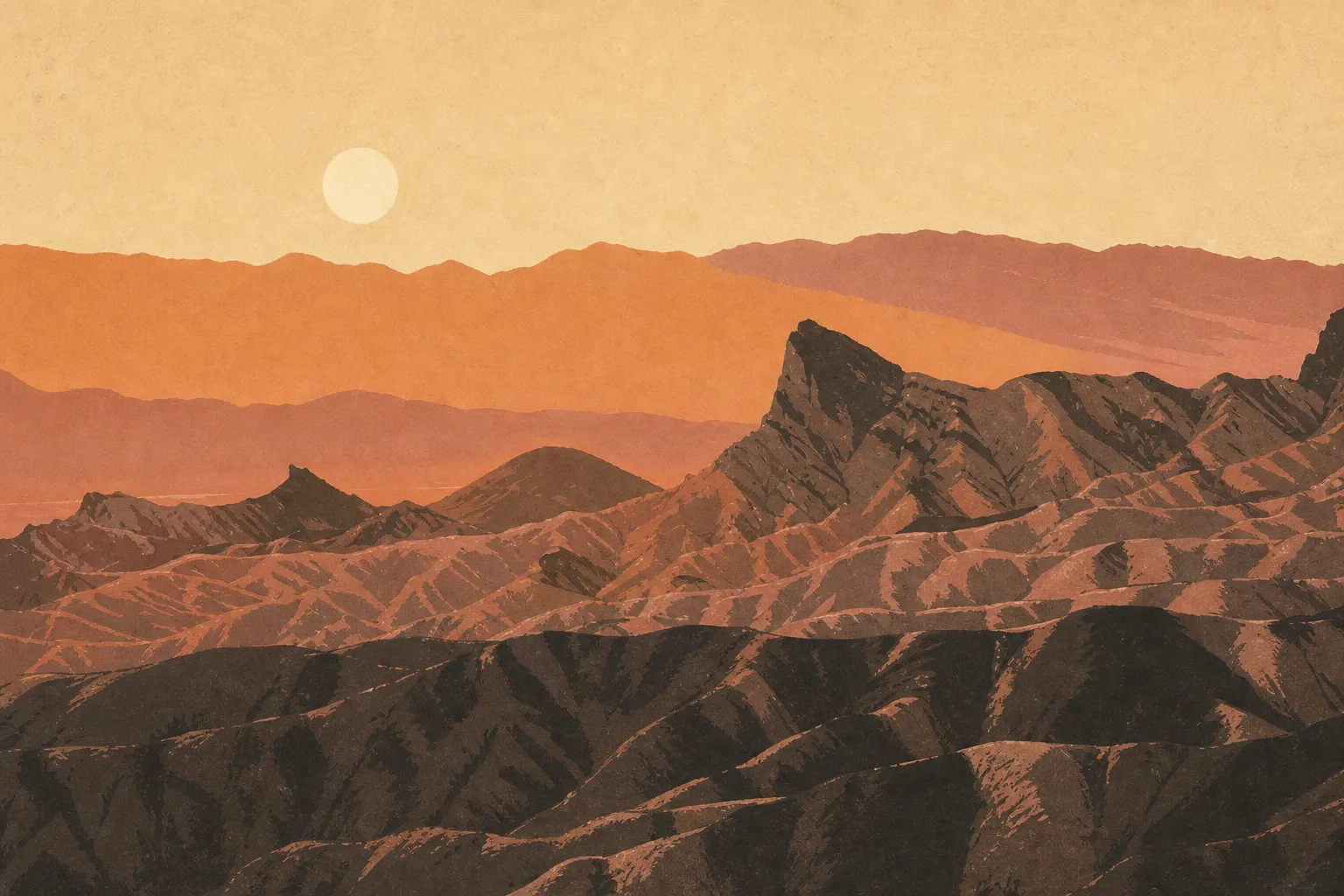
Death Valley National Park: The Complete Visitor Guide
Death Valley is desert taken to its extreme: the lowest point in North America, the place where the hottest air ever measured on Earth was recorded, and yet one of the most photogenic parks in the American West. People come for mineral landscapes unlike anything else: golden dunes, sculpted badlands, and cracked salt flats stretching to the horizon. The good news is that you can see the highlights by car, with short walks along the way. Plan on one or two full days for the must-see sights, and longer if you want to venture into the isolated north. This guide gives you the big picture. Each question has its own detailed guide, linked throughout the page.
Death Valley at a glance: where the park is and how to get there
The park straddles California and Nevada, east of the Sierra Nevada. At more than 5,000 square miles, it's the largest national park in the United States outside Alaska. The main visitor area is concentrated around two tiny but strategic communities: Furnace Creek, in the south-central part of the park, where you'll find the main visitor center, and Stovepipe Wells, a little farther northwest.
Most visitors arrive from Las Vegas, about a two-hour drive along CA-190 via Death Valley Junction. From the California coast, including Los Angeles, plan on four to five hours. The park has several entrances, and here's a useful detail: not every entrance has a traditional fee booth. You pay the entrance fee at automated stations or at the visitor center.
Before you leave, fill up on gas and water outside the park, or at the few stations in Furnace Creek and Stovepipe Wells. Prices are high inside the park. Distances between points of interest often run for dozens of miles, with no stores in between.
Entrance fees, passes, and reservations
Death Valley charges an entrance fee that's valid for seven consecutive days. The park's official fees are:
- Private vehicle, with up to 15 people: $30.
- Motorcycle: $25.
- Pedestrians, bicyclists, and bus passengers: $15 per person.
If your road trip includes several national parks, the $80 America the Beautiful annual pass quickly pays for itself. It covers all federal recreation sites for one year. Death Valley also offers its own annual pass for $55, but it only makes sense if you'll return to the park several times.
Here's something useful to know: you don't need an entrance reservation. Death Valley doesn't use the timed-entry system found at some other parks. You can enter whenever you want. Our Fees and passes page covers entrance fees, passes, and free-entry options, including park fee-free days, the fourth-grade pass, and senior and military passes.
Reservations, permits, and rules to follow
Reservations
Death Valley doesn't require a reservation to enter the park. Lodges and campgrounds with services such as water and electricity, however, fill up quickly between October and April. Book your nights several weeks ahead if you're traveling during the busy season.
Hiking permits
You don't need a permit for day hikes. Backcountry camping outside designated areas requires a free registration at the Furnace Creek visitor center. It's a quick formality, but it's mandatory.
Rules to follow
Speed: Rangers patrol the roads and issue tickets. The speed limits, which range from 45 to 55 mph depending on the road, are hard limits, not suggestions.
Pets: Dogs and cats are allowed on paved roads, in campgrounds, and in parking lots. They're strictly prohibited on all trails. In extreme heat, pavement can burn their paw pads within seconds, so don't take pets outside between 10 a.m. and 6 p.m. except during the cooler months.
Collecting: It's illegal to collect rocks, minerals, plants, or fossils. That includes the famous rocks of Racetrack Playa, which are subject to specific regulations.
Fires: Campfires are allowed only in designated fire rings at developed campgrounds. Ground fires are prohibited everywhere else in the park.
Drones: Flying drones is prohibited in all U.S. national parks unless you have prior authorization from the NPS, or National Park Service.
Trash: Leave No Trace principles apply strictly. Pack out everything you bring in, including organic waste.
Our Hiking guide explains trail-by-trail conditions and any seasonal restrictions.
How to get around Death Valley
You see Death Valley by car, period. There isn't a free shuttle like the one at Zion, so your vehicle is your only way to get around, and the distances are real. CA-190 is the park's main road. It's paved and suitable for all vehicles, connecting Furnace Creek and Stovepipe Wells while passing several major sites.
Three types of roads share the park:
- Paved roads such as CA-190, Badwater Road, and Artists Drive: accessible to any standard rental car.
- Packed-gravel roads such as Mesquite Flat and Ubehebe: passable with caution in a standard vehicle.
- Technical roads such as Racetrack Playa and Titus Canyon: for high-clearance 4WD vehicles with reinforced tires only. A flat on the Racetrack road can make for a very expensive tow.
Rental agreements generally prohibit driving on unpaved roads. Check yours before you leave the pavement. For details on which areas you can reach with your vehicle and current road conditions, consult our guide Getting around Death Valley. The park regularly closes roads after flash floods.
How long do you need to visit Death Valley?
How long do you need to visit Death Valley? One full day is enough to cover the highlights of the southern section if you stay efficient: Zabriskie Point at sunrise, Badwater Basin, Artists Drive, Golden Canyon, and Dantes View. Many people do it as a one-day trip from Las Vegas, and it works.
To slow down and add Mesquite Flat Sand Dunes and Mosaic Canyon, plan on two days with one night in the park. Three days or more lets you explore the wild north, including Ubehebe Crater and Racetrack Playa, along with some real hikes. Our recommendation is two days. That gives you a good balance between covering the essentials and not spending your whole trip behind the wheel. Find our detailed, hour-by-hour itineraries on the Itinerary and length of stay page.
Plan your visit
What to see and do in Death Valley
The park is divided into distinct geographic areas. You can visit them from the most accessible area around Furnace Creek to the most remote, in the north. Here's how to make sense of this vast landscape.
Road trip journal · 3 areas
Furnace Creek and the south: the must-see highlights
This is where most first-time visitors find the highlights, with the most spectacular sites grouped within a manageable radius.
- Badwater Basin: the salt flat 279 feet below sea level, the lowest point in North America. A boardwalk leads to the cracked salt polygons. Walk a few minutes toward the center to get away from the crowds and footprints.
- Zabriskie Point: a viewpoint over rolling badlands, especially striking at sunrise when the low light sculpts the ridges. It's a two-minute walk from the parking lot.
- Dantes View: at more than 5,250 feet, it offers a sweeping view down into the valley. It's often 27 to 36°F cooler than the valley floor, so bring a jacket.
- Artists Drive and Artists Palette: a one-way scenic loop through hills colored green, pink, and purple by oxidized minerals. It's beautiful in the late afternoon.
- Golden Canyon and Devils Golf Course: a walkable golden canyon and a salt field bristling with sharp formations. Don't venture onto it in flip-flops.
The central section around Stovepipe Wells
A 15-minute drive north, the landscape shifts to sand and rock.
- Mesquite Flat Sand Dunes: the park's most accessible dunes, just a short walk from the road. They're beautiful at sunrise and sunset, when the ridges stand out in sharp shadow.
- Mosaic Canyon: a narrow canyon with polished marble walls, explored on a short, fun walk that climbs between boulders.
The north: wild Death Valley
The north is for visitors with time and the right vehicle. Getting there takes effort, but the solitude is the reward.
- Ubehebe Crater: a 590-foot-deep volcanic crater that you can follow on foot along the rim.
- Racetrack Playa: the dry lake where rocks move on their own, leaving tracks in the clay. Wind pushes them across a thin layer of ice. Getting there means taking a long, rough road, and 4WD is required.
One more thing to know: an exceptional desert bloom, known as a “super bloom,” can turn the hills into carpets of yellow flowers. The phenomenon is rare and unpredictable, and depends on well-spaced winter rains. You can't guarantee it or plan around it.
Explore the park
The best hikes in Death Valley
Despite what you may have heard, you can hike in Death Valley, especially from October through April. The easy classics include Golden Canyon, with a flexible loop, Mosaic Canyon, and Natural Bridge. They're all short and technically straightforward. Strong hikers can tackle Telescope Peak, the park's highest point at 11,043 feet. From the summit, you can look across the scorching valley toward snow-covered peaks. That contrast sums up Death Valley on its own.
Here's the golden rule: in summer, never hike on the valley floor during the day. The heat can become deadly within hours. Our Death Valley hiking guide has trail details, distances, elevation gains, and difficulty ratings.
The detailed guide Death Valley Hiking: The Best Trails for Every Ability Death Valley's best hikes by area and difficulty, from Golden Canyon and Mosaic… Read the guide →Wildlife and plants to look for
Despite its name, the valley isn't dead. It shelters coyotes, kit foxes, and Rocky Mountain bighorn sheep in the higher elevations, along with an emblematic species: the Death Valley pupfish, a small fish that survives in salty springs, a remnant of a vanished lake. The desert puts on a display of ephemeral flowers after the rains. Never feed wildlife, especially coyotes that linger near parking lots. Feeding makes them dependent on people and dangerous. Our Wildlife page covers the species and the best places to watch them.
The detailed guide Death Valley Wildlife: What You’ll See and Where to Look Bighorn sheep, coyotes, pupfish, desert tortoises, and more Read the guide →When should you visit Death Valley?
Spring, from March through April, is the best time to visit Death Valley. Days are warm and sunny, skies are clear, and you might see a bloom, though it's never guaranteed. Fall, starting in late October, brings comfortable temperatures and clear skies. It's an excellent, less crowded alternative.
Winter brings mild days, cool nights, and beautiful low-angle light, with occasional snow on the peaks. Summer, on the other hand, arrives early and hits hard. The valley can become oppressive as early as May, and temperatures from June through September regularly reach 113 to 122°F. The world record of 134°F was recorded at Furnace Creek on July 10, 1913. You can visit in summer, but only if you stay in your vehicle and keep hydrated. Our Death Valley month-by-month guide has more detail, and our Death Valley weather tracker includes temperature records.
The detailed guide When to Visit Death Valley: Best Season, Weather, and Crowds Visit Death Valley from mid-October through April for the best conditions Read the guide →Where to stay in Death Valley
Finding a place to stay is Death Valley's real headache. Options are limited and book far in advance. There are three main categories:
- In the park: the Furnace Creek lodges, including a historic upscale property, and the simpler motel at Stovepipe Wells. They're convenient for catching sunrise, but expensive and quick to fill.
- Outside the park: motels in Beatty, Nevada, and Pahrump cost less and are 40 minutes to an hour away by car.
- Camping: several campgrounds managed by the park, some of which open only in winter.
Stay in the park
Around Death Valley: things to do nearby
Death Valley fits perfectly into an American West road trip. To the east, Las Vegas is the ideal base for logistics, two hours away. To the west, the road leads toward the Sierra Nevada and the ghost towns of the Gold Rush. Rhyolite, an abandoned mining town, is worth a stop just before the park's east entrance. Our upcoming Regions and Road Trips guides will place Death Valley in a broader itinerary.
Traveling with kids
The park works well for a family visit if you choose the right season. Avoid the valley with young children in summer, and stick to short sites such as Mesquite Flat Sand Dunes, the Badwater boardwalk, and Zabriskie Point. The visitor center's Junior Ranger program keeps younger kids busy. Our specific advice on pace, heat safety, and family-friendly activities is on the Family page.
Our take: is Death Valley worth the trip?
Yes, without question. Death Valley defies its reputation as an inhospitable furnace with a range of landscapes no other park brings together: the lowest point and one of the desert's highest peaks, otherworldly salt flats, postcard-worthy dunes, and colorful canyons, most of it accessible by car. When we visited in April, the late-day light on Zabriskie's badlands alone made the detour worthwhile. Our one reservation is to avoid summer if you can, and never underestimate the distances or the heat. With good preparation, Death Valley is a memorable stop on any American West road trip.
Frequently asked questions
How long do you need to visit Death Valley?
You need at least one full day to visit Death Valley and cover the southern highlights, including Zabriskie Point, Badwater, Artists Drive, and Dantes View. Two days with one night in the park offer the right balance. Three days or more let you reach the remote north.
How much is the entrance fee for Death Valley?
The Death Valley entrance fee is $30 per private vehicle and is valid for seven days. It's $25 for motorcycles and $15 per pedestrian or bicyclist. The $80 America the Beautiful annual interagency pass pays for itself after three national parks.
When is the best time to visit Death Valley?
Spring, from March through April, is the best time to visit Death Valley, with warm, sunny days and a chance of seeing a bloom. Fall, from late October through December, is an excellent, less crowded alternative. Avoid summer, when temperatures often climb above 113°F.
Is Death Valley a must-see?
Yes. Death Valley is a must-see in the American West because of its unique landscapes: the lowest point in North America, dunes, salt flats, and colorful canyons, most of them accessible by car. Visit outside the summer heat and prepare well, and it will stay with you long after your road trip ends.
The American Parks shop
Bring Death Valley home
Our park-inspired creations, made to order and shipped to your door.
Latest park news
- Death Valley Extreme Heat Warning: October 4 to 9, 2026An Extreme Heat Warning covers the low-lying areas of Death Valley through October 9: up to 110°F by day, 85°F at night. Here's how to plan.
- Death Valley closes Titus Canyon Road on October 2, with reopening expected in May 2027The road stays closed for repairs until May 2027 while crews fix flood damage and secure the rockfall-prone Red Pass area.
- Death Valley: Saline Valley Warm Springs Campground Partially Reopens After FireA portion of Saline Valley Warm Springs Campground reopened September 17, 2026, but the burned Lower Springs area stays closed to the public.