Kobuk Valley National Park: The Complete Visitor Guide
Kobuk Valley is one of the least-visited national parks in the United States, and that's no accident. It's north of the Arctic Circle in Alaska, with no road leading in. People come for two unforgettable sights: sand dunes in the Arctic and a huge caribou herd crossing the Kobuk River. Plan on an expedition of at least three to five days from Kotzebue, traveling by small plane and carrying everything you'll need. This isn't a Sunday outing. It's a real trip.
Let's be clear from the start: Kobuk Valley has no marked trails, developed campgrounds, or gift shop. This is true wilderness. Here's where it is, how to reach it, what to see, how much time to allow, and a link to a detailed guide for each topic.
Kobuk Valley at a Glance: Where the Park Is and How to Get There
Kobuk Valley covers about 2,700 square miles in northwestern Alaska, straddling the Arctic Circle. The park protects the middle Kobuk River valley, tucked between two mountain ranges, the Baird Mountains to the north and the Waring Mountains to the south. The landscape is a mix of tundra, scattered boreal forest, and dunes.
No road reaches the park. Everything starts with a flight. Most visitors depart from Kotzebue, a coastal town with regular flights from Anchorage. Bettles is another gateway, reached from Fairbanks. From Kotzebue or Bettles, you charter an air taxi, a floatplane or ski plane, that drops you directly in the park, usually on a gravel bar beside the river or on a lake.
The park's visitor center, the Northwest Arctic Heritage Center, is in Kotzebue rather than inside the park. This is where you get the weather forecast, safety advice, and latest updates before takeoff. The park itself is open 24 hours a day, every day of the year. There's no one to close a gate that doesn't exist.
Entrance Fees, Passes, and Reservations
The good news for your entrance budget is that Kobuk Valley charges no entrance fee. The park is free, with no ticket or timed entry reservation. You don't need an America the Beautiful pass to enter, because there isn't an entrance gate.
The real cost isn't the entrance ticket. It's the logistics. The air taxi from Kotzebue is the biggest expense, followed by your commercial flight to Kotzebue, lodging in town before and after the trip, and expedition gear rental. Some activities, such as fishing, may require a permit issued by the State of Alaska. We cover these costs in our National Park Entrance Fees & Passes page, which explains entrance fees and passes, and our Passport & Stamps page covers the stamping formalities. Kobuk Valley is, yes, one of the hardest park stamps for collectors to get.
Reservations, Permits, and Rules to Follow
You don't need a reservation to enter the park. Kobuk Valley is open 24 hours a day, 7 days a week, year-round.
Advance check-in. It's not required, but checking in with the rangers at the Northwest Arctic Heritage Center before you leave is strongly recommended. If you're delayed or have an emergency in the park, this lets rescuers start a search much faster.
Fishing permit. Sport fishing is allowed in the park if you have a valid Alaska license, available through the Alaska Department of Fish & Game. Rules cover species, areas, and seasons, so check the current requirements before you go.
Campfires. Campfires are allowed away from fragile vegetation, subject to the usual fire-safety conditions. Use a camp stove when possible to reduce your impact on the tundra.
Waste. Leave No Trace principles apply in full. There are no trash cans or toilets in the park. You must carry a human-waste system, such as a WAG bag or equivalent. Pack out everything you bring in.
Archaeological sites. Onion Portage has been home to human communities for more than 12,000 years and is one of Alaska's oldest archaeological sites. Never collect artifacts, dig in the ground, or damage these places in any way.
How to Get Around Kobuk Valley
Once you've landed in the park, forget the car, the shuttle, and even the trail. There are two ways to travel through Kobuk Valley: on foot, cross-country, and on the water.
The Kobuk River is the park's natural highway. Most visitors run a section of the river by packraft, canoe, or inflatable kayak, getting dropped off upstream and picked up downstream. The current is gentle through the park, making it manageable for cautious, self-reliant paddlers. It's also the most logical way to connect the dunes along the south bank.
Hiking here means traveling without marked trails. You move across tundra, gravel bars, and sand, navigating with a compass or GPS. You need to know how to read the terrain, manage stream crossings, and stay self-sufficient. Our Getting Around page breaks down the travel options and aircraft drop-off choices.
How Long Do You Need to Visit Kobuk Valley?
Allow at least three days in the field, and more realistically five to seven days with weather delays built in. The challenge isn't the park's size. It's the flight. Low clouds in Kotzebue can keep your plane on the ground for a day or two, both on the way in and on the way out. Travelers on a tight schedule can get stranded; smart planning means leaving two extra days in your itinerary.
If you're only aiming to see the Great Kobuk Sand Dunes on a round trip from Kotzebue, a long day trip by air may be enough when the weather cooperates. To experience the park, though, plan on a full week, including transportation. That gives you time to run part of the river, camp on the dunes, and watch for caribou. Our Itinerary & Trip Length page offers sample stays for different experience levels and budgets.
Plan your visit
What to See and Do in Kobuk Valley
The park doesn't have developed "areas" in the usual sense. Its highlights stretch along the Kobuk River and its tributaries. Here's how we break them down.
Road trip journal · 3 areas
The Great Kobuk Sand Dunes
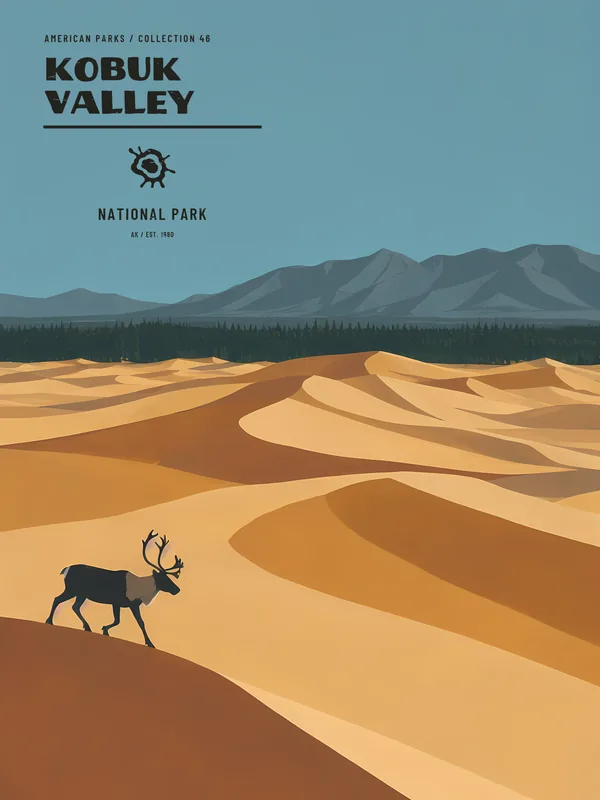
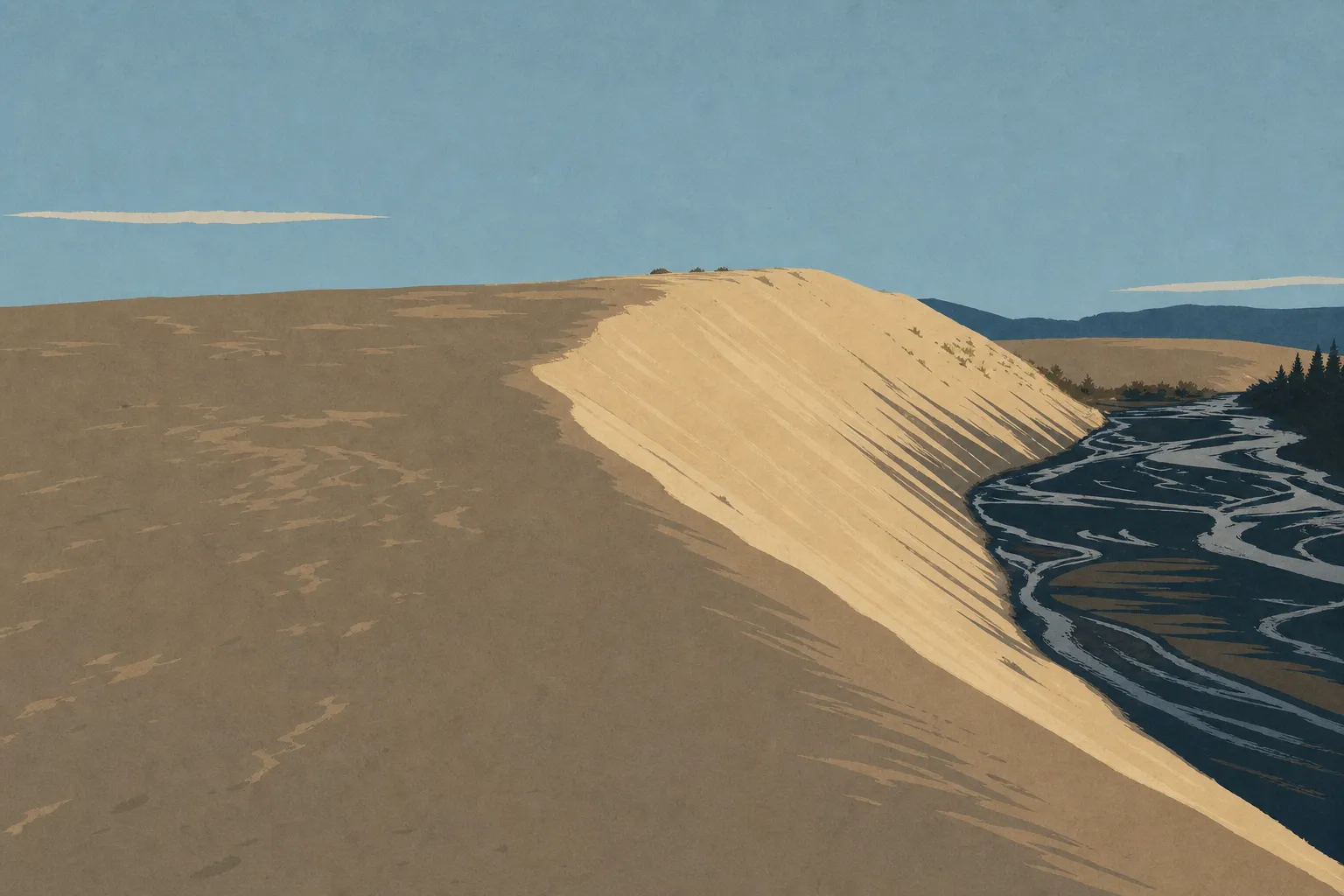
This is the park's signature sight: about 25 square miles of active sand dunes south of the river, at the edge of the boreal forest. The dunes are a remnant of the ice ages, shaped by wind over thousands of years. The contrast is striking. You can walk barefoot on sand that may top 86 °F in midsummer, with tundra and Arctic mountains in the background. Two smaller dune fields, the Little Kobuk Sand Dunes and the Hunt River Dunes, round out the area. You usually land on a river gravel bar, then take a short walk to the base of the dunes.
The Kobuk River and Its Waters
The Kobuk shapes the entire park. You travel it by water, fish it, and camp on its gravel bars. Its tributaries, including the Salmon River, a designated wild river, offer clear water and a run known among experienced paddlers. The river is the backbone of most expeditions.
Onion Portage and Inupiaq Heritage
In the eastern part of the park, Onion Portage is one of the Arctic's most important archaeological sites, with evidence of human occupation spanning nearly 9,000 years. People chose this crossing for a very practical reason: this is where caribou cross the river during their migration. The Inupiaq people still hunt here today, exercising recognized subsistence rights. You don't visit Onion Portage like a museum. You come to understand that nature and culture are inseparable here.
Our What to Do page covers each activity in detail, from fishing and packrafting to photography and wildlife watching.
Explore the park
The Best Hikes in Kobuk Valley
This bears repeating because it changes everything: Kobuk Valley has no marked trails. Hiking here means going completely cross-country over tundra, sand, and river gravel bars. The most common routes connect an aircraft drop-off point with the Great Kobuk Sand Dunes or follow a stretch of riverbank. Progress is slow, navigation is constant, and every stream crossing takes preparation.
This level of commitment calls for real Arctic backcountry experience or a guide. Our Hiking page lists realistic routes, distances, and terrain hazards. Read it before you make any plans.
The detailed guide Hiking in Kobuk Valley: the Best Routes for Every Skill Level Kobuk Valley has no roads or marked trails Read the guide →Wildlife and Plants to See
Caribou are the stars here. The Western Arctic Caribou Herd, one of the largest caribou herds in North America, crosses the valley twice a year, heading north in spring and south in fall. The fall crossing near Onion Portage is the park's major wildlife spectacle. Lines of animals cross the river, sometimes by the thousands. Timing changes every year with the weather and ground conditions.
They share the Arctic with brown and black bears, wolves, foxes, moose in wooded areas, and abundant migratory birds in summer. The rivers hold Arctic char and pike, both popular with anglers. As for plants, the tundra bursts into color late in summer with blueberries, lichens, and dwarf birches. Our Wildlife page details the species, viewing seasons, and the rules for keeping a safe distance from bears.
The detailed guide Kobuk Valley Wildlife: Animals to See and Where to Find Them Caribou migrations, grizzlies, wolves, moose, and more Read the guide →When to Visit Kobuk Valley
The useful season is short. The Arctic summer, from mid-June to mid-September, accounts for most visits, with endless daylight, navigable rivers, and exposed ground. Still, snow, rain, and freezing temperatures can arrive at any time of year. Always pack good rain protection and warm layers, and take staying dry seriously. Hypothermia is a risk on a wet, windy day even when it doesn't feel especially cold.
Late summer offers a double bonus: the fall caribou migration and the first nights dark enough to see the northern lights. Our When to Go page has month-by-month details, while the Weather page covers temperature and precipitation data.
The detailed guide When to Visit Kobuk Valley: Best Time, Weather, and Seasons The best time to visit Kobuk Valley is mid-June through late August Read the guide →Where to Stay in Kobuk Valley (Hotels and Campgrounds)
Inside the park, lodging means one thing: your tent. There are no developed campgrounds, shelters, or lodges within the park boundaries. You camp completely self-sufficiently, following Leave No Trace practices and protecting your food from bears.
Hotel logistics happen in Kotzebue, where you'll spend a night or two before and after the expedition while you wait for the aviation weather to cooperate. Options are limited and fill up early. We compare town lodging with camping in the park in our Where to Stay guide, Hotels & Lodges page, and Camping page. Travelers touring elsewhere in Alaska by RV can find the vehicle-based information in our RV Camping page, but no vehicle reaches the park itself.
Stay in the park
Around Kobuk Valley: Things to Do Nearby
Kobuk Valley is rarely a destination on its own. It's part of a group of parks and preserves in the Arctic northwest, all managed from the same visitor center in Kotzebue. Many travelers combine it with other remote Alaska gems on one big trip, since flying is the common thread anyway.
Kotzebue itself deserves a stop. It's a living Inupiaq community and a chance to understand the culture that has inhabited this region for thousands of years. To build a coherent statewide itinerary, keep an eye out for our upcoming Regions pages on the Arctic Alaska region as a whole and Road Trips, the major loops connecting several parks.
Our Take: Is Kobuk Valley Worth the Trip?
Let's be honest. Kobuk Valley isn't a park you simply check off between two other stops. It demands time, a substantial flight budget, real self-reliance, and a willingness to deal with unpredictable weather. If you're looking for easy-to-reach views and a visitor center next to the parking lot, this isn't the place for you.
But if the thought of walking across sand dunes north of the Arctic Circle, running a river with no one else around, and watching caribou cross gets you excited, then yes, Kobuk Valley is worth every bit of effort. It's one of the last places where you can experience nature in its raw form, without a filter. For people who love solitude and real adventure, it's the pinnacle. For everyone else, it's a dream to admire from afar. Our Practical Information, Rules & Safety page will help you decide where you stand.
Frequently Asked Questions
How Do You Visit Kobuk Valley National Park?
To visit Kobuk Valley National Park, first fly to Kotzebue from Anchorage, then charter an air taxi to drop you along the Kobuk River. No road reaches the park. Once there, you travel cross-country on foot and on the water, completely self-sufficient. Plan an expedition of at least three to five days and bring Arctic backcountry gear.
How Much Does a Visit to Kobuk Valley National Park Cost?
A visit to Kobuk Valley National Park costs nothing at the entrance. The park is free, with no ticket or pass. The real budget goes toward logistics, especially the air taxi from Kotzebue, commercial flights, lodging in town, and gear. For entrance fees and annual passes, see the National Park Entrance Fees & Passes page.
How Long Does It Take to Visit Kobuk Valley?
Allow at least three days in the field, and ideally five to seven days including transportation. The extra time is mainly for weather. Low clouds can delay your flight in either direction. When conditions are right, one day by air may be enough to see just the dunes.
What Are the Best Landscapes in Kobuk Valley?
Kobuk Valley's best landscapes include the Great Kobuk Sand Dunes, about 25 square miles of active dunes in the Arctic; the Kobuk River and its gravel bars; and the tundra ablaze with color in late summer. In fall, caribou crossing near Onion Portage adds a living spectacle to the scenery.
Is Kobuk Valley Worth It?
Kobuk Valley is worth it if you're looking for a genuine wilderness adventure far from tourist facilities. The park takes time, a flight budget, and self-reliance, but in return it offers Arctic dunes, a solitary river, and the caribou migration. If you're short on time or inexperienced, choose a more accessible park instead.
The American Parks shop
Bring Kobuk Valley home
Our park-inspired creations, made to order and shipped to your door.