
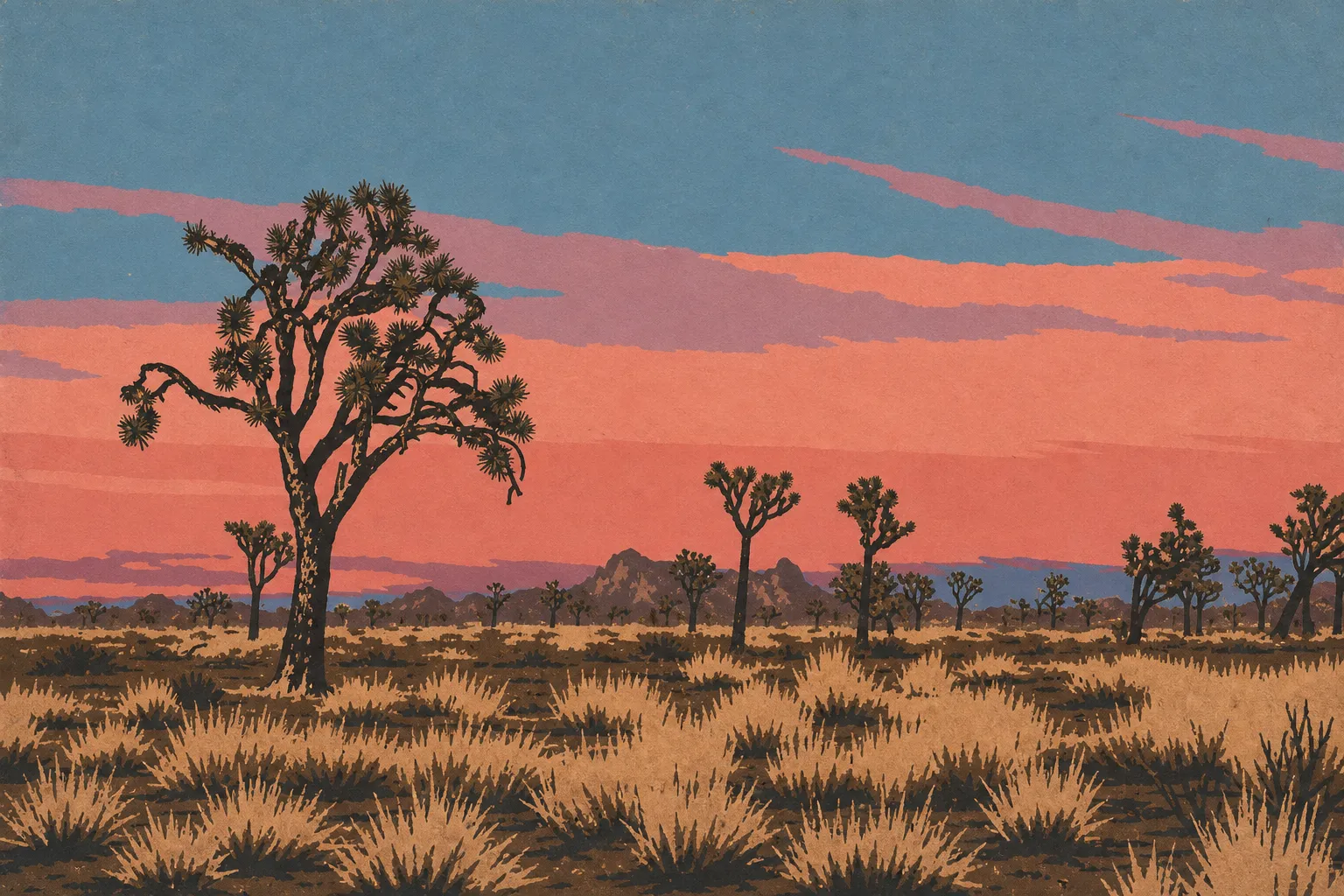
Joshua Tree National Park: The Complete Visitor Guide
Joshua Tree is the California desert just as you imagine it: twisted trees reaching their arms toward the sky, granite boulders stacked by a distracted giant, and a silence that does you good. The park is about a two-and-a-half-hour drive east of Los Angeles, on the doorstep of Palm Springs. People come to walk a little, climb among the rocks, watch the sunset from Keys View, and sleep beneath some of the darkest, starriest skies in the American Southwest. For a first visit, plan on a full day. Two days gives you breathing room. This guide gives you the big picture and points you, area by area, to the detailed guides.
Something that surprises many visitors is that Joshua Tree straddles two deserts. The Mojave Desert lies to the west. It's higher and cooler, and it's home to the famous Joshua trees, which are actually yuccas, not trees. To the east, the lower, hotter Colorado Desert is where you'll find chollas and ocotillos. This invisible boundary explains why the landscape changes so much depending on where you enter.
Joshua Tree at a Glance: Where the Park Is and How to Get There
The park occupies southern California, between Coachella Valley to the south and the high-desert towns of Yucca Valley, Joshua Tree, and Twentynine Palms to the north. You can reach all the entrances from I-10.
There are three main entrances:
- West Entrance, near the town of Joshua Tree. It's the busiest and closest to the headline sights in the northwest. Expect a line on weekends during peak season.
- North Entrance, in Twentynine Palms, is convenient if you're staying on that side.
- South Entrance, at Cottonwood, is the gateway to the Colorado Desert and Cholla Cactus Garden.
From I-10, take Exit 117 to California Highway 62 toward Yucca Valley and Twentynine Palms. It serves the west and north entrances, as well as Black Rock and Indian Cove. To arrive through the south entrance, take I-10 Exit 168. There is no public transportation to the park, so a car is essential. Our Joshua Tree access guide covers each approach route, along with distances and drive times.
The park is open 24 hours a day, 7 days a week, year-round. Some areas are reserved for day use only. Visitor centers have their own hours.
Entrance Fees, Passes, and Reservations
Joshua Tree charges an entrance fee. The ticket is valid for 7 consecutive days and covers the entire park.
- Private vehicle: $30 (the fee covers everyone in the car).
- Motorcycle: $25.
- Pedestrian or cyclist: $15 per person.
- Annual park pass: $55, which pays for itself on your second visit of the year.
If your trip includes other national parks, the America the Beautiful pass, valid for one year at all national parks, is almost always the better deal. Unlike some heavily visited parks, Joshua Tree doesn't require a timed entry reservation. You simply show up, pay, and enter. Our National Park Fees & Passes page explains entrance fees, pass categories, and free-entry situations. And if you collect stamps, note that the visitor center plays along. See our Passport & Stamps page.
Reservations, Permits, and Rules to Follow
Entry reservations: You don't need a timed entry reservation to enter the park (as of 2026). You can arrive at any entrance at any time.
Campgrounds: Most campsites can be reserved through Recreation.gov. During the spring season, from March through April, sites often fill up months in advance. A few first-come, first-served sites are available, but don't count on one during a spring weekend or a spectacular wildflower bloom. Our Joshua Tree Camping guide breaks down capacity, amenities, and reservation windows campground by campground.
Hiking and climbing: You don't need a permit for trails or climbing. Overnight stays outside designated campgrounds, however, require a backcountry permit, which is free and available at the registers provided at the entrances to wilderness areas. Some walls close seasonally to protect nesting wildlife, especially hawks and other raptors. Check with rangers about closures before you take out your ropes.
Essential rules:
- Stay on the trails in areas with cryptobiotic soil, a black or grayish-brown crust that looks like cracked dirt. This living soil, made up of lichens, mosses, and cyanobacteria, takes decades to recover from a single footprint.
- Don't collect plants, animals, rocks, or artifacts, not even a pebble.
- Campfires are allowed only in the metal rings at campgrounds. They're prohibited outside campgrounds, regardless of the season.
- Pets are allowed only on roads, in parking areas, and at campgrounds. They're not allowed on trails.
- Pack out everything you bring in. Trash cans are rare in remote areas.
Getting Around Joshua Tree
You explore Joshua Tree by car, linking stops along the scenic road that crosses the park from northwest to south. There is no shuttle here, so you can set your own pace, which is a real pleasure.
The main road connects the west entrance with the south entrance in one continuous crossing, with turnoffs to overlooks and trailheads. Fill up before you enter. There are no gas stations in the park, and distances between areas run into the tens of miles. The same goes for water, which we'll come back to below. Paved roads reach the main sights. A few unpaved roads, including Geology Tour Road and Covington Flats, require a high-clearance vehicle and sometimes four-wheel drive. Our guide to getting around Joshua Tree explains which roads are accessible to which types of vehicles.
How Long Do You Need to Visit Joshua Tree?
One day is enough to get a feel for the park: cross from west to south, stop at Hidden Valley, drive up to Keys View, take a short hike, and continue to Cholla Cactus Garden. It's a packed day, but doable.
With two days, you'll have room to breathe: one day for the northwest, with its rocks, overlooks, and hikes, and one for the Colorado Desert, plus a sunrise or sunset without rushing. Stay longer and the park rewards climbers, hikers, and anyone who wants to take their time beneath the stars. To build an hour-by-hour plan based on the number of days you have, head to our Itinerary & Length-of-Stay guide.
Plan your visit
What to See and Do in Joshua Tree
The heart of the park naturally breaks into three geographic areas. Here are the highlights of each one. Every site and hike has its own detailed guide, which you can follow through the links.
Road trip journal · 3 areas
The Northwest: Rocks, Overlooks, and Joshua Trees
This is the most spectacular and most visited part of the park, the postcard section. Hidden Valley is an easy loop of about 1 mile that winds between enormous granite boulders. It's perfect for a first warm-up and for understanding why climbers love the area. Barker Dam leads to a small historic reservoir and, if you're lucky, petroglyphs and a few animals stopping for a drink. Keys View, perched above 4,900 feet, looks down over Coachella Valley and the San Andreas Fault. On a clear day, you can see the Salton Sea in the distance. It's the park's go-to sunset spot. More athletic hikers climb Ryan Mountain, an approximately 3-mile loop with a steep, steady ascent, for a 360-degree panorama of the rock-studded valleys.
The North: Skull Rock and a Kingdom of Boulders
Around Jumbo Rocks, the landscape becomes a giant mineral playground. Skull Rock, a rock eroded into the shape of a skull, sits beside the road. It's a quick stop, and a photo is practically guaranteed. Short trails wind through the formations all around it, and they're easy to combine with a stay at Jumbo Rocks Campground.
The East: The Colorado Desert and Chollas
As you descend toward the south entrance, the elevation drops and the scenery changes. Joshua trees disappear, replaced by Cholla Cactus Garden, a concentration of teddy-bear cholla that seem to glow in backlight late in the day. Don't brush against them. Their spines are fierce. Farther south, Cottonwood Oasis and its palms announce another side of the desert. This is also where you'll find the longest and most solitary hikes.
For a complete overview of activities, including climbing, stargazing, photo walks, and secondary points of interest, explore our Joshua Tree activities guide.
Explore the park
Joshua Tree's Best Hikes
Walking is the best way to get a feel for the park, and there are options for every ability level. Short, easy loops such as Hidden Valley, Barker Dam, and the Cholla Cactus Garden walk work for everyone, including families. Intermediate hikes such as Ryan Mountain climb quickly and reward the effort with a view. Longer hikes toward Lost Palms Oasis or into the Colorado Desert require real preparation, plenty of water, and an early start.
Exact distances, elevation gains, hiking times, and difficulty levels are detailed trail by trail in our Joshua Tree hiking guide.
The detailed guide Joshua Tree Hiking: Best Trails by Difficulty and Access The best Joshua Tree trails by area and difficulty, with practical trail… Read the guide →Wildlife and Plants to Look For
The Joshua tree is the star, but it isn't alone. The park is home to remarkable desert vegetation: cholla, ocotillo, yuccas, barrel cacti, and spectacular spring blooms when winter rains have been generous.
Wildlife watching takes patience and cooler hours. Jackrabbits, antelope squirrels, and lizards are the most visible during the day. At dawn and dusk, you may spot coyotes, bighorn sheep in the higher elevations, and a wide variety of birds around water sources such as Barker Dam. Snakes, including rattlesnakes, and scorpions are part of the landscape. Respect them, watch where you place your hands and feet, and you'll be fine. Our Joshua Tree wildlife guide covers the species and the best places to see them.
The detailed guide Joshua Tree Wildlife: Animals to See and Where to Find Them Desert tortoises, coyotes, rattlesnakes, bighorn sheep, and more Read the guide →When to Visit Joshua Tree
The climate sets the schedule. Spring and fall are the most pleasant seasons, with days around 84°F, nights near 50°F, and very dry air, often below 25% humidity. Spring also brings desert wildflowers, which makes it the busiest season.
Winter is cool and bright, with daytime temperatures around 59°F, nights dropping below 32°F, and occasional snow at higher elevations. Summer is brutal, with daytime highs above 100°F and nighttime temperatures rarely falling below 75°F. Avoid hiking during the hottest hours. To choose the right month based on your priorities, such as flowers, cooler weather, or crowds, see our When to Visit page. For detailed monthly averages, see our Weather page.
The detailed guide When to Visit Joshua Tree: Best Seasons, Weather, and Timing The best time to visit Joshua Tree is March-April for wildflowers or… Read the guide →Where to Stay in Joshua Tree
There are no hotels inside the park. You can stay in the nearby towns or at one of the park's campgrounds. Joshua Tree, Twentynine Palms, and Yucca Valley have motels, desert-style vacation rentals, and a few distinctive places to stay. Palm Springs, farther south, offers a wider and more upscale selection, about 30 minutes from the south entrance.
Inside the park, several campgrounds, including Jumbo Rocks Campground, Hidden Valley Campground, Belle Campground, and White Tank Campground, let you sleep among the rocks, which makes all the difference for stargazing. Keep in mind that most have no water or electricity, and they fill quickly during peak season. Our Where to Stay guide compares all the options, including towns, atmosphere, and budget, with dedicated pages for Hotels & Lodges, Camping, and RV Travel.
Stay in the park
Around Joshua Tree: Things to Do Nearby
The park opens onto a region with plenty of personality. Pioneertown, a former Western movie set that has become a living town, is worth the detour for its legendary saloon and live music. Palm Springs and Coachella Valley offer a completely different experience, with an aerial tramway, modernist architecture, spas, and golf courses. Fans of unusual art will find open-air desert installations around Yucca Valley. Many travelers include Joshua Tree in a larger California road trip through the desert, along the coast, and through the major cities of the American West.
Our Take: Is Joshua Tree Worth the Trip?
Yes, without a doubt, as long as you know what you're coming for. Joshua Tree has neither geysers nor a giant waterfall. Its beauty is subtler, made up of light, rocks, and wide-open silent spaces. When we visited, the park really won us over at dusk, when the granite boulders turned orange and the sky lit up with stars. For a couple, a family, or a photographer looking for a one-of-a-kind setting close to California's beach towns, it's a stop we recommend without hesitation. We temper that enthusiasm in midsummer, when the heat sharply limits what you can do.
One last word about safety, because it makes all the difference in a desert. Bring at least 4 liters of water per person per day. There are almost no water sources in the park. Cell service is nearly nonexistent, so tell someone your itinerary. Don't rely on GPS alone. Bring a paper map. Fill up on gas before you enter. Protect yourself from the sun with a hat, sunscreen, and covering clothing, and save your hikes for the cooler hours. Watch where you put your hands and feet because of snakes.
Frequently Asked Questions
Is Joshua Tree Worth Visiting?
Joshua Tree is worth visiting if you enjoy desert landscapes, granite boulders, climbing, easy hiking, and starry skies. It's a park with a distinctive atmosphere, more contemplative than spectacular, and an ideal addition to a stay in Los Angeles or Palm Springs. In midsummer, the heat greatly limits its appeal.
How Long Does It Take to Visit Joshua Tree National Park?
Plan on a full day to see the essentials of Joshua Tree: the drive from the west entrance to the south entrance, a few overlooks, and a short hike. Two days offer a more comfortable pace and let you enjoy a sunset and a starry night without rushing.
Does Joshua Tree National Park Charge an Entrance Fee?
Joshua Tree National Park charges $30 per vehicle, $25 per motorcycle, or $15 per person entering on foot or by bicycle. The ticket is valid for 7 days. An annual park pass costs $55, and the America the Beautiful pass is a good deal if you're visiting several parks.
When Should You Visit Joshua Tree?
The best time to visit Joshua Tree is spring or fall, when temperatures are mild, around 84°F during the day, and crowds are manageable. Spring also brings desert wildflowers. Winter is cool and bright, but summer, with temperatures above 100°F, is not recommended for hiking.
The American Parks shop
Bring Joshua Tree home
Our park-inspired creations, made to order and shipped to your door.
Latest park news
- Joshua Tree: Two Wildlife Crossings Planned Along State Route 62Two wildlife crossings are being studied along State Route 62 near Joshua Tree, and while nothing changes for your visit, the project says a lot.