
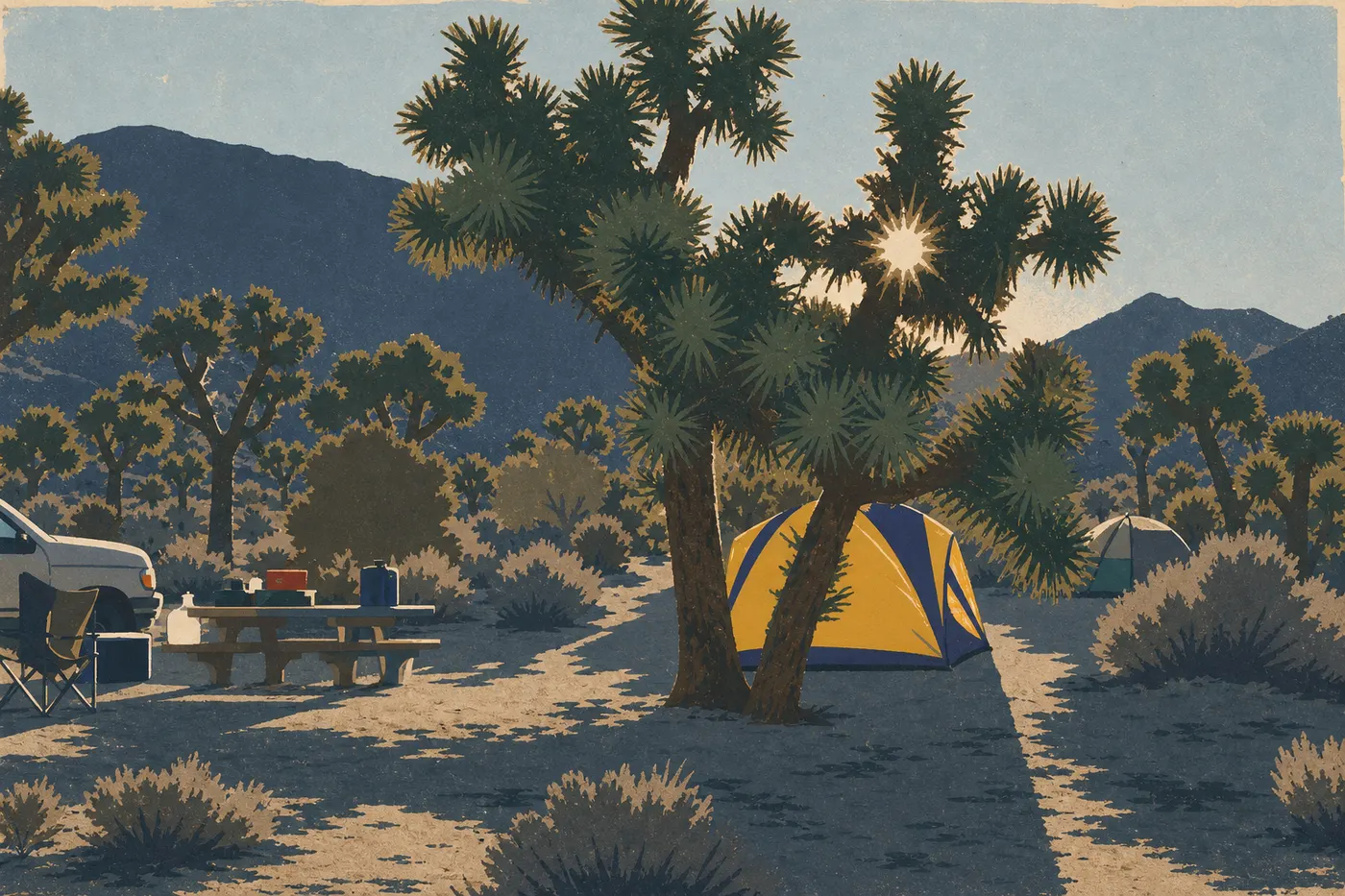
Camping in Joshua Tree: Which Campground to Choose, Reservations, and Fees
In a nutshell: Nine official campgrounds are spread throughout the park, with 501 sites in all. Six can be reserved on recreation.gov up to 6 months ahead; the other three are first come, first served. Reservations are essential from February through May and in October and November. Camping outside a designated site is prohibited. Backcountry camping is allowed with free registration.
Campgrounds in the park (9)
- Campground Cottonwood Campground recreation.gov · 62 sites Directions ↗
- Campground White Tank Campground first come, first served · 15 sites Directions ↗
- Campground Ryan Campground recreation.gov · 32 sites Directions ↗
- Campground Hidden Valley Campground first come, first served · 44 sites Directions ↗
- Campground Indian Cove Campground recreation.gov · 101 sites Directions ↗
- Campground Black Rock Campground recreation.gov · 99 sites Directions ↗
- Campground Belle Campground first come, first served · 18 sites Directions ↗
- Campground Sheep Pass Group Campground recreation.gov · 6 sites Directions ↗
- Campground Jumbo Rocks Campground recreation.gov · 124 sites Directions ↗
 Base map © OpenStreetMap · © CARTO
 Joshua Tree campgrounds by the numbers
9 official campgrounds inside the park, 501 campsites in total, 423 of them reservable.
| Campground | Sites | Booking | Fee / night | Open | Amenities |
|---|---|---|---|---|---|
| Jumbo Rocks Campground | 124 | Reservation | from $15 | Year round | toilets |
| Indian Cove Campground | 101 (13 group) | Reservation | from $17.50 | Closed Jun 1 to Aug 28 | toilets |
| Black Rock Campground | 99 | Reservation | from $17.50 | Closed Jun 1 to Aug 28 | toilets, potable water, dump station, cell service |
| Cottonwood Campground | 62 (3 group) | Reservation | from $17.50 | Closed Jun 1 to Aug 28 | toilets, potable water, dump station |
| Hidden Valley Campground | 44 | First come, first served | from $12.50 | Year round | toilets |
| Ryan Campground | 32 | Reservation | from $15 | Year round | toilets |
| Belle Campground | 18 | First come, first served | from $12.50 | Closed Jun 1 to Aug 28 | toilets |
| White Tank Campground | 15 | First come, first served | from $12.50 | Closed Jun 1 to Aug 28 | toilets |
| Sheep Pass Group Campground | 6 (6 tent only, 6 group) | Reservation | from $27.50 | Year round | toilets |
Source: National Park Service (NPS API), retrieved October 6, 2026. Fees and dates change: check the campground page before you go.
Can you camp inside Joshua Tree?
Yes, and the options cover the entire park. From the northern section to the southern section, NPS campgrounds put you close to the action, whichever way you approach the park. You must camp in a designated site. Pitching a tent outside a designated site, or outside a designated backcountry zone, violates NPS regulations.
Campgrounds in the park
Nine campgrounds cover the park, from the northern section (the North Entrance near 29 Palms and the West Entrance near Yucca Valley) to the southern section (the South Entrance at Cottonwood). The largest has 124 sites; the smallest has 6 group sites. The table above gives the full site-by-site details. Here are the key points to help you choose.
Jumbo Rocks
124 sites sit among the rock formations that made Joshua Tree famous. It's the largest campground in the park and one of the most popular for its exceptional night sky. Reservations are available on recreation.gov at $15 per night. Vault toilets; no water on site.
Hidden Valley
44 sites at the foot of Hidden Valley's rocks, a favorite area for climbers. Direct access to the main trails and climbing routes. First come, first served, at $12 per night. RVs limited to 24 feet. No water.
Ryan
32 quiet sites at slightly higher elevation, where nights are cooler than on the valley floor. A good starting point for Ryan Mountain. Open year-round, with reservations available on recreation.gov at $15 per night.
Belle
18 sites in the eastern part of the park, next to White Tank. Peaceful atmosphere outside weekends. First come, first served, at $12 per night. Closed in summer, from June through late August; see the table for exact dates.
White Tank
Only 15 sites. The White Tank Wash loop starts at the campground. First come, first served, at $12 per night. RVs limited to 24 feet. Closed in summer, from June through late August; see the table for exact dates.
Indian Cove
101 sites accessible through a separate entrance from CA-62, without driving through the rest of the park. Very popular with climbers from the region. All sites are reservable on recreation.gov at $18 per night. Partially closed in summer, from June through late August; see the table for exact dates.
Black Rock
99 sites in the northwest section, with potable water, restrooms, a dump station, and internet access. It's the best-equipped campground in the park. Reservations are available on recreation.gov at $18 per night. Partially closed in summer, from June through late August; see the table for exact dates.
Cottonwood
62 sites at the South Entrance, accessed from I-10 via Exit 168. Potable water and a dump station. A starting point for hikes to the palm oases. Reservations are available on recreation.gov at $18 per night. Partially closed in summer, from June through late August; see the table for exact dates.
Sheep Pass
Reserved for groups, with 6 group sites. Reservations are available on recreation.gov at $28 per night.
RV vs. tent: which site should you choose?
Nearly all of Joshua Tree's campgrounds accommodate tents and RVs, but individual sites don't have electrical hookups or running water. Black Rock is the best-equipped campground in the park, with potable water, a dump station, and internet access. Cottonwood also has potable water and a dump station. For a self-contained RV with full tanks and solar panels, every campground works. If you need a dump station, Black Rock and Cottonwood are the only options in the park.
As for vehicle length, Hidden Valley and White Tank are limited to 24 feet; the other campgrounds accept vehicles up to 35 feet. For access roads, recommended maximum lengths, and private alternatives outside the park, the Joshua Tree RV camping guide covers all the options.
Camping nearby: private campgrounds outside the park
When the park is full, which is common in March and April and on October weekends, several private campgrounds are available in Yucca Valley, 29 Palms, and the town of Joshua Tree. Scout out these alternatives ahead of time if you're arriving without a reservation. For lodging with a roof, including motels, lodges, and rentals, the guide to places to stay around Joshua Tree lists the options within a reasonable distance.
Dispersed and backcountry camping
The park allows backcountry camping in designated zones, as long as you register for free at the “Backcountry Board” signs located at the trailheads concerned. Three basic rules apply: camp at least 1 mile from any paved road, stay at least 200 feet from any water source, and leave no trace. No paid permit is required, but registration is mandatory.
This option suits hikers who are comfortable navigating in the desert and carefully calculating their water supply. Routes suitable for overnight backcountry trips are detailed in the Joshua Tree hiking guide.
How and when to reserve a campsite in Joshua Tree
Reservations are made on recreation.gov, not directly through the NPS website. The booking window opens 6 months before your arrival date. Campgrounds covered: Jumbo Rocks, Ryan, Black Rock, Cottonwood, Indian Cove, and Sheep Pass for groups.
For a March or April trip, during wildflower season, log on to recreation.gov exactly 6 months before your arrival, as soon as reservations open. Sites fill within hours. Demand is high in October and November, though slightly less intense. Summer, from June through September, is the only time when finding a site without much effort is realistic, but the heat makes camping difficult. See below.
For first-come, first-served campgrounds (Hidden Valley, Belle, and White Tank), aim to arrive on a weekday, Wednesday or Thursday, before noon. On weekends, the park may be full by Friday evening.
Fees: how much does a night of camping cost in Joshua Tree?
Sites cost between $12 and $28 per night, depending on the campground. The three first-come campgrounds, Hidden Valley, Belle, and White Tank, have the lowest rate at $12. Jumbo Rocks and Ryan cost $15. Indian Cove, Black Rock, and Cottonwood cost $18. Sheep Pass, reserved for groups, costs $28.
You also have to pay the park entrance fee: $30 per vehicle, valid for 7 days. If you're staying several nights, the annual pass quickly pays for itself. For entrance fees and annual passes, National Parks Fees & Passes provides the key information.
Camping safety and best practices
The desert leaves no room for improvisation.
Food storage: Coyotes and desert squirrels are especially good at breaking into coolers. Store all food in your vehicle, with the trunk closed, or in the metal food lockers available at some sites, especially at night. The same rule applies to trash.
Water: Only Black Rock and Cottonwood have potable water on site. Everywhere else, bring your own supply. Plan on at least 4 liters per person per day in summer and 2 liters during the cooler season.
Heat: In summer, daytime temperatures exceed 100°F and rarely fall below 75°F at night. Camping in July or August at a campground without shade is grueling, even for experienced campers. The Joshua Tree seasons calendar details conditions month by month.
Reptiles and arthropods: Shake out your shoes and sleeping bag before putting them on or getting in. Don't walk barefoot around the campground after dark. Rattlesnakes and scorpions are active at night.
Wind and sandstorms: Stake your tent securely with sturdy stakes, especially in winter and spring.
Which campground should you choose?
For scenery and stars: Jumbo Rocks, with 124 sites, the largest campground in the park and exceptional night skies, or Belle, with 18 sites and a quieter setting.
For climbing: Hidden Valley or Indian Cove, with direct access to climbing routes.
For families with kids: Black Rock, with water, a dump station, internet, and a northern location, or Cottonwood, with water, a dump station, and a southern location.
For self-contained RVs: All campgrounds work, except Hidden Valley and White Tank if your vehicle is longer than 24 feet. If you need a dump station, Black Rock and Cottonwood are the only options in the park.
For the full desert experience: Backcountry camping, with advance registration and thorough preparation for water and navigation.
For the overall logistics of your trip, see our complete Joshua Tree guide.
Frequently asked questions
Can you camp inside Joshua Tree?
Yes. The park has 9 official campgrounds with 501 sites in all. Camping outside designated sites is prohibited, except in designated backcountry zones with free registration at the appropriate signs.
Which campground should you choose in Joshua Tree?
For scenery, Jumbo Rocks, with 124 sites, the largest campground, and reservations at $15. For maximum comfort, including potable water, a dump station, and internet, choose Black Rock in the north. For potable water and a dump station in the south, choose Cottonwood. For climbing, choose Hidden Valley or Indian Cove.
When should you reserve a campground in Joshua Tree?
On recreation.gov, reserve 6 months ahead for Jumbo Rocks, Ryan, Black Rock, Cottonwood, Indian Cove, and Sheep Pass. During peak periods, March and April and October, sites fill within hours of reservations opening.
How do you camp in Joshua Tree?
Reserve on recreation.gov for the 6 campgrounds that accept reservations, or use the first-come, first-served system at Hidden Valley, Belle, and White Tank. Bring your own water if you're not staying at Black Rock or Cottonwood. Keep all food out of wildlife's reach.
How much does a night at a Joshua Tree campground cost?
Between $12 and $28 per site per night, depending on the campground: $12 for the three first-come campgrounds, Hidden Valley, Belle, and White Tank; $15 for Jumbo Rocks and Ryan; $18 for Indian Cove, Black Rock, and Cottonwood; and $28 for Sheep Pass, for groups. The park entrance fee, $30 per vehicle for 7 days, is added to the site fee. For entrance fees and annual passes, see the National Parks Fees & Passes page.
Where should you stay to visit Joshua Tree?
Camping in the park is the most immersive option, with 9 campgrounds spread from north to south. For lodging with a roof, including hotels, motels, and lodges, see our Where to Stay guide for Yucca Valley, 29 Palms, and the town of Joshua Tree.
When should you visit Joshua Tree?
Spring, from February through April, and fall, from October through November, offer the best camping conditions. Summer isn't recommended because of the heat, and several campgrounds close partially or completely from June through late August. Our When to Visit page details conditions month by month.