
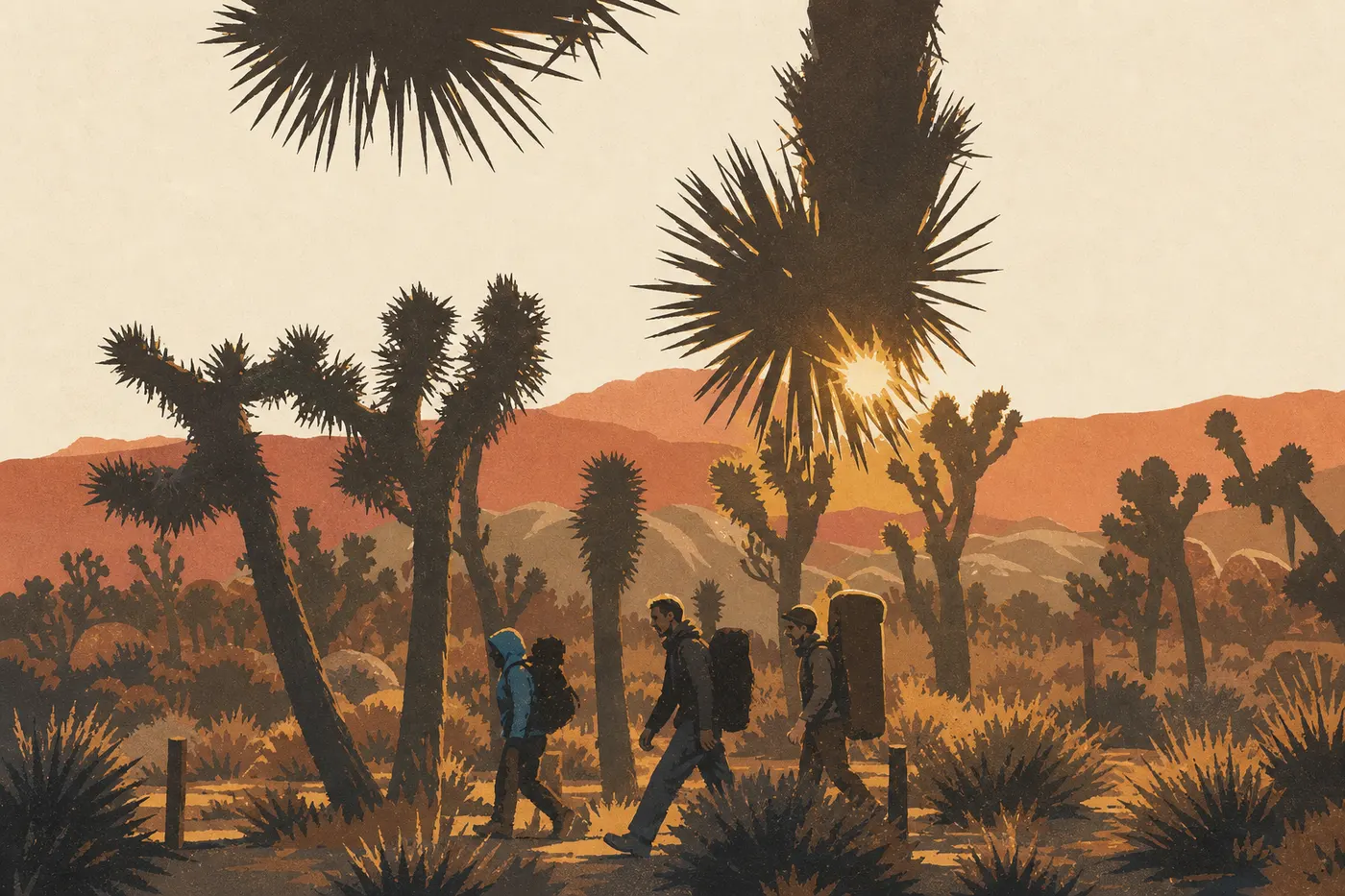
Joshua Tree with Kids: What to Do and How to Plan Your Visit
Joshua Tree National Park works well for families with kids as young as 5 or 6, as long as you choose the right season and plan carefully for water and heat. Kids love scrambling over the granite formations, staring at the park's improbable Joshua trees, and looking up at the night sky. With very young children (ages 0–4), a few flat trails are manageable, but a carrier is often the most practical option.
Why Visit Joshua Tree with Kids
Joshua Tree has a rare advantage: you don't have to sell kids on it. You arrive, get out of the car, and the questions start within minutes. The granite boulder piles become a natural playground. Climbing between the rocks, squeezing through passageways, playing hide-and-seek, the landscape does the work for parents.
Two practical family-friendly features deserve special attention.
First, the landscape is immediately easy to read. Distances are short. You won't walk for two hours just to get somewhere: Skull Rock is visible from the parking area, and Hidden Valley is a 20-minute walk away. This is a park where you see the payoff quickly.
Then there's the night sky. Joshua Tree is certified Gold Tier by the International Dark Sky Association. On a moonless night, you can see 2,000 stars with the naked eye from the park campgrounds. It's often what kids are still talking about months after the trip.
Is Joshua Tree Good for Kids? What Age Is Best?
Babies and ages 0–4: A few flat trails are available, including Cholla Cactus Garden and Cap Rock, but the sandy, rocky terrain makes a stroller a poor choice. A wrap or backpack carrier is the most realistic option. Heat is the main constraint. Outside spring and fall, taking an infant out for a day is not recommended.
Ages 5–9: This is the ideal age. Kids can easily handle the park's easy hikes, usually 1.2 to 2.5 miles, scramble over rocks with enthusiasm, and fill out their Junior Ranger booklet with real concentration. Their way of seeing the world is perfectly suited to this landscape: strange, tangible, and within reach.
Ages 10 and up: You can add longer hikes, intentional stargazing with a sky map, and, for families with a guide, an introduction to climbing on the park's established routes.
Multigenerational families: The park is largely accessible by car. You can see the main points of interest from the roadside or via short walks on flat terrain.
When to Visit Joshua Tree with Kids
Spring (March, April, and May) and fall (October and November) are the two best windows for families. High temperatures hover around 84°F during the day, while nights are cool but manageable.
In March and April, desert wildflowers bloom in some years. Families who arrive expecting a uniformly rocky desert may be surprised by the burst of color.
Avoid summer with kids, period. Temperatures climb above 100°F during the day and sometimes reach 109°F. Nights stay above 75°F. Heat can turn a 1.2-mile trail into a challenge for an adult and a real risk for a child.
Winter is doable, with daytime temperatures around 59°F, but nights can be bitterly cold, and snow occasionally falls at higher elevations.
The Joshua Tree weather guide and guide to the best times to visit break down temperatures month by month and the wildflower seasons.
How Many Days Do You Need for a Family Visit?
Two full days is the minimum for a satisfying visit. You can see the essential sites, including Skull Rock, Hidden Valley, Barker Dam, and Cholla Cactus Garden, fit in two or three short hikes, and spend one night in the park under the stars.
Three days gives everyone room to breathe, leaves time for unstructured play on the rocks, allows you to complete the Junior Ranger program properly, and lets you explore the park's two ecological zones, the Mojave Desert in the north and the Sonoran Desert in the south.
Four days or more makes sense for families combining Joshua Tree with Palm Springs or other regional destinations.
The Joshua Tree itinerary guide offers detailed two- and three-day plans.
What to Do in Joshua Tree with Kids: Our Picks
Skull Rock. It's the logical first stop. The rock looks like a skull, a comparison a 6-year-old will make immediately, and it's visible from Pinto Basin Road. The Skull Rock Nature Trail, a 1.7-mile walk, is our number-one pick for families.
Hidden Valley. This rocky basin is reached by a short 1-mile loop trail. The local legend, which says cattle rustlers used the valley to hide their herds in the 19th century, interests kids as much as the scenery. There's no shade, so bring sunscreen and a hat.
Barker Dam. The 1.3-mile loop leads to a small reservoir built in the early 20th century. Depending on the season, you may see birds and Native American petroglyphs carved into the rock. It's one of the park's most varied spots for curious kids.
Cholla Cactus Garden. This flat, quarter-mile trail crosses a field of cylindrical cholla cacti. Often called “jumping cholla,” their spines catch on clothing and skin at the slightest touch. It's a good opportunity to explain how plants defend themselves, as long as everyone stays on the trail and leaves the cacti alone.
Stargazing. In the evening, settle in away from streetlights at Skull Rock, Jumbo Rocks, or Cottonwood and look up. You can easily pick out Orion, the Big Dipper, and the Milky Way with the naked eye. A red headlamp lets you read a sky map without ruining your night vision.
The Joshua Tree activities guide covers all the activities available in the park.
Easy Family Hikes
| Trail | Distance | Elevation gain | Stroller | Why kids like it |
|---|---|---|---|---|
| Cholla Cactus Garden | 0.25 miles | Flat | Yes | Unusual cacti |
| Cap Rock Nature Trail | 0.4 miles | Flat | Partially | Rocks to climb |
| Hidden Valley | 1 mile | Minimal | No | Spectacular scenery |
| Barker Dam | 1.3 miles | Minimal | No | Water, birds, petroglyphs |
| Skull Rock Nature Trail | 1.7 miles | Minimal | No (gravel) | Iconic rock and nature |
Three practical points are worth noting.
Cholla Cactus Garden and Cap Rock are the only trails suitable for an all-terrain stroller. An urban stroller won't make it over the coarse gravel.
Skull Rock Nature Trail is our first choice for a family day with kids ages 5 to 12. It combines geology, wildlife viewing, and rocks that invite spontaneous climbing.
Outside spring and fall, start every hike before 9 a.m. By 10 a.m., the heat is punishing even on short routes.
The Joshua Tree hiking guide provides trail ratings, precise elevation gains, and the best start times.
The Junior Ranger Program
The National Park Service offers the Junior Ranger program in nearly every American national park, including Joshua Tree. The idea is simple: kids pick up a free activity booklet at the visitor center, complete it during their stay with observations, drawings, and quizzes about desert geology and wildlife, then bring it back to a ranger and take the pledge. In return, they receive an official park badge.
It's a useful framework for the day. It gives kids a thread to follow, encourages them to observe instead of simply walking, and helps them remember concrete facts about the Mojave Desert.
The booklet is available for several age groups, generally ages 5–7, 8–12, and 13 and up. Ask for the version that matches your kids' ages at the front desk.
The Oasis Visitor Center in Twentynine Palms, northeast of the park, and the Cottonwood Visitor Center in the south distribute the booklets. Hours vary by season.
Safety with Kids
This is the section that deserves the most attention. Joshua Tree isn't dangerous if you follow a few clear rules, but the desert doesn't forgive carelessness, especially when kids are along.
Heat comes first. Outside spring and fall, avoid physical activity after 10 a.m. Children can become dehydrated quickly, often before they say they're thirsty. Bring at least 1 liter of water per person for every hour of activity. There are no water refill stations on the park's trails.
Cholla cacti. Their barbed spines catch on clothing and skin at the slightest brush. If one makes contact, never pull it off with your bare hand. Use two sticks or tweezers to remove the spiny segment. Teach kids to stay at least 1 foot away from these cacti.
Rattlesnakes. They live in the park and are especially active in spring and fall. Teach kids one simple rule: never put a hand into a hole, under a rock, or into a bush without looking first. Stay on marked trails.
Sun. Bring a wide-brimmed hat, approved sunglasses, and at least SPF 50 sunscreen. Glare from pale sand and rock is intense, even on partly cloudy days.
Speed limits. The speed limit is 45 mph on the park's main roads and 25 mph in campgrounds and on secondary roads. Rock formations can reduce visibility at intersections.
The complete Joshua Tree guide covers the park's active alerts and full safety guidance.
Where to Stay with Kids
Inside the park, camping is the only lodging option. There are no lodges or other permanent accommodations. Jumbo Rocks Campground, with 124 sites, is the most popular family campground. It combines nearby rocks to climb with an exceptional night sky. Sheep Pass and Indian Cove are quieter.
Reservations through Recreation.gov are strongly recommended as soon as spring begins.
Around the park, the towns of Twentynine Palms to the northeast, Joshua Tree to the northwest, and Yucca Valley to the west offer family-friendly motels, lodges, and vacation homes. Palm Springs, about an hour west, has hotels with pools that can be convenient with young children.
The Joshua Tree lodging guide and our Camping guide compare campgrounds by atmosphere, price, and family accessibility.
Meals and Breaks with Kids
There are no restaurants or food vendors inside Joshua Tree National Park. Families regularly forget this and arrive around noon with hungry kids, making it the park's most common unpleasant surprise.
The rule is simple: always bring more food and water than you expect to need. Supermarkets and grocery stores are in Yucca Valley to the west and Twentynine Palms to the northeast. Shop before entering the park.
Picnic tables are available at Hidden Valley, Cottonwood Springs, Jumbo Rocks, and several other areas. Some have shaded shelters, which makes a big difference in the shoulder seasons.
For hiking snacks, nuts, energy bars, dried fruit, and salty snacks hold up well in the heat. Chocolate and ice cream won't survive in a car sitting at 95°F.
Family Budget
The entrance fee is $30 per vehicle and is valid for seven consecutive days, regardless of group size. For a family visiting several parks on the same trip, the America the Beautiful pass, $80 per year per vehicle, covers admission to all U.S. national parks. It pays for itself after the third park.
Children under 15 do not pay an additional entrance fee. The Junior Ranger program is free. Camping is charged per site, not per person. Expect to pay $15 to $25 per night, depending on the campground.
The National Parks fees and passes page explains entrance fees and annual passes. Our Joshua Tree practical guide also details the park-specific pass, which costs $55 per year, and the fee waivers.
Places to Combine with Joshua Tree for a Family Trip
Palm Springs (1 hour west). Pools, air conditioning, and the Palm Springs Aerial Tramway, which climbs to 8,500 feet and offers 360-degree views. It's a good air-conditioned reset after time in the desert.
Pioneertown (30 minutes northwest). This Western set, built for movies in the 1940s, is still intact. You can walk its main street in 20 minutes. Kids pick up on the atmosphere even if they don't know Westerns.
Anza-Borrego Desert (1.5 hours southwest). It's wilder and less visited than Joshua Tree. The large metal sculptures installed in the desert at Galleta Meadows feel like a giant outdoor art gallery, which works especially well for kids ages 8 and up.
Our Road Trip guides and Regions section develop these combinations into multiday trips from Los Angeles or Las Vegas.
Joshua Tree with Kids: Is It Worth It?
Yes, as long as you visit in the right season. It's one of the few parks where kids are amazed without needing much encouragement. The climbable rocks, otherworldly Joshua trees, and complete lack of artificial light at night let the park do the work.
The logistics take some planning. You need enough water for the entire day, there is no food service, and you have to plan around the heat. But the demands are predictable. You'll know exactly what to do before entering the park.
For a family's first visit to an American national park, Joshua Tree is an excellent introduction. It's 2.5 hours from Los Angeles, compact, easy to navigate, and highly rewarding for kids. Our Joshua Tree guide provides a complete overview of the park.
Frequently Asked Questions
Is Joshua Tree suitable for families with kids?
Joshua Tree works well for families with kids ages 5 or 6 and up, especially in spring (March–May) and fall (October–November). The climbable rocks, short trails, and Junior Ranger program suit this age group. Babies and young children can enjoy the park in a carrier or on the few flat trails, as long as you plan for the heat and rough terrain.
Is Joshua Tree a kid-friendly park?
Not in the sense of an amusement park. Joshua Tree is a desert park with real constraints: extreme summer heat, no water refill stations on the trails, and rocky terrain. With good preparation, including the right season, enough water, and appropriate timing, a visit is accessible and memorable at any age.
Is Joshua Tree worth visiting?
Joshua Tree is worth the trip for its unique landscape, with two deserts in one park, rock formations that invite scrambling, and its Gold Tier-certified dark skies. It leaves a lasting impression on kids, often for reasons that differ from the adults' reasons.
How long does it take to visit Joshua Tree National Park with kids?
Two full days let you cover the essential sites, including Skull Rock, Hidden Valley, Barker Dam, and Cholla Cactus Garden, and spend one night under the stars. Three days are recommended for exploring both ecological zones and leaving kids free time on the rocks. Our Itinerary and Length page offers detailed plans.
What is the best time to visit Joshua Tree with kids?
Spring, from March through May, and fall, from October through November, are the two best windows for families, with high temperatures around 84°F. Avoid summer with kids. Temperatures regularly climb above 100°F. Our When to Visit page breaks down the monthly averages.