
Where to Stay in Joshua Tree: Inside the Park, Nearby Towns, and Campgrounds
The short answer: Joshua Tree has no lodge inside the park. On-site lodging means camping, period. Elsewhere, your natural bases are Twentynine Palms (the closest), Joshua Tree town (the most distinctive), Yucca Valley (the most convenient), or Palm Springs, 45 minutes away, if you want a pool after your hikes. Plan on at least two nights to cover the highlights, and check the recommended Joshua Tree itinerary to plan your trip.
Where to stay: towns, lodges and campgrounds (15)
- Gateway town Joshua Tree entrance West Entrance · hotels, gas station, restaurants Directions ↗
- Gateway town Twentynine Palms entrance North Entrance · hotels, supermarket, gas station Directions ↗
- Gateway town Yucca Valley entrance West Entrance · hotels, supermarket, gas station Directions ↗
- Gateway town Desert Hot Springs entrance West Entrance · hotels, gas station, restaurants Directions ↗
- Gateway town Palm Springs entrance South Entrance - Cottonwood · hotels, supermarket, gas station Directions ↗
- Gateway town Indio entrance South Entrance - Cottonwood · hotels, supermarket, gas station Directions ↗
- Campground Cottonwood Campground recreation.gov · 62 sites Directions ↗
- Campground White Tank Campground first come, first served · 15 sites Directions ↗
- Campground Ryan Campground recreation.gov · 32 sites Directions ↗
- Campground Hidden Valley Campground first come, first served · 44 sites Directions ↗
- Campground Indian Cove Campground recreation.gov · 101 sites Directions ↗
- Campground Black Rock Campground recreation.gov · 99 sites Directions ↗
- Campground Belle Campground first come, first served · 18 sites Directions ↗
- Campground Sheep Pass Group Campground recreation.gov · 6 sites Directions ↗
- Campground Jumbo Rocks Campground recreation.gov · 124 sites Directions ↗
 Base map © OpenStreetMap · © CARTO
 ⚠ Gateway town & Lodge data is undergoing editorial review.
Staying Inside or Outside the Park?
The answer is more clear-cut here than elsewhere. Joshua Tree has neither a lodge nor concession-run cabins. Staying “in the park” means camping, period. If you want a bed and a bathroom, stay outside the park.
Two distinct options stand out.
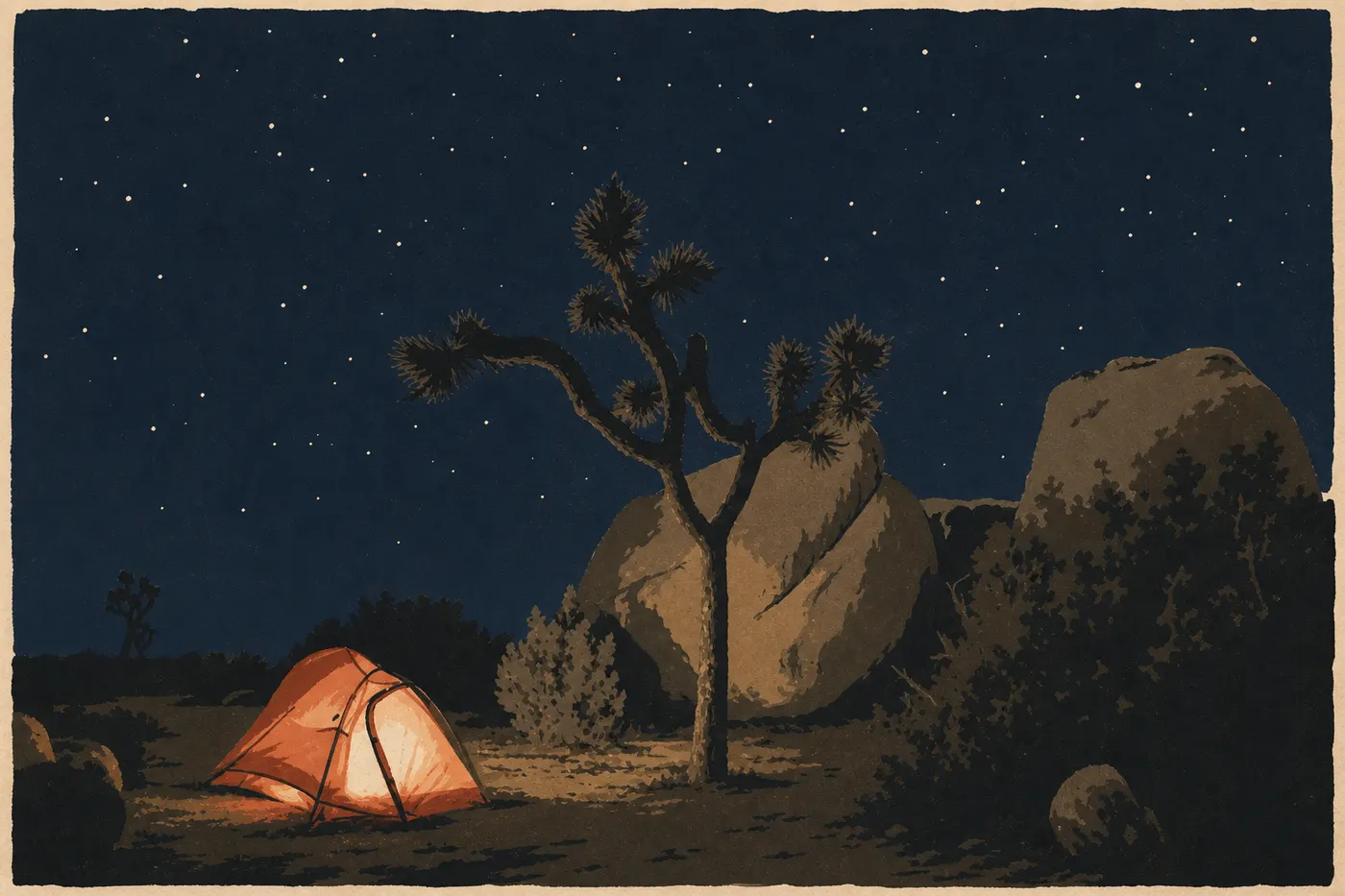
Hikers and stargazers. The park has nine campgrounds. You get dark skies, the desert right outside your tent, and trail access at dawn without a drive. The tradeoff is that most campgrounds have no showers, generators are prohibited at night, and sites disappear quickly during the busy season.
Travelers who prefer traditional lodging. You’ll enter the park for the day from a nearby town. It’s less immersive, but noticeably more comfortable. Distances are short: the gateway towns sit 15 to 30 minutes from the main entrances.
Staying in Joshua Tree: There’s No Lodge
Many visitors don’t realize this when planning their trip. Unlike Grand Canyon or Yellowstone, Joshua Tree has no hotel infrastructure inside the park’s boundaries. There’s no historic inn, rustic cabin, or official concessioner-run glamping. Keep this in mind from the moment you book.
If you’re looking for a hotel or B&B near the park, our selection of hotels and lodges around Joshua Tree lists the best options by town, along with the distances.
Camping in Joshua Tree: The Park Campgrounds
The park’s nine campgrounds are divided between the northern section, covering the West and North Entrances on the Yucca Valley, Joshua Tree town, and Twentynine Palms side, and the southern section, around Cottonwood Entrance, accessed from Interstate 10.
Campgrounds You Can Reserve
Black Rock (near Yucca Valley), Indian Cove (a rocky basin popular with climbers), and Cottonwood (in the southern part of the park, often less crowded than the northern campgrounds) accept reservations through recreation.gov. These are the only three where you can lock in a site ahead of time. Book as early as possible during the busy season.
First-Come, First-Served Campgrounds
Jumbo Rocks Campground, Hidden Valley Campground, Belle Campground, White Tank Campground, and Ryan Campground operate without reservations. During the busy season, you’ll need to arrive before noon to have a chance at a site. These campgrounds sit in the heart of the park, surrounded by the granite formations that made it famous.
The same rules apply everywhere: generators are allowed only during certain hours, quiet hours begin at 10 p.m., and collecting dead wood is prohibited. The Joshua Tree campground guide covers available amenities and last-minute strategies for finding a site.
Where to Stay Around Joshua Tree: The Gateway Towns
Twentynine Palms
Twentynine Palms is the closest town to the main North Entrance, just a few minutes away. This modest community, shaped in part by the presence of a Marine Corps base, has the essentials: motels, grocery stores, and gas stations. It isn’t a destination in itself, but it’s the fastest option if you want to minimize your morning and evening drive. Prices are among the lowest in the area.
Joshua Tree (the Town)
Don’t confuse the park with the town that shares its name. On the West Entrance side, Joshua Tree has developed its own identity in recent years, built around desert art and the California lifestyle. You’ll find galleries, polished cafés, and distinctive vacation rentals, including geodesic domes and mid-century modern villas. Short-term rentals are plentiful and often unusual. Expect to spend a little more than you would in Twentynine Palms.
Yucca Valley
Yucca Valley is the best-equipped town in the area, with supermarkets, big-box stores, chain restaurants, and pharmacies. It’s convenient for families and longer stays. The town is about 15 minutes from the West Entrance. Lodging ranges from budget motels to comfortable B&Bs.
Palm Springs
Palm Springs is about 45 minutes west via Interstate 10. It’s a different kind of destination, with pool resorts, 1950s modernist architecture, spas, and fine-dining restaurants. Prices are considerably higher than in Twentynine Palms, but the city is worth a night on its own if you’re combining Joshua Tree with the rest of Southern California. Be careful in April: the Coachella festival fills rooms and sends rates soaring.
When to Book Your Joshua Tree Lodging
Joshua Tree has two busy seasons: spring (February through April, when the desert blooms) and fall (September through November, when temperatures are mild). On weekends during these periods, campgrounds and nearby lodging fill up very quickly.
For campgrounds that accept reservations, the most sought-after sites often go several months ahead as soon as booking windows open on recreation.gov. For hotels and rentals, plan at least two to three months ahead for a spring stay. When to Visit Joshua Tree explains the best windows and the periods to avoid based on park weather.
Lodging Budget: How Much Does It Cost to Stay in Joshua Tree?
| Option | Nightly range |
|---|---|
| Camping in the park | $15 to $25 per site |
| Motel in Twentynine Palms | $80 to $130 per room |
| Rental in Joshua Tree town | $120 to $200 |
| Hotel in Yucca Valley | $90 to $160 |
| Hotel or resort in Palm Springs | $150 and up |
You’ll also need to pay the park entrance fee: $30 per vehicle, valid for seven days. The park’s annual pass ($55) pays for itself if you plan multiple visits, and the America the Beautiful interagency pass covers all U.S. federal parks. Our Fees & Passes page explains entrance fees and pass options.
Our Recommendation Based on Your Travel Style
First visit, limited budget. Settle in Twentynine Palms or Joshua Tree town. You’ll have a short drive, simple logistics, and affordable lodging.
Traveling with kids. Choose Yucca Valley for comfort and amenities. If the kids want the “night in the desert” experience, Black Rock (with restrooms and water access) is the best campground for a first trip.
Hikers and stargazers. Get a site in the heart of the park, at Jumbo Rocks Campground or Hidden Valley Campground, for sunrise over the rocks without any detour. During the busy season, arriving before noon is essential. Check out Joshua Tree hikes to choose your campground based on the trails you want to hike.
Longer stay or multiple destinations. Use Palm Springs as your base after two days on the trails. The pool and spa become part of the plan, and the city deserves your evening.
For an overview of the park, see our complete Joshua Tree guide.
Frequently Asked Questions
Where should you stay to visit Joshua Tree?
To visit Joshua Tree, you can stay at one of the park’s nine campgrounds or in a nearby town: Twentynine Palms (the closest to the North Entrance), Joshua Tree town (on the west side, with its desert-art atmosphere), Yucca Valley (the best equipped), or Palm Springs (45 minutes away, the luxury option). There’s no lodge inside the park.
Where do Joshua Tree visitors stay?
Joshua Tree visitors split their nights between the park campgrounds and lodging in the surrounding towns. Twentynine Palms and Joshua Tree town account for most overnight stays outside the park among travelers who prioritize proximity.
Is Joshua Tree worth visiting?
Joshua Tree is worth the trip for its unique landscapes at the meeting point of the Mojave Desert and Colorado Desert, its imposing rock formations, and some of the darkest night skies in Southern California. Two nights are enough to see the highlights without rushing.
What’s the closest town to Joshua Tree?
The closest town to the main North Entrance is Twentynine Palms. On the west side, Joshua Tree town is a few minutes from the park’s West Entrance.
What’s the best town to stay in when visiting Joshua Tree?
The best town depends on your travel style: Twentynine Palms for proximity and budget, Joshua Tree town for atmosphere, Yucca Valley for practical comfort, and Palm Springs for luxury and a combined trip.