
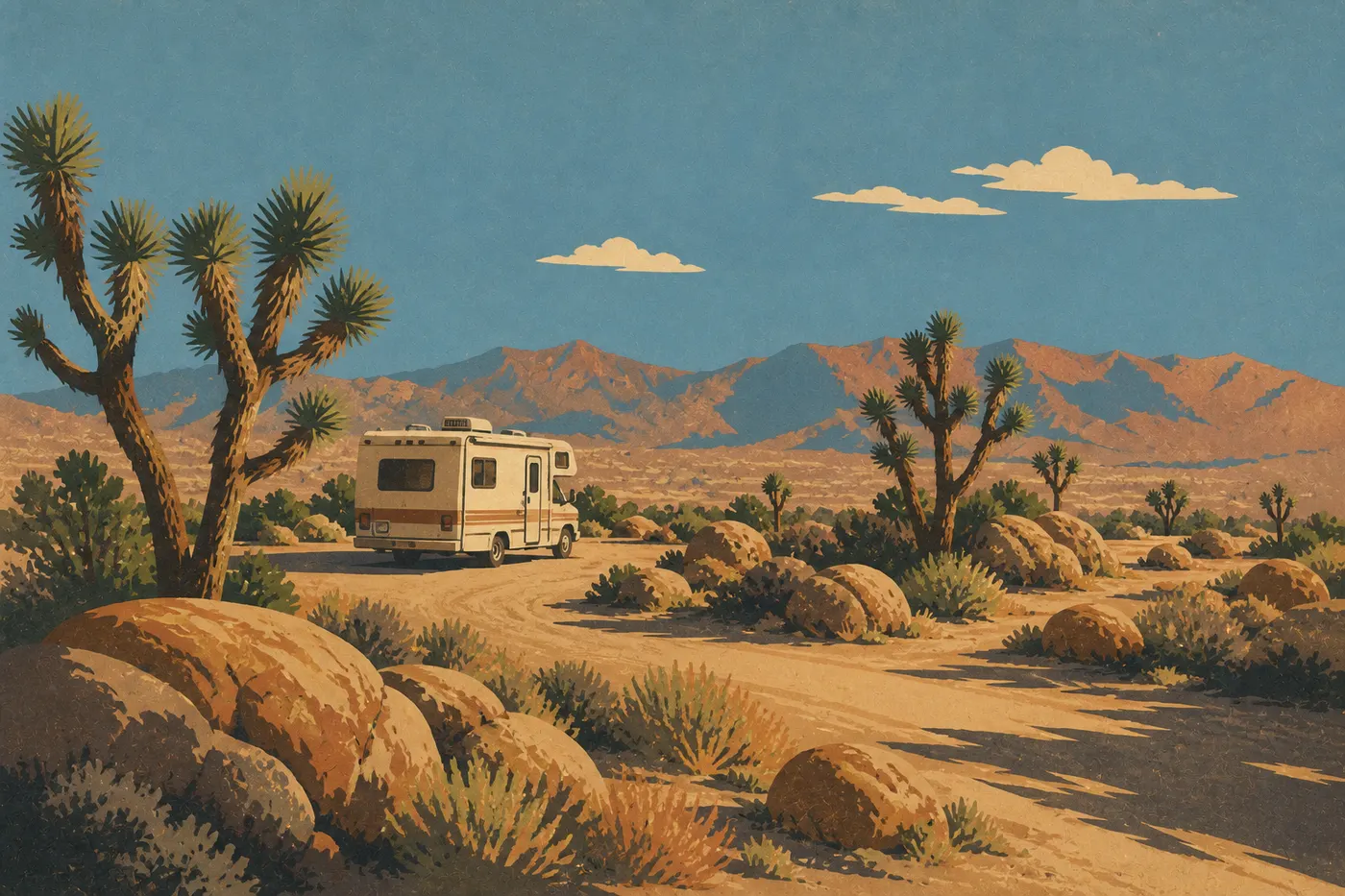
Joshua Tree by RV: Campgrounds, Rules, and Tips
The good news is that Joshua Tree is one of California's most RV-friendly national parks. There are no challenging tunnels, the main roads are wide and paved, and nine official campgrounds welcome larger vehicles. The main restriction to remember is a 35-foot maximum length at most sites, along with the lack of electrical hookups at eight of the nine campgrounds. In practical terms, bring a self-contained vehicle, book Black Rock if you need power, and read on before you start the engine.
Can You Drive and Camp at Joshua Tree by RV?
Yes, with no major driving restrictions. Park Boulevard and Pinto Basin Road, the park's two main routes, are wide and well maintained. You'll regularly see Class A motorhomes and fifth wheels using them without trouble. There are no vehicle-size limits on these roads.
For camping, the park offers nine official campgrounds between the northwest entrance, on the Yucca Valley side, and the South Entrance at Cottonwood. Almost all operate without hookups. Water, electricity, and sewer connections are available only at Black Rock. If your vehicle is longer than 35 feet, check the individual sites on recreation.gov before booking. A few isolated sites have stricter limits.
RV Restrictions and Regulated Roads
Unlike Zion and its famous Mount Carmel Highway tunnel, Joshua Tree has no vehicle-size restrictions on its main roads. A few points still deserve your attention:
- Maximum length per site: 35 feet, which applies throughout the campgrounds unless recreation.gov says otherwise.
- Unpaved roads: Geology Tour Road and the roads in the Cottonwood area aren't recommended for RVs. Deep sand and ruts can leave a long vehicle stuck.
- Parking outside a designated site: prohibited inside the park. You can't spend the night in your RV in a parking lot or along the road.
- Speed: 45 mph on park roads and 25 mph in campgrounds. Sandy ground increases braking distances.
Before you leave, check Joshua Tree's NPS alerts page. Road closures and temporary restrictions are updated there in real time.
The Park's Official Campgrounds
Black Rock
Black Rock is the only campground in the park with sites offering water and electrical hookups. Located at the northwest entrance, on the Yucca Valley side, it accepts vehicles up to 35 feet long. Reservations are required through recreation.gov. During the spring season, especially March and April, sites fill several weeks ahead. A dump station is available on-site, making Black Rock the most convenient base for several consecutive nights.
Cottonwood
At the South Entrance, Cottonwood is quieter and less crowded than the campgrounds in the north. There are no hookups, but sites are spacious, accommodate vehicles up to 35 feet, and can be reserved through recreation.gov. It's a good starting point for visitors arriving via I-10, Exit 168, who want to begin with the park's lower desert.
Jumbo Rocks Campground
Jumbo Rocks Campground, the park's largest, has sites scattered among Joshua Tree's distinctive rock formations. Sites are first-come, first-served. The maximum length is 35 feet, and there are no hookups. The setting is worth the detour alone. Waking up surrounded by pink granite boulders in the morning light is the image most people take home from Joshua Tree. On an April weekend, arrive before noon or you may leave without a site.
Hidden Valley
Sixteen miles from the West Entrance, Hidden Valley draws climbers and hikers. Sites are first-come, first-served, with a 35-foot maximum length and no hookups. The granite boulders around the campground rank among California's most popular climbing areas. Nonclimbers will enjoy the Hidden Valley Nature Trail, an easy 1-mile loop.
Indian Cove
Reached by a separate road from CA-62, Indian Cove sits slightly apart from the main loop and feels more secluded during the week. Sites can be reserved through recreation.gov, with a 35-foot maximum length. It's a good choice for families with children who want short trails close to camp.
Ryan, Belle, and White Tank
These three small campgrounds, each with fewer than 32 sites, are scattered across the central part of the park. All are first-come, first-served, have no hookups, and allow vehicles up to 35 feet long. Ryan provides quick access to Ryan Trail and a good view toward the south. Belle and White Tank are more intimate and better suited to camper vans and Class B motorhomes than to large Class A rigs.
Dispersed Camping and Areas Around Joshua Tree (Boondocking)
Camping outside official campgrounds is prohibited within the park's boundaries. However, the Bureau of Land Management (BLM) lands surrounding Joshua Tree offer free, legal boondocking. BLM areas east of Cottonwood and north of Twentynine Palms allow you to park your RV for one night, as long as you follow the 14-day limit at the same site and Leave No Trace principles.
For BLM areas around the park that are accessible to RVs, our Southern California Region guide offers practical information about dispersed camping options.
Dump Stations, Water, and Services
This is the tricky part of Joshua Tree for self-sufficient RVers. Inside the park:
- Black Rock: dump station and potable water available on-site.
- Cottonwood: potable water available. Check conditions when you arrive, since water supplies may be reduced in summer.
- All other campgrounds: no potable water and no dump station.
If you're camping anywhere except Black Rock, make sure your black and gray tanks can handle the entire stay. Outside the park, Yucca Valley and Twentynine Palms have gas stations with dump stations, as well as grocery stores where you can restock. Joshua Tree village also offers a few basic services between the two northern entrances.
Which Campground Should You Choose?
You need hookups: Black Rock is the only option in the park. Book as early as possible, preferably six months ahead for March and April weekends.
You're traveling with young children: Choose Indian Cove for its short trails and peaceful setting, or Cottonwood for direct access to Cottonwood Spring Oasis.
You want the most striking scenery: Choose Jumbo Rocks Campground. Waking up among the pink granite formations more than makes up for the lack of hookups. Our Camping page for Joshua Tree covers the activities near each campground.
You're an experienced climber or hiker: Choose Hidden Valley for climbing, or Ryan for southern views and Ryan Trail. Our Hiking page for Joshua Tree lists the trails accessible from each campground.
When in doubt, our complete guide to Joshua Tree compares all the campgrounds and their distances from the main attractions.
Renting an RV to Visit Joshua Tree
Joshua Tree is a good fit for a three- to five-night rental. The two closest airports are Palm Springs (PSP), about an hour away, and Los Angeles (LAX), 2.5 hours away. Cruise America, Outdoorsy, and RVshare offer a range of rentals there.
Here are a few guidelines for choosing your vehicle:
- Camper van or Class B: the most versatile option for Joshua Tree. It can access all the campgrounds, parks easily in picnic areas, and works well for BLM areas.
- Class C, 23 to 30 feet: a good balance of comfort and maneuverability for a couple or small family.
- Class A or fifth wheel, more than 30 feet: comfortable, but stick to Black Rock or Cottonwood for overnight parking and avoid all unpaved roads.
Always check the vehicle's total length with the rental company, including the front and rear overhangs, before confirming your campground reservation.
RVs and Pets, Budget, Reservations: What to Know
Pets: Dogs are allowed in the park and must be kept on a leash no longer than 6 feet at all times. They can't use hiking trails or go more than 100 feet from paved roads and parking areas. In summer, never leave them alone in a closed vehicle. The interior can exceed 140°F within minutes in extreme heat.
Entrance fees: $30 per vehicle, valid for seven days. The park's annual pass ($55) pays for itself after two visits in a year. If you're visiting several national parks, the America the Beautiful pass is an even better value. For entrance fees and annual passes, see the National Parks Fees and Passes page.
Reservations: Black Rock, Indian Cove, and Cottonwood can be reserved through recreation.gov, sometimes six months ahead for March and April weekends, the desert wildflower season. First-come, first-served campgrounds fill up as early as Thursday evening during the busy season. Arrive midweek to improve your chances.
Season: Spring, from March through April, and fall, from October through November, are ideal, with daytime temperatures around 84°F and cool nights near 50°F. Summer daytime temperatures regularly exceed 100°F. Camping without air conditioning becomes risky, and some areas close. Winter days are mild, around 59°F, but nights can freeze, especially at higher elevations. Our When to Visit page for Joshua Tree details conditions month by month.
In Summary: Our Joshua Tree RV Plan
Joshua Tree offers plenty for RVers, as long as you plan around two constraints: eight of the nine campgrounds lack hookups, and Black Rock fills up quickly. Our recommendation is to secure one night at Black Rock for dump, water, and power, then add a first-come, first-served night at Jumbo Rocks Campground for the scenery. Arrive during the week, keep your tanks full for nights away from Black Rock, and don't miss sunrise over the granite boulders.
Frequently Asked Questions
Can you sleep in your car at Joshua Tree?
Sleeping in a vehicle at Joshua Tree is allowed only in official campsites. Parking in a lot or along the road to spend the night is prohibited and can result in a fine.
Can you visit Joshua Tree by RV?
Yes. Joshua Tree's main roads have no vehicle-size restrictions for RVs. The maximum length accepted at campsites is 35 feet. Black Rock is the only campground with hookups for water and electricity.
Can you park an RV anywhere in Joshua Tree?
No. Overnight parking is allowed only in designated campground sites. Parking your RV outside those areas damages fragile desert vegetation and can result in a fine.
Where are RVs not allowed at Joshua Tree?
RVs should stay on the park's paved roads. Unpaved roads, including Geology Tour Road and roads in the Cottonwood area, aren't recommended. Camping outside official campgrounds is prohibited within the park.
Where can you stay in Joshua Tree National Park by RV?
The best options are Black Rock, with hookups and reservations; Cottonwood, which is quiet and reservable at the South Entrance; and Jumbo Rocks Campground, with spectacular scenery and first-come, first-served sites. Our Where to Stay page for Joshua Tree also covers hotels and alternatives outside the park.
Which campground should you choose at Joshua Tree?
It depends on your priority. Choose Black Rock for hookups and convenience, Jumbo Rocks Campground for scenery, Hidden Valley for climbing, or Indian Cove for families with children.
How much does a campsite cost at Joshua Tree?
The entrance fee is $30 per vehicle for seven days. For exact campsite rates and national park passes, see the National Parks Fees and Passes page.