
Mount Rainier with Kids: What to Do and How to Plan Your Trip
Is Mount Rainier a good fit for kids? Absolutely. A comfortable visit is realistic from about ages 4 or 5. The park offers areas that work for all ages, including Longmire, Paradise, and Grove of the Patriarchs, along with short, relatively level trails and a Junior Ranger program that turns a visit into an adventure for younger kids. You’ll need to do some planning, especially around weather and elevation gain, but the payoff is worth it.
Why Visit Mount Rainier as a Family
The snow-covered volcano rising above Washington State is an instant visual magnet. Kids can see it emerging from the clouds long before they enter the park. That first “wow” makes a great start.
The landscapes are right there. At Paradise, at 5,426 feet, you’re looking straight at Rainier’s snowy slopes from the parking lot. In July and August, the meadows burst into bloom, including lupines and anemones. You don’t have to walk for hours to see something memorable.
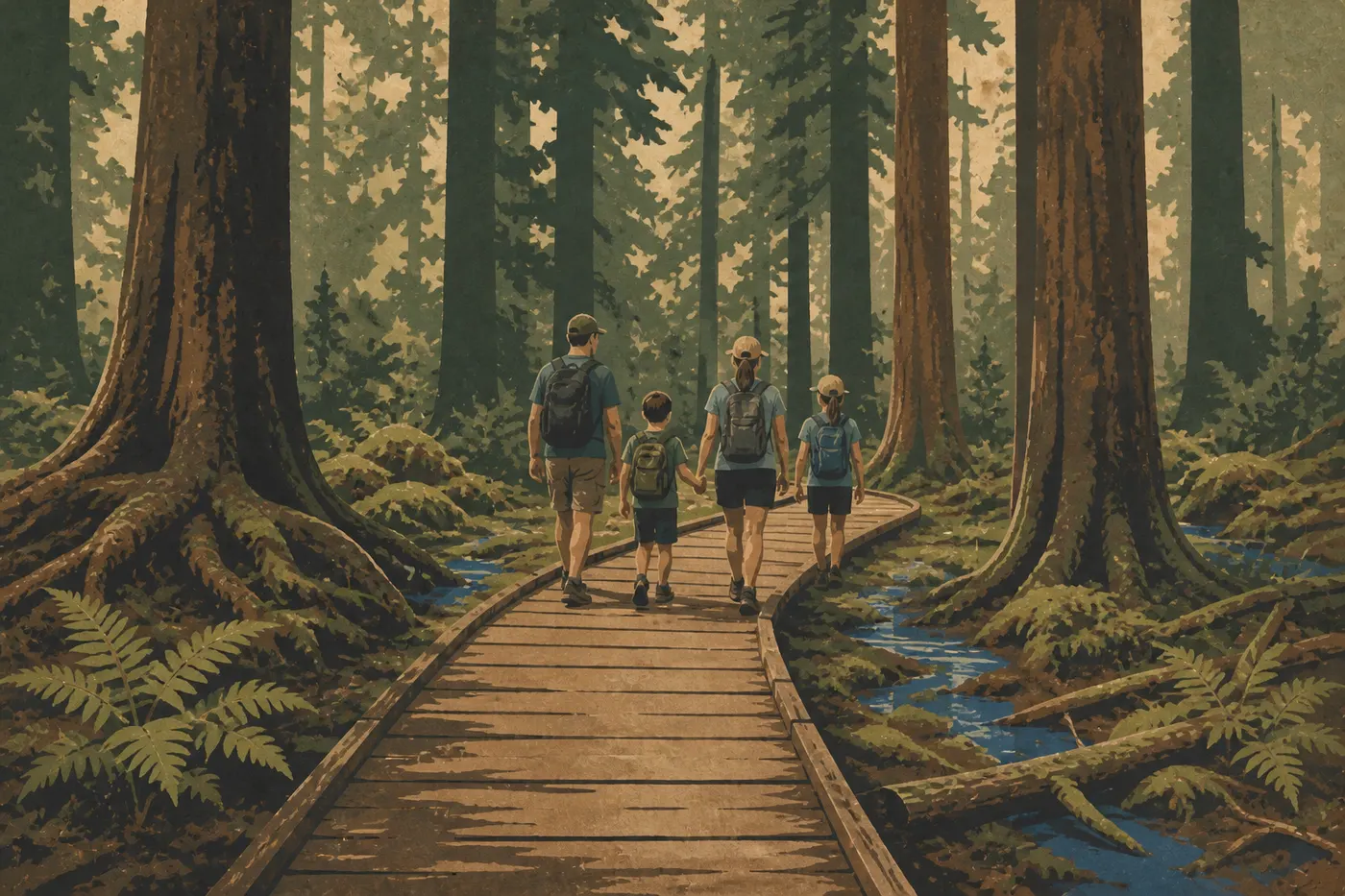
The short, well-marked trails make it easy to match the outing to the group’s pace. Grove of the Patriarchs, with its centuries-old Douglas firs and Sitka spruces, some more than 1,000 years old, impresses adults and kids alike. The trail is flat and just 1.0 mile round-trip.
The variety of areas including Longmire, Paradise, Ohanapecosh, and Sunrise lets you build a flexible itinerary around everyone’s ages and energy levels. A 5-year-old and a 14-year-old won’t have the same expectations, and the park can satisfy both.
Wildlife is easy to spot without actively searching. Black-tailed deer and Steller’s jays show up regularly. Black bears live here too, but encounters remain uncommon when you follow the basic rules covered in the safety section.
Is Mount Rainier Good for Kids? What Age Is Best
Mount Rainier works well for families with kids ages 4 or 5 and up, especially for a drive with a few short walks. Below that age, stroller-friendly areas are limited because paths are often gravel or natural terrain. The Trail of the Shadows at Longmire is the easiest option with an all-terrain stroller, as long as you’re comfortable with its limitations.
By ages 7 or 8, most kids can handle two or three short trails in one day and get the most out of the Junior Ranger program.
Teenagers will find more to enjoy around Paradise or Sunrise, with longer hikes, snowfields to cross in summer, and big mountain views.
Accessibility for visitors with limited mobility is partial. The Paradise and Longmire visitor centers have accessible facilities. The Mount Rainier guide has the latest accessibility details.
When to Visit as a Family
The short answer is July and August. Those are the safest months for a family visit. The main roads are open, the visitor centers are fully operating, and the Paradise meadows are mostly clear of snow.
Outside that window, weather becomes a real risk factor. At Paradise, snow can linger into June and return as early as October. A sunny summer weekend in Seattle can turn into drizzle and cold at elevation within an hour. Always pack waterproof layers, even in the middle of August.
June can work, but check road conditions. SR 410 to Sunrise often opens several weeks after the Nisqually Entrance to Paradise. September brings beautiful light and fewer visitors, provided you’re willing to accept a higher risk of bad weather.
For a month-by-month and seasonal breakdown, see our When to Visit page.
How Many Days Do You Need for a Family Visit
Two full days are the reasonable minimum. With a child under 8, two days let you cover Longmire and Paradise without rushing, while leaving time for breaks, snacks, and the inevitable surprises.
Three days give you room to add Ohanapecosh, including Grove of the Patriarchs and Tipsoo Falls, and explore Sunrise if the road is open. That’s our recommendation for a family with kids of different ages.
With less than two days, you’ll spend too much time in the car between areas and not enough time outside. The park covers 368 square miles, and the internal roads are slow, with a 35 mph speed limit on the main routes. Our Itineraries and Driving Times pages and Getting Around section give driving distances and times between areas.
What to Do at Mount Rainier with Kids: Our Picks
Here’s what works best with kids out of everything the park has to offer.
Paradise Area is the obvious starting point. Park the car, walk for ten minutes, and you’re looking out over flower-filled meadows with Rainier in the background. The Henry M. Jackson Visitor Center has interactive exhibits about volcanic geology that hold the attention of 8- to 12-year-olds. When we visited in July, blue lupines reached adult shoulder height.
Grove of the Patriarchs is a 1.0-mile trail on an island in the Ohanapecosh River, among centuries-old Douglas firs and Sitka spruces. Crossing the suspension bridge is a highlight for kids.
Longmire is an entrance area accessible year-round. The Longmire Museum traces the park’s history back to the 1880s. It’s small, free, and short enough for kids with limited patience.
Reflection Lakes are striking when the weather cooperates and Rainier reflects in the water. You don’t have to hike because you can see the view from the roadside. It’s a good option when the kids are tired.
Myrtle Falls can be reached from Paradise in less than 15 minutes round-trip. The falls are photogenic and don’t require any special effort.
For the full range of activities, visit our Things to Do page.
Easy Family Hikes
Mount Rainier isn’t an easy-hiking park overall. Many trails gain elevation quickly, and the terrain can be rough. These are the trails that genuinely work with kids.
Trail of the Shadows at Longmire is a 0.8-mile loop with virtually no elevation gain. It follows mineral springs and historic cabins dating from the 1880s. It’s the best first trail for very young kids and beginners.
Skyline Trail to Myrtle Falls at Paradise is a 0.9-mile round-trip walk to the waterfall with gentle elevation gain. You can access it directly from the Paradise parking lot. Parts of it are often snow-covered into July.
Grove of the Patriarchs Trail at Ohanapecosh is 1.0 mile, flat, and wooded. It’s the park’s best trail for all-terrain strollers.
Emmons Moraine Trail at White River is a 1.5-mile round-trip hike to views of Emmons Glacier, the largest glacier in the contiguous United States by area. The ground is rocky, so wear closed-toe shoes.
Alta Vista Trail at Paradise is a 1.6-mile loop with 394 feet of elevation gain. It’s a good choice for kids 8 and older who are used to walking. The trail offers views of Rainier and the Cascade Range.
Our Hiking page covers moderate trails and current conditions.
The Junior Ranger Program
The NPS Junior Ranger program is one of the best reasons to bring kids to an American national park. At Mount Rainier, the process is simple. Pick up an activity booklet at a visitor center, either Longmire or Henry M. Jackson, complete the activities during your visit, and show the booklet to a ranger. The child then takes the Junior Ranger pledge and receives an official badge.
The activities combine nature observation, volcanic geology quizzes, and field missions. The booklet comes in versions for ages 3 to 5, 6 to 12, and 13 and up. It’s more than a minor distraction. Kids really get involved, first for the badge and then because the activities are well designed.
Plan on about two to three hours to complete the standard booklet. A practical tip is to pick it up at the start of your first day so it naturally becomes part of the visit instead of turning into a last-minute rush to get it signed.
You can also download the booklet from the NPS website before you leave, which lets you go over it with the kids ahead of time.
Safety with Kids
Mount Rainier has a few specific risks you should understand before you arrive.
Weather and hypothermia can be a concern because conditions may change abruptly, even in July. At Paradise, temperatures can drop below 50°F as soon as the sky clouds over, even in midsummer. The nonnegotiable rule is that every child should have a waterproof jacket and a warm layer in their pack, whatever the morning forecast says.
Black bears do live in the park. Never leave food unattended, whether it’s in the car or on an unsupervised picnic table. If you see a bear, make noise and back away calmly without running. Never get within 50 yards of one.
Mountain goats are drawn to salt and aren’t afraid of people. Don’t feed them or approach them, and keep kids at a distance. A horn strike can cause a serious injury.
Elevation gain and trail edges can be an issue because some trails have exposed sections without guardrails. Hold young children’s hands there. Early-season snowfields can be slippery, so don’t cross them without the right gear.
Elevation is 5,426 feet at Paradise and 6,401 feet at Sunrise. Altitude sickness is unlikely at these elevations, but kids used to lowlands may tire more quickly. Keep them hydrated and slow the pace at elevation.
Where to Stay with Your Family
Two lodging options inside the park work particularly well for families.
The National Park Inn at Longmire is open year-round and has rooms with extra beds. It’s convenient for an off-season visit or for getting straight onto Longmire’s trails in the morning.
The Paradise Inn is open from late May through early October. The setting is more spectacular, but rooms sell out quickly. Reservations generally open in December or January for the following summer.
For camping, Cougar Rock at Longmire and Ohanapecosh are the two main campgrounds with reservations available. Family sites for July and August also book several months ahead.
Outside the park, Ashford, the gateway to the Nisqually Entrance, has several family-friendly cabins and lodges. Our Where to Stay guide and the Hotels and Lodges and Camping pages cover the options and current rates.
Food and Breaks with Kids
Food service in the park is intentionally limited.
The Paradise Inn restaurant serves lunch and dinner during the busy season, with generous portions. A full meal for a family of four costs around $70 to $80.
The National Park Inn at Longmire also has a year-round restaurant. It’s simpler, but convenient.
The Paradise and Sunrise visitor centers have snack counters. They’re useful for a quick break without a wait.
Our advice is to pack a picnic for at least one of your two days. There are plenty of well-placed picnic areas at Longmire, Reflection Lakes, and Ohanapecosh. With kids, relying less on park restaurants helps prevent end-of-day meltdowns. Bring plenty of water. You’ll find refill stations, but not everywhere along the trails.
Outside the park, Ashford has a few options, including a café, a grocery store, and a burger restaurant that works well for teenagers. Our Where to Eat page lists the addresses and current hours.
Family Budget
Park admission is $30 per vehicle and valid for 7 days, regardless of the size of your group. An annual pass for Mount Rainier alone costs $55.
If your trip includes other national parks, the America the Beautiful pass, at $80 per year, provides access to all federal sites and is the best value for a family visiting two or more parks during the year. Kids under 15 enter all NPS parks for free.
The Junior Ranger booklet is free. Visitor center exhibits are included with admission.
Our Fees and Passes page explains park entrance fees and national passes.
Other Family-Friendly Stops Around Mount Rainier
Mount Rainier works well as part of a loop from Seattle or Tacoma, about a 1.5- to 2-hour drive away.
Olympic National Park is 3 to 4 hours to the northwest. It combines beaches, temperate rain forests, and glaciers in one park. It’s very different from Rainier and makes a great change of scenery on an 8- to 10-day trip.
North Cascades National Park is less visited and wilder, about 3 hours to the north. It suits families looking to get off the beaten path, with fewer facilities than Rainier.
Seattle is easy to visit with kids, thanks to Pike Place Market, the aquarium, and the Museum of Pop Culture. Pairing it with Mount Rainier for a total trip of 5 to 6 days is a classic itinerary that works well. Our Regional and Road Trip guides offer detailed combined itineraries.
Mount Rainier with Kids: Is It Worth It?
Yes, without question, as long as you accept two real constraints: unpredictable, often chilly weather and the logistics of booking lodging during the busy season.
What the park offers in return is unusual. You get close to a snow-covered active volcano, find trails that work for a range of abilities, give kids an active role through the Junior Ranger program, and see landscapes that don’t need staging.
This isn’t an amusement park. Mount Rainier takes a little effort and preparation. Families who embrace that usually leave with lasting memories, and kids often ask to come back.
Frequently Asked Questions
Is Mount Rainier a good fit for families?
Mount Rainier works well for families with kids ages 4 or 5 and up. The park has accessible areas including Longmire, Paradise, and Ohanapecosh, with short trails and relatively easy terrain, a Junior Ranger program, and two lodging options inside the park. Weather is the main factor to plan for. Even in summer, bring warm and waterproof clothing.
What can you do at Mount Rainier with kids?
The best family activities include the short trails around Paradise and Longmire, a visit to Grove of the Patriarchs, the Junior Ranger program available at visitor centers, and wildflower meadows in July and August. Our Things to Do page lists all activities by type and difficulty.
Have climbers been found dead on Mount Rainier?
Rainier, at 14,411 feet, is one of North America’s more technical peaks. Dozens of people have died there over the decades. These accidents involve mountaineering expeditions to the summit. The park’s visitor areas, including Paradise, Longmire, and marked trails, have nothing to do with mountaineering and don’t present this type of risk.
What can you do in Washington State with kids?
Washington State offers several family-friendly national parks, including Mount Rainier, Olympic, and North Cascades, as well as Seattle with its aquarium, Pike Place Market, and Museum of Pop Culture, plus the beaches of Puget Sound. Our Regional and Road Trip guides offer combined itineraries from Seattle for a 7- to 10-day trip.