
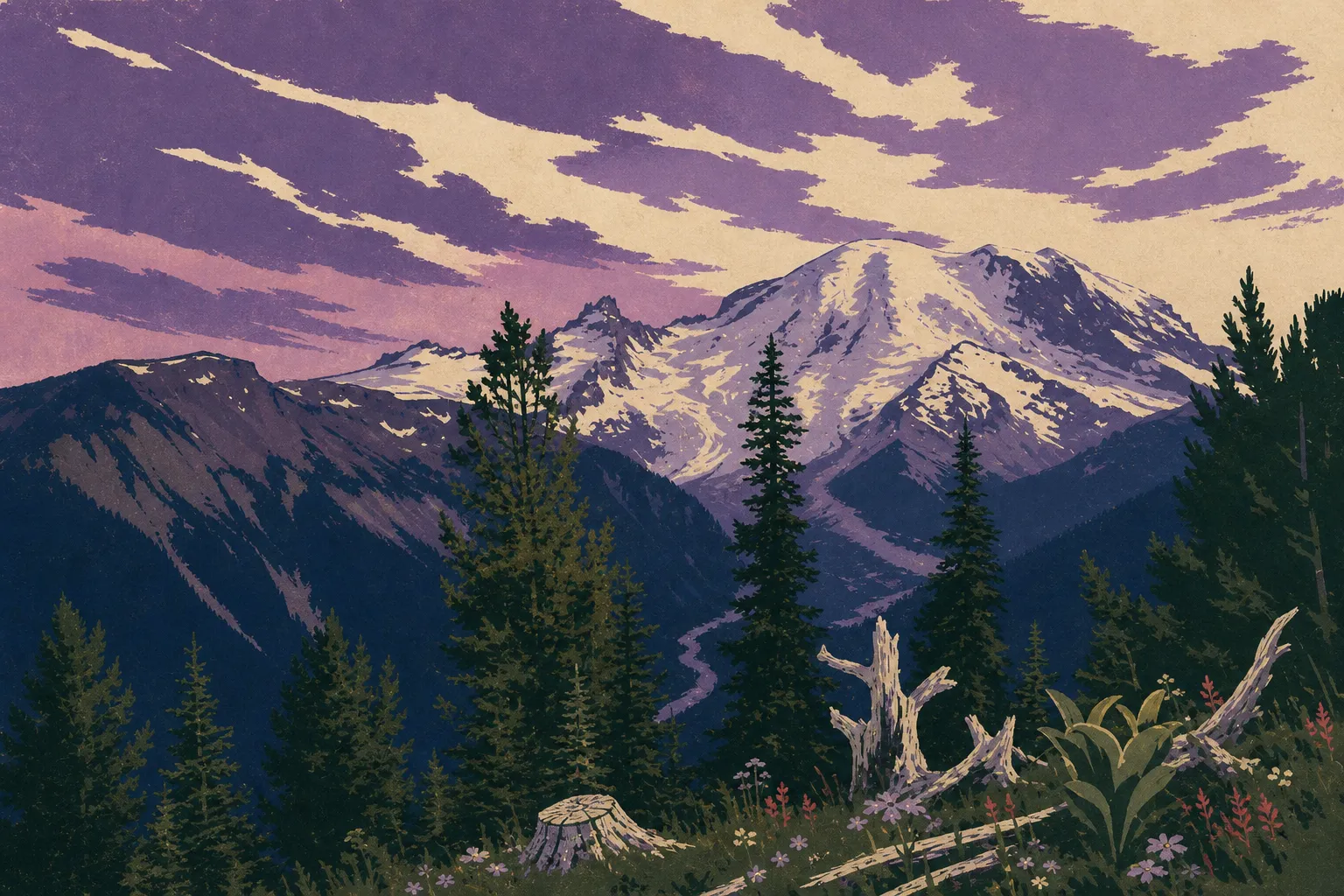
Mount Rainier National Park: The Complete Visitor Guide
A 14,410-foot volcano capped with glaciers, flower-filled subalpine meadows in July, and old-growth forests where trees rise more than 160 feet: Mount Rainier brings several faces of the Pacific Northwest together in one park. It's in Washington State, about a two-hour drive southeast of Seattle. Plan on two full days to see the highlights without rushing, or one day if you're focusing only on the Paradise area. The rest of this page lays out the game plan: where to enter, what it costs, which areas to prioritize, and where to find our detailed guide to each topic.
This page covers the essentials for planning your visit. Each topic has its own detailed guide, linked throughout the page.
Mount Rainier at a Glance: Where the Park Is and How to Get There
The park occupies central-western Washington State. Four major cities lie within 200 miles: Seattle, Tacoma, and Yakima in Washington, plus Portland in Oregon. Most visitors arrive by car from Seattle-Tacoma International Airport.
The park has several entrances, each serving a different area. Nisqually Entrance, in the southwest on State Route 706, is the only one open year-round. It's also the most direct way to reach Longmire and then Paradise. For your GPS, use 39000 State Route 706 E, Ashford, WA 98304. One thing to know: if you arrive outside daylight hours, the entrance station may be closed. Buy your pass online ahead of time through Recreation.gov.
The other entrances, Sunrise in the northeast, Ohanapecosh and Stevens Canyon in the southeast, and Carbon River and Mowich Lake in the northwest, open seasonally. That's generally from early summer through fall, depending on snowmelt and road conditions.
Entrance Fees, Passes, and Reservations
The entrance fee is charged per vehicle and is valid for seven days. Current rates are:
- Private vehicle: $30
- Motorcycle: $25
- Pedestrian or bicyclist (per person): $15
- Mount Rainier annual pass: $55
If you're visiting several U.S. national parks on the same trip, the America the Beautiful pass, valid for one year at all federal recreation sites, quickly becomes a better deal than buying individual tickets. Our National Park Fees and Passes page explains entrance fees and annual passes.
One thing to watch closely is the timed entry system that Paradise may use during the busy summer season in some years. The rules change from year to year. Check the current year's requirements before you leave. We keep this information updated on our Practical Information, Rules, and Safety page.
Reservations, Permits, and Park Rules
Parking Reservations
During the peak season in July and August, the parking lots at Paradise and Sunrise fill up before 10 a.m. Recreation.gov's parking reservation system was introduced to manage the crowds. Check whether it will be in place during the year of your visit. In 2024, timed parking reservations were required at Sunrise on weekends. Reserve as soon as the calendar opens.
Camping and Climbing Permits
Backcountry camping in the park requires a wilderness permit, available through Recreation.gov ($6 per person per night). Campsites near popular trails such as the Wonderland Trail disappear within minutes when seasonal reservations open.
Summit climbs to the 14,410-foot peak require a separate permit: $52 per person, issued by the NPS through Recreation.gov. This remains a high-altitude mountaineering expedition, with crevasses, arctic conditions, and technical gear required.
Park Rules to Follow
Pets are not allowed on trails. They may accompany visitors in developed areas, including parking lots and Longmire, and on paved roads, as long as they're leashed to a maximum length of 6 feet.
Picking plants, flowers, and mushrooms is prohibited in wilderness areas. Campfires are prohibited outside designated fire rings in campgrounds.
The speed limit inside the park is 35 mph, with 25-mph zones around Longmire and Paradise. Wildlife regularly crosses the roads. A moose or deer can appear around any bend.
Getting Around Mount Rainier
Unlike Zion, Mount Rainier doesn't require a shuttle system. You visit by car. The road from Nisqually to Paradise, continuing down toward Stevens Canyon and Ohanapecosh, forms the park's scenic backbone. It's the main route for volcano views.
Build two realities into your plans. First, not all areas connect directly. Getting from Paradise to Sunrise means long stretches of mountain road, so allow plenty of time. Second, the high-elevation roads close in winter. The Nisqually-Paradise connection stays plowed during the day when conditions allow, but sections toward Sunrise, Stevens Canyon, and Mowich Lake are closed for much of the year.
Follow posted speed limits, often 45 mph and much slower on tight curves, and watch for wildlife on the road at dawn and dusk.
How Much Time Do You Need to Visit Mount Rainier?
Plan on at least one full day at Mount Rainier, and ideally two or three days. Here's our approach:
- One day: Focus on Paradise. Enter through Nisqually Entrance, stop at Longmire, drive up to Paradise for a walk through the meadows, and visit one or two viewpoints. It's not enough to see everything, but it's doable.
- Two days: Paradise on day one, then Sunrise or Ohanapecosh on day two. You'll experience two very different settings, with subalpine meadows in one area and old-growth forests and rivers in the other.
- Three days or more: Add Carbon River or Mowich Lake, which feel wilder, and give yourself time to hike.
The distances between areas can quickly eat up half a day. Don't underestimate the drive times. We offer ready-to-follow day-by-day itineraries on our Itinerary and Timing page.
Plan your visit
What to See and Do at Mount Rainier
The park is divided into distinct geographic areas, each with its own character. Here's how we rank them.
Road trip journal · 5 areas
Paradise, the Volcano's Balcony
At about 5,250 feet on the south side, Paradise is the park's signature area and its busiest. The name supposedly comes from an exclamation made when visitors first saw its flower-filled meadows. In July and August, lupines, paintbrush, and anemones cover the meadows, with the ice-capped summit in the background. This is the starting point for the park's most popular hikes, as well as the location of a large visitor center and the historic Paradise Inn.
Longmire, the Historic Gateway
On the road between Nisqually Entrance and Paradise, Longmire is the park's historic birthplace. It has a museum, a year-round information center, mineral springs, and short forest loops. It's an ideal stop to stretch your legs and check on conditions.
Sunrise, the Highest Area Accessible by Car
In the northeast, Sunrise is the highest area in the park reached by road. The view of Rainier's north face and Emmons Glacier is striking. Keep in mind that Sunrise Road opens late, often in early July, and closes in the fall. This area is strictly seasonal.
Ohanapecosh and Stevens Canyon, Old-Growth Forests and Waterfalls
In the southeast, Ohanapecosh takes you into a lush old-growth forest, with the famous Grove of the Patriarchs Trail and its ancient trees. Stevens Canyon Road connects this area to Paradise, with viewpoints and waterfalls along the way, including Narada Falls.
Carbon River and Mowich Lake, the Wild Side
In the northwest, these two remote areas offer temperate rainforest at Carbon River and an alpine lake at Mowich Lake. Access is more basic, and roads may be unpaved or closed. They're best for visitors who've already seen the rest and are looking for solitude.
Explore the park
The Best Hikes at Mount Rainier
Mount Rainier is a hiker's paradise, from a paved family-friendly trail to challenging high-elevation traverses. A few essentials to know are the Skyline Trail at Paradise, an exposed loop with glacier views; gentler meadow trails in the same area; the Grove of the Patriarchs Trail at Ohanapecosh; and, for experienced hikers, sections of the Wonderland Trail, the multi-day loop that circles the entire volcano.
You'll find distances, elevation gain, difficulty, opening dates, and safety tips on our Hiking page.
The detailed guide Hiking at Mount Rainier: The Best Trails for Every Skill Level Skyline Trail, Burroughs Mountain, and Grove of the Patriarchs Trail Read the guide →Wildlife and Plants to Watch For
The park is home to Cascade marmots, black-tailed deer, mountain goats on the ridges, black bears in the forest, and abundant birdlife. As for plants, the star is still the burst of wildflowers in the subalpine meadows in midsummer, a display that lasts only a few weeks.
The golden rule is the same everywhere: keep your distance, never feed an animal, and secure all food. Our Wildlife page covers the species, best viewing spots, and seasons.
The detailed guide Mount Rainier Wildlife: What to See and Where Mountain goats, marmots, black bears, elk, and pikas Read the guide →When to Visit Mount Rainier
The park's climate is cool and wet, shaped strongly by the Pacific Ocean and elevation. July and August are the sunniest months, with summer highs around 59 to 79°F. This is also the season for wildflowers and fully open roads. The tradeoff is the crowds.
Spring, fall, and winter are very rainy, and mountain weather changes quickly. At Paradise, winter can stretch from November through May, with several yards of snow on the ground. The park remains open year-round, but winter changes the experience, with snowshoeing and skiing, and closes many roads.
The detailed guide When to Visit Mount Rainier: Best Time and Weather The best time to visit Mount Rainier Read the guide →Where to Stay at Mount Rainier
Two historic lodges are inside the park: Paradise Inn at Paradise and National Park Inn at Longmire, which is open year-round. Rooms sell out months ahead. Outside the park, the small town of Ashford near Nisqually Entrance has lodges, cabins, and vacation rentals, as do communities near the other entrances.
For camping, the park has several campgrounds, most of them open seasonally. Reservations are strongly recommended for summer campers.
Stay in the park
Around Mount Rainier: Things to Do Nearby
Rainier pairs well with the other gems of the Pacific Northwest. Seattle and its urban scene are within easy reach. Farther south, Mount St. Helens tells the region's volcanic story. To the west, the Olympic Peninsula and Olympic National Park offer rainforests and wild coastline, while North Cascades National Park awaits to the north.
These stops fit naturally into a regional road trip. Our Road Trips and Regions pages can help you put them in order.
Visiting with Kids: What to Know
Mount Rainier works well for a family trip as long as you pace yourselves. Paradise's paved walks, the Junior Ranger program, easy-to-reach waterfalls, and visitor centers make good anchors. Keep the elevation, possible summer cold, and long drives between areas in mind. Our Family page gathers practical advice for visitors with kids.
Where to Eat in the Park
Food options are limited and concentrated around Longmire and Paradise, with lodge restaurants and snack options. Elsewhere, bring your own picnic and water, especially in the more remote areas. Our Where to Eat page lists dining options and tips for stocking up before you enter the park.
Our Take: Is Mount Rainier Worth the Trip?
Yes, without hesitation, as long as you choose the right window. When we visited Paradise in late July, the flower-filled meadows beneath the volcano were worth the trip on their own. The park offers an unusual concentration of landscapes, from glacier to ancient forest, across manageable distances. Its drawback is also its strength: weather controls everything. A low cloud ceiling can hide the summit completely. Leave some flexibility in your plans and have a backup, and you'll leave won over.
Frequently Asked Questions
Is Visiting Mount Rainier Worth It?
Visiting Mount Rainier is clearly worth it, especially from July through early September, when the high-elevation roads are open and the meadows are in bloom. The park combines a glaciated volcano, old-growth forests, and mountain wildlife in a compact area. The only real risk is low cloud cover hiding the summit, so keep your schedule flexible.
Where Should You Stay at Mount Rainier?
For lodging at Mount Rainier, choose between two historic lodges in the park, Paradise Inn and National Park Inn at Longmire, accommodations in Ashford near Nisqually Entrance, and several seasonal campgrounds. Book well ahead for summer. The complete comparison is in our Where to Stay guide.
How Much Time Do You Need to Visit Mount Rainier?
You need at least one day to visit Mount Rainier while focusing on Paradise, and ideally two or three days to add Sunrise, Ohanapecosh, and time for hiking. Long mountain roads between areas quickly lengthen the drive. Our detailed itineraries are on the Itinerary and Timing page.
What Is the Entrance Fee for Mount Rainier?
The entrance fee at Mount Rainier is $30 per private vehicle, valid for seven days, or $55 for the park's annual pass. The fee is $25 for motorcycles and $15 per person entering on foot or by bicycle. If you're visiting several national parks, the America the Beautiful pass is often a better deal.
Can You Visit Mount Rainier by Car?
Yes, you can visit Mount Rainier by car. There's no required shuttle system, and the scenic road connecting Nisqually, Paradise, Stevens Canyon, and Ohanapecosh serves the main sites. Many high-elevation roads close in winter, however. Details are on our Getting Around page.
What's the Best Area of Mount Rainier?
Paradise is the best area for a first visit to Mount Rainier, thanks to its flower-filled meadows and close-up volcano views on the south side. Sunrise offers the highest viewpoint accessible by road in the northeast, while Ohanapecosh appeals to old-growth forest lovers. Our Things to Do page covers each area.
The American Parks shop
Bring Mount Rainier home
Our park-inspired creations, made to order and shipped to your door.
Latest park news
- Mount Rainier: Fryingpan Creek Bridge Faces Years of ConstructionSince September 28, 2026, the Fryingpan Creek bridge has been under construction at Mount Rainier, a multiyear project that may disrupt access to this part of the park.
- Mount Rainier: Fryingpan Creek bridge, major construction spring 2027, Summerland closedConstruction of the new Fryingpan Creek bridge begins spring 2027; this fall brings tree removal, a closed Summerland lot, and possible delays on White River Road.
- Mount Rainier: Pinnacle Peak Trail Closed by WildfireAn active wildfire has closed the Pinnacle Peak Trail and the surrounding area in the south of the park until further notice.