
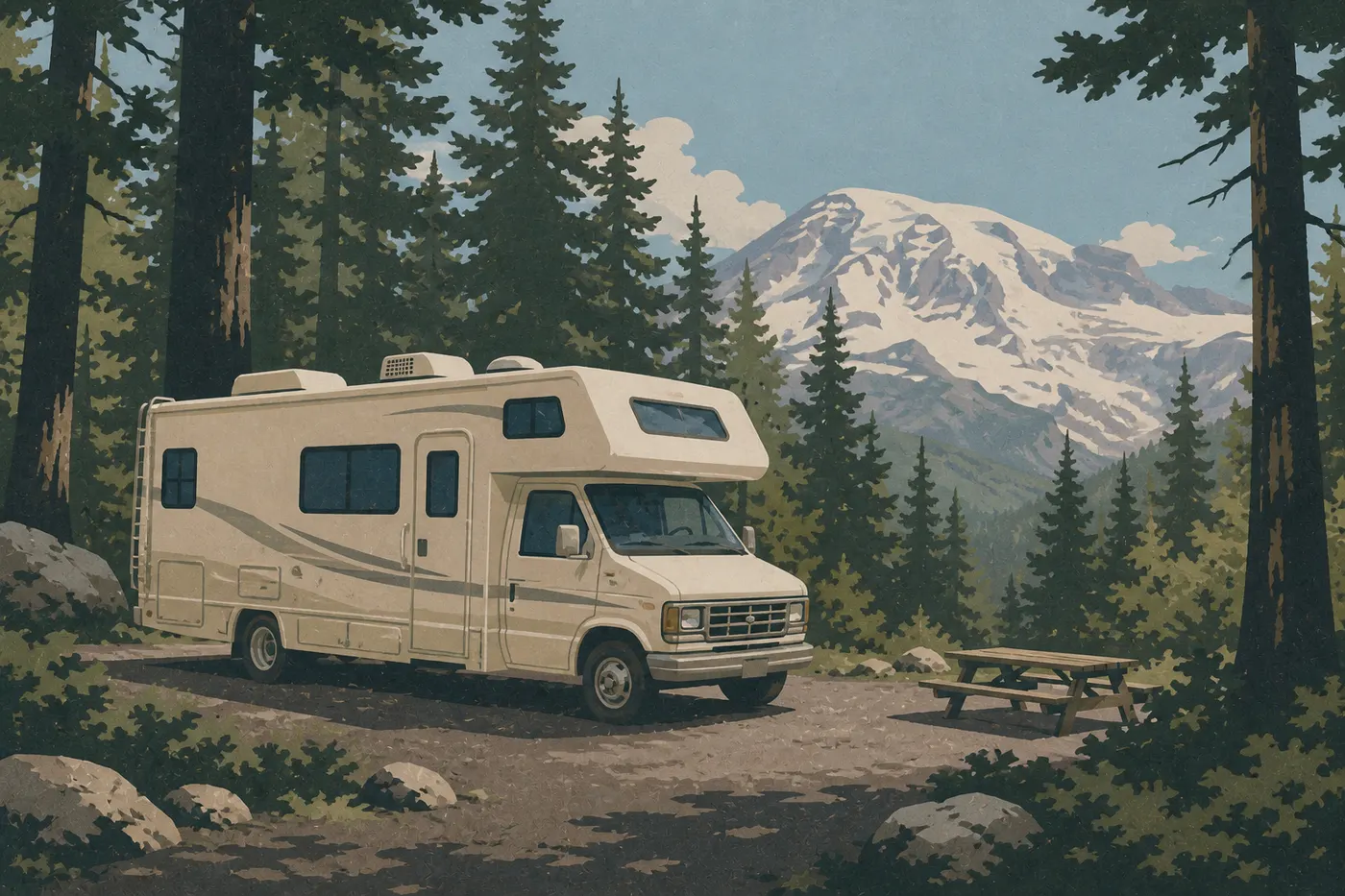
Mount Rainier by RV: Campgrounds, Rules, and Tips
Mount Rainier welcomes RVs at four official campgrounds. There are no electrical hookups, but a snowcapped volcano rising 14,410 feet is always in the background. The main thing to know is that you won't have water, electric, or sewer hookups at your campsite, and two areas are completely off-limits to motor vehicles. The two main routes, Nisqually to Paradise and SR 410 to Sunrise, are paved and suitable for a standard-size vehicle. The complete Mount Rainier guide gives you an overview of the park and its different areas.
Can you drive and camp at Mount Rainier in an RV?
Yes, and you don't need a vehicle-specific permit. Entrance costs $30 per private vehicle, including RVs. The $55 annual pass pays for itself on your second visit and covers all U.S. national parks.
Nisqually Entrance on the southwest side (SR 706, GPS: 39000 State Route 706 E, Ashford) is open year-round. It provides access to Longmire and Paradise, and to Ohanapecosh via SR 410. All four NPS campgrounds in the park accept RVs, subject to site-specific length limits. There are no hookups anywhere, so make sure you have enough water, power, and holding-tank capacity before entering.
To reach Mount Rainier and choose the right entrance for the season, the Mount Rainier Access guide covers roads, seasonal entrances, and shuttles.
RV restrictions and regulated roads
Mount Rainier doesn't have a low-clearance tunnel like Zion, but it does have areas where RVs aren't allowed.
Carbon River Road: repeated flooding turned this road into a pedestrian and bicycle trail. No motor vehicles, not even a compact van, may use it.
Mowich Lake Road: this unpaved road runs over dirt and gravel for several miles. Class C and Class A RVs should stay off it. A lightweight van can technically make it during the dry season, but maneuvering is still difficult.
Paradise parking area: in July and August, the lot fills before 10 a.m. on weekends. Long-vehicle spaces are limited. Arrive before 8 a.m. if you're planning to visit by RV for the day.
Campground length limits: each site lists a maximum vehicle length. Going over it leaves no room to maneuver into the site, and rangers issue citations. Check your total length, including a trailer if you're towing one, before booking.
The park's official campgrounds
Cougar Rock
In the southwest part of the park, about 1.9 miles from Longmire, Cougar Rock is the best-equipped base for RVers visiting the Paradise area. Its 173 sites include some that can accommodate vehicles up to 35 feet. A dump station is available on-site during the season. There are no electrical hookups.
It generally opens from late May through early October. Reservations are available on Recreation.gov up to six months in advance. In July and August, sites disappear within hours of each reservation window opening, so don't wait.
Ohanapecosh
On the southeast side of the park, accessible through Stevens Canyon Entrance, Ohanapecosh is Mount Rainier's largest campground, with 188 sites. Some sites have a maximum length of 32 feet. The setting is wooded and cooler than Cougar Rock. The Ohanapecosh Hot Springs, a short walk away, are worth visiting in the evening.
It generally opens from late May through mid-October. Reservations are available on Recreation.gov.
White River
Reached via SR 410 in the northeast, White River is the starting point for Sunrise and the clearest views of the volcano. It has 112 sites, but the maximum length drops to 27 feet, so a standard Class A won't fit. No reservations are available. Sites are first-come, first-served. The season is short, from late June through late September.
Sunshine Point
The only campground open year-round, Sunshine Point sits a few hundred yards from Nisqually Entrance. Its 18 sites have no reservations and are primarily intended for tents and small vehicles. A Class B van fits comfortably, while a 30-foot Class C will feel cramped.
Dispersed camping and areas around Mount Rainier (boondocking)
Boondocking is prohibited inside the national park. Any overnight stay must be at a designated NPS campground or in the backcountry with the required permit.
The Gifford Pinchot National Forest, which borders the park to the south and east, allows dispersed camping in some areas, either free of charge or for a few dollars. Conditions vary by district, and summer fire restrictions are common. Check with the White Pass district before heading out.
For stays with hookups before or after your park visit, private campgrounds in Ashford, west of Nisqually Entrance, and Packwood, southeast of the park, offer water and electricity.
Dump stations, water, and services
Services inside the park are intentionally limited.
Dump station: available at Cougar Rock during the season. Outside this campground, no dump station is available within the NPS boundary. Plan to dump in Ashford near Nisqually Entrance or in Enumclaw near the northern entrance before entering the park.
Drinking water: available at campgrounds open for the season. Facilities may be shut off at the beginning and end of the season. Check the status on the NPS website before leaving.
Fuel: there are no gas stations in the park. Fill up in Ashford or Enumclaw.
Electricity: no NPS campground has hookups. If you rely on electricity for medical equipment, plan to spend a night outside the park at a site with hookups.
Which campground is right for you?
Family with a Class C up to about 30 feet: Cougar Rock is the clear choice. It has a dump station, sites near Paradise and Longmire, and the largest capacity in the park's western area.
A wooded, quiet setting: Ohanapecosh, on the east side of the park. It's farther from the bustle of Paradise, with the Hot Springs close enough for an evening visit.
Sunrise over the volcano: White River offers direct access to Sunrise. The 27-foot maximum and lack of reservations are easier to manage if you arrive on a Thursday or Friday outside holiday weekends.
Compact van in the off-season: Sunshine Point is open year-round and lets you get close to the park even in November. The roads to Longmire generally remain passable outside periods of heavy snowfall. The Mount Rainier weather guide details conditions month by month.
Renting an RV to visit Mount Rainier
Seattle is the logical base. Seattle-Tacoma International Airport is about 56 miles from Nisqually Entrance. Most major rental companies, including Cruise America, Outdoorsy, and RVShare, operate in the Seattle-Tacoma area.
Camper van (Class B): the easiest vehicle to handle on park roads. It fits in every parking area, including Paradise if you arrive early. Ideal for two people.
Class C up to 30 to 33 feet: a good balance of comfort and maneuverability. Cougar Rock and Ohanapecosh can accommodate it well.
Class A over 33 feet: Cougar Rock may technically accept it at some sites, but Paradise and Sunrise parking areas aren't recommended for it. This option is best for travelers who already know how to handle this type of vehicle in the mountains.
The National Park Fees and Passes page explains entrance fees and pass options.
RVs, pets, budget, and reservations: what to know
Pets: allowed in campgrounds and required to stay on a leash no longer than 6 feet at all times. They're not allowed on hiking trails, in NPS buildings, or in backcountry areas. The Mount Rainier with Kids guide covers the practicalities of traveling with children or pets.
Site budget: expect to pay $20 to $30 per night, depending on the campground and site. Park entrance fees are extra, at $30 per private vehicle or $55 for the annual pass valid in all U.S. national parks.
When to reserve: Cougar Rock and Ohanapecosh sites open six months in advance on Recreation.gov. July and August weekends sell out within hours. Weekdays and the off-season are much less competitive.
Campfires: allowed only in designated fire rings, subject to seasonal restrictions that are common in summer. Check with the ranger station when you arrive.
Best time to visit: July and August offer clear roads and the most stable conditions. For a less crowded trip, mid-September is still workable before the first snow. The When to Visit Mount Rainier guide covers the seasons in detail.
In summary: our Mount Rainier RV plan
We recommend Cougar Rock as the main base for a standard-size RV, especially if you're targeting Paradise and hikes in the western area. For a wilder setting on the east side, Ohanapecosh is just as strong a choice. Dump in Ashford before entering the park, check your total length before booking, and plan from the start to manage without hookups. Mount Rainier rewards self-sufficient travelers.
Frequently asked questions
Can I sleep in my car at Paradise, at Mount Rainier?
No. Sleeping in a vehicle in park parking areas, including the Paradise parking area, is prohibited. All overnight stays must be at a designated NPS campground or in the backcountry with the appropriate permit.
Where should I stay at Mount Rainier?
Where you stay at Mount Rainier depends on your accommodations. The four NPS campgrounds serve tent campers and RVers, while Paradise Inn and National Park Inn offer historic lodges. The Mount Rainier lodging guide covers all categories and rates.
Where are RVs prohibited at Mount Rainier?
RVs cannot access Carbon River Road, which has been converted to a greenway, or Mowich Lake Road, an unpaved route unsuitable for long vehicles. The Paradise parking area is also a poor choice for large RVs during peak season because suitable spaces are limited.
Where can I stay in an RV outside the park?
Around Mount Rainier, RVers can stay at private campgrounds in Ashford and Packwood with hookups, in Gifford Pinchot National Forest on dispersed sites, or at the region's many NPS campgrounds. Road trips from Seattle make it easy to combine Mount Rainier with other parks in the Pacific Northwest.