
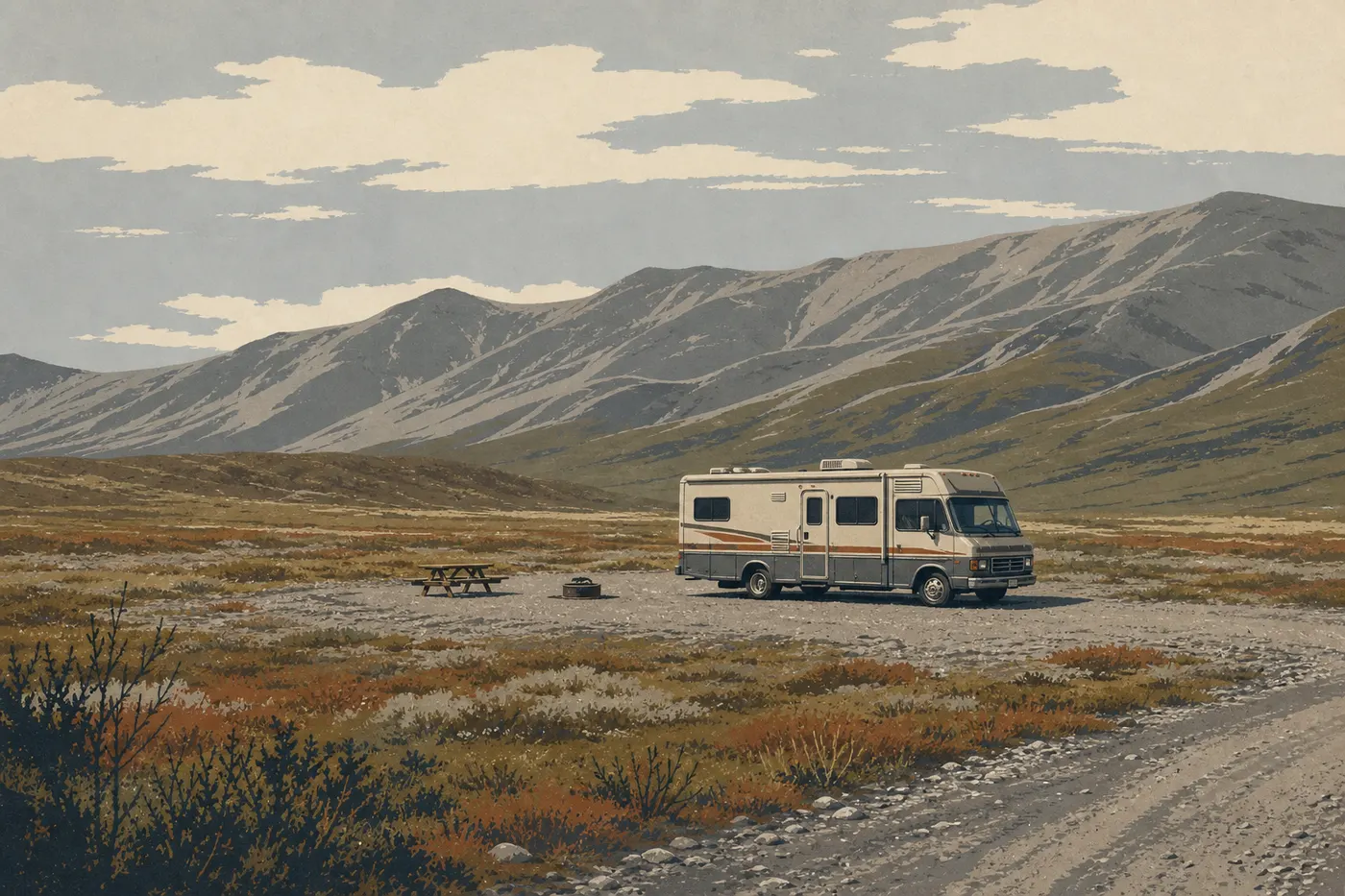
Gates of the Arctic by RV: Campgrounds, Rules, and Tips
The short answer: No, an RV can't enter Gates of the Arctic National Park. The park has no roads or marked trails. To get there, you'll need to take a charter flight or hike in from a drop-off point along the Dalton Highway. An RV is still useful as a mobile base for reaching the park's outskirts and traveling into the Arctic interior by air.
Can you drive and camp in an RV at Gates of the Arctic?
Gates of the Arctic is one of the few American national parks with no road infrastructure at all. No paved road or dirt track crosses or enters the park. The NPS maintains a true wilderness policy here. There are no official marked trails, developed campgrounds, stores, or gas stations.
An RV can't enter the park. You can leave your vehicle along the Dalton Highway, or in Fairbanks, and reach the park by air or on foot from its southern edge.
Restrictions and access: why RV travel stops at the park boundary
The park's southern boundary roughly follows the Dalton Highway, Alaska State Route 11. The highway doesn't officially cross any park entrance. Travelers use two main starting points:
- Coldfoot (mile 175 on the Dalton Highway, about 250 miles north of Fairbanks): the last place with relatively complete services before Deadhorse. Charter flights leave from here for the park's interior.
- Bettles (accessible only by air from Fairbanks): the main entry point for hikers and guided travelers. The NPS maintains a seasonal visitor center here.
There's one critical thing to check before you leave. Much of the Dalton Highway is unpaved gravel. Many Alaska RV rental companies prohibit driving on it under the rental agreement or restrict the size of vehicles allowed. Read your rental agreement before making any reservation.
The Dalton Highway: an RV base camp
For anyone who wants to approach Gates of the Arctic in an RV, the Dalton Highway is the only practical route. From Fairbanks, take Route 2, the Elliott Highway, north, then join Route 11 near Livengood.
Here are a few distance markers from Fairbanks:
- Livengood (Dalton turnoff): about 68 miles
- Coldfoot (last place to refuel): about 250 miles
- Wiseman (historic town and starting point for hiking toward the park's edge): about 258 miles
The road is gravel from Livengood all the way to Deadhorse. Ruts, dust, and flying rocks can damage tires or a windshield. Keeping your speed to 50 mph or less is a basic precaution. Carry at least two spare tires and a tire repair kit. Cell service drops to zero north of Coldfoot.
Dispersed camping and boondocking on the Dalton Highway
Along the Dalton Highway, lands managed by the Bureau of Land Management (BLM) allow dispersed camping without reservations. You don't need a designated site. Set up on level ground away from the road and follow Leave No Trace principles.
Two areas deserve special attention:
- Marion Creek rest area (around mile 180, near Coldfoot): managed by the BLM, with a few informal sites and no electricity or hookups. Free.
- Around Wiseman: parking is tolerated along the shoulders, with a true end-of-the-world feel. Wiseman has only a handful of year-round residents and serves as a starting point for hiking toward the park's edge.
For overnight stays inside the park itself, camping is allowed but completely primitive. There are no facilities, designated sites, or trash collection. Everything goes on your back after you land by plane. Our Gates of the Arctic camping guide explains backcountry camping in the park, including bear precautions. A bear canister is strongly recommended.
Official park campgrounds
There aren't any. Gates of the Arctic has no official campgrounds, RV sites, hookups, or dump stations within its boundaries. That's a permanent feature, not a seasonal gap.
The only structured camping options are outside the park, on BLM land along the Dalton Highway, as described above, or at Coldfoot. Coldfoot Camp has a basic campground with a few sites for small vehicles. Confirm availability directly with the manager before arriving in a large RV.
Dump stations, water, and services
Services are exceptionally scarce along the Dalton Highway. Here's the honest inventory:
- Fairbanks: all options are available, including a dump station, potable water, propane, and supermarkets. Fill up completely here before you leave.
- Yukon River Camp (mile 56): gas station and café, but no dump station or water fill-up.
- Coldfoot Camp (mile 175): diesel and gasoline, food, and basic lodging. RV facilities are limited and change with the season, so call ahead before relying on them.
- Beyond Coldfoot: nothing. Plan your water supplies and holding-tank capacity as if you were heading into the wilderness.
The basic rule is to head back toward Fairbanks while your gray and black tanks are still manageable. Never dump them in the wilderness.
What kind of traveler is this RV trip for?
This isn't an RV trip for beginners. The Dalton Highway calls for a sturdy vehicle, a driver who is comfortable on unpaved roads, and real logistical self-sufficiency. The nearest roadside assistance may take several hours to reach you beyond Coldfoot.
For an experienced RVer or van-lifer, though, this is a complete itinerary in its own right. Expect open tundra as far as you can see, summer midnight light, with the sun barely setting from late June through mid-July, and the rare feeling of standing at the edge of the Far North.
Families with young children will find more comfort and services in parks with developed infrastructure. Our guide to visiting Gates of the Arctic with kids explains why. For a solo or couples' trip, thorough preparation is enough to offset the isolation.
Renting an RV to visit Gates of the Arctic
Fairbanks is the logical starting point for a rental. Some local agencies offer vehicles specifically approved for the Dalton Highway and suited to Alaska's unpaved roads.
Before you sign a rental agreement:
- Ask in writing whether the Dalton Highway is covered.
- Check how many spare tires are included. Two is ideal.
- Choose a short vehicle, under 23 feet, so it's easier to maneuver through narrow passing areas.
- Download offline maps before you leave. There is no cell service north of Coldfoot.
The charter airlines serving the park from Fairbanks and Coldfoot are listed in our guide to getting to Gates of the Arctic. It's useful for combining an RV rental with a tundra drop-off flight.
Budget, pets, and reservations: what to know
Park entry: free. Gates of the Arctic doesn't charge an entrance fee.
Campsite: backcountry camping in the park is free. BLM areas along the Dalton Highway are free as well.
Pets: dogs are allowed in the park, including the backcountry. Keep them leashed where you may encounter other campers, and check with the Coldfoot or Bettles visitor center before putting your pet on a charter flight.
When to book: access to the park depends on charter flights, which fill up quickly in July and August. Book flights as early as January for a summer departure. No reservation is required for an RV trip on the Dalton Highway, but plan around your weather window. Our Gates of the Arctic seasons guide covers conditions month by month, the risk of sudden Arctic storms, and periods to avoid.
The main budget item: it's not the campsite, which is free, but the charter flight from Fairbanks or Coldfoot. A round trip to a drop-off area in the middle of the tundra can cost several hundred dollars per person.
In summary: our Gates of the Arctic RV plan
- Fairbanks: rent the RV and stock up on everything, including water, food, diesel, and spare tires.
- Dalton Highway: drive carefully, keep to 50 mph or less, and protect the windshield.
- Coldfoot or Wiseman: park the RV and reach the park's interior by charter flight or on foot from the edge.
- Primitive camping in the park: tent, Arctic sleeping bag, bear canister, and strict Leave No Trace practices.
- Return to Coldfoot: pick up the RV and head back toward Fairbanks for a complete dump and refill.
This trip combines two ways of traveling. The RV serves as a mobile base on the Dalton, while the plane provides access to the deep Arctic. Our complete Gates of the Arctic guide covers every aspect of the trip.
Frequently asked questions
Can you camp at Gates of the Arctic?
Yes, you can camp at Gates of the Arctic, but only in primitive backcountry conditions. There are no developed campgrounds in the park, no designated sites, no electricity, and no restrooms. You hike in or get dropped off by charter flight, then camp in the open tundra.
Can you visit or drive through Gates of the Arctic in an RV?
No. The park has no roads, so an RV can't enter. Access is by charter flight from Fairbanks or Coldfoot, or on foot from the southern edge via the Dalton Highway.
Can you park an RV anywhere in the park?
The question doesn't arise because no road leads into the park. RV parking is available along the Dalton Highway on BLM land and at Coldfoot, outside the park boundaries.
Where should you land to reach Gates of the Arctic?
The two main entry points are Fairbanks, with access to the Dalton Highway and charter flights, and Bettles, a village south of the park with a seasonal NPS visitor center. Coldfoot, accessible by RV via the Dalton, also has seasonal charter flights to the interior.