
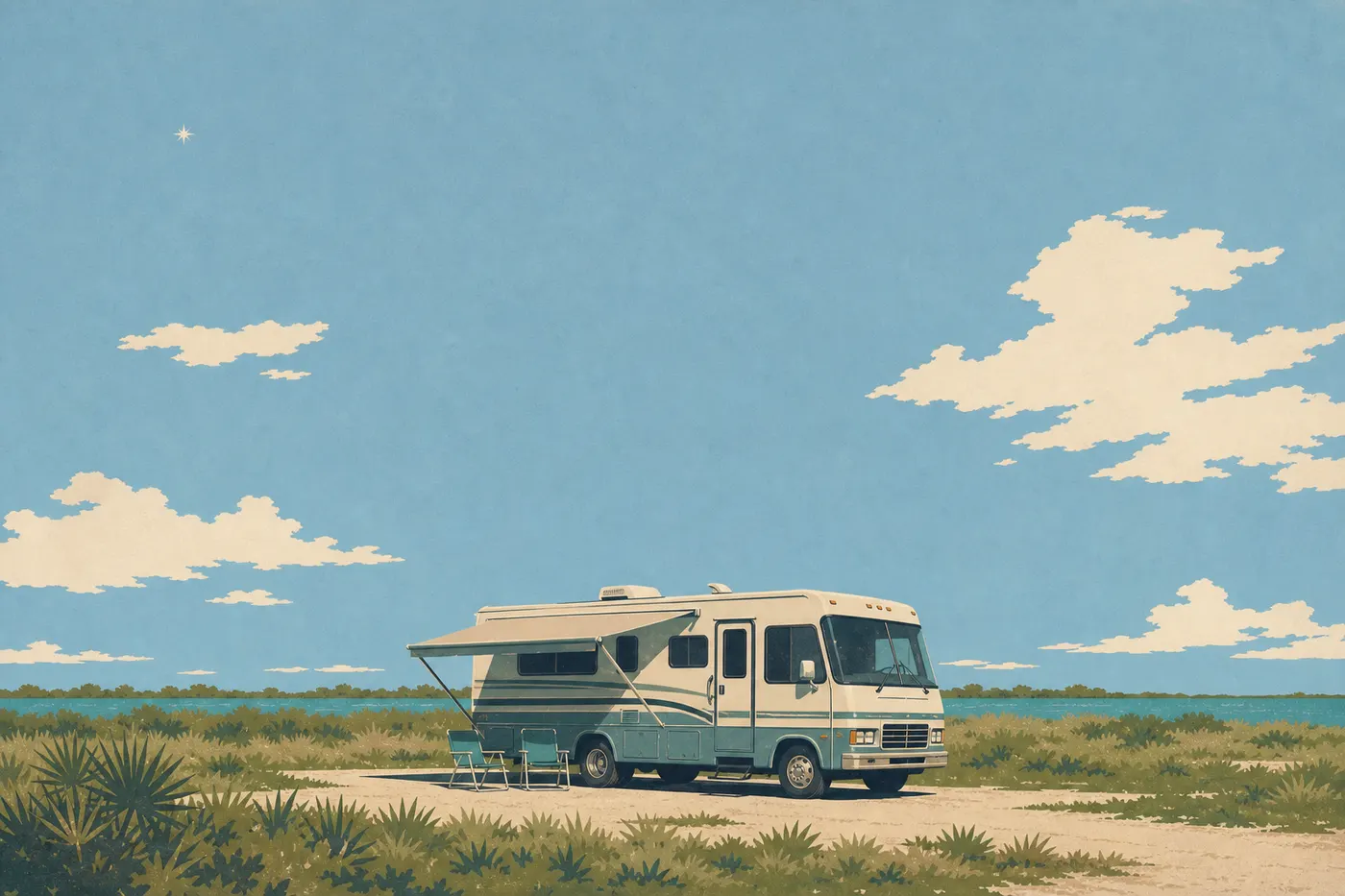
Everglades by RV: Campgrounds, Rules, and Tips
The Everglades welcome RVs, and do so quite well. The park has two reservable NPS campgrounds, a dump station at Flamingo, and a flat main road with no height or length restrictions. The biggest challenge isn't the size of your vehicle. It's the season. During the wet season, from mid-May through November, oppressive heat, swarms of mosquitoes, and flood risks can turn a stay into an ordeal. In the dry season, from December through mid-May, it's one of the Southeast's most unusual RV experiences.
Can you drive and camp in the Everglades by RV?
Yes, without reservation. The park's main road, State Road 9336, connects the Ernest Coe entrance with Flamingo along about 37 miles of flat, open pavement. There are no tunnels, tight turns, or height or length restrictions on this route. A 30-foot Class A motorhome can get through just as easily as a camper van.
There are two separate entrances. The main entrance at Homestead is the busiest and provides access to Long Pine Key and Flamingo campgrounds. The Gulf Coast entrance at Everglades City, in the northwest, serves the Ten Thousand Islands area. Both are easy to reach by RV.
The entrance fee is $35 per private vehicle and is valid for 7 days. The NPS Annual Pass costs $70 and covers all U.S. federal recreation areas.
RV restrictions and regulated roads
The Everglades is one of the most RV-friendly parks in the NPS system. There are no low-clearance tunnels, hairpin turns, or 18-percent grades. A few points still deserve your attention.
Unpaved roads. Unpaved roads inside the park are off-limits to ordinary motor vehicles. Shark Valley's Tram Road is reserved for bicycles and organized shuttles.
Parking at visitor areas. The overlooks and picnic areas along the main road have parking lots, but some can't accommodate longer vehicles. Check the sign at the entrance to each area before maneuvering.
Wet season. Between June and October, heavy rain can lead to temporary closures of campground access roads or parking areas. Check NPS alerts at nps.gov/ever before you leave.
Generators. Generator use is limited at both campgrounds. The usual permitted hours are around 8 a.m. to 8 p.m. Check with the visitor center when you arrive.
The park's official campgrounds
Everglades National Park has two campgrounds that can accommodate RVs. Reservations are made through Recreation.gov and are essential during the dry season.
Long Pine Key
About 6 miles from the Ernest F. Coe Visitor Center, Long Pine Key offers open-loop sites suited to standard-size RVs. There are no electrical hookups, so this is dry camping, but restrooms and showers are available.
It's an ideal base for exploring the Long Pine Key trails and the bird-filled prairies in the northern section. The atmosphere is quiet beneath a pine canopy that filters the late-afternoon light. When we visited in February, the silence after 9 p.m. was almost absolute, a rare luxury in Florida.
Rate: about $30 per night. Open primarily during the dry season.
Flamingo
Flamingo is the Everglades' most developed campground, at the southern end of the park, 37 miles from the main entrance. It offers RV sites with electrical hookups, as well as an on-site dump station.
The hookup sites accommodate the vast majority of RVs on the market, including common Class B and Class A motorhomes and fifth wheels. Recreation.gov lists the available length for each site when you book. Check it if you're driving a long vehicle.
The marina is just steps away. Manatees often swim up the channel in the morning, and sunsets over Florida Bay are a well-earned reward after 37 miles of straight road.
Rate: about $30 to $40 per night, depending on the site.
Dispersed camping and areas around the Everglades
The national park doesn't offer dispersed RV camping, but Big Cypress National Preserve, which borders the Everglades to the north, allows it in designated areas, including for RVs. Some roads, including Loop Road and Turner River Road, are passable in dry weather with a vehicle that has low ground clearance. Avoid them in a large Class A motorhome unless you've checked the route first.
Immediately outside the park, Homestead and Florida City have several private RV parks. They're a practical alternative if you arrive without a reservation or want a night with full hookups before entering the park.
To combine RV nights with nights in a room, see our Everglades lodging guide.
Dump stations, water, and services
Flamingo's dump station is the most convenient one inside the park and accepts both gray and black water. Potable water is available at Long Pine Key and Flamingo.
Outside the park, Homestead's RV parks offer full services. For longer stays, plan to stop in Homestead before entering the park. Internal facilities sometimes have limited hours during the off-season.
Which campground should you choose?
You're coming to see wildlife, including manatees, alligators, and coastal birds. Choose Flamingo. The marina, channels, and sunsets over the bay are reason enough to drive the extra 37 miles from the entrance.
You're planning hikes or bike rides. Long Pine Key is better located for hitting the trails early, without driving the entire main road.
You want both. Splitting your stay between one night at Long Pine Key and two nights at Flamingo works perfectly for a 3- to 4-day trip. Campground opening dates vary by season. Our Everglades seasons guide has the details.
Renting an RV to visit the Everglades
Miami is the natural starting point for renting an RV before heading to the Everglades. Its international airport and concentration of specialized agencies, including Cruise America, RVshare, and Outdoorsy, make it the most convenient hub, about an hour's drive from Homestead.
For this park, a 20- to 25-foot vehicle, such as a Class C or camper van, is more than enough. The main road is wide, the sites are generous, and there are no obstacles to navigate around. A 30-foot Class A motorhome can get through easily too, provided you're comfortable behind the wheel.
Expect to pay $150 to $250 per day in high season for a Class C vehicle, not including fuel.
Pets, budget, and reservations: what to know
Pets. Pets are allowed in the campgrounds and along the park roads. They must be leashed, with a maximum leash length of 6 feet. Don't leave pets unattended in the vehicle, and don't take them onto backcountry trails.
Your RV camping budget. For 4 nights in the Everglades, plan on a $35 entrance fee, or a $70 annual pass, plus $30 to $40 per night for a site. Fuel depends on your vehicle. The Homestead-to-Flamingo drive is about 75 miles round-trip.
Reservations. Book through Recreation.gov. During the dry season, Flamingo's hookup sites fill quickly as soon as the reservation window opens, 6 months before arrival. Don't wait.
Our Everglades RV plan at a glance
Enter through Ernest Coe in the morning. Spend the first night at Long Pine Key, take a trail at sunrise, then move on to Flamingo for two nights. Use the dump station there before heading back toward Miami or the Florida Keys. Aim for December through March, before the heat and mosquitoes take over again.
Frequently asked questions
How do you camp in the Everglades?
Most camping in the Everglades takes place at the two NPS campgrounds: Long Pine Key, for dry camping without hookups, and Flamingo, with electrical sites and a dump station. Reservations are made through Recreation.gov. You need a wilderness permit for primitive sites reached by kayak.
Can you sleep in the Everglades?
Yes. You can stay overnight at an NPS campground or at a backcountry site, with a kayak and permit required. There is no lodge inside Everglades National Park. Our Where to stay page lists all lodging options in the area.
Can you camp in an RV at Everglades National Park?
Yes. Long Pine Key and Flamingo campgrounds accommodate RVs. Flamingo also has electrical hookups and a dump station. The park's main road has no height or length restrictions for standard RVs.
How do you get around the Everglades?
Most visitors explore by car or RV via State Road 9336, from Ernest Coe to Flamingo, a distance of about 37 miles. For getting around the park by area, see the dedicated guide.