
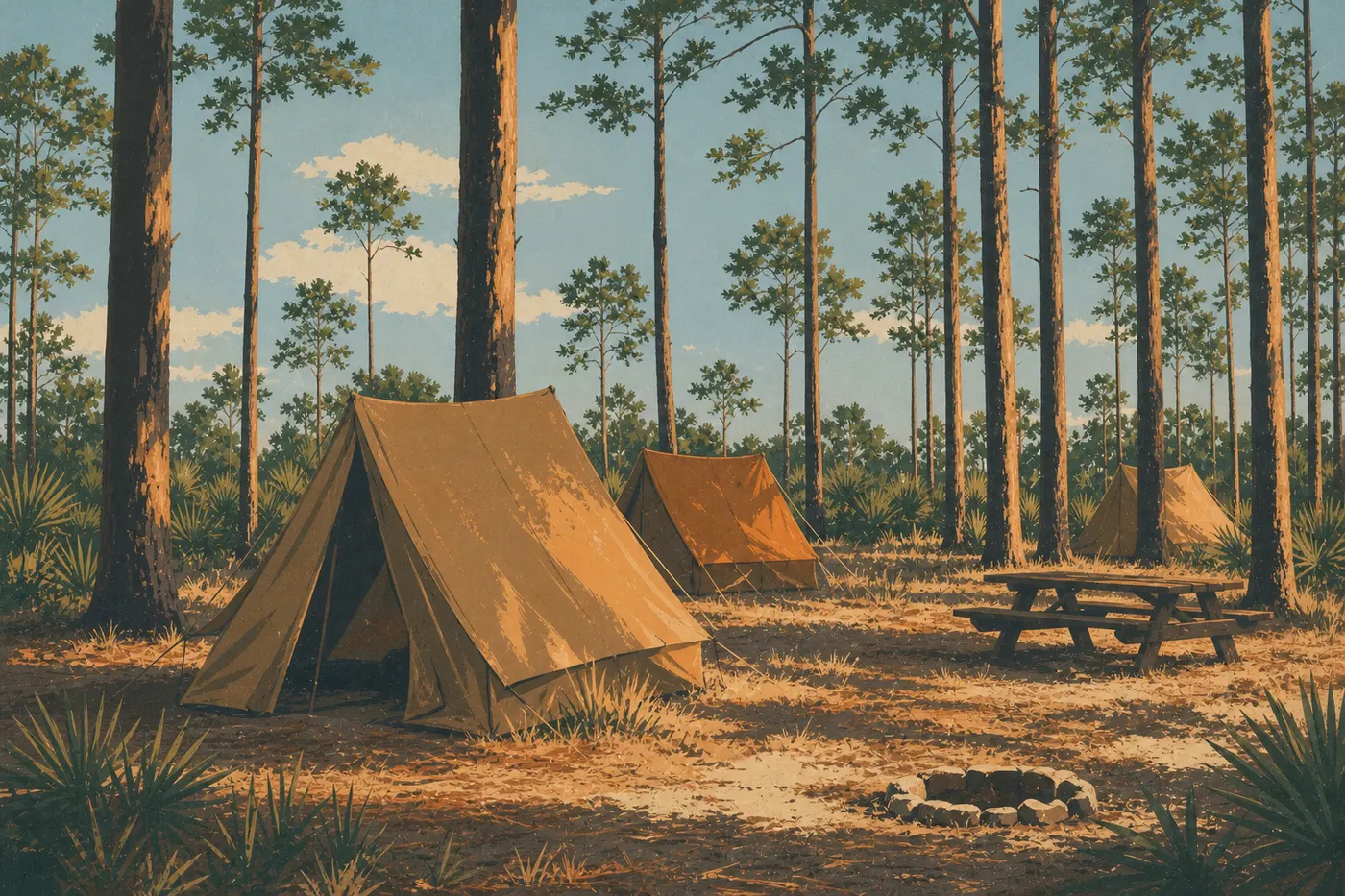
Camping in the Everglades: 2 NPS Campgrounds, Fees, and Reservations
In a nutshell: Two NPS-operated campgrounds let you camp inside Everglades National Park, for a total of 382 sites. Flamingo, at the end of the road, stays open year-round. Long Pine Key, on the Homestead side, operates only from November through April. Both sites take tents and RVs at $33 per night, with some sites available by reservation and the rest first-come, first-served.
Campgrounds in the park (2)
- Campground Long Pine Key Campground see NPS · 108 sites Directions ↗
- Campground Flamingo Campground see NPS · 274 sites Directions ↗
 Base map © OpenStreetMap · © CARTO
 Everglades campgrounds by the numbers
2 official campgrounds inside the park, 382 campsites in total, 267 of them reservable.
| Campground | Sites | Booking | Fee / night | Open | Amenities |
|---|---|---|---|---|---|
| Flamingo Campground | 274 (274 tent only, 65 RV only, 41 electric hookups, 3 group) | Reservations and first come | from $33 | Year round | toilets, showers, potable water, dump station, camp store, firewood, cell service |
| Long Pine Key Campground | 108 (108 tent only, 108 RV only, 1 group) | Reservations and first come | from $33 | Closed May 1 to Oct 31 | toilets, showers, potable water, dump station, cell service |
Source: National Park Service (NPS API), retrieved October 6, 2026. Fees and dates change: check the campground page before you go.
Can you camp inside the Everglades?
Yes, camping is allowed inside the park. Two drive-in campgrounds are open to the public: Flamingo at the southern end and Long Pine Key on the Homestead side. Dispersed camping is prohibited except at officially designated backcountry sites, and you'll need a permit. Wood fires are prohibited outside the fire grates provided on site.
Campgrounds in the park
Long Pine Key
Long Pine Key is about 6 miles from the Ernest F. Coe Visitor Center entrance, on the Homestead side. It's the most accessible campground from Miami, with 108 sites for tents and RVs, no electrical hookups, and one group site. Amenities include restrooms, showers, running water, a dump station, and Wi-Fi.
The site's main advantage is that the Long Pine Key trails start right from the campground, making it an ideal spot for seeing egrets in the pine hammocks. In the evening, the golden light over the prairies is worth the trip on its own.
One thing to watch: Long Pine Key is closed from May through October. If you're visiting during that period, Flamingo is your only drive-in option inside the park.
Flamingo
Flamingo sits at the southern end of the park, 37 miles from the main entrance. It's the larger of the two NPS campgrounds, with 274 sites, and the only one open year-round. The options are varied: 234 individual drive-in sites, including 55 with views of Florida Bay; 40 walk-up sites, including 9 along the water; and 3 group sites on the waterfront.
For RVs, 65 sites are set aside for large rigs, including pull-through sites, and 41 have electrical hookups. Amenities are comprehensive: restrooms, showers, running water, a dump station, a seasonal store, a firewood sales point, and Wi-Fi.
The location is ideal for kayaking toward the Ten Thousand Islands or reaching the backcountry chickees. The trade-off is the remoteness, which means you'll need to plan everything ahead of time, including fuel, water, and provisions, before you arrive.
RV or tent: which site should you choose?
Both campgrounds accommodate RVs up to 35 feet long. The 41 electrical hookups are all at Flamingo. Long Pine Key is fully self-sufficient, and generators are allowed only during the hours specified in the regulations.
For tent camping, Long Pine Key's pine canopy offers better protection from the afternoon heat than Flamingo's more open terrain. At Flamingo, the waterfront walk-up sites offer a closer connection to the natural surroundings.
If you're deciding between camping and another type of lodging, our Everglades lodging guide compares all the options available around the park.
Camping nearby: private campgrounds outside the park
When the park is full, which happens often from December through April, Homestead and Florida City offer several private campgrounds within 30 minutes of the Ernest F. Coe Visitor Center entrance. They often have full RV hookups, a pool, and Wi-Fi, services that not all park campgrounds provide.
Details on these off-site options are in our Where to Stay guide.
Backcountry camping: spend the night in the wild
The Everglades have one of the most distinctive backcountry networks in the United States. Sites fall into three categories: chickees, raised wooden platforms over the water; ground sites, firm ground on island areas; and beach sites along the Gulf of Mexico.
To reach them, you'll need a backcountry permit issued by the park, available online or at the Ernest F. Coe Visitor Center. Most sites are accessible only by kayak or canoe. Distances are long, there are no drinking-water supplies along the way, and waste disposal in the swamp environment follows strict rules. The payoff is an overnight stay on a chickee in the mangroves, an experience unlike any other in an American national park.
For route details and permit rules, our Everglades hiking guide covers the backcountry routes and permit requirements.
How and when to reserve a campsite in the Everglades
Reservations for Flamingo and Long Pine Key are made through the park concessioner's website. The booking window generally opens six months in advance. During the busy season, from December through April in the dry season, the best sites can go within hours of the calendar opening. Both campgrounds use a mixed system: some sites can be reserved ahead of time, while others remain first-come, first-served.
Our advice is to reserve as early as possible if you're targeting Flamingo in January or February. In the off-season, from May through November, the heat and humidity keep many visitors away. Long Pine Key is closed then. Flamingo remains open, but conditions are considerably less comfortable.
To choose the right time of year for your priorities, our guide to the best time to visit the Everglades breaks down the two seasons.
Fees: how much does a night of camping in the Everglades cost?
Both campgrounds charge the same rate: $33 per night per site, whether you're in a tent or an RV without a hookup. Sites with electrical hookups at Flamingo may be priced differently, so check the page's summary table or the reservation page for exact amounts. The backcountry permit is an additional fee.
These rates don't include the park entrance fee: $35 per private vehicle or $20 per person entering on foot or by bicycle. The America the Beautiful Pass, $80 per year, covers entrance but not camping.
For entrance fees and annual passes, see the National Park Fees & Passes page.
Camping safety and best practices
Alligators: the 16-foot rule
The Everglades are home to a dense alligator population. The rule is nonnegotiable: keep at least 16 feet away from any alligator you see. Feeding an alligator is a federal offense punishable by a fine. After dark, never approach the water without a flashlight. Alligators are present year-round, but they're more active and territorial from May through September during the hot season and breeding period. Never leave children or pets unattended near the water.
Mosquitoes: the forgotten major threat
The wet season, from May through November, can turn some areas into a nightmare for anyone who arrives without repellent. Bring DEET- or picaridin-based insect repellent, cover your arms and legs at dusk, and choose a tent with built-in mosquito netting. When we visited in October, skipping this precaution for just one evening was enough to make the night memorable for all the wrong reasons.
Food and storage
Keep all food in airtight containers and store them in your vehicle or in the storage lockers provided on site. Raccoons and opossums are formidable nighttime scavengers.
Heat and hydration
Summer temperatures can climb above 95°F. Bring more water than you think you'll need, especially in the backcountry, where there are no resupply points along the way.
Which campground is right for you?
First visit, arriving by car: Long Pine Key is convenient, close to the trails, and away from Flamingo's crowds. Keep in mind that it closes from May through October.
Kayaking or canoeing, with backcountry access: Flamingo is the gateway to the coastal areas and chickees, and it's open year-round.
RV with an electrical hookup: Flamingo is the top choice, with 41 sites with electricity and a 35-foot maximum length. Reserve early. If the park is full, try the private campgrounds in Homestead.
The most rugged experience: Get a backcountry permit and spend the night on a chickee. Plan on at least two days of paddling.
Our complete Everglades guide brings together all the planning information you need if you're starting from scratch.
Frequently asked questions
Can you sleep in the Everglades?
Yes. Two drive-in NPS campgrounds accommodate tents and RVs: Flamingo, with 274 sites and open year-round, and Long Pine Key, with 108 sites and open from November through April. An extensive network of backcountry sites rounds out the options, accessible by kayak or canoe with a required permit.
How do you reserve a campsite in the Everglades?
Reservations are made through the park concessioner's website. Some sites remain available first-come, first-served at both campgrounds. During the busy season, from December through April, reserve as soon as the calendar opens, generally six months ahead, to get the best choice.
When is alligator season in the Everglades?
Alligators are present in the Everglades year-round. They're more active and territorial from May through September during the hot season and breeding period.
How much does a night of camping in the Everglades cost?
Both campgrounds charge $33 per night per site, whether you're in a tent or an RV without a hookup, excluding the park entrance fee of $35 per vehicle. Flamingo's electrical sites and the backcountry permit carry additional fees, depending on the case.
Which campground is open year-round in the Everglades?
Flamingo is the only campground open year-round, with 274 sites in total. Long Pine Key closes from May through October. If you're visiting the park during that period, Flamingo is your only drive-in option inside the park.