
Everglades Itinerary: What to See in 1, 2, or 3 Days
The Everglades is unlike any other U.S. national park. There are no canyons or geysers, just a 62-mile-wide river of grass flowing silently toward the sea, home to alligators, American crocodiles, and an unusually dense bird population. The good news for planning is that the park is organized around three separate entrances, and each area takes a full day to explore.
Ideal length: 2 days. Spend day 1 on Main Park Road from Homestead to Flamingo, then day 2 at Shark Valley. Add a third day if kayaking through mangroves appeals to you. Only have one day from Miami? It’s doable if you leave at 7 a.m.
How Long Do You Need to Visit the Everglades?
Plan on 1, 2, or 3 days in the Everglades, depending on your time and priorities.
One day (from Miami): focus on SR-9336, from the Ernest F. Coe entrance to Flamingo. Leave early to see wildlife before the heat sets in, and plan to head back in the late afternoon.
Two days: this is the format we recommend. Add Shark Valley, which is worth the trip on its own for its spectacular concentrations of alligators during the dry season.
Three days: round out the trip with Everglades City and a kayak outing in the Ten Thousand Islands, an almost untouched mangrove archipelago.
One limitation to keep in mind is that the park’s three main areas aren’t connected to one another within the park. To get from the main entrance to Shark Valley, you have to go back around the outskirts of Miami, a 1.5-hour drive. Plan your overnight stops accordingly.
To choose the best season, see our guide to the best times to visit the Everglades.
Entrances, Access, and Getting Around the Park
The park has three main entrances spread across South Florida.
The Main Entrance (Ernest F. Coe)
This is the natural starting point for most visitors. The Ernest F. Coe Visitor Center is at 40001 State Road 9336, Homestead, FL 33034. From Miami, take Florida’s Turnpike (Road 821) south to Florida City, then turn right onto SR-9336. Allow 1 hour from downtown Miami.
There’s no shuttle from Miami, so you’ll need a car inside the park, where distances are long. Flamingo, the end of the road, is 37 miles away.
Shark Valley
The northern entrance is on U.S. 41 (Tamiami Trail). From Miami, it’s a 1-hour drive west. This is where you’ll find the park’s highest concentrations of alligators.
Gulf Coast (Everglades City)
The northwestern entrance is accessible from Naples, 31 miles away, or Miami, about 2.5 hours away. It provides access to the mangroves and boat tours.
Entrance fees: $35 per vehicle, $20 per person on foot or by bike, and $30 per motorcycle. The park’s annual pass costs $70. The America the Beautiful pass ($80, valid at all federal recreation sites) is accepted. The park is open 24/7, while entrance stations are staffed from 8 a.m. to 4:30 p.m. The National Parks entrance fees and passes page explains entrance fees and annual passes.
For everything related to getting around inside the park, including bike rentals, tram tours, and boat access, our guide to getting around the Everglades has up-to-date practical information.
The Everglades Areas
The park is organized around three distinct geographic areas, each with its own character.
Main Park Road: From the Main Entrance to Flamingo
This is the most visited corridor. SR-9336 runs 37 miles in a straight line from the Ernest F. Coe entrance to Flamingo, at the southern tip of the park. About a dozen stops line the route, including visitor centers, marked trails, overlooks, and picnic areas.
Highlights include Anhinga Trail at Royal Palm, Pa-hay-okee Overlook for panoramic views of the sawgrass prairie, and Flamingo, where American crocodiles live. Their snouts are more pointed and their coloring grayer than those of alligators. Wildlife is abundant along the entire corridor, especially early in the morning.
Shark Valley
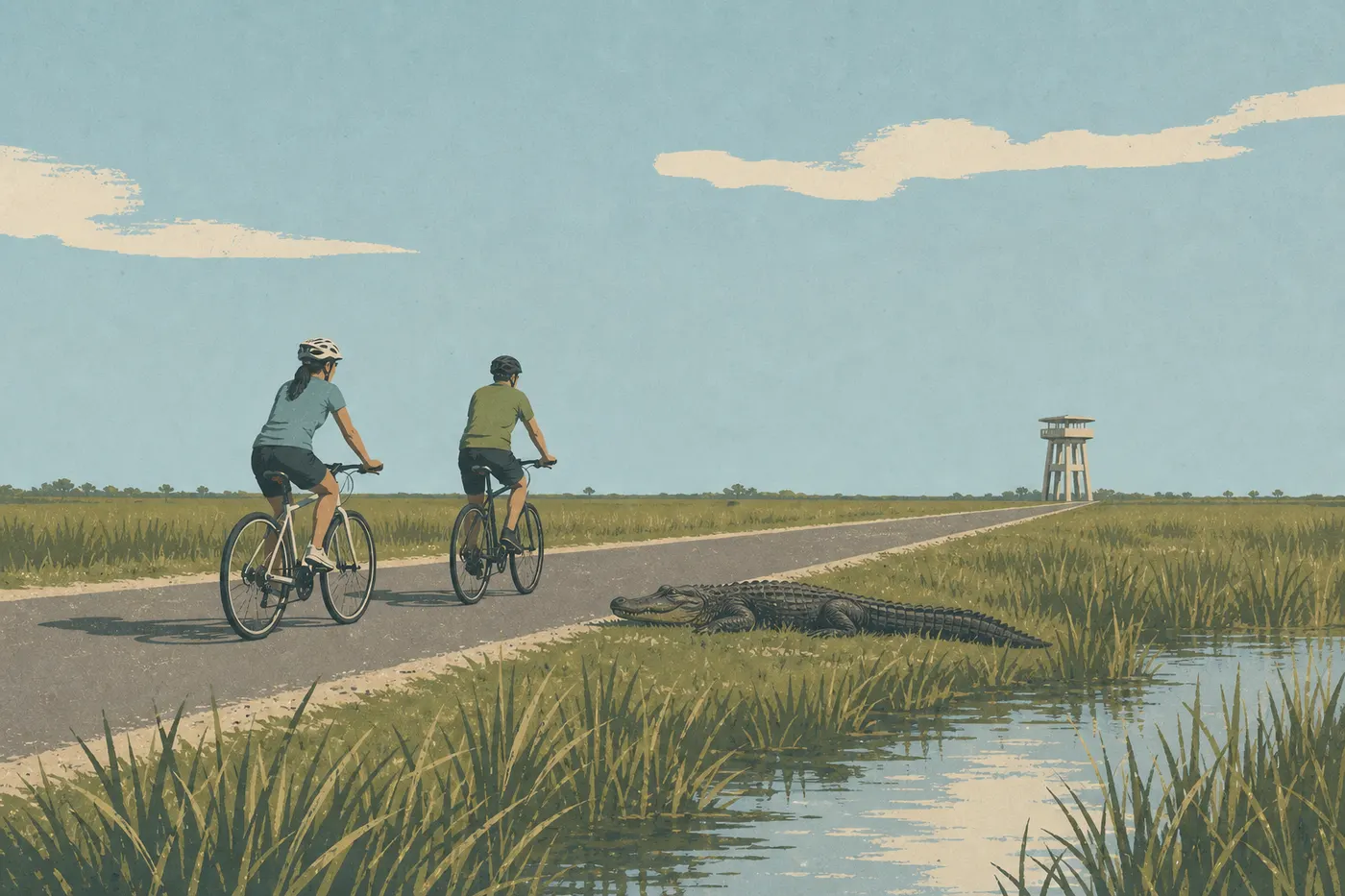
The name “valley” is misleading. This is a sawgrass plateau crossed by a 15-mile paved loop. You can ride it on a guided tram tour, which takes 2 hours and departs hourly starting at 9 a.m., or by bike, with rentals available on-site for about $9 an hour. An observation tower rises 49 feet at the center of the loop and offers 360-degree views across the Everglades. During the dry season, from December through April, hundreds of alligators line the road.
Everglades City and the Gulf Coast
This entrance leads to a landscape radically different from the other two: mangroves, winding channels, and the Ten Thousand Islands. There’s no real land trail here. This is kayak, canoe, and motorboat country. The Gulf Coast Visitor Center provides detailed paddle maps showing the marked routes. Several local outfitters offer guided full-day or half-day trips.
Day-by-Day Itinerary
Day 1: From the Main Entrance to Flamingo
7 a.m.: Leave from Homestead or Florida City, the closest lodging bases to the main entrance.
7:30 a.m.: Stop at Ernest F. Coe Visitor Center. Pick up the park’s free paper map, handed out at the entrance. Cell service is nearly nonexistent beyond Royal Palm. Also check trail conditions, especially during the wet season when some trails flood.
8 a.m.: Royal Palm. Anhinga Trail is a flat 1-mile trail that takes about 45 minutes. It follows a canal where anhingas, green herons, and roseate spoonbills let you approach within just a few feet. This trail has the highest concentration of wildlife in the entire park, so don’t miss it, especially this early in the day. Follow it with Gumbo Limbo Trail, a 0.4-mile loop that takes about 20 minutes and passes through a forest of dwarf palms and strangler figs. The lush, humid setting is a striking contrast to the prairie.
10 a.m.: Drive to Flamingo. Stop at Pa-hay-okee Overlook, a raised overlook that takes 10 minutes to visit, for views across the vast green sawgrass. Then take Mahogany Hammock Trail, a 0.7-mile loop that takes about 30 minutes. It passes through a dense forest of mahogany trees with a muggy atmosphere and looks nothing like what you saw that morning. This is one of the contrasts that makes the drive so fascinating.
Noon: Picnic at West Lake. Tables are available on-site. West Lake Trail runs 1.5 miles along a lake surrounded by mangroves. It’s one of the few places in the park where alligators and American crocodiles share the same body of water.
2 p.m.: Flamingo. This is the end of the road, 37 miles from the entrance. The marina offers boat tours, so book ahead during the busy season. American crocodiles sometimes bask right beside the road to the marina. Starting at 5 p.m., mosquitoes take over, so head back or cover up completely.
Return: Allow 1 hour to get back to Homestead. For lodging options in the area, including Flamingo Campground, which should be booked early, see our guide to lodging in the Everglades.
Day 2: Shark Valley
8 a.m.: Leave from your base in Homestead, Miami, or a town along U.S. 41.
9 a.m.: Arrive at Shark Valley. Reserve your tram as soon as you arrive, or choose a bike if you prefer to set your own pace. The loop covers 15 miles on a flat, paved road. There’s almost no shade along the route, so a wide-brimmed hat, high-SPF sunscreen, and at least 2 liters of water per person are essential.
The tram stops at the observation tower halfway around the loop. Climb the 65 steps for the view. From January through March, alligators occupy virtually every stretch of the road, sometimes lying across it. The NPS rule is to stay at least 13 feet away. In practice, they decide.
1 p.m.: Lunch at Shark Valley Visitor Center. A snack bar operates during the busy season. Check ahead, since hours vary.
3 p.m.: Return to your lodging or drive to Everglades City, 1.5 hours along U.S. 41, to get ready for day 3.
Day 3: Everglades City and the Gulf Coast
8 a.m.: Gulf Coast Visitor Center. Check the weather conditions before heading out on the water. Book a guided kayak trip, which takes 2 to 4 hours depending on the outfitter. The Ten Thousand Islands form one of the largest mangrove networks on the North American continent. Without a guide, it’s easy to get lost in the channels. If you paddle on your own, stay strictly on the marked kayak routes shown on the Visitor Center map.
Noon: Return to Everglades City. Have lunch by the water, with fried fish, stone crab in season, and local shrimp. Our Everglades restaurant guide lists places in the area.
2 p.m.: Loop Road option. If you’re heading back to Miami on U.S. 41, take a detour onto Loop Road, also known as County Road 94. This partially unpaved road runs 22 miles through Big Cypress National Preserve and offers excellent wildlife-viewing opportunities during the dry season. Bring a vehicle with decent ground clearance, especially after rain.
Options for Different Trip Lengths
Express, one day from Miami. Leave at 7 a.m. Head to Royal Palm first. Anhinga Trail before the heat is nonnegotiable. Then visit Pa-hay-okee Overlook, Mahogany Hammock, and Flamingo for lunch. Return via SR-9336. You’ll be back in Miami around 6 or 7 p.m., with good photos and a few sunburns.
Classic, two days. Drive Main Park Road on day 1 and visit Shark Valley on day 2. This is the most common and balanced option. You’ll see the park’s two faces, a grassy prairie and abundant alligators, without complicated logistics.
In-depth, three days. Add Everglades City and kayaking to experience the park’s third face: mangroves and the sea. Each day takes in a distinct ecosystem.
Regional road trip. After the Everglades, the Florida Keys naturally continue south. Key West is 2.5 hours from Homestead via U.S. 1. To the northwest, Naples and its beaches offer an easy transition before you continue on to Tampa. Find these multi-destination routes in the Road Trips section.
Itinerary Map
The NPS publishes an official Unigrid map of the park. It’s available as a PDF on nps.gov/ever and as a paper map at every entrance. It covers all roads, trails, visitor centers, and campgrounds. Bring a paper copy. Cell service disappears quickly once you’re inside the park, especially beyond Royal Palm. Our Everglades areas map offers an overview of the areas with the main geolocated points of interest.
Where to Stay Along the Itinerary
The park has two campgrounds: Flamingo, at the end of Main Park Road, and Long Pine Key, 7 miles from the Ernest F. Coe entrance. Both can be reserved through Recreation.gov and fill up several weeks ahead during the busy season, from January through March. For hotels and motels, Homestead and Florida City have most of the options near the main entrance. On the west side, Naples offers more comfortable lodging choices. Find all the details, including price ranges and booking tips, on our Where to Stay page.
Extend Your Trip: What to See Around the Everglades
South: the Florida Keys begin at Homestead via U.S. 1 and stretch 124 miles to Key West. Diving, snorkeling, and fishing charters are the main draws.
Northwest: Big Cypress National Preserve borders the park and offers similar wildlife with far fewer visitors. Loop Road is its gateway.
Toward Naples: the city is 1.5 hours from Everglades City. It’s a natural starting point for the west coast beaches before you continue north to Tampa or Orlando.
Explore these multi-park extensions and regional routes in the Regions section.
The Ideal Itinerary for Your Available Time
You have 1 day: drive SR-9336 to Flamingo. Make Anhinga Trail your top priority before 9 a.m. You need to leave Miami at 7 a.m.
You have 2 days: add Shark Valley on day 2. It offers the best balance of effort and discovery, and it’s the option we recommend to anyone visiting the Everglades for the first time.
You have 3 days: add Everglades City and a kayak trip through the mangroves. Each day takes in a radically different ecosystem, which is the park’s real strength.
In every case, bring plenty of water, since there are few fountains inside the park, along with high-SPF sun protection and effective mosquito repellent. The Everglades is one of the few U.S. parks where nature can genuinely put you in a difficult situation, and that’s precisely what makes it unforgettable. For detailed safety rules, including distances from alligators and what to do during a thunderstorm, see our Everglades guide.
Frequently Asked Questions
How long do you need to visit the Everglades?
Plan on 2 days to cover the two main areas, SR-9336 and Flamingo plus Shark Valley. A third day lets you add Everglades City and kayaking through the mangroves. An express one-day visit from Miami is possible if you leave at 7 a.m.
Which road runs through the Everglades?
The main road is SR-9336. It starts at Ernest F. Coe Visitor Center in Homestead and crosses 37 miles of the park to Flamingo at the southern tip. U.S. 41, or Tamiami Trail, follows the park’s northern edge and provides access to Shark Valley from Miami.
What’s the best place to visit in the Everglades?
Each entrance has its own strength: Royal Palm for wildlife, especially the must-see Anhinga Trail; Shark Valley for hundreds of alligators along the 15-mile loop; and Everglades City for mangroves and kayaking. If you only have half a day, choose Royal Palm.
What’s the closest city to the Everglades?
Florida City and Homestead are the closest service towns to the Ernest F. Coe main entrance. Miami is about 1 hour north. Naples is the main hub on the west side for the Gulf Coast entrance at Everglades City.