
Black Canyon Of The Gunnison National Park: The Complete Visitor Guide
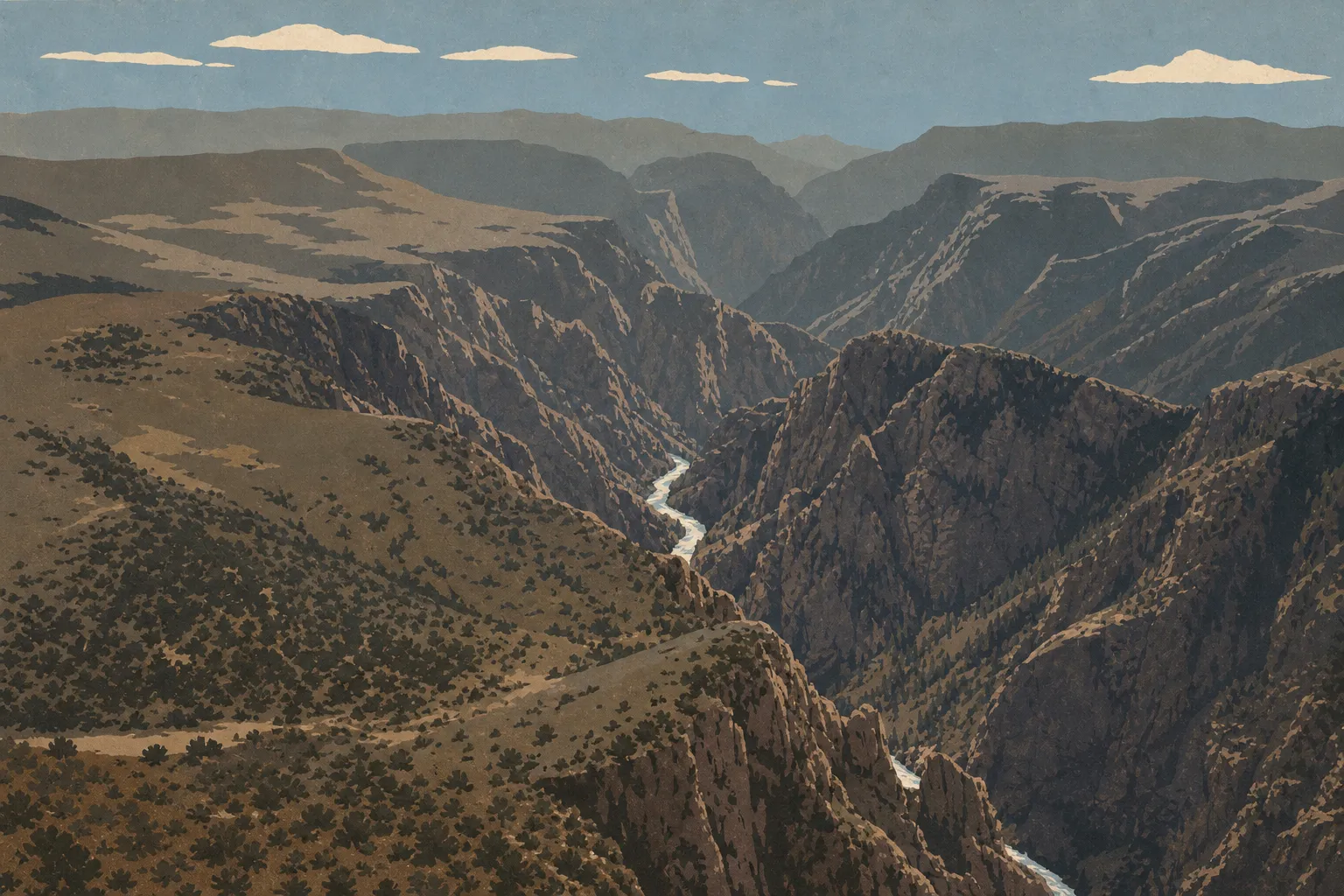
Some parks are places you drive through. Others stop you in your tracks. Black Canyon of the Gunnison belongs in the second category. You arrive at the edge of a nearly vertical, black-rock chasm, with the Gunnison River reduced to a silver thread far below. The vertigo hits right away, and that is exactly what people come here for.
The quick answer: Black Canyon of the Gunnison is a national park in western Colorado, known for its narrow, dark, vertiginous canyon carved by the Gunnison River. You visit from two rims, the South Rim (easy to reach) and the North Rim (remote and open only in summer). Plan on a half day to a full day for the South Rim, or two days if you also want to see the North Rim or descend into the canyon. This is a park you experience from overlooks more than on hikes, and it fits perfectly into a road trip through Colorado or toward Utah.
Black Canyon of the Gunnison at a glance: where the park is and how to get there
The park sits in western Colorado, away from the main tourist routes. It centers on a gorge about 12 miles long, with walls that plunge more than 2,600 feet below the overlooks in places. The rock is so dark and the canyon so narrow that some sections get only a few minutes of sunlight each day. That is where the name "black canyon" comes from.
There are two entrances, and they offer completely different experiences.
The South Rim is the main rim, receiving more than 90% of visitors. You reach it via CO 347, traveling about 7 miles north from its intersection with US Highway 50, east of Montrose. The GPS address is 9800 Highway 347, Montrose, CO 81401. This is where you will find the visitor center, the scenic road, and most of the overlooks. It is open 24 hours a day, year-round.
The North Rim is the wild side, across the canyon. It sits about 11 miles southwest of Crawford, reached via CO 92 and then a road that becomes gravel. Be aware that North Rim Road and its ranger station close in winter and early spring. The closure usually begins in mid-November, with reopening in early May. Always check road conditions before heading out.
The key point is that the two rims face each other, but no road connects them inside the park. Getting from one to the other requires a long drive around, taking roughly two to three hours. You cannot simply decide to see both rims on a whim. For the full details on approach routes from Montrose, Denver, or Utah, see how to get to Black Canyon of the Gunnison, and how to get from one rim to the other once you are there.
Entrance fees, passes, and reservations
You pay the park entrance fee once, and it remains valid for seven days on both rims. Current rates are:
- $30 per private vehicle (car or family van).
- $25 per motorcycle.
- $15 per person entering on foot or by bicycle.
If you are visiting several American parks, the math is straightforward. The America the Beautiful annual pass (usually around $80) covers all federal national parks and pays for itself after three or four visits. The park also offers its own $55 annual "Black Canyon" pass, which is worthwhile only if you plan to return several times in the same year. It offers little benefit for a one-time visit.
The good news, compared with parks such as Arches or Zion, is that Black Canyon does not require a timed entry reservation. You show up, pay, and go in. Reservations are only needed for camping and certain guided activities.
Our Fees & Passes page explains entrance fees, free days, and annual passes. If you collect stamps, the South Rim visitor center is waiting for you. We cover it in our Passport & Stamps page.
Reservations, permits, and rules to follow
Entry and reservations
Black Canyon of the Gunnison does not require a reservation for entry on a specific date. You simply go to the entrance station. That is a real advantage over heavily visited parks that have introduced paid timed-entry windows.
Campgrounds, however, are reserved through Recreation.gov. Sites fill quickly in July and August, so book several weeks ahead if you are planning a trip during peak season.
Permits for regulated hikes into the inner canyon
Descending into the canyon on the unmarked routes (Gunnison Route, Warner Route, Long Draw) requires a free wilderness permit, which you must pick up in person at the visitor center before setting out. These routes are for experienced hikers comfortable with unstable terrain. On one trip down the Gunnison Route, it took me nearly twice as long as expected to climb back out. The slope and loose rock were far more exhausting than they looked from the rim. Consistently allow twice as much time for the ascent as for the descent, and carry more water than you think you will need.
Fishing in the Gunnison River requires a separate Colorado state permit. Some sections of the park are reserved for catch-and-release fly-fishing. Check the exact regulations at the visitor center.
Main rules
- Pets are allowed in the park but prohibited on marked trails and in the inner canyon. They must be kept on a leash no longer than 6 feet at all times.
- Drones are prohibited throughout the park.
- Picking plants, rocks, fossils, or any other natural objects is prohibited.
- Campfires are allowed only in the designated fire rings at campgrounds.
- Camping outside designated areas is prohibited.
Getting around Black Canyon of the Gunnison
There is no mandatory shuttle or traffic-control system here. You explore in your own car, and that works just fine.
The heart of the visit on the South Rim is South Rim Road, a scenic road about 7 miles long that follows the canyon edge. It serves a dozen or so overlooks, each reached by a short path from a parking area. The routine is simple: drive, stop, walk for five to 15 minutes, take in the view, and move on. The road ends at a dead end at High Point, so you will need to drive back the way you came.
On the North Rim, the road is shorter, partly unpaved, and leads to a handful of overlooks that many people find more dramatic because they feel even more vertiginous. A regular car can handle it in dry weather, but conditions become tricky after rain.
Two practical driving tips. First, South Rim Road is narrow and winding. Follow the posted speed limits, usually around 25 mph, and watch for cyclists. Second, fill up in Montrose before driving up. There is no gas station in the park.
How long does it take to visit Black Canyon of the Gunnison?
People ask this all the time, so here is our straightforward answer, adjusted to different travel styles.
- A half day (2 to 3 hours): Drive South Rim Road and stop at the main overlooks (Gunnison Point, Chasm View, Painted Wall, and Sunset View). This is the "we are passing through and want to get a feel for the place" option. It is enough if you are traveling between Colorado and Utah.
- A full day: Add all the South Rim overlooks, a short rim hike (Rim Rock or Oak Flat), and stay for sunset as it lights up the canyon walls. This is our recommended format for most visitors.
- Two days: Include the more remote North Rim and/or a demanding descent to the river at the bottom of the canyon. This is for experienced hikers with the right gear.
In short, Black Canyon is not a park where you spend a week. Its strength lies in its concentrated intensity. For an hour-by-hour itinerary and ideas for combining it with nearby parks, see our Itinerary & Time page.
Plan your visit
What to see and do at Black Canyon of the Gunnison
The main experience unfolds at overlooks spread across both rims. Here is how to break down the terrain.
Road trip journal · 3 areas
South Rim: the accessible, must-see side
This is where nine out of 10 visitors start, and for good reason. South Rim Road links the overlooks with very little effort, and each one offers a different angle on the gorge.
Here are a few stops worth leaving the car for:
- Gunnison Point, just behind the visitor center, for your first encounter with the drop-off.
- Chasm View, one of the narrowest points in the canyon, where you can hear the river roaring far below.
- Painted Wall View, facing Painted Wall. This gneiss cliff, streaked with pink granite veins, is the tallest sheer cliff in Colorado at nearly 2,250 feet. You cannot miss it.
- Sunset View and High Point, at the end of the road, are perfect late in the day.
The South Rim also has the visitor center, a few short rim trails, and the main campground.
North Rim: the wild and vertiginous side
Across the canyon, the North Rim takes some effort to reach. The road is partly unpaved, there are fewer people, and the overlooks can make you feel as if you are tipping into the void. Spots such as Chasm View (on the north side) and Exclamation Point offer rawer, more intimate perspectives. One essential reminder: this rim closes from mid-November to early May, and reaching it requires a real detour. Save it for travelers who have the time and want solitude.
Descending into the canyon and other activities
For adventurous visitors, several unmarked routes (Gunnison Route and Warner Route) descend to the river. These are not ordinary hikes. They involve steep slopes, unstable terrain, and a major climb back up. You need a free permit, and good physical conditioning is essential. Trout fishing in the Gunnison and stargazing (the park is an International Dark Sky Reserve) round out the experience.
We cover every overlook, activity, and difficulty level on our Things to Do page. If you are traveling with kids, our Family page sorts out what works for little legs and what does not. Many overlooks are protected, but you still need to stay alert near unguarded edges.
Explore the park
The best hikes at Black Canyon of the Gunnison
Let's be honest: Black Canyon is not a hiking mecca like Zion. Most rim trails are short and mainly connect the overlooks. Rim Rock Trail, Oak Flat Loop, and Warner Point Nature Trail offer beautiful views in less than an hour of walking, with no major difficulty.
The real challenge is the descent to the river, reserved for experienced hikers who are physically prepared. There are no marked trails, the slope is steep, and the climb back up will put your legs to the test.
Distances, elevation gains, difficulty levels, and gear advice are covered in detail on our Hiking page.
The detailed guide Hiking in Black Canyon of the Gunnison: The Best Trails for Every Skill Level A guide to the best hikes in Black Canyon of the Gunnison, with trails by area,… Read the guide →Wildlife and plants to look for
Despite its barren appearance, the canyon supports a quiet but very real community of wildlife. Look up at the walls. That is where the raptors live. Golden eagles, peregrine falcons, and vultures regularly ride the canyon's updrafts. Along the rims, mule deer, marmots, and squirrels can be spotted, especially early in the morning. The river holds trout that make anglers happy.
As for vegetation, the rims are covered with juniper and pinyon pine forest, along with Gambel oak that turns russet in the fall. As everywhere, keep your distance from wildlife and never feed an animal. Our Wildlife page covers the species, viewing seasons, and best times of day.
The detailed guide Black Canyon of the Gunnison Wildlife: What to See and Where to Look Mule deer, mountain lions, black bears, and peregrine falcons Read the guide →When to visit Black Canyon of the Gunnison
The short version is that late spring and fall offer the best balance. From late May through June, the North Rim reopens and temperatures are mild. In September and October, the light is beautiful and the crowds thin out.
Summer (June through August) is still peak season, but watch for frequent afternoon thunderstorms and heat. Summer days range from 55 to 90°F, with nights between 45 and 61°F. Winter transforms the park. The South Rim stays open, but the road may be snow-covered. The North Rim closes, and daytime temperatures range from 16 to 39°F, with nights that can fall to 10°F.
The climate deserves attention because it affects access to the North Rim and how comfortable your visit will be. Our When to Visit page breaks things down month by month, while our Weather page covers detailed observations, snowfall, and forecasts.
The detailed guide When to Visit Black Canyon of the Gunnison: Best Times, Seasons, and Access The best times to visit Black Canyon of the Gunnison are May-June and… Read the guide →Where to stay at Black Canyon of the Gunnison
The park itself has no hotel or lodge. For lodging with solid walls, you will need to stay outside the park. There are three options, depending on your travel style.
- Camp in the park: Three campgrounds, including South Rim Campground, are well placed for sunsets and sunrises. Sites are limited, and reservations are recommended in summer.
- Stay in Montrose: This is the closest town to the South Rim, about 30 minutes away, with the largest selection of hotels, motels, and restaurants. It is the most practical choice for most visitors.
- Travel by van or RV: This is possible in the park campgrounds and nearby, with size restrictions on some roads.
Our dedicated guides have the full comparison: our Where to Stay guide for the big picture, our Hotels & Lodges page for comfortable stays in and around Montrose, our Camping page for sites in the park, and our RV Camping page for restrictions affecting larger vehicles.
Stay in the park
Around Black Canyon of the Gunnison: things to do nearby
The park fits naturally into a larger trip. To the west, Montrose serves as the gateway and logistical base. To the north, Grand Mesa, one of the world's largest volcanic plateaus, offers lakes and forests. Farther on, Utah and its parks (Arches and Canyonlands) are within road-trip distance to the west, while the San Juan Mountains and Million Dollar Highway await to the south.
Black Canyon is rarely a stand-alone destination. It is a strong stop on a longer route. To build a complete regional itinerary, keep an eye on our Regions pages (Colorado and the surrounding area) and Road Trips (longer multi-stop routes).
Our take: is Black Canyon of the Gunnison worth the trip?
Yes, as long as you know what you are coming for. Black Canyon is not a park of long hikes or sweeping panoramas like the Grand Canyon. It is a park of vertical sensations, contained vertigo, and mineral silence. What stayed with us from our visit was the intimacy of the place: few people, and the feeling of standing at the edge of a hidden fissure in the continent.
If you are crossing Colorado or heading to Utah, stopping here is an easy choice. A few hours are enough to take in the views, and the detour is modest. If you want a stand-alone park for three days of trekking, look elsewhere. Our recommendation is to add it to a road trip, give it a full day with sunset, and leave with images of a less familiar side of Colorado.
Frequently asked questions
How long does it take to visit Black Canyon of the Gunnison?
Plan on a half day to drive South Rim Road and see its main overlooks, a full day to see everything and stay for sunset, or two days if you add the North Rim or a descent to the river. This is an intense park, but it does not require a long stay.
How much is the entrance fee for Black Canyon of the Gunnison?
The entrance fee is $30 per private vehicle, $25 per motorcycle, and $15 per person entering on foot or by bicycle. It is valid for seven days on both rims. The America the Beautiful annual pass, which covers all national parks, pays off after visiting three or four parks.
Can you visit Black Canyon of the Gunnison by car?
Yes. You can visit all of Black Canyon by car. South Rim Road, about 7 miles long, serves a dozen overlooks reached by short trails, and no shuttle is required. There is no gas station in the park, so fill up in Montrose.
What is the best time to visit Black Canyon of the Gunnison?
The best times are late May through June and September through October, with mild temperatures, fewer crowds, and access to the North Rim. Summer is busy and prone to afternoon thunderstorms. Winter closes the North Rim and brings snow to the South Rim. Our When to Visit page has the details month by month.
Should you choose the South Rim or the North Rim?
Choose the South Rim if you are short on time or visiting outside the main season. It is open year-round, easy to reach from Montrose, and has most of the services. Choose the wilder, more vertiginous North Rim if you want solitude and are traveling between early May and mid-November, when its road is open.
Is Black Canyon of the Gunnison worth visiting?
Yes. Black Canyon of the Gunnison is worth the trip for its narrow, vertiginous canyon, which is unlike anything else, especially as part of a road trip through Colorado or toward Utah. This is a park of overlooks and sensations more than long hikes. One full day is enough to take in its full force.
The American Parks shop
Bring Black Canyon Of The Gunnison home
Our park-inspired creations, made to order and shipped to your door.
 Black Canyon of the Gunnison National Park Posterfrom €24.90
- 63items in the collectionSee the whole shop →
Latest park news
- Black Canyon: Fire Restrictions Lifted Starting September 18, 2026After heavy rains, the Stage 1 fire restriction order is lifted at Black Canyon of the Gunnison and Curecanti.
- Black Canyon of the Gunnison: East Portal Road Closed Until Further NoticeEast Portal Road in Black Canyon of the Gunnison is currently closed because of unstable weather. Here's what you need to know before you go.
- Black Canyon of the Gunnison: East Portal Road Closed After Flood DamageEast Portal Road and its campground are closed until further notice at Black Canyon of the Gunnison due to flood damage.