
Getting Around Yellowstone: Access, Entrances, Shuttles, and Parking
Yellowstone covers nearly 3,475 square miles in the northwest corner of Wyoming, roughly the size of Corsica, but with geysers. The good news is that unlike Zion or Yosemite, Yellowstone doesn't require any shuttles. Your car is still your best ally. The catch is underestimating the distances and how quickly parking lots fill up. Here's what you need to know to avoid losing an hour on the road.
How to Get to Yellowstone
You can only reach Yellowstone by car. Once you've come through one of the five entrances, here's how to get around inside the park.
The Park Entrances and Which One to Choose
The West Entrance is the most direct route to the geysers, while the North Entrance is the only one open year-round. For the best choice based on where you're coming from, see the guide to getting to Yellowstone.
Getting Around the Park
By Car
Your own car is the standard way to get around Yellowstone. The main road system follows Grand Loop Road, an 8-shaped loop about 142 miles long that connects the park's major areas. Set aside a full day just to drive half of it, with stops at the sights.
You need to follow these speed limits: 45 mph on the main roads and 25 mph in village areas. These limits exist mainly because bison, elk, and bears cross the road whenever they feel like it, without warning.
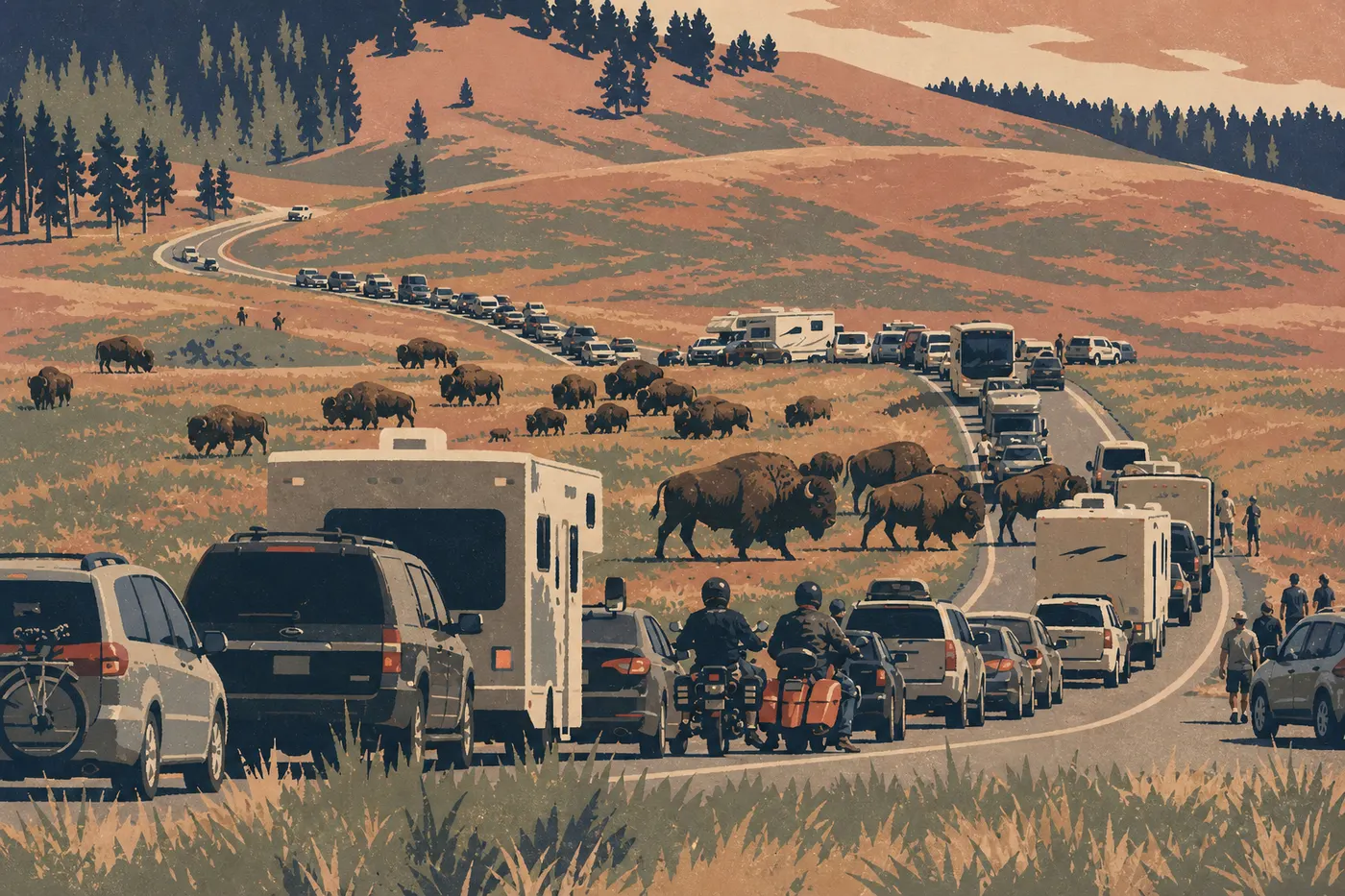
Sooner or later, you'll run into a “bison jam.” A motionless herd in the road can bring traffic to a standstill for 15 to 45 minutes. The official rule is simple: stay in your vehicle, turn off the engine if you can, and wait. It's Yellowstone's most frustrating and most photographed scene.
By Shuttle or Organized Transportation
Yellowstone doesn't have an internal public shuttle system like Zion. A few seasonal shuttles connect certain lodges with nearby attractions, such as Old Faithful Inn and the geyser, but coverage is limited. Without a car, your only alternatives are organized bus or van tours departing from West Yellowstone, Gardiner, or Jackson.
In winter, from mid-December to mid-March, you can enter the park from the West and South Entrances by snowmobile or snowcoach, a tracked bus reserved for the winter experience. Book well in advance.
By Bike
Bikes are allowed on all paved roads open to traffic, but they're prohibited on boardwalks and nearly all trails. To be direct, the roads don't have wide shoulders, the elevation changes are real, and RV traffic is heavy in summer. This option is best left to experienced cyclists who are used to sharing the road with large trucks. There are no bike rentals in the park.
Where to Park
Parking is free throughout the park, but spaces are limited. In peak season, the lots at the most popular sights fill up fast. Arrive before 9 a.m. to avoid the rush, because after 10 a.m. they're often full. To choose the best time based on crowds and seasonal closures, see when to visit Yellowstone.
Keep a close eye on these locations:
- Old Faithful: large parking lot, filled in less than an hour after opening in summer.
- Grand Prismatic Spring Overlook: tiny lot at the Fairy Falls Trailhead. Plan to arrive at dawn or in the middle of the afternoon, when the morning visitors are leaving.
- Mammoth Hot Springs: usually easier, with access through midmorning.
- Canyon Village: several parking areas and slightly less pressure.
Yellowstone has no parking reservation or parking pass system. It's first come, first served. Rangers won't make exceptions for prohibited areas or unofficial roadside parking.
Distances and Driving Times Between Areas
The park is enormous, and that's the number-one surprise for visitors discovering Yellowstone. Here are a few benchmarks to help you plan your days:
- Old Faithful → Canyon Village: about 34 miles, or 1 hr 15 min with the usual delays.
- Mammoth Hot Springs → Lamar Valley: about 34 miles, 1 hour via Lamar Valley Road.
- Old Faithful → Mammoth Hot Springs: about 50 miles, 1.5 hours.
- Canyon Village → Fishing Bridge (Yellowstone Lake): about 16 miles, 30 min.
These times include bison jams and summer construction zones. To plan your days between these areas based on your priorities, see the Yellowstone itineraries for 1, 2, or 3 days.
Special Cases: RVs, Vans, Accessibility, and Pets
RVs and camper vans. Yellowstone welcomes recreational vehicles on its main roads. Some parking lots and secondary turnoffs have length or width restrictions. Check the limits for each area before taking a large vehicle there, and stay on Grand Loop Road to avoid surprises. Campgrounds that can accommodate large vehicles and area-specific restrictions are listed in the Yellowstone RV guide.
Visitors with limited mobility. The park accepts the America the Beautiful pass and the Access Pass for eligible U.S. residents. The boardwalks at the major geothermal sites, including Old Faithful, Mammoth Hot Springs Terraces, and Grand Prismatic, are generally wheelchair accessible. Most trails over natural terrain remain unpaved. The main Visitor Centers are fully accessible.
Pets. Dogs are allowed in the park, but strict restrictions apply. They must be leashed, with a maximum leash length of 6 feet, and are allowed only on paved roads, in parking lots, and at campgrounds. They're strictly prohibited on trails, boardwalks, and near geothermal areas. In hot weather, never leave your pet in a vehicle parked in the sun. Temperatures rise quickly inside a car.
Practical Transportation Info: Fuel, Cell Service, and Apps
Fuel. Gas stations are available inside the park at Canyon Village, Fishing Bridge, Grant Village, Tower Fall, and Old Faithful. Prices there are noticeably higher than outside the park. It's best to fill up in West Yellowstone, Gardiner, or Cody before entering, especially if you're arriving in the late afternoon, since some stations close early in the evening.
Cell service. Almost the entire park is a dead zone. You may get sporadic connections near some Visitor Centers, but there's no guarantee. Download your maps for offline use before entering the park. That's nonnegotiable if you don't want to reach a closed road without being able to check.
Useful apps to prepare before your trip:
- NPS App: offline maps, real-time road closures, and wildlife alerts.
- GasBuddy: find the best fuel prices in gateway towns before entering the park.
Road closures are updated daily on the official NPS website. Check them the day before every outing. Construction or incidents can close part of Grand Loop Road without warning.
Frequently Asked Questions
How do you get around Yellowstone National Park?
Most visitors get around Yellowstone National Park in their own cars, using Grand Loop Road, a loop of about 142 miles. There is no internal public shuttle system. In winter, snowmobiles and snowcoaches take over from the West and South Entrances.
Can you visit Yellowstone by car?
Yes. Visiting Yellowstone by car isn't just possible, it's recommended. Unlike Zion or Yosemite, this park doesn't require a shuttle system.
Where can you park in Yellowstone?
Parking in Yellowstone is free, but it's in high demand during peak season. Lots at major sights such as Old Faithful and Grand Prismatic Spring Overlook fill up before 10 a.m. Arrive early or plan your visits for the middle of the afternoon to find a space more easily.
What's the best entrance to Yellowstone?
The West Entrance is the most direct route to the geysers, while the North Entrance is the only one open year-round.
Is there cell service in Yellowstone National Park?
Cell service is almost nonexistent inside Yellowstone National Park. Download your maps through the NPS App and gather all the information you need before passing through the entrance.