
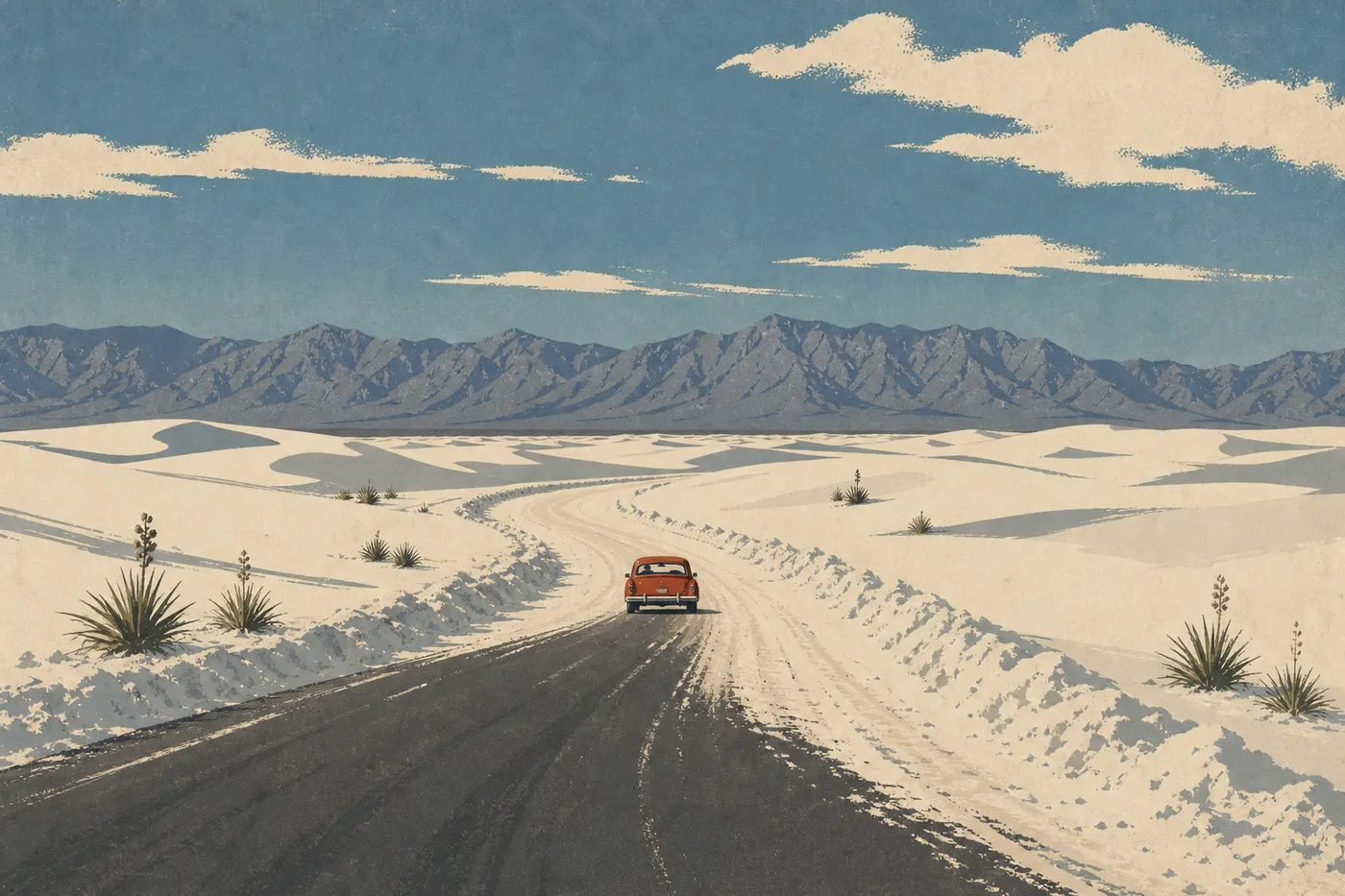
Getting Around White Sands: Access, Entrance, Driving, and Parking
Do you need your own car or a shuttle? A car, without exception. White Sands National Park has no public shuttle. You enter through a single gate, follow one road into the white gypsum dunes, and park at the trailhead of your choice. It's the easiest park in the American Southwest to navigate: one main road, parking areas, and trails.
How to Get to White Sands
White Sands is accessible via US Highway 70, 15 miles west of Alamogordo and 52 miles east of Las Cruces. No public transportation serves the park, so you'll need a rental car. For options from the area's airports and road-trip stops, see the White Sands access guide.
The Park Entrance
White Sands has only one entrance, on US-70. The entrance station provides access to the visitor center, just a few minutes' drive from the gate.
Hours. The park opens at 7 a.m. every morning. Closing time varies. The park closes 30 minutes after local sunset, which is 8 minutes earlier than the sunset time listed for Alamogordo. In summer, that gives you until 9 p.m.; in winter, you'll need to leave in the early evening.
For entrance fees and annual passes, see the National Parks Fees & Passes page. The America the Beautiful pass ($80) pays for itself after visiting two or three national parks in a year.
Military Closures on US-70
This is White Sands' main logistical complication. The park is enclosed by White Sands Missile Range (WSMR). The military periodically closes US-70 for missile tests, sometimes for several hours at a time and often with little advance notice. If you're already in the park when the road closes, you'll have to wait there until it reopens.
Take two practical precautions: check the US-70 status the day before on the WSMR website or by calling the visitor center, and don't schedule a tight connection from the park in the late afternoon.
Getting Around the Park
By Car
The main road is called Dunes Drive. It starts at the entrance and heads northwest for about 8 miles. The first section is paved. The second is a compacted-gypsum road that any ordinary passenger vehicle can handle without four-wheel drive. Drive slowly. Sandstorms can reduce visibility, and animals regularly cross the road.
There are no secondary loops or additional drivable roads. Dunes Drive is the only motorized option.
On Foot
Trailhead parking areas put you right at the foot of the dunes. Each trail is marked with numbered posts because the wind constantly shifts the dunes and erases established paths. The White Sands hiking guide covers the trails, their lengths, and their difficulty levels.
By Bike
Biking is technically possible on Dunes Drive, but the compacted-gypsum section is demanding and has no shade. We don't recommend it between 10 a.m. and 5 p.m. in summer. There are no bike rentals in the park or in the immediate area.
Where to Park: Parking Areas and Parking Rules
Several parking areas line Dunes Drive, each next to a trail or picnic area:
- Playa Trail parking area (the first stop from the entrance, with a hard-packed surface).
- Dune Life Nature Trail parking area (midway along the road, ideal for families with children).
- Interdune Boardwalk parking area (accessible parking, with a short loop on a wooden boardwalk).
- Alkali Flat Trail parking area (at the end of the road, an advanced trail through deep dunes).
Reservations aren't available or necessary. Parking is first come, first served. During peak season and on weekends, parking areas fill early. Arrive before 9 a.m. to avoid driving around looking for a spot. When to Visit White Sands explains the busiest times.
The visitor center has a separate, larger parking lot that also serves as a starting point before you drive to the trailheads.
Distances and Drive Times in the Park
From the entrance to the farthest parking area, at Alkali Flat Trail, the distance is about 8 miles. Without stopping, you can drive Dunes Drive in about 20 minutes.
White Sands isn't a park with multiple areas that you need to connect. It's a linear progression through the dunes. Choose a trail based on your fitness level and available time, park in the corresponding lot, and that's it. The complete White Sands guide and the Itinerary & Duration page offer plans for a two-hour quick visit, a half-day, or a full day.
RVs, Accessibility, and Pets
RVs and vans. Dunes Drive has no known height or length restrictions for vehicles. The compacted-gypsum section can become unstable after rain, though, so check conditions at the visitor center that same morning. There are no electrical hookups in the park. The White Sands RV guide covers parking and overnight options around the park.
Accessibility. Interdune Boardwalk is the most accessible trail, with a level surface and a trailhead beside a designated accessible parking space. The visitor center is also accessible. The other parking areas have compacted gypsum, which can be harder to navigate in a lightweight wheelchair when it's dry.
Pets. Dogs are allowed in the park on a leash up to 6 feet long. In summer, the white gypsum reflects intense heat, and the ground can burn their paw pads. Test the temperature with your hand before letting your pet walk on the dunes.
Practical Transportation Info: Fuel, Cell Service, and Water
Fuel. There are no gas stations in the park or immediately nearby on US-70. Fill up in Alamogordo or Las Cruces before entering.
Cell service. Coverage is very limited or nonexistent in the dunes. Download your maps before you arrive, including the official NPS app, Gaia GPS, or the park's PDF map available on the NPS website. Wi-Fi is available at the visitor center.
Water. There is no drinking water available in the dunes themselves. The visitor center has drinking fountains. In summer, plan on at least 1 liter per hour of exertion. Heat and the park's elevation of about 3,900 feet can dehydrate you quickly.
Frequently Asked Questions
How do you get around White Sands National Park?
You get around by car on Dunes Drive, the park's only road. There is no public shuttle. From the trailhead parking areas, you continue on foot to reach the trails.
Can you visit White Sands by car?
Yes. It's the only motorized transportation option. Any ordinary vehicle can drive Dunes Drive, including its compacted-gypsum section.
Where can you park at White Sands National Park?
Parking is available in trailhead lots along Dunes Drive. Reservations aren't available. During peak season, arrive before 9 a.m. to find a space.
What's the best entrance for White Sands?
There is only one entrance, on US-70. There's no choice to make.
Where is White Sands located?
White Sands National Park is in New Mexico, on US Highway 70, 15 miles west of Alamogordo and 52 miles east of Las Cruces.
Is there cell service in the park?
Cell coverage is very limited or nonexistent in the dunes. Download your maps before entering the park.
Are there restrooms at White Sands?
There are restrooms at the visitor center and at several service areas along Dunes Drive. There are none in the dunes once you're away from the parking areas.
Did Trump make White Sands a national park?
Yes. White Sands became a national park on December 20, 2019, when President Donald Trump signed the National Defense Authorization Act for fiscal year 2020 (NDAA 2020), which included the designation. The site had been a national monument since 1933.