
When to Visit White Sands: Best Time, Weather, and Seasons
White Sands National Park is home to the world's largest gypsum dune field, set in the Chihuahuan Desert of New Mexico, about 15 miles west of Alamogordo. This isn't ordinary sand. The white gypsum reflects light in a way that changes the mood from hour to hour. The setting comes with a few constraints, though: summer heat is serious, spring winds blow relentlessly, and the park occasionally closes for military testing from the nearby White Sands Missile Range.
The best time to visit White Sands is October and November, when daytime temperatures are mild (68 to 79 °F), the fall light on the white gypsum is exceptional, and visitor numbers drop sharply from summer.
The short answer: fall, especially October and November, is the ideal window. Days are mild, nights are cool, crowds thin out, and the low-season light brings out the dunes. Winter (December through February) is an excellent second choice, with even fewer visitors, pleasant days, and cold nights. You can visit in spring and summer too, as long as you adjust your schedule.
White Sands Climate Month by Month
The table below summarizes climate trends. For current forecasts and precise monthly averages, see our White Sands Weather page.
| Month | Low | High | Precipitation | What to Expect |
|---|---|---|---|---|
| January | 32 °F | 59 °F | Very low | Mild days, nights near 32 °F |
| February | 36 °F | 64 °F | Very low | Quiet, peaceful off-season |
| March | 41 °F | 73 °F | Low | Strong winds, frequent gusts |
| April | 48 °F | 82 °F | Low | Winds still a major factor |
| May | 57 °F | 93 °F | Low | Heat sets in quickly |
| June | 64 °F | 100 °F | Very low | Heat wave on the dunes |
| July | 68 °F | 97 °F | Moderate | Monsoon season; afternoon thunderstorms |
| August | 66 °F | 93 °F | Moderate | Monsoon season; dramatic but hot |
| September | 59 °F | 88 °F | Low | Ideal transition month |
| October | 48 °F | 79 °F | Very low | Best month of the year |
| November | 37 °F | 66 °F | Very low | Fall light, very quiet |
| December | 32 °F | 57 °F | Very low | Mild days, cold nights |
White Sands gets less than 10 inches of precipitation a year. Most of it falls during the July-August monsoon, in the form of brief but intense afternoon thunderstorms. The rest of the year is almost consistently clear, which makes day-by-day planning easier.
White Sands in January
January is one of the park's quietest months. Days reach about 55 °F, while nights can drop to 27 °F. The dunes are nearly empty on weekdays, and the cool winter light gives the gypsum an almost blue tint that you don't see the rest of the year. Full Moon Hikes are offered this month. Spots sell out weeks ahead, so reserve through the visitor center.
White Sands in February
February is slightly milder, with highs around 61 °F, and remains very quiet. The off-season is in full swing: open parking lots, rangers with time to help, and no lines. The park is ideal if you want a place largely to yourself, without summer crowds or spring winds. Occasional military closures are the only variable to watch, and the NPS announces them in advance on its website.
White Sands in March
Wind arrives in March. Regular gusts fill the air with fine gypsum dust, which is uncomfortable for hikers and unkind to photographs. Temperatures still reach about 70 °F, and the first desert blooms appear along the edge of the dunes after winter rains. Arrive by 7 a.m. Wind is usually lighter early in the morning.
White Sands in April
April brings both wind and crowds. American spring break swells weekend attendance, and gusts remain common. Aim for mornings right after opening and avoid exposed ridgelines in the middle of the day. Our Hiking page points out the most sheltered trails. Highs climb to about 79 °F by the end of the month.
White Sands in May
The wind gradually eases, but heat takes over, with highs around 88 °F. Mornings remain manageable, but the dunes heat up quickly after 10 a.m. Visitor numbers are moderate, between the quiet of winter and the summer rush. Bring at least 2 liters of water per person for any outing in full sun.
White Sands in June
June is the most demanding month. Highs approach 97 °F, and the dune surface can reach 122 °F under the midday sun. The rangers' rule is nonnegotiable: arrive at opening (7 a.m.) and leave by 10 or 11 a.m. Outside that window, any hike requires at least 2 liters of water per hour. In the evening, long days leave a generous window before closing, set for 30 minutes after local sunset.
White Sands in July
July marks the start of the Chihuahuan Desert monsoon. Brief but intense thunderstorms break out in mid- to late afternoon. Highs remain around 95 °F. After each storm, the light on the dunes is spectacular. This is the season for patient photographers. The July 4th weekend is the busiest of the year.
White Sands in August
August is the wettest month, with about 1.5 inches of rain, and remains under the influence of the monsoon. Temperatures ease slightly from July, with highs around 91 °F, but the heat is still serious. Attendance starts to drop toward the end of the month as the American school year begins. The strategy is the same as in July: sunrise or late afternoon.
White Sands in September
September is an underrated transition month. The monsoon fades, nights turn cooler, and highs fall below 86 °F by the end of the month. Crowds drop noticeably without reaching the quiet of late fall. Conditions remain demanding early in the month and comfortable from the third week onward. It's a good alternative if October lodging is booked.
White Sands in October
This is the best month of the year at White Sands. Highs hover around 75 °F, and cool nights, around 45 °F, make sunrise visits pleasant and productive for photography. Crowds thin out sharply after American school breaks. Midmonth weekdays are among the quietest stretches of the shoulder season. Check the Full Moon Hikes schedule as soon as the NPS releases it.
White Sands in November
November is ideal if you're looking for complete quiet: 64 °F during the day, with nights close to freezing. The dunes are nearly empty on weekdays, and this month offers the year's best balance of peace and light. Lodging rates in Alamogordo are at their lowest. Full Moon Hikes are still offered, so reserve as soon as the NPS schedule opens.
White Sands in December
December brings winter, with days in the low 50s and nights that can fall to 28 °F. It's the least visited month of the year. Conditions are ideal for a family visit with young children: no heat risk, accessible trails, and a quiet visitor center. Bring extra layers for sunrise.
White Sands Season by Season
Winter (December through February): The Hidden Season

Winter is White Sands' hidden gem. Daytime temperatures range from 54 to 63 °F, nights drop close to freezing, but hard freezes remain rare. The dunes are empty on weekdays. White gypsum against a winter sky produces cool, highly photogenic light that you won't find in any other season.
What we especially enjoy in winter is the Full Moon Hikes, guided full-moon hikes organized by the park. Sign up directly through the visitor center. Spots fill up weeks in advance. Wildlife is quieter in winter; you'll mostly see kit foxes in the middle of the day, but the park's tranquility more than makes up for it.
One thing to watch: the park closes for a few hours each week for firing operations from the adjacent White Sands Missile Range. The official NPS website announces these closures, which usually last two to four hours. In winter, you have plenty of time to wait in Alamogordo or shift your visit.
Spring (March through May): Wind, Then Heat

In spring, everything starts with the wind. From March through April, regular gusts fill the air with fine gypsum dust. It's not dangerous, but it's uncomfortable for hikers and unkind to photographs. In May, the wind gradually eases and the heat starts to climb in earnest.
Spring's advantage is the desert bloom. A few plants along the edge of the dunes produce fleeting flowers after the winter rains. If you enjoy botany or macro photography, this is a unique window.
If you're visiting in April, aim for mornings right after opening at 7 a.m. (wind is often lighter before 10 a.m.) and avoid exposed ridgelines in the middle of the day. Our Hiking page identifies the most sheltered trails for the conditions.
Summer (June through August): Timing Is Essential
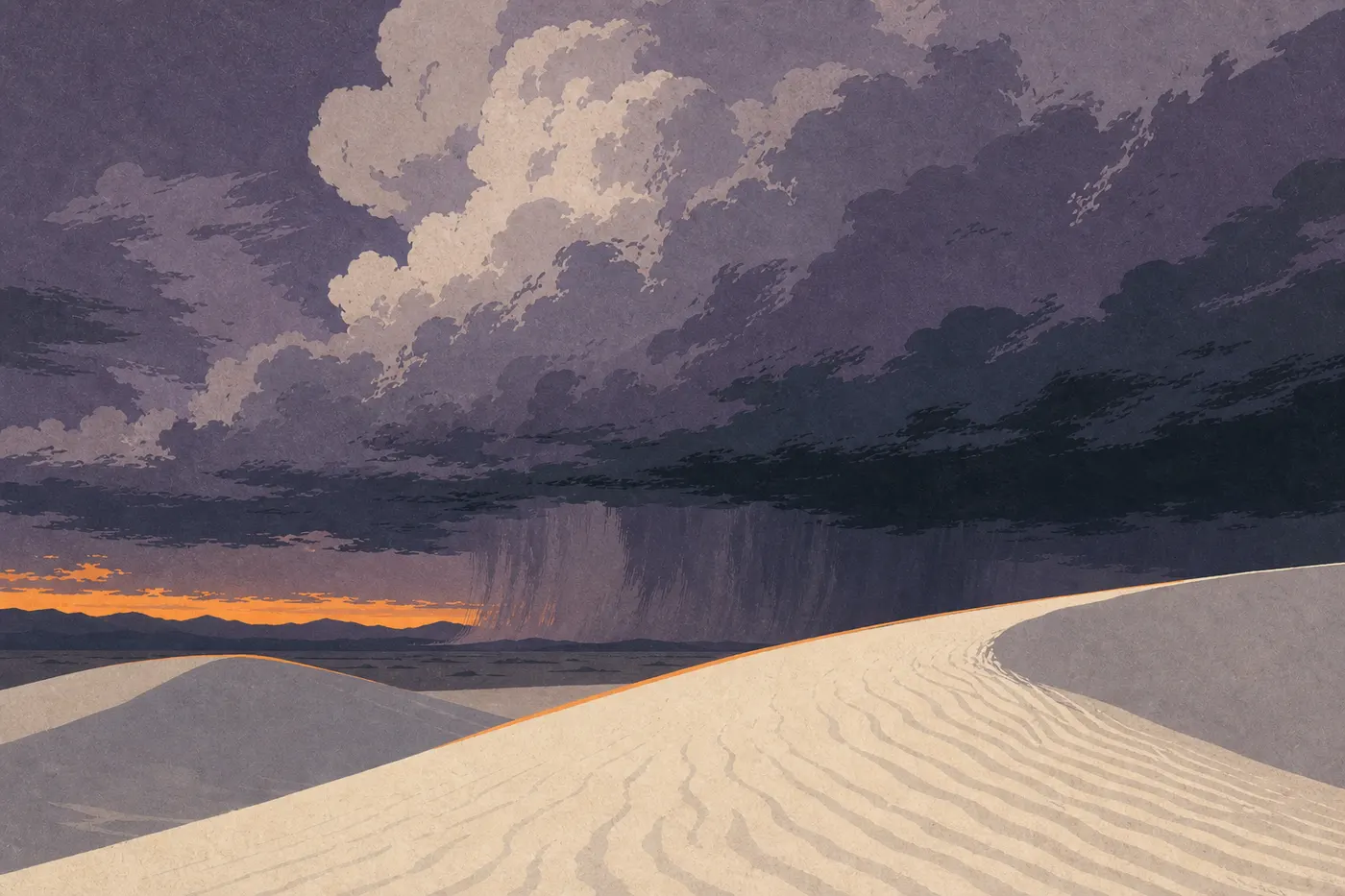
June is the hottest month. The dune surface can reach 122 °F under the midday sun. That's not an exaggeration. The rangers' instruction is simple and nonnegotiable: after 10 a.m. in June, bring at least 2 liters of water for every hour of hiking planned and protect your head.
July and August bring the Chihuahuan Desert monsoon. Clouds build late in the morning, and thunderstorms break out in mid- to late afternoon. After a storm, the dunes emerge in spectacular light. This is the season for patient, well-equipped photographers.
Summer strategy: arrive at sunrise (opening is at 7 a.m.) and leave before noon. Or come back in the late afternoon for sunset. The park closes 30 minutes after local sunset, which occurs 8 minutes before sunset in Alamogordo. That leaves a generous evening window during June's long days.
Fall (September through November): The Benchmark Season

October is our top recommendation. I was lucky enough to spend several days there in the middle of the month. Late-afternoon golden light turns every dune into an abstract shape, and the silence is complete less than a mile from the parking lot. Daytime highs hover around 79 °F, while cool nights give you a reason to get up early. Attendance drops noticeably after American summer school breaks.
November extends fall in an even quieter form. Fall Full Moon Hikes are usually the most sought-after of the year, so check the schedule as soon as the NPS publishes it.
September is an underrated transition month. The monsoon retreats, temperatures remain high but manageable, and weekends are less crowded than in July and August. Consider it if October isn't possible.
Crowds: When to Avoid the Crowds at White Sands
White Sands is less than an hour and a half from El Paso and just under four hours from Albuquerque. Visitation has grown sharply since the site became a national park in December 2019.
Peak periods:
- July and August: American families on road trips, with the July 4th weekend especially busy.
- Spring break (March-April): American school and college breaks.
- Every weekend: Residents of Texas and El Paso make up a significant share of visitors. Saturday is consistently the busiest day.
To visit without waiting for a parking spot, target a weekday in fall or winter, or arrive at 7 a.m. whatever the season. An hour after opening, the visitor center is already starting to fill up on a spring Saturday.
Best Time for Your Budget at White Sands
Park admission is $25 per vehicle (valid for seven days), $20 per motorcycle, or $15 per person on foot. The park's annual pass costs $45. If you're visiting several national parks, the America the Beautiful pass pays for itself after two or three sites in a year. Our National Parks Fees & Passes page explains admission fees and pass options.
For lodging, mainly in Alamogordo and Las Cruces, rates vary less than around Zion or the Grand Canyon. Winter remains the most affordable season. In summer, demand rises with road-tripping families, so book your hotel or lodge two to four weeks ahead. Our Where to Stay guide lists options by budget and distance from the park.
Which Season Fits Your Travel Style?
For photography: October or November for fall light, and summer for monsoon storms. Sunrise and sunset are the two essential appointments, whatever the season. White gypsum is highly sensitive to light quality, so avoid the midday sun.
For hiking: fall and winter, without question. The Alkali Flat Trail (5 miles round-trip, in the heart of the dunes) should be avoided between 10 a.m. and 4 p.m. in June. Our Hiking page breaks down trails by difficulty and season.
For a family trip with kids: winter (December through February) is ideal. Mild temperatures, no risk of heatstroke, and few visitors. Avoid long hikes with young children on the dunes in June. Surface heat is serious. Our Family page lists precautions and suitable activities.
For wildlife viewing: spring (April-May) and early fall (September-October) are the periods of peak activity for kit foxes, desert lizards, and reptiles. Our Wildlife page covers notable species and the best viewing spots.
For keeping costs down: November through February for lodging, bearing in mind that park admission fees don't vary by season.
In Summary: The Best Time for Your Travel Style
| Travel style | Recommended period |
|---|---|
| Photography (light) | October, November; summer sunsets |
| Hiking | October through February |
| Families | December through February |
| Wildlife | April through May, September through October |
| Lodging budget | November through February |
| Avoiding crowds | Weekdays from November through February |
If you only have one window, choose October. The weather is stable, the light is remarkable, and you'll find a parking spot at the visitor center without waiting.
To plan your entire trip, our complete White Sands guide brings together all the practical information.
The Worst Time to Visit White Sands
June is, without question, the most difficult time. The dune surface reaches 122 °F under the midday sun, and the risk of heat illness is real. Rangers respond to hikers in trouble every year. The access window shrinks to two or three hours around sunrise, which doesn't work for every type of visitor.
July and August weekends combine heat and crowds. July 4th and the first weeks of August are consistently packed, with lines at the parking areas. Spring (March and April) is best avoided by photographers. Wind carries airborne gypsum particles that veil the site's whiteness and make long hikes uncomfortable.
Frequently Asked Questions
What are the best months to visit White Sands?
The best months to visit White Sands are October and November. Daytime temperatures (68 to 79 °F) are pleasant, nights are cool without being cold, and crowds are far lighter than in summer. Winter (December through February) is an excellent second choice if you prefer a nearly empty park.
What is the best time to visit White Sands?
The best time to visit White Sands runs from mid-September through late November. Summer heat has faded, spring winds are gone, and late-season light is especially beautiful on the white gypsum.
Is the park open year-round?
White Sands is open 365 days a year, with the visitor center generally opening at 7 a.m. (hours vary by season). The park occasionally closes for a few hours each week for firing operations from the adjacent White Sands Missile Range. The NPS announces these closures, which generally last two to four hours. No access road closes because of weather.
When is high season at White Sands?
High season at White Sands runs through July and August, with a peak around July 4th. American spring break (March-April) is a second busy period. Saturday is consistently the busiest day, whatever the season.
What is the least crowded month?
December and January are the least crowded months. Mid-November weekdays and early February are also very quiet. If you want the park almost to yourself, target a weekday in mid-December or January. The dunes are empty before 10 a.m., and parking stays easy all day.
What's the climate like at White Sands?
White Sands has a semi-arid desert climate: very hot summers (up to 100 °F), mild winters (54 to 63 °F during the day), windy springs, and ideal fall weather. A summer monsoon brings thunderstorms in July and August. Annual precipitation is less than 10 inches. Our White Sands Weather page provides detailed monthly averages.
How many days do you need to visit White Sands?
How many days to plan depends on your pace. Half a day to one full day covers the main trails and Dunes Drive. A two-day stay lets you add a sunrise, sunset, and possibly a Full Moon Hike. Our Itinerary & Trip Length page offers ready-made plans for different schedules.
How much does a trip to White Sands cost?
Park admission is $25 per vehicle (valid for seven days). Nearby lodging is concentrated mainly in Alamogordo, starting at $70 a night in the off-season. For admission fees and annual passes, see the National Parks Fees & Passes page.
What's the best season to visit the American West?
The best seasons for visiting the American West are spring (April-May) and fall (September-October), with moderate temperatures, long days, and travel before or after the summer crowds. Our American West road trip guides suggest park combinations and itineraries by trip length.
What's the best time to visit New Mexico?
The best time to visit New Mexico runs from September through November and, to a lesser extent, from March through May. For White Sands specifically, fall is clearly better than spring because of the wind. Find suggested stops in our American West road trip guides.