
White Sands Itinerary: What to See in 1, 2, or 3 Days
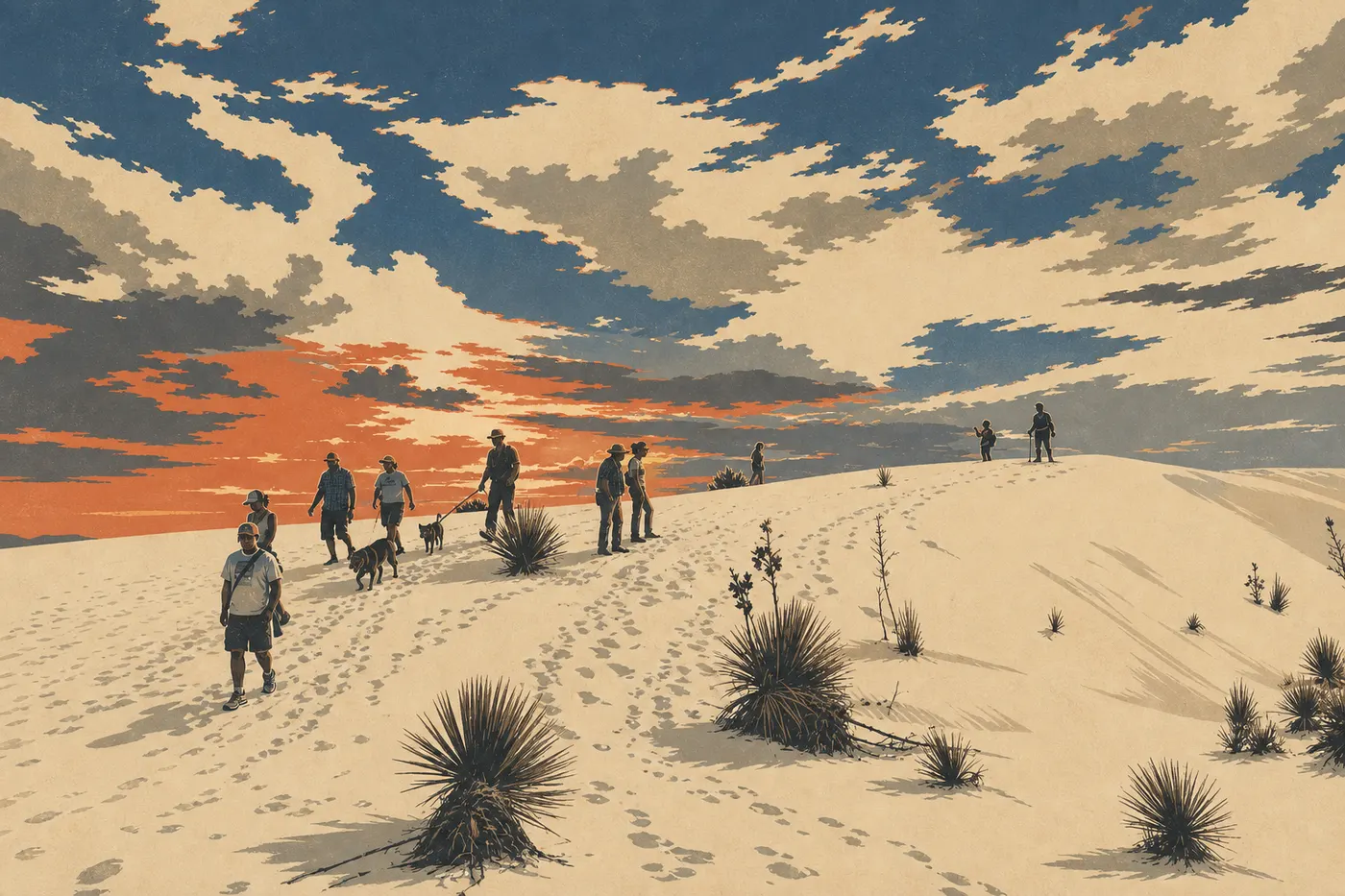
White Sands looks nothing like any other American national park. There are no vertiginous canyons or dense forests here, just 275 square miles of white gypsum dunes, an 8-mile road, five marked trails, and a sky that turns orange at sunset. It's compact, yes, but it's breathtaking.
The quick answer: one day is enough to see the highlights. Two days gives you a comfortable pace for sunrise and sunset, the major trails, and time to stretch out on the dunes without watching the clock. Three days opens the door to excursions around the region. Our complete White Sands guide gives you the big picture if you're starting from scratch.
How Much Time Do You Need to Visit White Sands?
White Sands is one of the most compact national parks in the country. Dunes Drive, the park's only drivable road, runs 8 miles from the entrance to the far end of the dunes. If you drive without stopping, it takes about 30 minutes each way. But you'd miss the whole point.
For a quick visit, plan on three to four hours. That gives you two photo stops, the Dune Life Nature Trail, and some time to sled on the dunes near the Visitor Center. For a full day, add the Alkali Flat Trail and stay through sunset. If you want to sleep in the park and see it at dawn, plan on two nights.
Here's our recommendation by traveler profile:
- 1 day: ideal for visitors traveling between Las Cruces and Alamogordo, as long as you arrive before 10 a.m.
- 2 days: the format we recommend for almost every visitor, with enough time to see the park in every kind of light.
- 3 days: for hikers who want to combine the park with Trinity Site or the nearby Organ Mountains.
There's one logistical detail to know before you plan. US Highway 70, which runs alongside the park, sometimes closes temporarily for missile tests conducted by White Sands Missile Range, whose territory borders the park. These closures generally last one to two hours. Our guide to getting to White Sands explains how to plan around these interruptions and where to find official road-condition updates before you leave.
Fees and Hours
Entrance fees:
- $25 per private vehicle
- $15 per person (pedestrians and bicyclists)
- $20 per motorcycle
- White Sands annual pass: $45
If you have an America the Beautiful pass ($80 per year), it covers admission to all federal recreation sites.
Hours: the park opens at 7 a.m. every day. It closes 30 minutes after local sunset, which is about 8 minutes before the sunset time forecast for Alamogordo. Plan to leave the dunes in time so you don't end up driving in the dark on an unlit road.
For distances from Alamogordo, Las Cruces, or El Paso, and everything related to driving in the park, see getting around White Sands.
White Sands Areas
White Sands is a linear park: one entrance, a straight road leading into the heart of the dunes, and a turnaround that sends you back the same way. The atmosphere changes noticeably as you go deeper in.
Entrance Area: The Visitor Center and First Dunes
The first few miles from the entrance are less dramatic. Vegetation is still present, and the dunes are lower and less white. This is where you'll find the Visitor Center, with restrooms, a gift shop selling and renting sleds, an exhibit about gypsum geology, and a ranger information area. Take time to go inside on your first visit. Rangers know the current trail conditions and can recommend the best times depending on the season.
Just beyond the Visitor Center is the Interdune Boardwalk (0.4 miles, fully paved and accessible to strollers and wheelchairs). This short trail winds through interdune areas and introduces the plant species adapted to gypsum. It's a good starting point with young children before you venture onto the open dunes.
Middle Area: Dune Life Nature Trail and Playa Trail
Around the middle of Dunes Drive, the landscape opens up and the dunes reach comfortable heights for sledding. Two trails begin here.
The Dune Life Nature Trail (1 mile, loop, easy) crosses moderately sized dunes and follows interpretive signs about the wildlife and plants of the gypsum desert. The kit fox, bleached earless lizard, and soaptree yucca are well documented along the way. Allow 45 minutes to an hour if you're taking your time.
The Playa Trail (1 mile round-trip, moderate) leads to a dry lakebed, the remains of a prehistoric body of water. The landscape is flat and almost barren, a striking contrast with the dune ridges. After a certain point, trail markers disappear and cairns guide you forward. Keep a close eye on your route.
Heart of the Dunes: Alkali Flat Trail and Backcountry Camping
At the end of Dunes Drive, the dunes reach their greatest height and their whitest color. This is the area photographers target during golden hour.
The Alkali Flat Trail (5 miles round-trip, difficult) is the park's signature trail. It crosses the most remote part of the dunes toward an old playa, with no shade or shelter. It's not recommended between 10 a.m. and 3 p.m. in summer, when temperatures frequently rise above 95°F in July and August. In spring or fall, it's a true wilderness hike: total silence, dunes stretching to the horizon, and no sign of civilization anywhere in sight. The White Sands hiking guide compares all five trails in the park in detail.
If you want to sleep in the dunes, the Backcountry Camping Trail (about 2 miles) leads to ten primitive sites. You must get a permit at the Visitor Center the same day, and there are no online reservations. There is no water or trash service at the sites, so everything you bring in must come back out with you.
Day-by-Day Itinerary
Day 1: The Essentials, Including Sunrise
Arrive when the park opens at 7 a.m. At that hour, parking lots are nearly empty and the dunes still hold the night's wind patterns, without footprints. It's the best photo window of the day.
7 to 10 a.m.: park at the lot at the end of Dunes Drive and set out on the Alkali Flat Trail. Starting early lets you enjoy the low-angle light and avoid the midday heat. Allow 2.5 to 3 hours for the round trip, including breaks.
10 to 11:30 a.m.: head back toward the middle area and stop at the Dune Life Nature Trail. Rangers sometimes offer short guided walks in the morning. Ask at the front desk when you arrive.
11:30 a.m. to 1:30 p.m.: leave the park for lunch in Alamogordo, 15 miles east. The park has no indoor dining, only a few picnic tables under shaded shelters.
2 to 5 p.m.: return to the park for the Interdune Boardwalk or a sledding session on the dunes near the Visitor Center. Gypsum isn't as fast as snow, but the ride is smooth and falls are harmless on this rounded sand.
Sunset: get onto the high dunes at least 45 minutes before the official sunset time. The sky moves through shades of pink, orange, and purple that few American landscapes can match. Rangers sometimes lead a free guided sunset walk. Confirm the schedule at the Visitor Center.
Day 2: Slow Down and Explore
The second day lets you experience the park differently, with less rushing and more time to take it in.
Morning: head to the end of Dunes Drive when the park opens for sunrise. At this hour, the New Mexico sky is a deep blue that contrasts with the white dunes. Walk off-trail on the open ridges in areas where unmarked foot traffic is allowed.
A useful fact for walking barefoot: gypsum stays cooler than ordinary silica sand because it has low thermal conductivity and its white color reflects sunlight. In summer, you can walk barefoot in the morning and late afternoon. In the middle of the afternoon, the ground is still hot anyway.
Midday: have a picnic in the dunes or return to Alamogordo. If you've reserved a backcountry campsite, which you need to do in the morning at the Visitor Center, with very limited spaces, settle in before 5 p.m.
Afternoon: if you're not camping, a trip to the New Mexico Museum of Space History in Alamogordo is a worthwhile option. The museum traces the history of rocket testing in the Tularosa Basin and has a collection of rare space hardware.
A night camping in the dunes, surrounded by desert silence beneath a star-filled sky free from light pollution, is an experience few American national parks can offer on the same level.
Day 3: The Surrounding Area and Historical Context
On the third day, leave the park to explore the wider region.
Trinity Site: about 62 miles north, on White Sands Missile Range land, sits the site of the first nuclear test in history, conducted on July 16, 1945. The site opens to the public only twice a year, on the first Saturday in April and the first Saturday in October. If your visit falls on one of those dates, don't miss the detour. You'll need photo ID to enter the military area.
Las Cruces: if you're heading west, Las Cruces is worth half a day. It has a lively university atmosphere, a Saturday morning farmers market, and reasonably priced Tex-Mex and New Mexican food. It's also the most comfortable base for a multi-day stay if you prefer Alamogordo's hotel options.
Carlsbad Caverns: about 2.5 hours east, Carlsbad Caverns is a natural extension of a road trip through southern New Mexico. The contrast between the white dunes and the underground chambers is striking. Our Road Trip and Region guides offer itinerary ideas for adding White Sands to a longer trip through the Southwest.
Variations Based on Your Time
Express, under 3 hours: Visitor Center, Interdune Boardwalk, 30 minutes on the open dunes, and leave before the crowds arrive. You'll see the park without really getting its rhythm.
Classic, one full day: arrive at 7 a.m., hike Alkali Flat in the morning, have a picnic at a shelter, go sledding in the early afternoon, and watch sunset from the high dunes. It's a full schedule, but entirely doable.
Immersive, 2 days: the recommended format, laid out in the day-by-day itinerary above. It works for all fitness levels.
Regional road trip, 3 days or more: use White Sands as your base, with excursions to the Organ Mountains, Las Cruces, Alamogordo, and possibly Carlsbad Caverns. To extend your stay, our Road Trip and Region guides explore itineraries linking White Sands with nearby destinations.
Itinerary Map
The NPS publishes an official Unigrid map brochure that you can download for free from the park website. It includes Dunes Drive, all five trails and their distances, picnic shelters, and backcountry camping areas. Ask for a paper copy at the entrance. Rangers routinely hand one out with your ticket.
The annotated White Sands map shows recommended viewpoints for different times of day and landmarks to help you navigate off-trail.
One tip from the field: once you're out on the open dunes, visual landmarks disappear quickly. Every ridge looks alike. Turn on your GPS app's offline mode before entering the park, or carefully note the number on the nearest parking sign before you walk away.
Where to Stay Along the Itinerary
There is no lodging inside the park, apart from the ten primitive backcountry campsites, which have no water, electricity, or trash service. The two closest bases with comfortable lodging are Alamogordo, 15 miles east, and Las Cruces, 52 miles west.
Alamogordo has most of the budget hotel chains and motels. Las Cruces offers more variety in terms of comfort and dining. The hotels and lodges around White Sands are compared by budget and proximity to the park. The RV guide to the Tularosa Basin details sites with hookups.
Extend Your Trip: What to See Around White Sands
White Sands fits naturally into a longer trip through New Mexico or the American Southwest.
Organ Mountains-Desert Peaks National Monument (28 miles west): hikes through spectacular rock formations above Las Cruces. Free access, with no federal entrance fee.
Carlsbad Caverns National Park (about 2.5 hours east): some of the country's most impressive underground chambers, filled with bats in summer. A good option for a five-day road trip through southern New Mexico.
Lincoln National Forest: north of Alamogordo, this national forest offers high-elevation hikes with views over the Tularosa Basin, a world away from the dunes.
El Paso, Texas: 1.5 hours southeast, for an evening of borderland food and a complete cultural change of scene before you get back on the road.
Our Road Trip and Region guides offer ideas for extending your White Sands stay to nearby destinations.
The Ideal Itinerary for Your Time
Less than a day: focus on the end of Dunes Drive for the best light. Save the trails for another visit rather than rushing through one halfway.
One full day: Alkali Flat in the morning, sledding in the afternoon, and sunset on the high dunes. It's the ideal plan for a complete first experience of the park.
Two days: add sunrise on the second morning and take time to simply settle into the dunes with no particular goal. White Sands is one of the few parks where doing nothing is a perfectly legitimate activity, and one that's hard to forget.
Three days or more: combine the park with Trinity Site, if the dates work, Las Cruces, or Carlsbad Caverns. New Mexico deserves time.
Frequently Asked Questions
How much time do you need to visit White Sands?
Allow three to four hours for a quick visit, a full day to cover all the trails, and two days to enjoy the golden hours in the morning and evening. Most visitors spend four to six hours in the park.
Where is White Sands located?
White Sands National Park is in New Mexico (NM), on US Highway 70, 15 miles west of Alamogordo and 52 miles east of Las Cruces. Alamogordo is the nearest town.
Did Trump make White Sands a national park?
Yes. White Sands became a national park on December 20, 2019, through legislation signed by President Trump. Before that, the site had been designated a national monument since 1933.
Can you drive through White Sands?
Dunes Drive runs 8 miles into the park from the main entrance, but there is no through road. You return the same way you came in. US Highway 70 runs along the south side of the park without crossing it.
When is the best time to visit White Sands?
Fall and spring offer the most comfortable temperatures. Summer is hot, with afternoons above 95°F in July and August, but sunsets are among the most spectacular of the year. Winter days are mild and evenings are cool. Spring is the windy season, so expect strong gusts in March and April. For month-by-month details, see our When to Visit page.
How much does it cost to enter White Sands?
$25 per private vehicle, $15 per person (pedestrians and bicyclists), and $20 per motorcycle. The White Sands annual pass costs $45. The America the Beautiful pass ($80 per year) is accepted and covers admission to all U.S. federal recreation sites.
Is White Sands worth visiting?
White Sands is the world's largest gypsum dune field of its kind. The landscape has no equal on the American continent. Even a short visit leaves a lasting impression. The short answer is yes, absolutely.