
Haleakalā National Park (Maui): The Complete Visitor Guide
Haleakalā is two parks in one ticket. On one side, there's a volcanic summit rising 10,023 feet above the clouds and glowing orange at sunrise. On the other, there's the coastal Kīpahulu District, with its jungle and cascading pools at the far end of the island of Maui. No road directly connects these two sides, so you can't really "do" Haleakalā in an hour. Allow half a day for the summit, or a full day if you're adding Kīpahulu.
This guide covers the essentials for planning your visit. Each topic has its own detailed guide, linked throughout. Let's start with the practical details.
Haleakalā at a Glance: Where the Park Is and How to Get There
The park covers the southeastern flank of Haleakalā volcano on the island of Maui, Hawaiʻi. It is divided into two distinct districts.
The Summit District climbs to the highest point, at 10,023 feet. You reach it by a winding mountain road famous for its many switchbacks, gaining elevation quickly. Allow about 1.5 hours of driving from the Maui coast to reach the summit, and longer during busy periods.
The Kīpahulu District runs along the ocean near Hāna, at the end of the famous Hana Highway. It gives you access to the jungle, the Pīpīwai area, and a completely different climate. The key point is that no road within the park connects the summit to Kīpahulu. To get from one to the other, you have to descend and drive around part of the island, which takes several hours. Plan the two districts as separate excursions.
For full details on access, roads, and drive times, see our guide to getting to Haleakalā. To locate each district at a glance, our park map gives you the big picture.
Entrance Fees, Passes, and Reservations
Admission is valid for 3 days and covers both districts, the summit and Kīpahulu, on the same ticket.
Current fees, which you should confirm before your visit:
- Private vehicle: $30
- Motorcycle: $25
- Pedestrian or cyclist, per person: $15
If you visit several national parks in a year, the $55 annual park pass quickly pays for itself, as does the America the Beautiful national parks pass. Our editorial page on fees and passes explains entrance fees and annual passes.
One important detail that catches many visitors too late: sunrise at the summit requires a separate reservation, in addition to the entrance ticket. It is required for summit access between 3 a.m. and 7 a.m. Time slots fill quickly and must be reserved online in advance. Outside those hours, the summit remains open 24 hours a day with no reservation. We explain how it works below and in detail in our park practical information.
Reservations, Permits, and Rules to Follow
A Reservation Is Required for Sunrise
This is what confuses visitors most. Between 3 a.m. and 7 a.m., access to the Summit District requires an advance reservation every day of the year, with no exceptions. You make it through recreation.gov, paying a $1 reservation fee on top of the entrance fee. Reservations open 60 days in advance. For weekends and American school vacations, they can disappear within a few dozen minutes. The rule is simple: reserve as soon as your dates are confirmed, not the night before.
Without a reservation before 7 a.m., you'll be turned away at the entrance gate. Access opens up again after 7 a.m., with no reservation required.
Camping and Wilderness Permits
The park has two campgrounds with no reservations, available on a first-come, first-served basis: Hosmer Grove Campground in the Summit District and Kīpahulu Campground. For cabins and wilderness campsites inside the crater, you need a wilderness permit, issued through a lottery on recreation.gov. Apply for your permit several months in advance.
Rules to Follow in the Park
- Stay on marked trails. The endemic flora is fragile, and some areas are actively regenerating.
- Do not collect or take rocks, plants, or sand. This is a federal offense punishable by a fine.
- Drones are strictly prohibited throughout the park.
- Dogs are allowed only on roads and in parking areas. They are not allowed on trails or in wilderness campsites.
- The nēnē, Hawaiʻi's state bird and an iconic species making a comeback, is protected. Do not approach or feed it.
- The speed limit on park roads is 25 mph.
Getting Around Haleakalā
There is no shuttle in the park. You visit Haleakalā by car, which is the main way to reach each district.
To reach the summit, the winding road climbs to the Haleakalā Visitor Center and then to the Puʻuʻulaʻula Overlook, the true summit. It passes through several elevation zones and serves the main overlooks along the way. The descent demands as much attention as the climb. Downshift to brake with the engine and spare your brakes on this long slope.
To reach Kīpahulu, take Hana Highway, a narrow road lined with one-lane bridges. It is a drive to savor slowly, not a straightaway to rush through.
Renting a car is practically essential for this park. Our guide to getting around the park covers driving, parking at overlooks, and planning between the two districts.
How Much Time Do You Need to Visit Haleakalā?
For a visit to Haleakalā, allow half a day for the summit alone and a full day if you're adding the Kīpahulu District.
Here's the breakdown:
- Summit, express version: 3 to 4 hours is enough to drive up, visit the overlooks, and come back down.
- Sunrise at the summit: plan to leave the coast 2 to 3 hours before dawn to allow time for the climb and finding a parking spot. Add in the cold wait. We'll come back to that.
- Kīpahulu: at least half a day, especially if you're hiking the Pīpīwai Trail to Waimoku Falls.
- Both districts in one day: doable but packed, since you have to drive around the island between them.
Our advice is to dedicate one morning to the summit and another day to Kīpahulu, combined with Hana Highway. To fit these blocks into your broader Maui itinerary, see our Haleakalā itinerary ideas.
Plan your visit
What to See and Do at Haleakalā
The heart of the visit is best experienced district by district. Here's the geographic breakdown so you don't miss anything.
Road trip journal · 4 areas
The Summit and Its Overlooks
This lunar landscape is what made the park famous: a huge erosion basin, red and ochre cinder cones, and strange, low-angle light in the early morning. Leleiwi Overlook looks out across the slopes and, when low clouds roll in, sometimes offers the Brocken specter, your shadow projected into the mist and ringed by a halo. Higher up, Puʻuʻulaʻula Overlook marks the highest point at 10,023 feet. On a clear day, you can see across much of Maui and the neighboring islands.
Sunrise, by Reservation
Watching the sun emerge from a sea of clouds more than 10,000 feet up remains Haleakalā's signature experience. The volcano's name means "house of the sun" in Hawaiian. One essential reminder: a reservation is required between 3 a.m. and 7 a.m., and it gets bitterly cold up there before dawn. Sunset requires no reservation and is just as rewarding, with fewer people.
Stargazing
Once night falls, the elevation and lack of light pollution make the summit an outstanding place to stargaze. Dress very warmly and give your eyes time to adjust to the darkness.
The Kīpahulu District
The atmosphere changes completely here. You're at sea level, surrounded by lush vegetation. The Pīpīwai Trail follows a stream through a bamboo forest to Waimoku Falls. The ʻOheʻo Pools also attract curious visitors, but swimming is often prohibited depending on conditions. Always check the signs on site.
For the complete list of activities, see our selection of things to do at Haleakalā.
Explore the park
Haleakalā's Best Hikes
Haleakalā offers hiking in two opposite worlds, which is what makes it so rich.
At the summit, the Keoneheʻeheʻe Trail (Sliding Sands) descends into the heart of the volcanic basin over loose cinder. The views are spectacular, but remember that every step down becomes a climb back up at high elevation, when breathing is harder. The short, shady Hosmer Grove Loop works for everyone and passes through an introduced forest full of birds.
In Kīpahulu, the Pīpīwai Trail and its bamboo forest lead to the tall Waimoku Falls. It is the district's signature trail.
Our hiking selection has the full details on distances, elevation gain, and difficulty, along with recommendations based on your fitness and available time.
The detailed guide The Best Haleakalā Hikes for Every Skill Level Trail picks, difficulty levels, access details, and practical tips for hiking… Read the guide →Wildlife and Plants to Look For
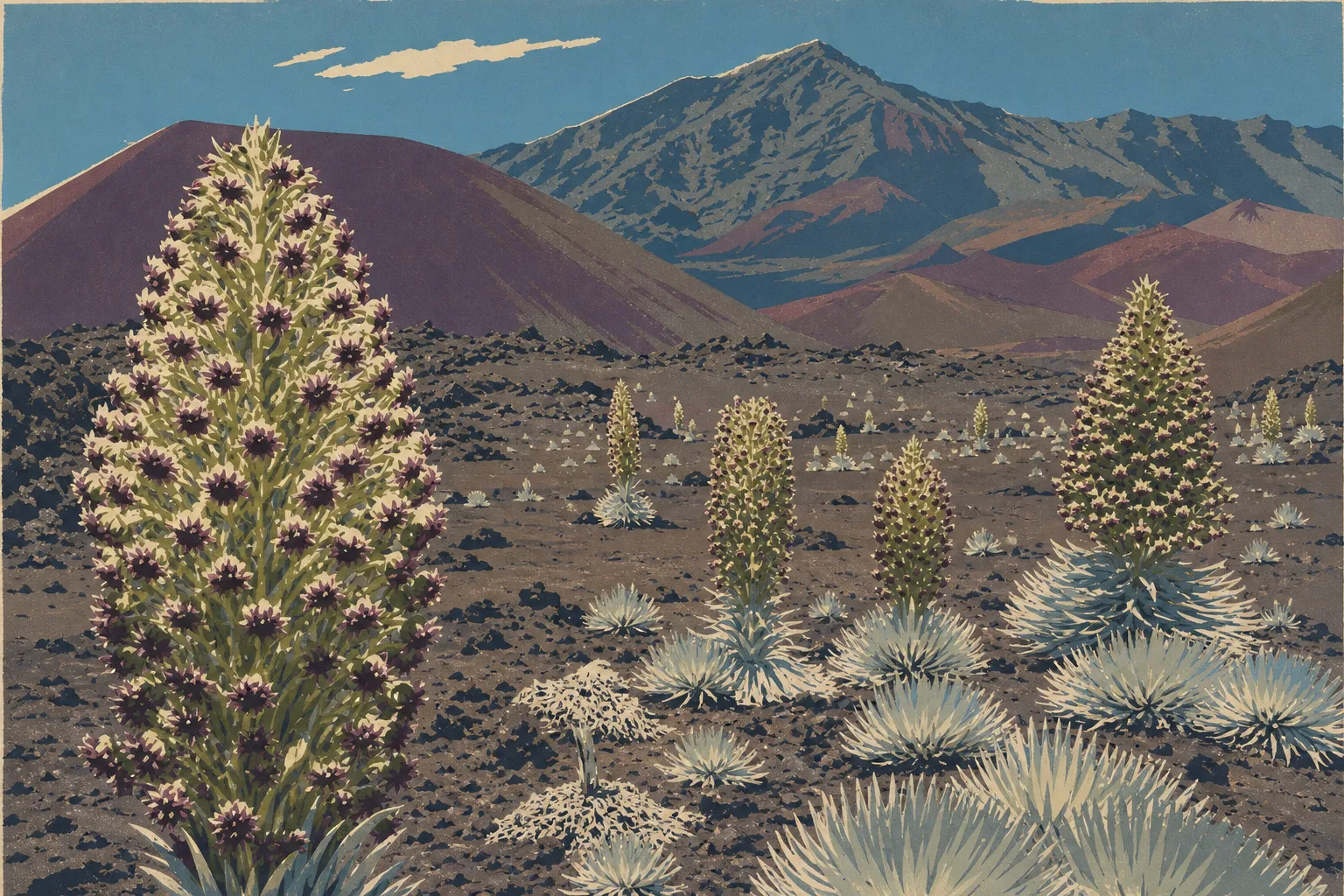
Haleakalā is home to species found nowhere else. The star is the ʻāhinahina, or Haleakalā silversword, a silvery plant that grows only on these volcanic slopes, blooms once, and then dies. Never touch it, and stay on the trails. Its shallow roots are fragile.
As for birds, the park protects several threatened endemic Hawaiian species, including the nēnē, Hawaiʻi's state bird, which you may sometimes see near high-elevation parking areas. Never feed it. That makes it dependent on people and draws it toward the roads.
Our Wildlife page has the full species guide and the best places to see them.
The detailed guide Haleakalā Wildlife: What to See and Where to Look Nēnē, Hawaiian petrels, pueo, and honeycreepers Read the guide →When to Visit Haleakalā
You can visit Haleakalā year-round, but each district has its own seasonal rhythm and very particular weather.
The summit is a world apart. It can be as cold as 30°F up there while Kīpahulu on the coast is at 81°F the same day. Temperatures drop about 1°F for every 330 feet of elevation gain, and clouds, rain, and full sun can replace one another within minutes. Always bring layers for the climb, whatever the season down below.
This is only a summary. Our When to Visit page covers the details month by month, including crowds, rainy season, and the best sunrise windows. Our Weather page covers exact conditions at elevation.
The detailed guide When to Visit Haleakalā: Best Time, Weather, and Seasons Visit Haleakalā in April-June or September-October for clear skies, manageable… Read the guide →Where to Stay at Haleakalā
There is no hotel in the park. Most visitors stay elsewhere on Maui and visit the park for the day, which explains the overnight departures for sunrise.
Three main options stand out:
- Stay on the Maui coast, in Kīhei, Wailea, Pāʻia, or Kahului, and drive up for the day. This is the most common choice.
- Camp in the park, at the summit or in Kīpahulu, for adventurous travelers who are well equipped for the cold.
- Travel by RV, with its own parking and overnight-stay restrictions.
Our Where to Stay page compares the options, with sections on Hotels & lodges, Camping, and RV travel for different travel styles.
Stay in the park
Practical Information, Rules, and Safety
Haleakalā is not a dangerous park, but the elevation and weather can surprise visitors who are unprepared. Here are a few practical rules.
- Cold and wind: at the summit, bring a hat, gloves, and several layers, even in summer. We repeat this because it is the number-one mistake.
- Altitude sickness: going from sea level to 10,023 feet in 1.5 hours can cause headaches and shortness of breath. Climb slowly, stay hydrated, and don't scuba dive the day before. Diving before going to elevation increases the risk.
- Sun: solar radiation is intense at elevation, even when the air is cool. Sunscreen and sunglasses are essential.
- Driving downhill: downshift to brake with the engine and prevent the brakes from overheating.
- Supplies: there is no restaurant or gas station in the park. Fill up on gas, water, and food before you head up. See our Where to Eat page to plan your meals.
All park rules, safety recommendations, and detailed practical information are collected on our Practical Information, Rules & Safety page. To collect the park stamp, take a look at our editorial Passport & stamps page.
Around Haleakalā: Things to Do Nearby
Haleakalā rarely stands alone in a trip. It fits into a broader visit to Maui and Hawaiʻi. Hana Highway, which leads to Kīpahulu, is a full excursion in its own right, with waterfalls and beaches along the way. The island's south and west coast resorts offer beaches and snorkeling as a counterpoint to the volcano.
To build the park into a broader trip, our upcoming Road Trips and Regions pages will place Haleakalā in a complete Hawaiian itinerary.
Our Take: Is Haleakalā Worth the Trip?
Yes, as long as you know what you're coming for. Visitors who expect to make a quick stop for a "pretty viewpoint" may be put off by the cold and the sunrise line. Those who take Haleakalā for what it is, a two-sided volcano where high-elevation desert gives way to coastal jungle in the same park, leave with a lasting impression. Our recommendation is simple: don't rush it. Give the summit your sunrise or sunset, and give Kīpahulu a full day. That's when the park really comes together.
Frequently Asked Questions
Do You Need a Reservation for Haleakalā?
A reservation is needed only to access the summit for sunrise, between 3 a.m. and 7 a.m. It is separate from the entrance ticket and must be booked online in advance because spaces are limited. Outside those hours, no reservation is required. The park remains open 24 hours a day.
What Are the Must-Do Things Around the Park on Maui?
The park's highlights are sunrise or sunset at the summit, stargazing at night, and the Pīpīwai Trail hike to Waimoku Falls in Kīpahulu. Across Maui, Hana Highway, which serves Kīpahulu, is a major excursion in its own right.
What Are the Best Hikes in Haleakalā National Park?
The best hikes are split between the two districts: the Keoneheʻeheʻe Trail (Sliding Sands) and the short Hosmer Grove Loop at the summit, plus the Pīpīwai Trail to Waimoku Falls in Kīpahulu. Our Hiking page has the full details on distances and difficulty.
What Is the Curse of Haleakalā?
The "curse of Haleakalā" refers to a belief that taking rocks or volcanic sand from the park brings bad luck until the objects are returned. Legend aside, removing rocks, plants, or anything else from nature is prohibited in an American national park. Leave with photos.
The American Parks shop
Bring Haleakalā home
Our park-inspired creations, made to order and shipped to your door.
Latest park news
- Haleakalā: No Water or Restrooms at Kīpahulu, Pack Your OwnOn Haleakalā's south coast, the Kīpahulu District has lost its restrooms and water, so come prepared with your own drinking water.
- Haleakalā: New Bilingual Hawaiian-Language Exhibits Open at the SummitNew exhibits in ʻōlelo Hawaiʻi and English now greet visitors at the Haleakalā summit visitor center, according to Maui Now.
- Haleakalā closed both districts as Tropical Storm Nolo neared; both have now reopenedAfter Tropical Storm Nolo passed, Haleakalā reopened both districts on September 28, 2026; sunrise reservations and Kīpahulu camping are back Monday.