
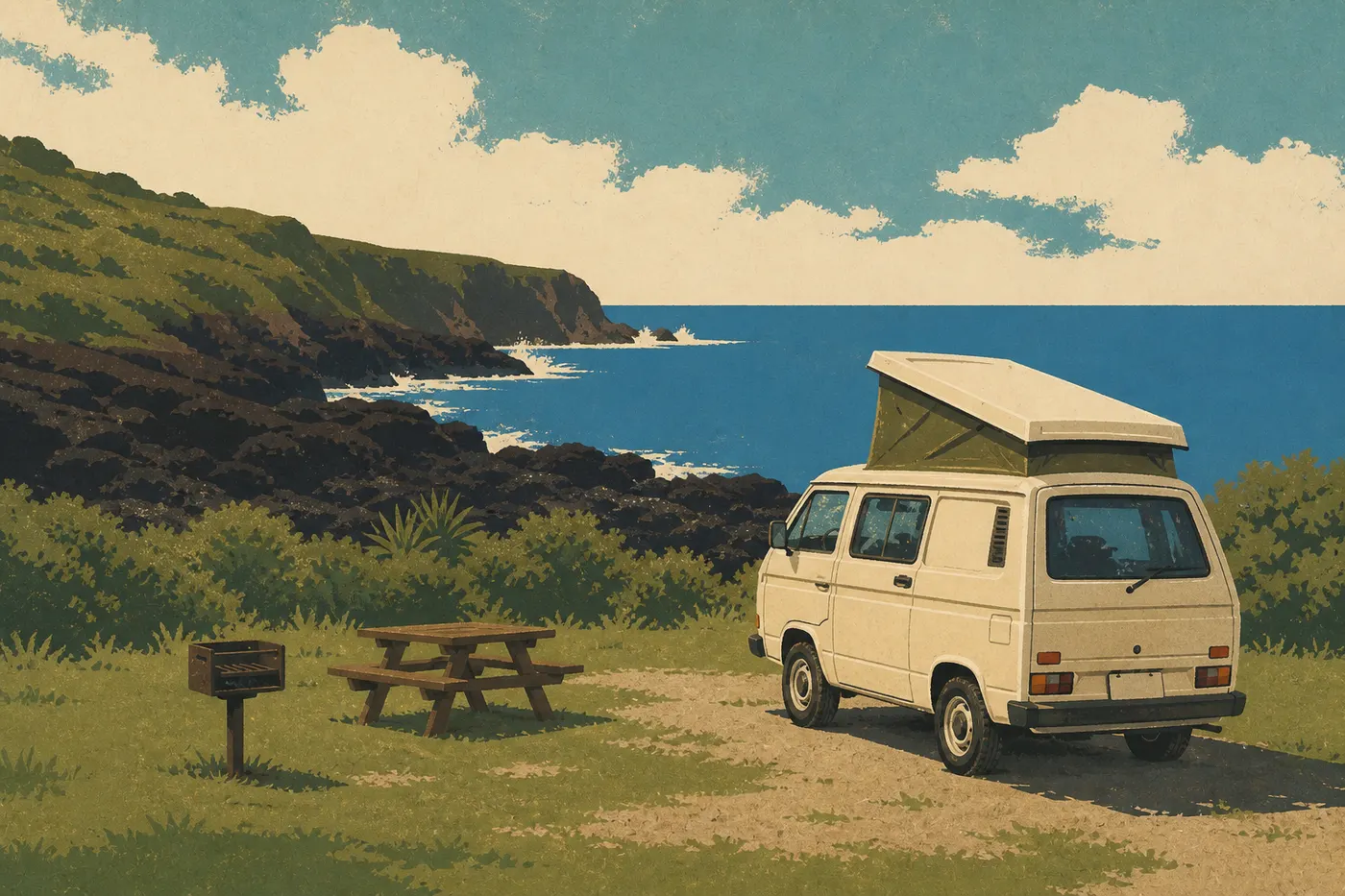
Haleakalā by RV: Campgrounds, Rules, and Tips
The short answer: yes, you can camp in an RV at Haleakalā, and both park campgrounds are accessible by vehicle. The main limitation is vehicle size. The road to the summit is a series of hairpin turns. The Hana Highway, the only way to reach the coastal Kīpahulu District, has numerous one-lane bridges that aren't recommended for long vehicles or vehicles towing trailers. A camper van or small motorhome can get around everywhere. An 11-meter Class A with a trailer cannot.
Can You Drive and Camp an RV at Haleakalā?
Haleakalā National Park is divided into two separate districts, and that should guide all your vehicle planning.
You reach the Summit District via Haleakalā Crater Road (State Highway 378) from Pukalani. The paved road climbs from sea level to 10,023 feet over about 31 miles and is manageable for a reasonably sized vehicle.
The Kīpahulu District on the southeast coast, near Hāna, isn't connected to the summit by an internal park road. To get there, you take the famous Hana Highway (Route 360), with its roughly 620 curves and one-lane bridges. The road is officially discouraged for RVs and trailers.
If you visit both districts, allow about 1.5 hours to drive between them on the road outside the park. Plan accordingly. This isn't a quick round trip.
RV Restrictions and Regulated Roads
Summit road: the tight turns make it difficult to maneuver long vehicles. Camper vans and compact motorhomes, under 20 to 23 feet, can drive it without difficulty. Long Class A motorhomes and RV-and-trailer combinations often exceed the clearance limits of some parking areas. Check NPS alerts on nps.gov before you leave, since restrictions can change with road conditions.
Hana Highway and Kīpahulu access: the one-lane bridges limit vehicle size. Don't attempt the Hana Highway with a vehicle longer than 23 feet or with a trailer in tow. If you get stuck, you may not always be able to turn around.
Sunrise access: the park is open 24 hours a day, but every vehicle entering between 3 and 7 a.m. needs an online reservation. Book on recreation.gov well in advance. Sunrise time slots fill quickly during the busy season. This applies to every vehicle, including RVs. For general access information, the Haleakalā access guide covers roads, shuttles, and parking in detail.
Parking: parking areas inside the park are sized for standard vehicles. At the summit, the Puʻuʻulaʻula Overlook parking lot fills before dawn for sunrise. Arrive in the late afternoon the day before to secure a spot where you can park comfortably.
The Park's Official Campgrounds
Hosmer Grove (Summit District)
At about 6,900 feet, Hosmer Grove is the campground best suited to RVs. The sites are drive-up, with no hookups. There is no electricity, running water is not guaranteed at each site, and there is no dump station. Facilities are limited to vault toilets.
The campground operates largely on a first-come, first-served basis. Check the latest information on recreation.gov, since reservable sites may be available depending on the season. At this elevation, nights are cold and can approach 32°F in winter. Bring warm gear even for a summer stay. The park entrance fee is $30 per vehicle, valid for 3 days. The campsite may be included in that fee or charged separately at a modest rate, depending on the latest NPS updates.
Kīpahulu (Coastal District)
Kīpahulu Campground sits along the southeast coast, just steps from the ʻOheʻo Pools and the bamboo forest along the Pīpīwai Trail. It is also drive-up, with no hookups at all.
Here's the key point: you have to take the Hana Highway to get there. The drive isn't suitable for large RVs, as explained above. If you're in a van or small motorhome, the trip is worth it. Waterfalls and lush tropical vegetation stand in striking contrast to the summit's volcanic barrenness. Fees and reservation procedures are similar to those at Hosmer Grove. Always check road conditions before leaving, since heavy rain often leads to closures.
Dispersed Camping and Areas Around Haleakalā (Boondocking)
The kind of boondocking common in the American West is virtually nonexistent on Maui. Hawaiʻi has no BLM land, and dispersed camping outside designated areas is prohibited on the island. A few state parks on Maui allow camper vans and other RVs, with reservations through the Hawaiʻi Division of State Parks. For all lodging options around the park, the Haleakalā lodging guide covers private campgrounds, lodges, and alternatives outside the park.
Dump Stations, Water, and Services
None of the park's campgrounds has a dump station or hookups. Arrive with full tanks, and leave with your gray and black water.
The nearest dump stations are in Kahului, Maui's main town, about 45 minutes from the summit by road. Plan your logistics before entering the park. Once you're set up at Hosmer Grove, you're halfway up the volcano and far from any services. Potable water may be available at the park entrance. Ask at the ranger station when you arrive, since the supply may be temporarily unavailable.
Which Campground Is Right for You?
Sunrise and crater hikes: Hosmer Grove is the clear choice. You're just minutes from the Keoneheʻeheʻe Trail (Sliding Sands) and overlooks of the crater. Arrive in the afternoon, spend the night, and enter the summit area before dawn without worrying about parking.
Waterfalls, rainforest, and coastal biodiversity: Kīpahulu is hard to replace, provided you're driving a van or small motorhome. For details on trails in each district, the Haleakalā hiking guide compares distances, elevation gains, and difficulty levels.
For families: both campgrounds work well for kids. Hosmer Grove offers cooler, quieter nights. Kīpahulu is warmer and greener, with the pools within walking distance.
Renting an RV to Visit Haleakalā
Maui isn't a major destination for Class A rental companies, and large fleets are rare on the island. You can find camper vans and Class B motorhomes, though, from local rental companies and peer-to-peer platforms such as Outdoorsy and RVshare.
Our advice is to choose a vehicle under 20 feet. That gives you access to both districts and their narrow parking areas, and lets you handle the Hana Highway without risking getting stuck on a bridge. A compact Class C or converted Sprinter is a good fit for this park. Vehicles delivered to Kahului Airport (OGG) are the most convenient. To compare rental price ranges, check offers directly on Outdoorsy or RVshare.
RVs, Pets, Budget, and Reservations: What to Know
Pets: pets are allowed in the park, but the rules are strict. They're prohibited on trails and in wilderness areas. At the campground, pets must be on a leash no longer than 6 feet, and a person must be with them at all times. You can't leave a pet alone in an RV, since the vehicle doesn't count as an approved home. Check the current rules on nps.gov before you leave.
Budget: the entrance fee is $30 per vehicle, valid for 3 days, or $55 for the park's annual pass. The annual pass can make sense if you're visiting several U.S. national parks during your trip to Hawaiʻi. The campsite is included with admission or costs a modest additional fee. There are no hookup fees because hookups aren't available.
Reservations: campgrounds are mostly first-come, first-served. During the busy season, from May through September, and for sunrise, sites can fill by early afternoon. Arrive early to secure a spot. Cabins and wilderness sites, which are tent-only and inaccessible by vehicle, require reservations through recreation.gov.
In Summary: Our Haleakalā RV Plan
Choose a compact vehicle, such as a van or Class B under 20 feet, and both park districts are open to you. For the summit, stay at Hosmer Grove. Arrive midafternoon, spend the night, and wake up at 3 a.m. to enter before dawn with your reservation ready. For the coast and waterfalls, choose Kīpahulu and take your time on the Hana Highway. It rewards drivers who respect it. In either case, fill your water tanks and take care of dumping in Kahului before entering the park. No surprises and no ruined days.
Frequently Asked Questions
Do I need a reservation for Haleakalā?
An online reservation through recreation.gov is required to enter the park between 3 and 7 a.m. for sunrise. The rest of the day, you can enter by paying the entrance fee. Most campsites are first-come, first-served and don't require reservations.
Can you camp in an RV at Haleakalā?
Yes. Hosmer Grove in the Summit District and Kīpahulu in the Coastal District welcome camper vans and other RVs at drive-up sites. The park has no hookups. Vehicle size is the main limitation, especially when reaching Kīpahulu via the Hana Highway.
Can you visit or cross Haleakalā by RV?
The Summit District is accessible to reasonably sized vehicles, under 20 to 23 feet. The Kīpahulu District, accessible only via the Hana Highway and its one-lane bridges, isn't recommended for large vehicles or trailers. The two districts aren't connected by an internal park road.
Can you park an RV anywhere at Haleakalā?
No. You may park only in designated areas. The summit parking lots are small and fill early in the morning for sunrise. Arrive the day before to secure a spot with a large vehicle.
Which campground should you choose at Haleakalā?
Hosmer Grove is best for the summit, crater, and high-elevation hikes. Kīpahulu is best for the tropical coast, the ʻOheʻo Pools, and the bamboo forest. If your vehicle is compact, both are worth visiting during the same trip.
What are the best hikes in Haleakalā National Park?
From the summit, the Keoneheʻeheʻe Trail (Sliding Sands) descends into the volcanic crater. From Kīpahulu, the Pīpīwai Trail crosses a bamboo forest to Waimoku Falls. Our Hiking page gives distances, elevation gains, and difficulty levels for every trail.
Is Haleakalā active?
Haleakalā is considered potentially active. Its last eruption was about two centuries ago. It isn't continuously active like Kīlauea on Hawaiʻi Island. Our complete Haleakalā guide covers the site's geology and volcanic history.
Where can you see sunrise at Haleakalā?
From the summit at Puʻuʻulaʻula Overlook, 10,023 feet above sea level, you'll watch the sun rise over the ocean from above the cloud layer. Reservations are required on recreation.gov for entry between 3 and 7 a.m. Bring warm clothing. Summit temperatures can approach 32°F at dawn.