
Guadalupe Mountains National Park: The Complete Visitor Guide
Lost in far West Texas, just a short distance from the New Mexico border, Guadalupe Mountains protects an ancient fossilized coral reef that became a mountain range. Visitors come to climb Texas's highest peak, Guadalupe Peak, and explore a canyon that blazes red and gold in the fall, a rare sight at this latitude. Plan on one or two full days to see the essentials. The park is large but organized around a handful of clearly defined areas, and most visitors combine it with Carlsbad Caverns, just to the north.
This is a hiker's park. There’s no scenic road across the range and no shuttle. Here, you walk. Here’s how to plan your visit without unpleasant surprises.
Guadalupe Mountains at a Glance: Where the Park Is and How to Get There
The park stretches across far western Texas along US 62/180, on the range’s northern slope. The main entrance is the Pine Springs Visitor Center, which includes the information desk, campground, and trailheads for the major hikes.
From El Paso, the most convenient airport, it’s about 110 miles east on US 62/180, just under a two-hour drive. No public transportation serves the park, so you’ll need a rental car. Fill up before you leave. Gas stations are few and far between in this area.
Good news if you want to combine both parks: Carlsbad Caverns, the region’s other national park with its spectacular caves, lies just across the New Mexico border, about 31 miles north. Many road trips include both in the same itinerary.
Entrance Fees, Passes, and Reservations
Admission costs $10 per person. Note the distinction: here, the fee is charged per visitor, not per vehicle as it is in many American parks. School and educational groups enter free.
If you’re staying several days or planning to return, the park’s $35 annual pass quickly pays for itself. The America the Beautiful interagency pass, valid at all national parks, also covers admission to Guadalupe Mountains. If your road trip includes several parks, that’s the pass to get.
There’s no timed entry reservation system for entering the park. Campgrounds and overnight backcountry hikes, however, require separate arrangements.
Reservations, Permits, and Rules to Follow
You don’t need a reservation to enter the park. Sites at Pine Springs Campground are first-come, first-served. In October, during peak fall color season, arrive early.
For backcountry camping outside the developed campgrounds, you need a free permit. You can get one at the Pine Springs Visitor Center on the day of your trip or in advance.
Here are the essential rules:
- Dogs are allowed in developed areas such as campgrounds, picnic areas, and parking lots, but they’re prohibited on all trails. Dogs must be leashed, with a maximum leash length of 6 feet.
- Campfires are prohibited in the backcountry. Restrictions in developed campgrounds vary by season, so check when you arrive.
- Collecting plants, minerals, fossils, or artifacts is prohibited.
- Drones are prohibited without prior NPS authorization.
- Salt Basin Dunes close 30 minutes after sunset, and camping there is prohibited.
Our Practical Information, Rules & Safety page covers all the regulations and emergency procedures.
Getting Around Guadalupe Mountains
Let’s be clear: Guadalupe Mountains isn’t a park you explore from your car. There’s no road across the range, no scenic loop, and no shuttle. US 62/180 runs along the southern edge of the park, and small access roads lead to the trailheads. Everything else happens on foot.
The park is divided into distinct areas, sometimes separated by dozens of miles of driving. You can’t get from one to another in five minutes, so it’s better to choose one area per half-day than try to cover everything. The western side, home to the dunes, is reached by a road that deserves caution. We’ll come back to it below.
How Long Do You Need to Visit Guadalupe Mountains?
One full day is enough for a first taste: a good hike in the morning and a canyon in the afternoon. Two days is the right amount of time if you want to climb Guadalupe Peak and explore a second area without rushing. Stay longer and the park rewards strong hikers with the forested high plateau of The Bowl and the remote northern corners.
If you’re combining the park with Carlsbad Caverns, plan on three days in the region so you don’t have to rush.
Plan your visit
What to See and Do in Guadalupe Mountains
The park makes the most sense when explored area by area. Each one has its own character, trailhead, and atmosphere. Here are the four main areas, from busiest to most secluded.
Road trip journal · 4 areas
Pine Springs, the Heart of the Park
This is where everything starts. The visitor center, main campground, and most famous trails all begin here. Two signature hikes are Guadalupe Peak, the roof of Texas, a demanding day hike that climbs steeply to the summit, and Devil’s Hall, a shorter outing that follows a rocky canyon bed to a narrow passage shaped like a natural staircase. From Pine Springs, you can also admire El Capitan, the limestone escarpment that serves as the park’s emblem and has guided travelers for centuries.
McKittrick Canyon, Ablaze in Fall
This is the area that makes Guadalupe Mountains unique. In late fall, usually from late October to mid-November, the canyon’s maples and ash trees turn red, orange, and gold, an unexpected display in the middle of the Texas desert. The trail follows a stream bordered by lush vegetation and leads to old stone structures tucked into the canyon walls. Be aware that McKittrick Canyon has strict hours and a gate that closes, so check before you go.
Dog Canyon, the Quiet Northern Slopes
At the northern end of the park, accessible by a long road that circles the range, often from New Mexico, Dog Canyon is the area for anyone seeking peace and quiet. Cooler, greener, and higher in elevation, it offers a small campground and trailheads leading toward the high plateau. Few people, lots of silence.
Salt Basin Dunes, Desert Dunes
On the isolated western side, a field of dazzling white gypsum dunes stretches across nearly 2,000 acres. Access is limited to daylight hours, from sunrise until 30 minutes after sunset, and camping is strictly prohibited. One important warning: the access road has a clay surface. After rain, it becomes dangerously slick and impassable. Don’t head out there if storms are threatening.
Explore the park
The Best Hikes in Guadalupe Mountains
Hiking is the reason this park exists. Three major classics stand out: the climb to Guadalupe Peak for strong legs and summit views, McKittrick Canyon for fall color and the cool stream, and Devil’s Hall for a shorter but playful outing along a rocky canyon bed. Experienced hikers will set their sights on The Bowl, a high-elevation plateau covered in conifers that contrasts sharply with the desert below.
The elevation gain is real, and so is the sun exposure. Start early, carry plenty of water (the park is desperately short of it on the trails), and leave yourself a time cushion before dark.
The detailed guide Guadalupe Mountains Hiking: The Best Trails for Every Level Trail guides, difficulty levels, and practical advice for hiking Guadalupe… Read the guide →Wildlife and Plants to Look For
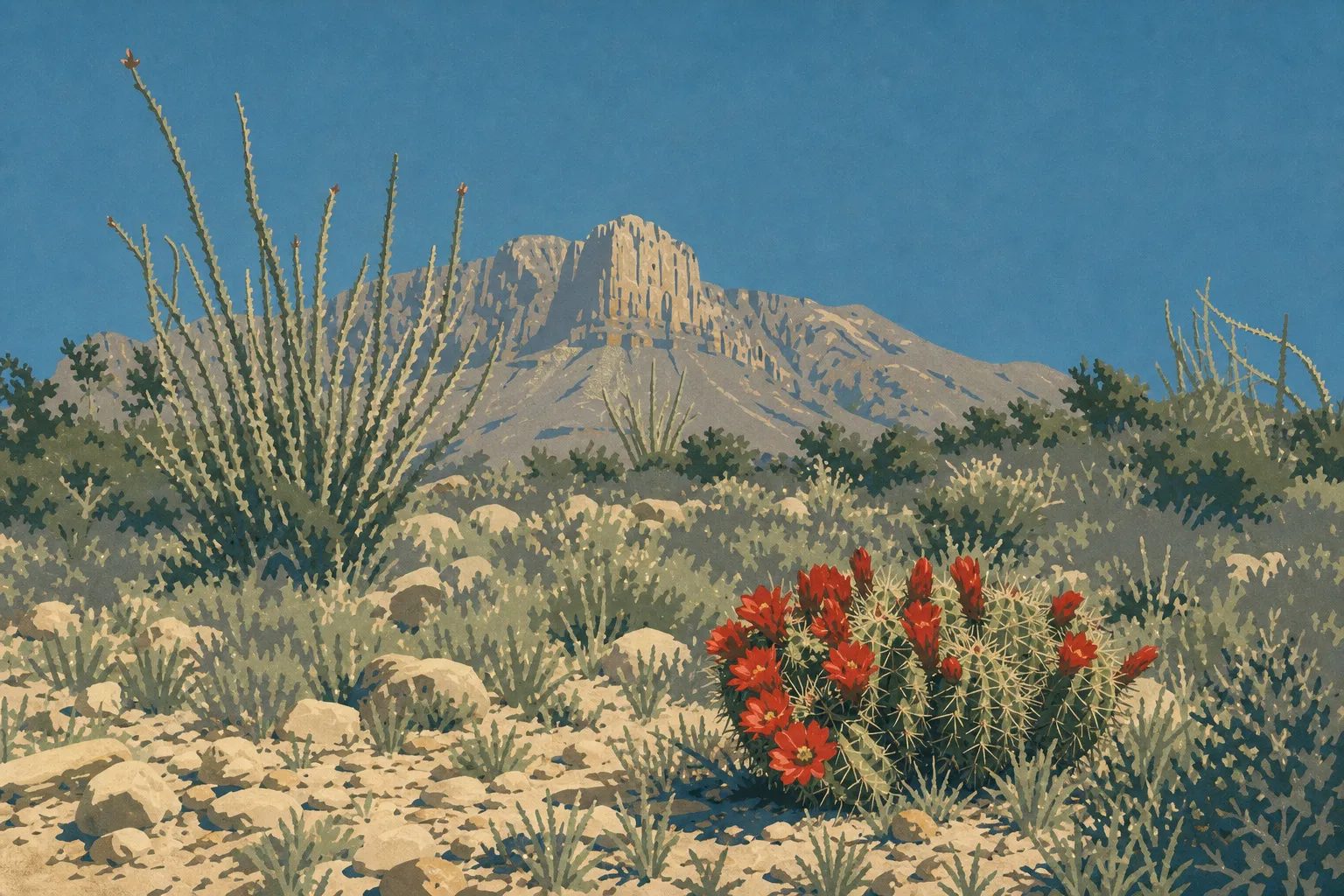
The park spans several environments, from the Chihuahuan Desert below to conifer forests at higher elevations, which means a wide variety of species. You may see mule deer, elk in the high country, foxes, and a rich diversity of birds, especially along the lush corridor of McKittrick Canyon. For safety, remember that the region is home to rattlesnakes and scorpions. Watch where you put your hands and feet, especially in summer. Bigtooth maples and Texas ash trees put on the canyon’s entire fall show.
The detailed guide Guadalupe Mountains Wildlife: What You'll See and Where to Look Mountain lions, black bears, elk, javelinas, and golden eagles Read the guide →When to Visit Guadalupe Mountains
Fall is the prime season for two reasons: McKittrick Canyon’s colors and finally comfortable temperatures. From May through October, highs often reach 81 to 100°F or higher, making long hikes strenuous. From November through April, the weather eases considerably, with highs of 50 to 70°F. Winter occasionally brings light snow, which rarely lasts more than a day.
Two things stay constant year-round: the wind, which can be fierce, with gusts topping 59 mph, and the chill at higher elevations. Above 7,900 feet, expect temperatures to be about 20°F lower than at the park entrance, with the wind making it feel even colder.
The detailed guide When to Visit Guadalupe Mountains: Best Time, Weather, and Seasons October and March-April are the best months for Guadalupe Mountains Read the guide →Where to Stay in Guadalupe Mountains
The park has no lodge or hotel within its boundaries. You have two options: camp in the park or stay in town. Pine Springs Campground, which is open year-round, is the most convenient base for hitting the trails at dawn. Dog Canyon has a second campground that’s more remote and cooler. For a real bed, most travelers stay around Carlsbad or White’s City, New Mexico, which also makes it easy to visit the caves at Carlsbad Caverns.
Stay in the park
Things to Do Around Guadalupe Mountains
The main nearby attraction is Carlsbad Caverns, about 31 miles north: a cave system among the most impressive in the United States, and one you shouldn’t miss if you’re already in the area. Farther southwest, El Paso opens the door to the Chihuahuan Desert and the Mexican border. Guadalupe Mountains fits naturally into a Texas road trip or a loop through Texas and New Mexico.
Our Take: Is Guadalupe Mountains Worth the Trip?
Guadalupe Mountains is worth the trip as long as you know what you’re coming for. This isn’t a park of overlooks you can reach by car. It’s a hiker’s park, where the best rewards have to be earned on foot. If you enjoy hiking, solitude, and landscapes that change with elevation, you’ll have two wonderful days here, especially in fall when McKittrick Canyon catches fire with color. If you’re looking for comfort and easy viewpoints, you may leave wanting more. When we visited, what stayed with us most was the contrast between the scorching desert below and the cool forest on the high plateau. Combined with Carlsbad Caverns, it makes for one of the American Southwest’s most underrated nature weekends.
Frequently Asked Questions
What Is the Highest Peak in Texas?
Texas’s highest peak is Guadalupe Peak, which rises to 8,751 feet in the heart of the park. You reach it on a demanding day hike from Pine Springs, rewarded with 360-degree views of the desert and El Capitan.
What Are the Must-See Sites in Texas?
Among Texas’s must-see sites, Guadalupe Mountains stands apart for nature lovers: the state’s highest peak, McKittrick Canyon blazing with fall color, and the white dunes of Salt Basin. The park pairs perfectly with Carlsbad Caverns, just across the New Mexico border.
What Is the Most Beautiful American National Park?
Choosing the most beautiful American national park comes down to personal taste, and Guadalupe Mountains isn’t in the same category as the heavily visited giants such as Yellowstone or Zion. Its strength is its quiet: you rarely share the trails with many other people, and the contrast between desert and high-elevation forest offers an experience few parks can match.
What Is the Most Beautiful Place in Texas?
The most beautiful place in Texas is up for debate, but McKittrick Canyon in the park often comes up in the conversation. In late fall, its maples and ash trees turn red and gold in the middle of the desert, a rare phenomenon at this latitude. The summit of Guadalupe Peak and the dunes of Salt Basin complete the picture.
The American Parks shop
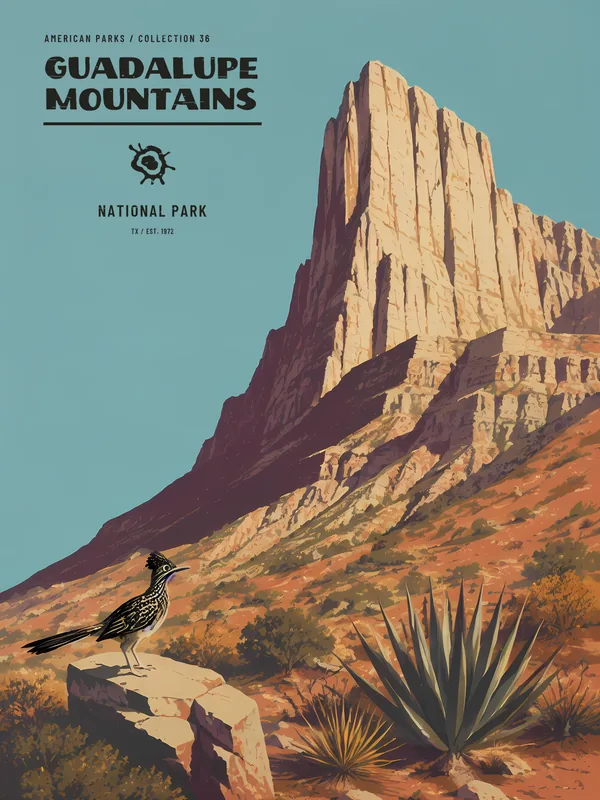
Bring Guadalupe Mountains home
Our park-inspired creations, made to order and shipped to your door.
Latest park news
- Guadalupe Mountains: McKittrick Canyon Closed by Wildland FireA wildland fire has forced the temporary closure of McKittrick Canyon and its backcountry campgrounds at Guadalupe Mountains. Here's what to plan around.
- Guadalupe Mountains: Pine Springs Parking Lot Closed for RoadworkThe Pine Springs trailhead parking lot is closed for paving work, so park at the visitor center before you head out on the trail.