
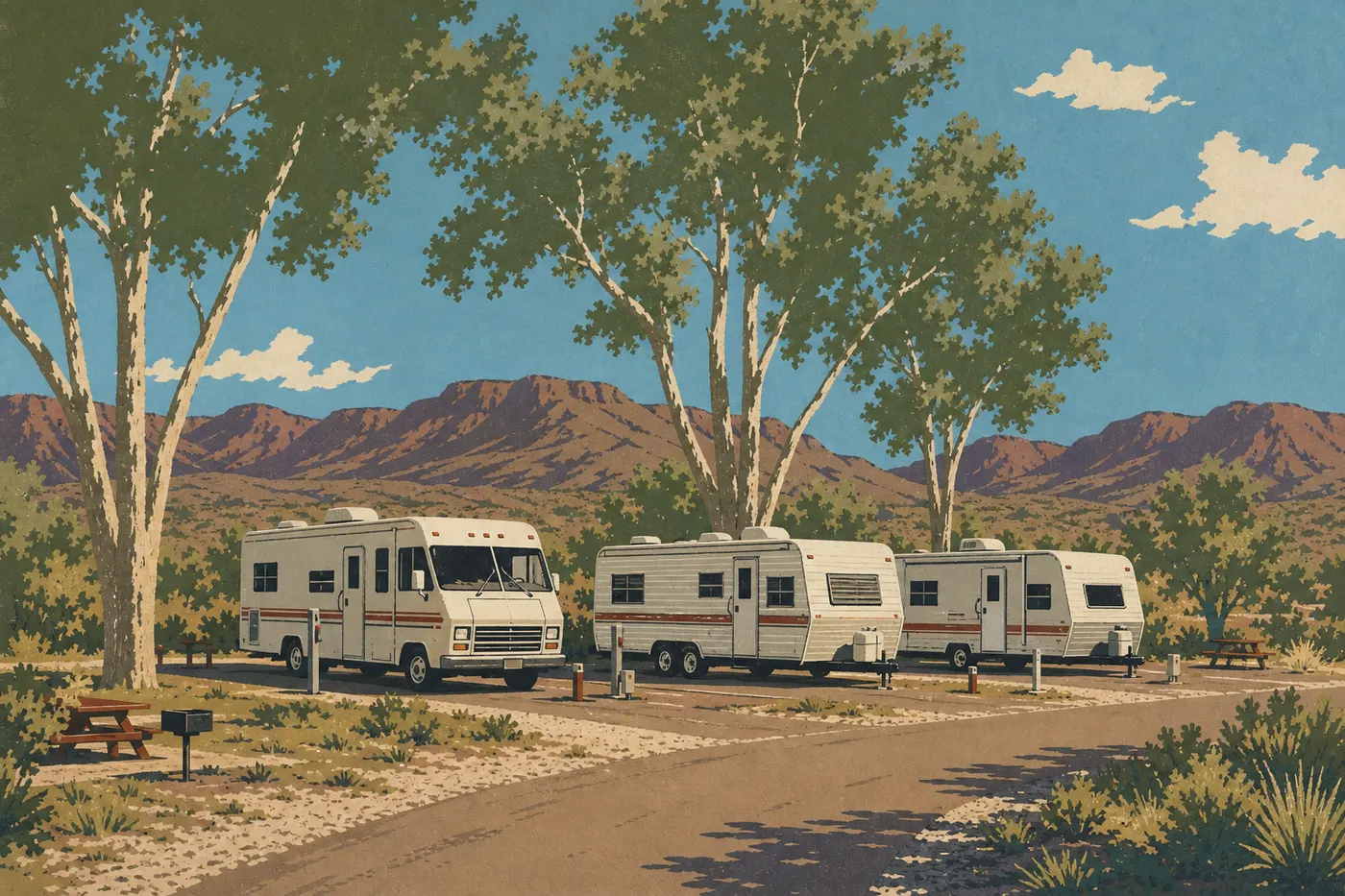
Big Bend by RV: Campgrounds, Rules, and Tips
Yes, Big Bend is very RV-friendly. The park has four official campgrounds, including an RV park with electrical hookups, plus about 20 primitive sites scattered across the desert. The key restriction to know before you go is that Chisos Basin Road bans vehicles longer than 24 feet overall. If your rig exceeds that limit, Chisos Basin is off-limits, and the rule is strictly enforced.
Can you drive and camp at Big Bend in an RV?
Big Bend is open 24 hours a day, year-round, with no time restrictions at the entrances. The entrance fee is $30 per vehicle, valid for 7 days. The park's main roads, including US 385 to Panther Junction, TX 118 to Study Butte, the road to Rio Grande Village, and the road to Castolon, are paved and easy enough for standard-size RVs.
Chisos Basin Road is the only route with significant restrictions. Elsewhere, a well-maintained 26- to 30-foot vehicle can travel the main roads without trouble. The unpaved roads are reserved for high-clearance 4WD vehicles.
RV restrictions and regulated roads
This is the park's most important RV rule.
Chisos Basin Road: vehicles, including a tow vehicle and trailer combination, longer than 24 feet are strictly prohibited on this road. The NPS strongly advises against taking any trailer or vehicle longer than 20 feet onto it, even if it falls below the legal limit. The hairpin turns and 15% grades leave no room for guesswork.
In practice:
- Camper van or Class B, under 20 feet: no restrictions.
- Class C around 23 feet: technically possible, but stressful over the final few miles. Consider your mountain-driving experience.
- Class A, 5th wheel, or any rig longer than 24 feet: Chisos Basin is off-limits. Head to Rio Grande Village or Cottonwood instead.
Other things to keep in mind:
- Unpaved backcountry roads are off-limits to standard vehicles. They require a high-clearance 4WD vehicle.
- Parking at Chisos Basin Village, including the visitor center, lodge, and restaurant, is limited for large vehicles, especially in March and April and in October and November.
- The speed limit is 45 mph on the main roads and 25 mph in developed areas.
The park's official campgrounds
Chisos Basin Campground
Perched at about 5,740 feet in the Chisos Mountains, this is the park's most sought-after campground for its mountain setting. Only vehicles under 20 feet can reach it. There are no electrical hookups, but drinking water is available on-site. The roughly 60 sites can be reserved through Recreation.gov, which is essential during the busy seasons in March and April and in October and November. The rate is around $14 per night.
The views of Casa Grande and The Window rock formations make the logistical effort worthwhile, as long as your vehicle fits within the length limits.
Rio Grande Village Campground
The main campground in the low desert, just steps from the Rio Grande. It accepts RVs up to about 30 feet on its widest sites. The campground has no electrical hookups, but water is available on-site. Reservations are available through Recreation.gov, and the campground fills quickly during the busy seasons. The rate is about $14 per night.
Rio Grande Village RV Park
This is the only option inside the park with electrical hookups, up to 30 amps. About 20 sites are managed by concessioner Forever Hospitality. Individual sites have no water or sewer hookups, but a dump station is available on-site. The rate is around $36 per night, and you must reserve directly with the concessioner, not through Recreation.gov. It's a good choice for recharging your batteries in summer or running the AC all night.
Cottonwood Campground
Near Castolon in the western part of the park, this more isolated campground accepts standard-size vehicles. There are no hookups, and drinking water is available seasonally. It sees fewer visitors than Rio Grande Village and has a wilder feel. It's a good alternative when the other campgrounds are full and you don't need electricity.
Dispersed camping and areas around Big Bend (boondocking)
Big Bend is surrounded by BLM (Bureau of Land Management) land where boondocking is legal and free, subject to a 14-day consecutive limit at the same site. The area around Terlingua and Study Butte, at the park's western entrance, has many flat, open spots. You'll also find an active van-life and full-timer community, with a few water sources in town within a reasonable distance.
Inside the park itself, the NPS offers about 20 primitive roadside campsites, located along vehicle-accessible roads and offering no amenities at all, including no water, restrooms, or tables. A free backcountry permit is required, and you must pick it up at Panther Junction Visitor Center on the day you arrive. Sleeping in the Chihuahuan Desert, alone beneath the Texas stars with no other vehicle in sight, is the full Big Bend experience.
For BLM areas around Big Bend, the Regions section of the site provides information about the areas around the park.
Dump stations, water, and services
Dump station: only one dump station is available inside the park, at Rio Grande Village RV Park. Outside vehicles can use it for a small fee. Plan ahead, since it's your only option in the park.
Drinking water: available at Chisos Basin, Rio Grande Village, and Panther Junction, the park headquarters. There are no reliable water sources in the backcountry. Start out with full tanks.
Fuel: a Conoco gas station at Rio Grande Village charges park prices, about 20% to 30% more than stations outside the park. There are two more stations in Terlingua and Study Butte at the western entrance.
Groceries: a small convenience store at Rio Grande Village covers the bare essentials. For a proper grocery run, Alpine, 1.5 hours north, or Presidio, 1.5 hours west, are your best options.
Which campground is right for you?
Camper van or Class B, under 20 feet, and you love the mountains: Chisos Basin. Nothing else in the park matches the setting. The road takes some effort, but the payoff is worth it.
Large rig, such as a Class A or 5th wheel, that needs electricity: Rio Grande Village RV Park. Reserve early. The 20 hookup sites fill quickly during the season.
Solitude and a night under the stars: the primitive roadside campsites. Pick up your free permit at Panther Junction when you arrive, then choose a site using the maps available there.
Family with kids and a mid-size RV, 23 to 26 feet: Rio Grande Village Campground offers the best balance of access, scenery, and proximity to activities. The Rio Grande hot springs are just a few minutes away on foot.
For weather conditions during the campgrounds' operating season, see the Big Bend seasonal guide. Some mountain sites close periodically in winter during the rare freezing episodes.
Renting an RV to visit Big Bend
Big Bend is far from everything. The two most practical starting points are San Antonio, about 280 miles and 5 hours away, and El Paso, about 200 miles and 3.5 hours away. Major national agencies such as Cruise America, along with peer-to-peer platforms like RVshare and Outdoorsy, offer Class C motorhomes in both cities.
Our advice is simple: if you plan to visit Chisos Basin, check the vehicle's overall length before you sign. A 25-foot Class C will keep you out of the park's most spectacular campground. Choose a compact model or a Class B if you want to keep all your options open.
RVs and pets, budget, reservations: what to know
Pets: dogs are allowed in campgrounds as long as they're leashed, with a maximum leash length of 6 feet. They're prohibited on all trails and in the backcountry. Summer heat, which rises above 104°F in the low desert, poses a real danger to animals.
Campsite budget: expect to pay $14 per night for a site without hookups and about $36 for an electrical hookup at the RV Park. These rates are in addition to the $30 per-vehicle entrance fee, valid for 7 days. The park's $55 annual pass pays for itself after two visits in a year.
When to reserve: for March and April and for October and November, Chisos Basin sites book up to 6 months ahead on Recreation.gov. Rio Grande Village follows the same pattern. In July and August, extreme heat keeps many visitors away. Sites are often available without reservations, but conditions can be tough.
Air conditioning: without electrical hookups, running the AC all night quickly drains the batteries in a standard RV. In summer, hookups at Rio Grande Village RV Park aren't a luxury.
In summary: our RV plan for Big Bend
Choose your base camp according to your vehicle's size: Chisos Basin for vans and Class B motorhomes, and Rio Grande Village RV Park for large rigs that need electricity. Add a night at a primitive roadside campsite for a taste of the wilderness. Fill up with water and fuel whenever you can, since the only dump station is at Rio Grande Village. Reserve early if you're aiming for March or October.
For rooms, lodges, and all non-RV options, Big Bend lodging options and the park guide cover the full range of accommodations.
Frequently asked questions
Can you go dispersed camping in Big Bend National Park?
Yes. Dispersed camping is possible in Big Bend through the primitive roadside campsites and backcountry areas, as long as you get a free backcountry permit at Panther Junction Visitor Center before setting up.
Can you visit Big Bend in an RV?
Yes. RVs can access all four of Big Bend's official campgrounds. The main restriction concerns Chisos Basin Road: vehicles, including a tow vehicle and trailer combination, longer than 24 feet are prohibited, and any rig over 20 feet is strongly discouraged.
Can you park an RV anywhere at Big Bend?
No. Overnight parking is allowed only in official campgrounds or on designated backcountry sites. On BLM land next to the park, around Terlingua and Study Butte, free boondocking is allowed instead.
Where are RVs prohibited in the park?
Vehicles longer than 24 feet are prohibited on Chisos Basin Road. The unpaved backcountry roads are reserved for high-clearance 4WD vehicles. Overnight parking outside designated areas is prohibited throughout the park.
How much does a campsite cost at Big Bend?
About $14 per night for a site without hookups and about $36 for an electrical hookup at Rio Grande Village RV Park. These rates are in addition to the $30 per-vehicle entrance fee, valid for 7 days. For entrance fees and annual passes, see the National parks fees and passes page.
What's the best time to visit Big Bend in an RV?
March and April and October and November offer the most pleasant conditions, with mild temperatures and great light for photography. Summer, from May through August, isn't recommended without a powerful AC system. The low desert rises above 104°F by morning. Our When to visit page breaks down conditions month by month.