
Wind Cave Itinerary: What to See in 1, 2, or 3 Days
Wind Cave National Park offers two very different experiences: one of the world's most complex underground cave systems, with the greatest known concentration of boxwork (honeycomb-like calcite formations that dramatically cover parts of the passage walls), and an open prairie where a bison herd has roamed freely for more than a century. These two experiences complement each other, but they aren't interchangeable. One day is barely enough to take in either one.
With two days, you'll explore the cave in depth with one or two guided tours, then hit the surface trails to look for wildlife. Three days give you time to add longer hikes and begin exploring the surrounding area. If you're making a quick stop on a Black Hills road trip, a half-day can work, as long as you choose one cave tour and don't try to squeeze in everything.
How much time do you need to visit Wind Cave?
Wind Cave is a relatively small surface park, considerably smaller than its neighbors in the region. But the surface tells you nothing about the cave's size. You can only visit the cave on a guided ranger-led tour, not on your own. Tours last from one to four hours. Spaces are limited, and they fill up early in July and August. This shapes your schedule more than the geography does.
Here's what you can realistically cover with the time you have.
- 1 day: One cave tour (Garden of Eden or Natural Entrance are the most accessible) and a drive along the scenic road to look for bison and prairie dogs. Minimal, but it works.
- 2 days: Two different cave tours to compare the formations and atmosphere, a hike on the surface trails, and a proper prairie wildlife-watching session. This is our recommendation for most visitors.
- 3 days: The same itinerary, plus a longer hike (Rankin Ridge for panoramic views, Wind Cave Canyon for canyon vegetation) and the start of an exploration of the immediate surroundings.
One practical tip: book your first cave tour before you arrive at the Visitor Center, either online or by phone at 605.745.4600. The Candlelight Tour in particular often sells out several days ahead during the busy season.
Access, entrances, and getting around the park
Wind Cave National Park lies in southern South Dakota along US Highway 385. From Hot Springs to the south, it's 11 miles north. From Custer to the north, it's about 22 miles south. The Visitor Center, the required starting point for all cave tours, sits about 0.5 miles west of the main highway.
There is no shuttle in the park. You'll need your own vehicle to get between the Visitor Center, wildlife-viewing areas, and trailheads. The interior roads are open year-round to standard vehicles. In winter, heavy snowfall (up to 30 inches in a season) can temporarily close some access roads, so check conditions before you leave.
The northern approach, coming from Custer or Mount Rushmore, is the more scenic option. You cross Custer State Park via the Needles Highway or SD Highway 87, then enter Wind Cave through a beautiful transition from ponderosa pine forest to open prairie. From the south, Hot Springs makes a good base. The town is 11 miles from the Visitor Center and offers a range of lodging, plus a notable nearby attraction, the Mammoth Site, where mammoth excavations are still underway.
For distances from the region's major airports (Rapid City and Denver) and car-rental options, see our Wind Cave access guide.
Wind Cave's main areas
The underground cave system
This is the heart of the park and the main reason to come. Wind Cave has the world's greatest known concentration of boxwork. These honeycomb-like calcite formations develop across the walls and ceilings of the passages and are rare almost everywhere else. Here, they are the main feature. You'll also see frostwork, made of rosette-shaped aragonite crystals, and calcite popcorn, but boxwork is what leaves visitors speechless.
Access is strictly regulated through five guided tours, ranging from the shortest to the most demanding.
- Garden of Eden Tour (1 hour, easy): Ideal for a first visit. Boxwork and frostwork are everywhere. You enter and leave by elevator.
- Natural Entrance Tour (1.25 hours, moderate): This tour uses the cave's natural entrance, a simple opening in the rock where the wind that gave the park its name in the 19th century once emerged. You return to the surface by elevator.
- Fairgrounds Tour (1.5 hours, moderate): A longer tour with a wider variety of formations. A good choice for a second visit.
- Candlelight Tour (2 hours, moderately strenuous): You tour by candlelight alone, recreating the atmosphere of the first historic explorations. Groups are very limited, so reservations are essential.
- Wild Cave Tour (4 hours, strenuous): Coveralls and kneepads are provided, and you'll crawl through narrow passages. For ages 16 and up. This is the only tour that gives you a real sense of the scale of the underground system.
The cave stays at a constant 54°F year-round, whatever the season on the surface. Bring an extra layer, even in August.
The prairie and surface wildlife
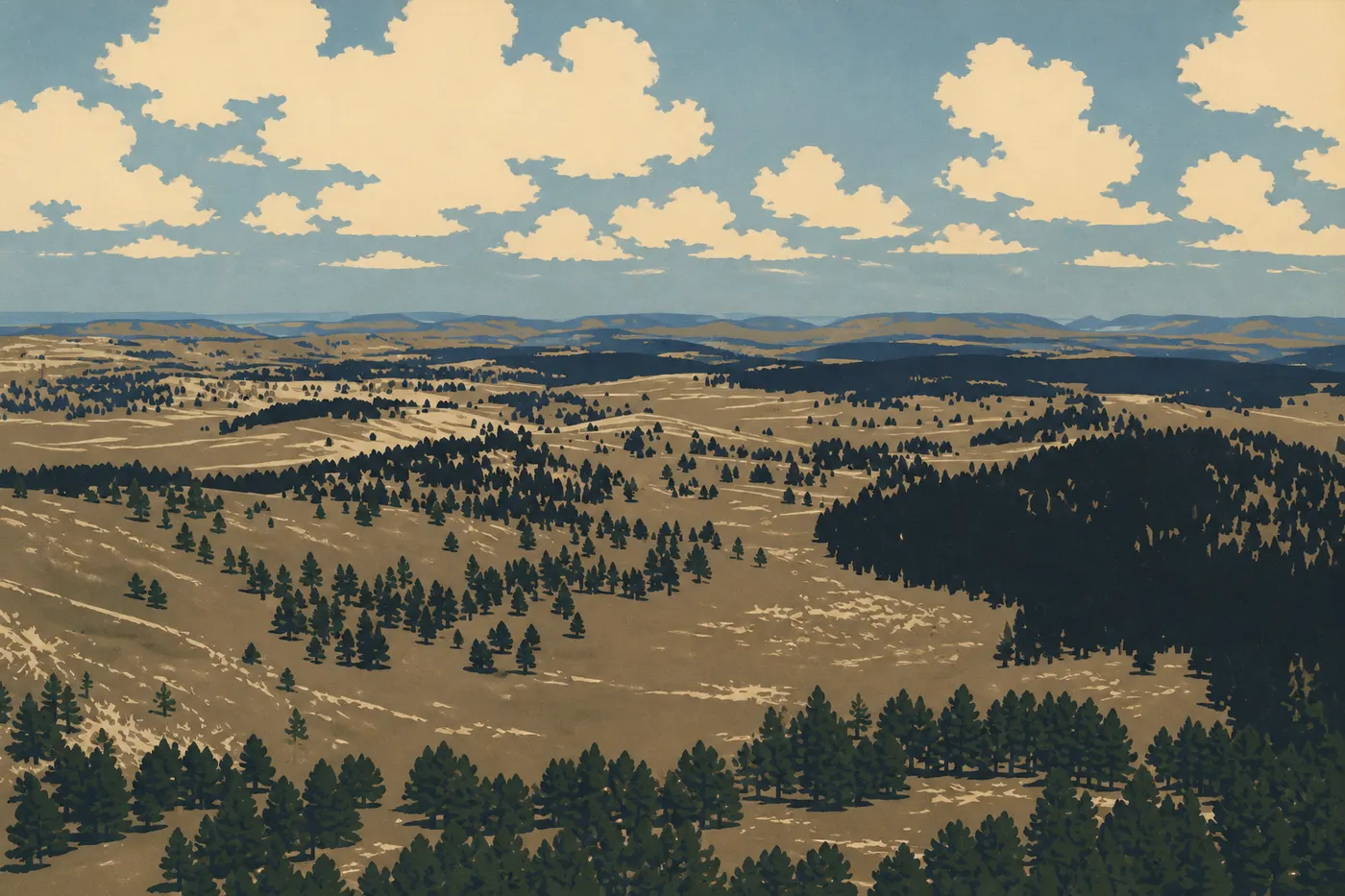
Above the underground system, a large mixed-grass prairie covers most of the park. It's one of the few places in the United States where a plains bison herd lives in its natural habitat without commercial management. The herd descends from 14 animals transferred from the New York Zoo in 1913, and the bloodline has continued ever since.
You can see wildlife from the roads and trails without making any special effort. Bison, often grouped on grassy slopes, elk, pronghorns, mule deer, coyotes, and prairie dog colonies all share this landscape. Prairie dogs are concentrated in two or three areas clearly marked on the Visitor Center map. Bison may block the roads. Keep at least 82 feet away and stay in your vehicle if an animal cuts across your path.
The ridge and canyon trails
This third area gets the fewest visitors and is often the most peaceful place to escape the crowds around the Visitor Center during the busy season. The park has a network of surface trails that alternate between open prairie, ponderosa pine forest, and steep-sided canyon areas.
Two trails stand out. Rankin Ridge Trail leads to the park's highest point, about 4,134 feet, with 360-degree views of the Black Hills. Allow 45 minutes for the 1.2-mile loop, which has moderate elevation gain. Wind Cave Canyon Trail follows a narrow canyon south. Vegetation is denser here than on the open prairie, and birds of prey are easier to spot along the canyon walls.
Day-by-day itinerary
Day 1: Go underground
Arrive at the Visitor Center when it opens, between 8 and 9 a.m. depending on the season. Confirm or book your morning time slot for the Natural Entrance Tour or the Garden of Eden Tour. These are the two tours that provide the best context for a first descent. We prefer the Natural Entrance Tour for its historical story about the park's discovery.
In the afternoon, head out onto the surface trails. Prairie Vista Trail, an easy loop of less than 3.1 miles, is a good introduction to the wildlife and vegetation. In the early evening, drive slowly along the park's scenic road. This is when the bison are most active, and the low light across the rolling prairie is genuinely beautiful.
Spend the night at Elk Mountain Campground in the park, or stay in Hot Springs or Custer.
Day 2: A second cave tour, then the canyon
Choose a second cave tour that's different from the first. If you booked it the day before, the Candlelight Tour is well worth it for the atmosphere. When we visited in July, it had already sold out by midmorning for that same day, so don't miss your chance. Otherwise, the Fairgrounds Tour is the best alternative for the variety of formations.
In the afternoon, set out on Wind Cave Canyon Trail. The canyon stays shaded for much of the day, making it a welcome option during hot summer weather (summer thunderstorms are frequent and severe, so keep an eye on the sky in midafternoon). Watch the canyon walls for red-tailed hawks and sharp-shinned hawks.
Before heading back, make one last stop near the prairie dog colony closest to the Visitor Center. During the hour before sunset, the animals are especially active and easy to photograph.
Day 3: Longer trails and beyond the park
Spend the morning on Rankin Ridge Trail. The view from the summit more than makes up for the modest elevation gain, and the pine forest before the lookout is pleasant. Check with the rangers if you're visiting after a storm. The clay trails stay muddy for several hours.
In the afternoon, leave the park heading north toward Custer State Park, about a 20-minute drive away. Wildlife Loop Road, an 18-mile loop, offers good chances to see bison, deer, and wild burros from your vehicle. It's a natural starting point for a larger road trip through the Black Hills.
For detailed lodging information, including camping in the park, hotels in Hot Springs and Custer, and RV options, see our Where to Stay in Wind Cave page.
Options for different trip lengths
Quick stop (half a day to 1 day): One cave tour (Garden of Eden or Natural Entrance, the shortest options) and a drive along the scenic road to look for bison. This is the minimum that makes sense if Wind Cave is part of a larger Black Hills road trip and you're short on time.
Classic (2 days): Two different cave tours, a surface hike, and wildlife viewing. This balanced plan works for most travelers and covers both sides of the park without rushing.
Immersion (3 days or more): Add the Wild Cave Tour (book it as early as possible, especially during the busy season), the two main surface hikes, and a half-day in Hot Springs or Custer State Park. This format suits geology or wildlife enthusiasts who want to dig deeper, literally.
Wind Cave on a Black Hills road trip (5 to 7 days): Wind Cave fits naturally into an itinerary that includes Mount Rushmore, Crazy Horse Memorial, Custer State Park, and Badlands National Park. Our Black Hills Road Trip and Great Plains Region guides detail these combinations.
Itinerary map
The park's official map, available for free at the Visitor Center (a PDF in the “Unigrid” format can also be downloaded from the NPS website), is the essential reference for the surface. It shows numbered trails, wildlife areas, and trailheads. It's clear and well designed.
For an overview of the park's place in the region, including distances from Hot Springs, Custer, Rapid City, and Badlands, see our Wind Cave map page, which brings together the key visuals for planning your visit.
Keep in mind that the surface map and underground map are two separate documents. The map of the passage system, displayed at the Visitor Center, is remarkably complex and gives you a good idea why cavers estimate that only a fraction of the entire system has been mapped.
Where to stay along the itinerary
Elk Mountain Campground, inside the park, is the most logical choice for a 2- to 3-day stay. It offers tent and RV sites in a pleasant wooded setting, with no electricity at most sites.
For a hotel or other indoor lodging, Hot Springs to the south and Custer to the north offer the closest options at reasonable rates. Rapid City, about a 1.25-hour drive away, is the region's main service hub and has a wider range of hotels.
Full details, including seasonal booking advice and RV options, are available in our complete Wind Cave guide and on our Where to Stay in Wind Cave page.
Extend your trip: what to see around Wind Cave
Wind Cave is surrounded by a dense network of sites that naturally complement one another.
Within 19 miles: Custer State Park, with wildlife, lakes, and scenic roads, and Hot Springs, with the Mammoth Site, where mammoth excavations are still underway. It's a great stop for kids and anyone interested in paleontology.
At 28 to 37 miles: Crazy Horse Memorial, a monumental sculpture that has been under construction since 1948, and Mount Rushmore National Memorial.
About an hour away: Badlands National Park, a landscape of eroded badlands that provides a complete visual contrast with Wind Cave's green prairie. The two parks work well together on a single trip to the region.
These extensions go beyond a single-park itinerary. Our Black Hills Road Trip and Great Plains Region guides build them into coherent 5- to 10-day programs.
The ideal itinerary for your time
Two days is still the ideal length of stay at Wind Cave: one day underground with two different tours, and one day on the surface for hiking and wildlife. Spend less time and you'll leave feeling as though you've only glimpsed something exceptional without understanding its depth. Stay longer and each additional hour reveals trails that most visitors completely overlook.
If you only have a half-day, choose the Natural Entrance Tour for the symbolism of the natural entrance, then drive slowly along the scenic road to look for bison. That will be enough to understand why this park exists, even though the 186-mile network will remain entirely beneath your feet.
Frequently asked questions
How many days do you need to visit Wind Cave?
Two days is the ideal amount of time to visit Wind Cave, combining two different cave tours with surface trails and wildlife viewing. One day is enough for a quick visit focused on a single cave tour.
What's the best itinerary for visiting Wind Cave?
The most efficient sequence is a Natural Entrance Tour or Garden of Eden Tour on the morning of day 1, a scenic drive in the afternoon, then a Fairgrounds Tour or Candlelight Tour on the morning of day 2, followed by a hike on Wind Cave Canyon Trail or Rankin Ridge Trail.
Can you drive through Wind Cave?
Wind Cave isn't a through-route park. An internal scenic road lets you see bison and prairie from your vehicle, but the park isn't on a major through highway. The interior roads stay open year-round, weather conditions permitting.
What is there to see at Wind Cave?
Wind Cave offers two complementary experiences: guided tours through the underground system and its world-renowned boxwork formations, plus prairie wildlife viewing, including bison, elk, pronghorns, and prairie dogs. Our Things to Do at Wind Cave page covers all the available activities and trails.
How much does it cost to enter Wind Cave?
Park access fees and cave tour prices vary by season and type of visit. For current prices and national pass options, including the America the Beautiful pass, see the National Parks Fees & Passes page.
What's the best time to visit Wind Cave?
From June through September, the roads are open, all cave tours are available, and wildlife is active. Summer can be hot on the surface, regularly topping 81°F, but the cave stays around 54°F year-round. Our best time to visit Wind Cave guide covers the seasons one by one, including the advantages of visiting in spring or fall.
Is Wind Cave worth visiting?
Wind Cave is worth visiting if you're in the Black Hills. The underground boxwork is a unique geological feature on a scale that is unmatched in the world among sites open to the public. The surface prairie and its historic bison herd round out the experience without duplicating what you'll find in the neighboring parks.