
Wind Cave National Park: The Complete Visitor Guide
Wind Cave is really two parks in one. Underground, a limestone maze holds the world's largest known concentration of boxwork, those delicate honeycomb-like mineral blades. Above ground, a mixed-grass prairie in the Black Hills is home to bison, elk, and prairie dogs going about their quiet lives. Established in 1903 as the seventh national park in the United States, it was the world's first park created to protect a cave. Plan on a half day if you're only taking a guided tour, or a full day to combine the cave with the prairie trails. The park is in South Dakota, just a short drive from Custer State Park and Mount Rushmore.
Here's the big picture: where the park is, how to get in, what to see in each area, and how much time to allow. Each topic has its own detailed guide, so follow the links as you read.
Wind Cave at a Glance: Location and Getting There
Wind Cave occupies the southern Black Hills in South Dakota. The park stretches along US Highway 385, about 11 miles north of Hot Springs and 22 miles south of Custer. The Visitor Center, where all cave tours begin, sits about 2,600 feet west of the highway and is well signposted.
There isn't an airport nearby. The usual gateways are Rapid City, about an hour's drive north, for its regional airport, or a flight to Denver followed by several hours of driving. You'll need a car. No public transportation serves the park, and getting between sites in the Black Hills means driving.
The park itself stays open around the clock, all year. The Visitor Center's hours and the guided-tour schedule change with the season. Snow and severe weather can close some roads, especially in winter.
Entrance Fees, Passes, and Reservations
Access to the aboveground areas of the park, including roads, prairie trails, and picnic areas, doesn't work like it does at the big parks with entrance booths. Going underground, however, requires a paid ranger-led tour, and that's the part you need to plan ahead for.
You can reserve tour tickets online, and we strongly recommend doing so in summer. Time slots fill quickly, and tours sell out during the busiest part of the season. A limited number of spots may still be available in person on the day of the tour, but we wouldn't count on it on a July morning. Prices vary by tour type and length.
For current prices, discounts, and how the interpark passes work, the annual America the Beautiful pass covers many sites in the region, our Fees & Passes page explains entrance fees and passes. And if you collect stamps, the Visitor Center has one. See our Passport & Stamps page.
Reservations, Permits, and Rules to Follow
Reservations. Cave tours are booked through recreation.gov. During the busy season, you'll need to book several days ahead. Some tours sell out before noon on peak days.
Permits. You don't need a permit for surface hiking. Backcountry camping requires a free permit, which you can get at the Visitor Center before you hit the trail.
Cave rules. Never touch the formations. Heat and natural oils from your skin can damage boxwork and crystals over decades. You can't remove anything, including rocks, crystals, or sediment. Closed-toe shoes with nonslip soles are required and checked at the entrance. Sandals and slippers aren't allowed. The cave stays at 55°F year-round, so bring a light jacket even in midsummer.
Surface rules. Pets are allowed in the park, including on trails, at the campground, and on roads, but not in the cave. They must remain on a leash no longer than 6 feet. Never feed wildlife. Stay at least 75 feet from bison and elk. Campfires are allowed only in designated sites at the campground.
Getting Around Wind Cave
Wind Cave is easy to explore by car. There is no shuttle, and the park doesn't have the far-flung districts found in some larger western parks. Two main roads, US Highway 385 and SD Highway 87, connect the main points of interest, including the Visitor Center, trailheads, campground, and Rankin Ridge fire lookout tower.
Distances within the park are short. Leave your car in the Visitor Center parking lot for cave tours, then drive a few minutes to the surface trailheads. The prairie is also easy to explore from the car. It's not unusual to see a bison herd crossing the road. Slow down, keep your distance, and stay in the car.
Our Getting Around guide covers the roads, parking areas, and driving rules in detail.
How Much Time Do You Need at Wind Cave?
A cave tour lasts one to two hours, depending on the option you choose. Add time to wait before the tour and walk from the Visitor Center. Plan on a solid half day just for the underground portion.
For a well-rounded visit, plan on a full day. Take a cave tour in the morning, hike one or two prairie trails in the afternoon, and stop at Rankin Ridge for the view. If you're also visiting Jewel Cave, Custer State Park, or Mount Rushmore that day, limit Wind Cave to a half day and focus on a single guided tour.
Our Itinerary & Timing page offers ready-to-use plans, including a quick half day, a full day, and ways to fit Wind Cave into a larger Black Hills road trip.
Plan your visit
What to See and Do at Wind Cave
The park's highlights unfold on two levels: the cave beneath your feet and the prairie around you. Here's how to break it down.
Road trip journal · 3 areas
The Cave and Its Guided Tours
This is why the park exists. You can only explore the cave with a ranger, never on your own, and for good reason. It's one of the world's longest and most complex underground systems, with galleries winding across several levels.
Its signature feature is boxwork, thin calcite walls that project from the walls and ceiling to form honeycomb-like cells, like honey cake frozen in stone. Wind Cave contains most of the known examples on the planet. Few can be found elsewhere, and rarely in such impressive condition.
Several tour options are available depending on the season. They include a classic tour through the natural entrance, a tour focused on the finest boxwork rooms, a shorter accessible option, and sometimes a candlelight tour or strenuous off-trail exploration for more adventurous visitors. Underground temperatures stay cool and steady year-round, around 54°F. Bring a jacket even in summer, along with sturdy closed-toe shoes, since the stairs can be damp.
The Prairie, Wildlife, and Surface Trails
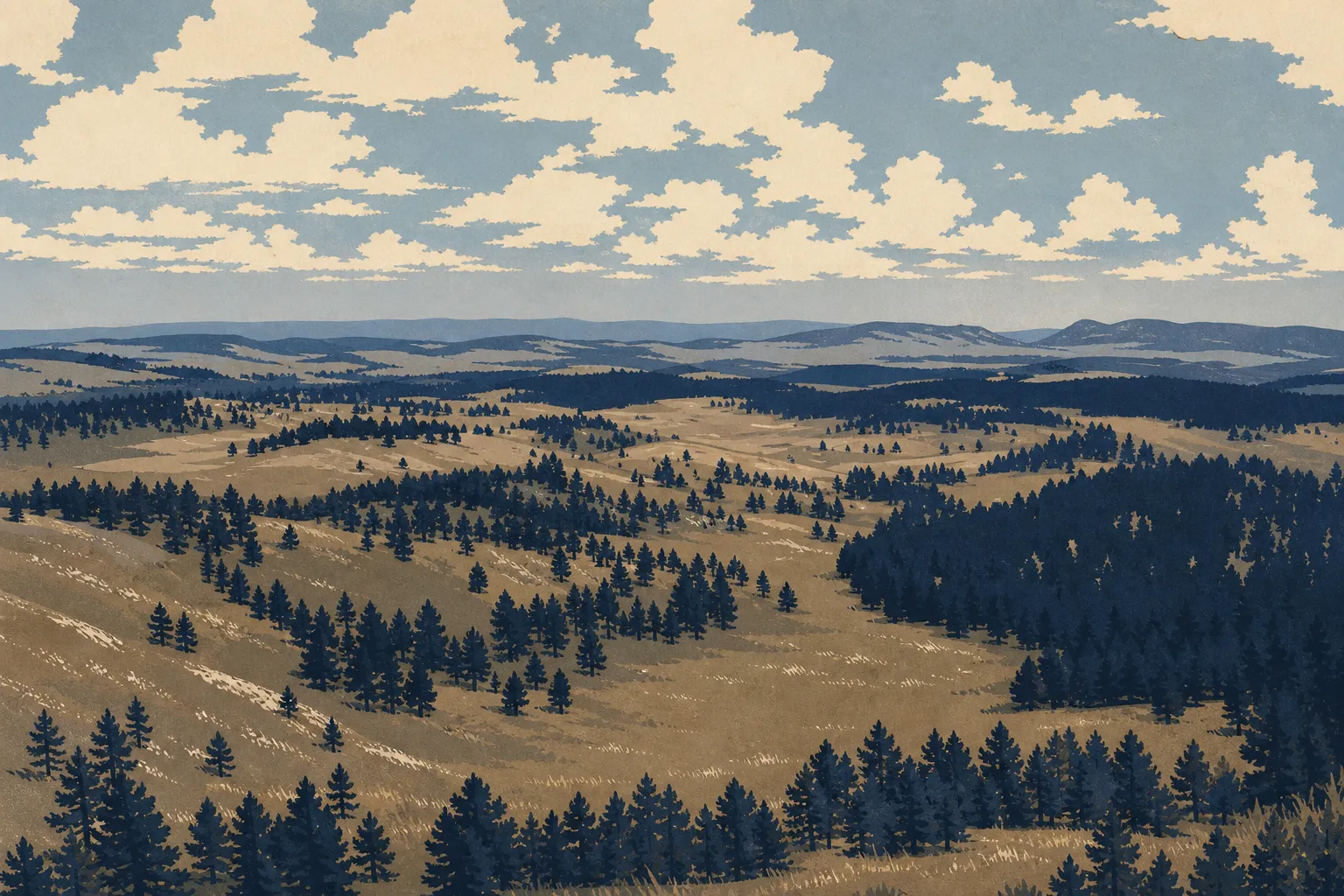
Once you leave the cave, the scenery changes completely. Wind Cave protects one of the few remaining intact mixed-grass prairies in the Black Hills, where the plains meet the forested mountains. It's prime wildlife-viewing country.
You'll see free-ranging bison, elk, pronghorns, and lively prairie dog towns. Surface trails range from short loops to hikes lasting several hours, winding through the rolling landscape.
Rankin Ridge
The park's highest point, Rankin Ridge, is reached by a short loop leading to a former fire lookout tower. From the top, the view takes in the prairie, the dark hills covered with ponderosa pines, and, on a clear day, much of the southern Black Hills. It's the park's best viewpoint for a modest amount of effort.
Explore the park
Wind Cave's Best Hikes
You can explore Wind Cave's surface on foot without major technical challenges. A network of trails crosses prairies, wooded ravines, and ridges. Take the Rankin Ridge loop for the view, follow trails along the creeks for shade and wildlife sightings, or choose longer routes that lead deep into the prairie away from the road. There's something for every ability level.
One piece of practical advice: on our last visit, we underestimated the prairie sun, with its lack of shade and strong winds. A hat, plenty of water, and sunscreen are essential. Watch for bison, too. They're unpredictable and much faster than they look. Stay at least 80 feet away and turn around if one blocks the trail.
See our Hiking guide for trail details, including length, difficulty, and trailheads.
The detailed guide Wind Cave Hiking: The Best Trails for Every Skill Level A practical Wind Cave hiking guide with trail picks by skill level, essential… Read the guide →Wildlife and Plants to Look For
Wind Cave is as much a wildlife refuge as it is a geological wonder. Bison, saved from extinction in the early twentieth century, form one of the country's genetically valuable herds here. Elk are easiest to spot in the early morning and at dusk, pronghorns race across the prairie, and prairie dogs animate their burrow towns while raptors and sometimes a coyote watch from nearby.
The vegetation reflects a rare transition zone. The mixed-grass prairie of the Great Plains meets the ponderosa pine forests of the Black Hills. This edge helps explain the area's rich wildlife. The best viewing times are the cooler hours, early in the morning and late in the day. Our species-by-species, season-by-season advice is on our Wildlife page.
The detailed guide Wind Cave Wildlife: What You'll See and Where to Look Bison, prairie dogs, elk, pronghorn, and more Read the guide →When to Visit Wind Cave
Summer, from June through August, brings the fullest selection of cave tours and a lively prairie, but days can be hot, often above 81°F, and thunderstorms can be severe, with hail and lightning. Spring is the wettest and most changeable season. Fall is our favorite time: mild days, cool nights, fewer visitors, and active wildlife. Winter is still accessible but harsh, and snow periodically closes roads.
That's just the short version. Our When to Visit page covers the month-by-month calendar and which tours run in each season. See our Weather page for more.
The detailed guide When to Visit Wind Cave: Best Seasons and Month-by-Month Guide The best times to visit Wind Cave are early May to mid-June and September Read the guide →Where to Stay at Wind Cave
The park has one campground, Elk Mountain Campground, a simple, well-placed base for enjoying the prairie at sunrise. There are no hotels or lodges within the park. For a roof over your head, stay in Hot Springs, the closest option to the south, in Custer, or farther afield in Rapid City or Keystone, depending on the rest of your itinerary.
Our dedicated pages have the full comparison of lodging, campgrounds, budgets, and neighborhoods. Read our Where to Stay guide, Hotels & Lodges, and Camping pages. If you're traveling in an RV, see our RV Camping page.
Stay in the park
Around Wind Cave: Things to Do Nearby
Wind Cave is rarely a standalone destination, and that's part of its appeal. The southern Black Hills pack an impressive number of sites into a small area. Just north, Custer State Park and its Wildlife Loop offer another chance to see bison herds. Nearby, Jewel Cave offers a second cave, even longer and with a completely different mineral character. People often ask whether to choose Jewel or Wind Cave, but you can do both. They're not alike. Add Mount Rushmore, the Crazy Horse Memorial, and the small hot-springs town of Hot Springs.
To build a coherent multi-day itinerary, our Black Hills road trips and our overview of the South Dakota region will give you useful bearings.
Our Take: Is Wind Cave Worth a Stop?
Yes, as long as you know what you're looking for. This isn't a park of spectacular vistas like Zion or Yellowstone. It's a park of geological wonder and understated nature: a cave known worldwide for its boxwork, and an authentic prairie where wildlife can be watched without a staged experience. Its location among the Black Hills' major sights makes it an almost obvious stop on a South Dakota road trip.
Our verdict is simple: allow at least a half day, a full day is ideal, and reserve your tour ahead of time in summer. Combined with Custer State Park and Jewel Cave, Wind Cave makes up one of the country's best cave-and-bison stretches.
Frequently Asked Questions
How do you visit Wind Cave National Park?
To visit Wind Cave, drive to the park on US Highway 385, park at the Visitor Center, and reserve a cave tour in advance. A guided tour is the only way to go underground. You can then explore the surface, including the prairie, trails, and wildlife areas, freely by car and on foot.
What should you wear to visit Wind Cave?
Dress in layers. The cave stays cool year-round, around 54°F, so bring a jacket even in summer. Closed-toe shoes with good traction are also important for the damp stairs. Above ground, a hat, sunscreen, and water are essential on the shade-free prairie.
Which is better, Jewel Cave or Wind Cave?
Neither. They're two different caves about 19 miles apart. Wind Cave is known for its boxwork, a rare calcite formation of which it contains most of the known examples. Jewel Cave is longer and appeals to visitors who like its crystals. If your schedule allows, visit both.
How much time do you need to visit Wind Cave?
Allow a half day for a single guided cave tour, including waiting and walking time. A full day lets you combine the cave, prairie trails, and the Rankin Ridge viewpoint. Our Itinerary & Timing page lays out plans for different amounts of time.
The American Parks shop
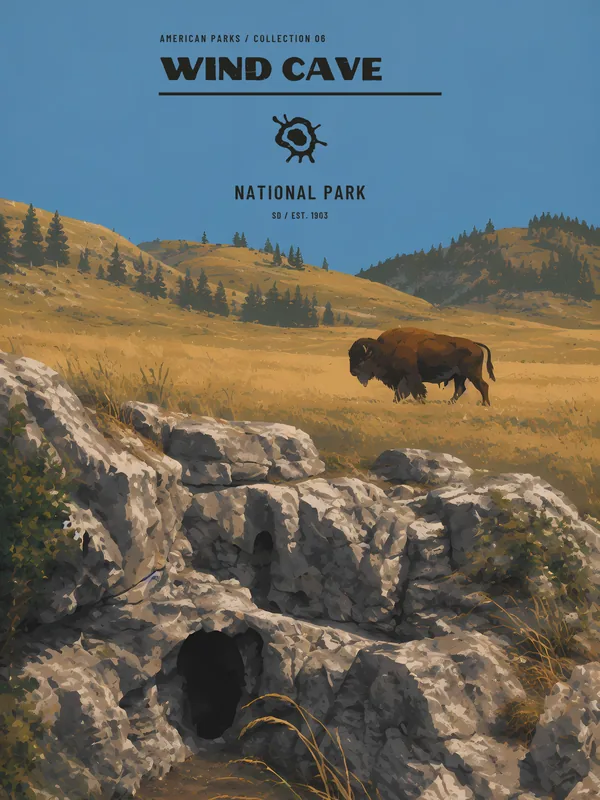
Bring Wind Cave home
Our park-inspired creations, made to order and shipped to your door.
Latest park news
- Wind Cave: Natural Entrance Tour Closes for the WinterThe Natural Entrance Tour closes for winter at Wind Cave, but three other guided tours stay open.
- Wind Cave: Guided Cave Tours Suspended After Phone System OutageAn emergency phone system outage has put all guided tours of Wind Cave on hold until service is restored.