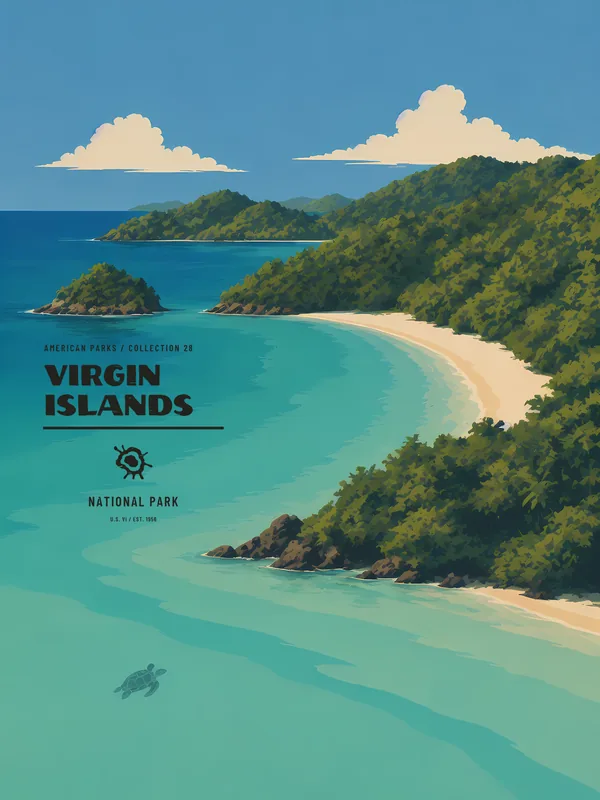
Virgin Islands National Park: The Complete Visitor Guide
Virgin Islands National Park covers about two-thirds of St. John in the U.S. Virgin Islands (US Virgin Islands, code VI). People come for three things: white-sand beaches edged by tropical forest, coral gardens you can reach from shore, and sugar plantation ruins scattered through the vegetation. The park has no single scenic road or monumental entrance. Instead, an archipelago of bays is connected by a handful of ridge roads. Plan on 3 to 4 days to see it without rushing, and more if snorkeling and hiking are high on your list.
One clarification that avoids confusion: this national park is American and sits on St. John. Don't mix it up with the British Virgin Islands (Tortola, Virgin Gorda, Jost Van Dyke), which are close by but belong to another country and have different currency and entry requirements.
Virgin Islands at a glance: Where the park is and how to get there
St. John is the smallest of the three main U.S. Virgin Islands, east of Puerto Rico in the Lesser Antilles. The island uses U.S. dollars. International visitors must meet U.S. entry requirements. Visitors from visa-waiver countries need an ESTA, while others may need a visa, depending on individual eligibility.
The key point is that St. John has no airport. Getting there always takes two steps.
- Land at St. Thomas's Cyril E. King Airport (code STT), the regional gateway.
- From the airport, reach Red Hook on the east end of St. Thomas by rental car or taxi. Allow a good half hour by road, depending on traffic.
- From Red Hook, a passenger ferry drops you at Cruz Bay, St. John's main town and the park's gateway. The crossing takes about twenty minutes.
A vehicle ferry also runs, though it's slower and less frequent, if you want to bring your rental car ashore. Each option, along with schedules and alternatives such as the car barge, taxis, and rentals on the island, is covered in our Virgin Islands access guide.
Entrance fees, passes, and reservations
Entry to Virgin Islands National Park is mostly free. You don't pass through a gatehouse to reach the bays and trails. Some developed sites or services, such as access to a very popular beach, ranger-led programs, or occasional user fees, may charge for access, and the details can change from one season to the next.
Our Fees & Passes page explains entrance fees and America the Beautiful passes, as well as when a reservation helps. If you're visiting several U.S. national parks in one year, the annual pass pays for itself quickly. That's the calculation we lay out there.
Passport stamp collectors can find out where to stamp their NPS Passport Book on our Passport & Stamps page.
Reservations, permits, and rules to follow
Reservations: You don't need a reservation to enter the park or take a day hike. Cinnamon Bay Campground, however, is operated by the park concessioner and requires advance reservations, especially during the busy season from December through April. Don't show up without confirmation if you plan to spend the night.
Permits: No permit is required for day-hike trails. Certain activities, such as nighttime access to specific areas or organized outings in coral-protection zones, may require authorization from the visitor center. Check before you leave.
The park's basic rules:
- Collecting or removing coral, shells, sand, or plants is strictly prohibited and can result in a federal fine.
- Don't feed wildlife, including iguanas and shorebirds.
- Campfires are allowed only in designated areas of Cinnamon Bay Campground.
- Drones are prohibited without prior authorization from the park superintendent.
- Fishing is allowed in some areas with permits issued by the U.S. Virgin Islands authorities. It's prohibited in protected coral areas.
- Anchoring on coral is prohibited. Use the available mooring buoys.
Cruz Bay Visitor Center is open Monday through Thursday from 8:15 a.m. to 4:00 p.m. and Friday from 8:15 a.m. to 1:30 p.m. It's closed on weekends, July 4, Thanksgiving, and Christmas. The park itself is open year-round with no hourly restrictions.
Getting around Virgin Islands
You'll get around St. John by car. The island is small but mountainous, and distances are deceptive. Roads wind along the ridges, climb and drop steeply, and traffic keeps to the left. That's a local legacy, even though the cars' steering wheels are also on the left, which can be surprising at first. Take care on blind curves, and watch for free-roaming donkeys and goats.
Two roads shape the visit from Cruz Bay:
- North Shore Road follows the north coast and its string of bays (Honeymoon, Trunk, Cinnamon, Maho, Francis, and Leinster). This is the beach and snorkeling route.
- Centerline Road runs along the ridge toward the east end of the island and provides access to inland trails and the south coast (Reef Bay, Salt Pond, and Lameshur).
Without a car, combine shared taxis (open-air “safari trucks”), shuttles, and water taxis to reach secluded bays or snorkeling islets. Our guide to getting around St. John covers the options, travel times, and driving pitfalls.
How long do you need to visit Virgin Islands?
The short answer is 3 to 4 days for a balanced first trip. Here's a sample itinerary:
- Day 1: Cruz Bay, Honeymoon Beach, and the easy north coast, including Trunk Bay and its marked underwater trail.
- Day 2: The rest of the north coast (Cinnamon, Maho, Francis, and Leinster) and the Annaberg plantation ruins.
- Day 3: The interior and south, with a hike down the Reef Bay Trail to its petroglyphs, or a day of snorkeling at Waterlemon Cay.
- Day 4 (optional): A boat trip to Virgin Islands Coral Reef National Monument or an excursion to the nearby British Virgin Islands.
In a single day from a cruise ship or St. Thomas, you'll see only one or two bays. It's frustrating but doable. A week, on the other hand, fills easily if you alternate beaches and trails. Our Itinerary & Trip Length page offers ready-to-use outlines based on the number of days you have.
Plan your visit
What to see and do in Virgin Islands
The visit breaks down by geographic area. There are three main zones, plus the protected underwater area offshore.
Road trip journal · 4 areas
The north coast: Beaches and shore snorkeling
This is the park's showcase. Trunk Bay is known for its marked underwater trail, where swimmers follow submerged signs along the reef. Cinnamon Bay, the island's longest beach, combines swimming, camping, and the remains of a sugar mill. Maho Bay has calm, shallow water where green turtles regularly graze on seagrass. Farther east, Leinster Bay provides access on foot to Waterlemon Cay, an islet you reach by swimming. It's one of St. John's best snorkeling spots, with rays, turtles, and starfish. Francis Bay rounds things out with a short birding trail along the edge of a pond.
Cruz Bay and the west: The gateway
Around town, you can do almost everything on foot. The park's Cruz Bay Visitor Center provides information, hands out maps, and runs some ranger programs. A few minutes away on foot, Honeymoon Beach and the Lind Point Trail offer a first swim without getting in the car. This is also where you'll find the practical services: rentals, groceries, and restaurants.
The interior and south coast: History and trails
Away from the north beaches, the south tells the island's colonial and natural history. The Reef Bay Trail descends through the forest to petroglyphs carved near a pool and passes the ruins of an old sugar mill. Annaberg, on the northeast side, preserves a lime kiln, windmill, and workers' quarters. It's the clearest reminder of the sugar era and the slavery that sustained it. To the south, Salt Pond Bay and Lameshur Bay round out the route with wild bays, a salt pond, and trails leading to rocky points.
Virgin Islands Coral Reef National Monument: The park underwater
Off St. John lies a separate protected marine area, Virgin Islands Coral Reef National Monument. It extends the park beneath the surface, with seagrass beds, mangroves, and coral reefs explored by snorkeling or diving, often from a boat. This is where you'll find guided outings.
Each area deserves time. Our Virgin Islands activities guide explains what to do bay by bay, from snorkeling, kayaking, and paddleboarding to ruin tours and ranger programs.
Explore the park
The best hikes in Virgin Islands
St. John is more than a beach island. About twenty trails cross the park, from short walks to a bay to forest routes. The standouts are the Reef Bay Trail, a historic descent to petroglyphs that requires either a hike back up or a prearranged boat shuttle; the Lind Point Trail from Cruz Bay; and the Ram Head Trail in the south, which leads to a wind-swept point with expansive ocean views.
Tropical heat and humidity make even short trails feel harder than they look on a map. Start early, carry more water than you think you'll need, and cover up from the sun. Our selection of St. John hikes has the route details, elevation gain, time estimates, and difficulty levels.
The detailed guide Hiking in Virgin Islands: The Best Trails for Every Skill Level The best hikes in Virgin Islands National Park, with trail guides, safety tips,… Read the guide →Wildlife and plants to look for
Underwater, the stars are green turtles, common in the seagrass beds of Maho and Francis Bay, along with stingrays and colorful reef life such as parrotfish, hawksbill turtles, and starfish around Waterlemon Cay. On land, the island is home to iguanas, land crabs, and many birds, including hummingbirds, bananaquits, and pelicans along the coast. The dry tropical flora includes cacti, strangler figs, tamarinds, and mango trees.
Two practical rules, with no folklore involved: don't touch or stand on coral, because it's living and fragile; keep your distance from turtles, and never chase or touch them. Our Wildlife page catalogs what you can see, where, and in which season.
The detailed guide Virgin Islands Wildlife: Animals to See and Where to Find Them Sea turtles, green iguanas, brown pelicans, and more Read the guide →When to visit Virgin Islands
The climate is tropical and pleasant almost year-round, shaped by the trade winds blowing from east to west. Winter brings stronger winds and less rain. Summer brings more showers and lighter winds. The period to watch closely is hurricane season, which runs from late summer into early fall. Check the forecast often and keep your dates flexible.
In practical terms, late fall through spring brings the most dependable dry weather, as well as the highest crowds and prices. The wetter shoulder season costs less but comes with greater weather risk. Our When to Visit page lays out the calendar month by month, while our Weather page covers winds, rain, and temperatures.
The detailed guide When to Visit Virgin Islands National Park: Best Time, Seasons, and Month-by-Month Guide The best time to visit Virgin Islands National Park is December through April,… Read the guide →Where to stay in Virgin Islands (hotels & campgrounds)
St. John lodging falls into three broad categories: private villas and vacation rentals scattered across the hills, a handful of upscale hotels and resorts, and camping in the park at Cinnamon Bay. The campground lets you stay close to the beaches without spending a fortune. St. Thomas, with more large hotels, also works as a backup base if you're willing to take the daily ferry.
Our Where to Stay guide includes the detailed comparison, price ranges, and recommendations. It's divided into Hotels & Lodges, Camping, and RV Camping for travelers who take a different approach. Families will find dedicated advice on calm beaches, logistics, and kid-friendly activities in the Family page.
Stay in the park
Around Virgin Islands: Things to do nearby
St. John makes an excellent base for exploring the area. St. Thomas, just a ferry ride away, adds its capital, Charlotte Amalie, and scenic overlooks. The British Virgin Islands, especially Tortola, Virgin Gorda with its famous granite boulders at The Baths, and Jost Van Dyke, are also within reach by boat. The change of scenery is guaranteed, but you'll need a passport and must complete another country's entry formalities. On a broader trip, St. John fits easily into a larger Caribbean road trip or exploration of the region.
Our take: Is Virgin Islands worth the trip?
Yes, with one qualification. If you're looking for vast American landscapes of rock, such as canyons, geysers, and high peaks, this is a different kind of park. Its strength is the rare combination of protected Caribbean nature, shore-accessible snorkeling, and a sugar heritage steeped in history, all on an island you can explore in a few days. The cost of the trip and the logistics of taking two ferries are real considerations. In return, water lovers and hikers get one of the Caribbean's most complete experiences. For a smooth trip, set your dates, transportation, and lodging first. Our When to Visit, Access & Transportation, and Where to Stay pages handle that work. For finding your way around, use our Map page. Park rules, safety, and health information appear above in this guide under reservations, permits, and rules. For lunch options, our Where to Eat page lists places in Cruz Bay and around the bays.
Frequently asked questions
How do you visit Virgin Islands National Park?
Visit Virgin Islands National Park by first reaching St. John, which has no airport. Land at St. Thomas (Cyril E. King Airport, code STT), get to Red Hook, and take the ferry to Cruz Bay. Once you're there, a rental car is the easiest way to visit several bays in a day. Our Access & Transportation page has the details.
Is it safe to visit the Virgin Islands right now?
The U.S. Virgin Islands are a common travel destination, and St. John's park welcomes visitors year-round. Most precautions come down to tropical common sense: protect yourself from the sun, stay hydrated, watch ocean currents, drive on the left on mountain roads, and keep an eye on the weather during hurricane season from late summer into fall. You'll find our practical guidance above in this guide under reservations, permits, and rules.
What is the best month to visit the Virgin Islands?
The best time to visit the Virgin Islands runs from late fall through spring. It's the dry season, cooled by the trade winds, and the most reliable period for weather, but it's also the busiest and most expensive. The wetter shoulder season offers better prices if you keep an eye on hurricane risk. Our When to Visit page has the month-by-month calendar.
Is Virgin Islands National Park a good tourist destination?
Virgin Islands National Park is a good destination for people who enjoy the ocean, snorkeling from the beach, short hikes, and Caribbean heritage. It's less suited to travelers seeking the vast rocky landscapes of the American West. Plan on 3 to 4 days and an island budget. Our complete guide above explains what to expect bay by bay.
The American Parks shop
Bring Virgin Islands home
Our park-inspired creations, made to order and shipped to your door.