
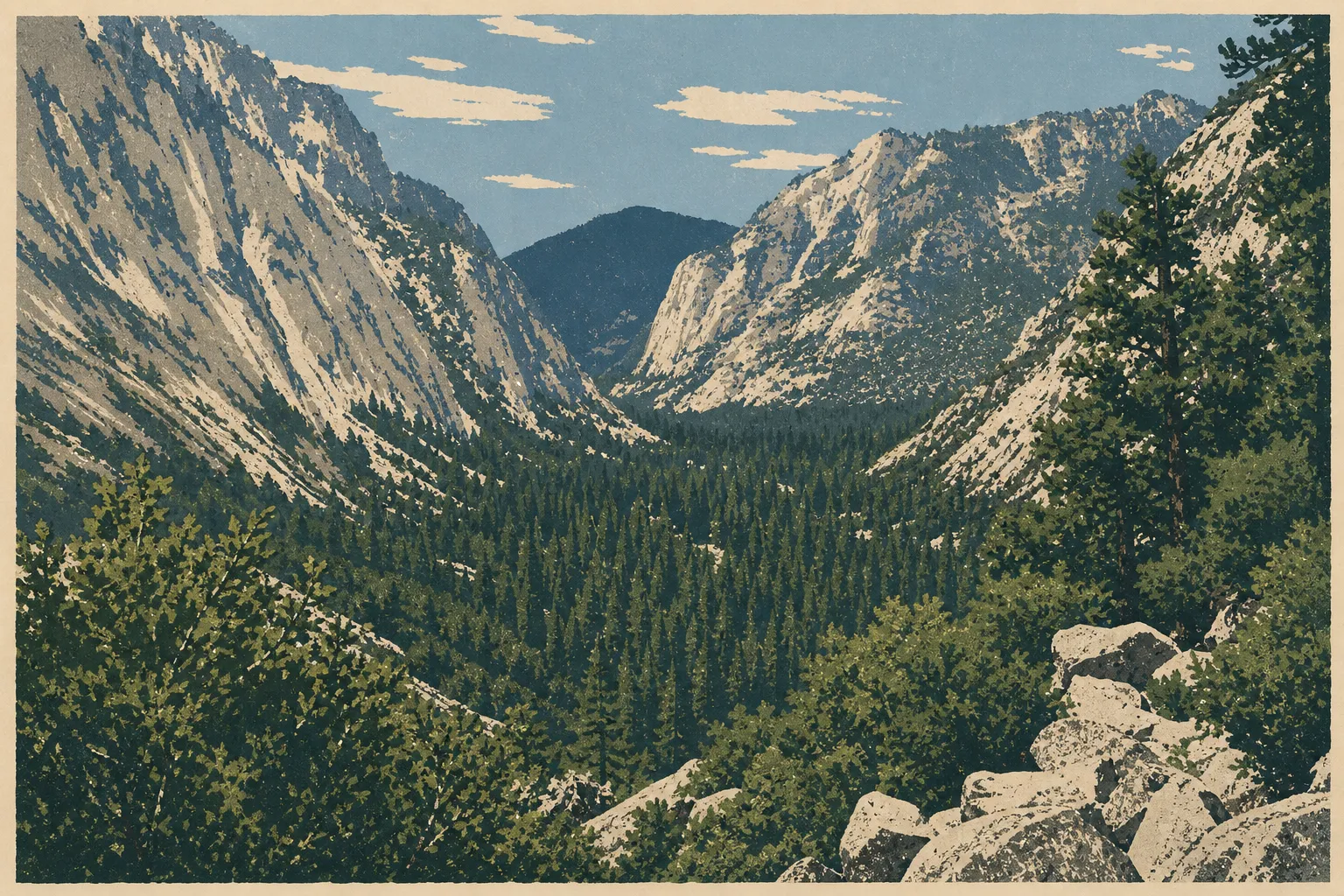
Sequoia & Kings Canyon National Parks: The Complete Visitor Guide
Two neighboring national parks managed together on the western slope of California's Sierra Nevada. Sequoia protects the largest trees on the planet, including General Sherman, the world's largest tree by volume. Kings Canyon opens onto one of the deepest canyons in North America. Plan on 2 to 3 days to cover both without rushing: one day for the giant sequoias, another to descend into the canyon, plus extra time for the slow, winding roads.
Here's what you need to organize your trip: where the parks are, how to get in, what is worth seeing in each area, and where to find the details on every topic.
Sequoia and Kings Canyon at a Glance: Where the Parks Are and How to Get There
The two parks sit in east-central California, east of Fresno and Visalia in the Central Valley. Expect about 4 to 5 hours of driving from Los Angeles and a little longer from San Francisco. They are not on the most direct route between the two cities, which makes them less crowded than Yosemite.
Two main roads provide access to the parks:
- Highway 198 starts in Visalia, passes through the town of Three Rivers, and climbs into Sequoia National Park. Inside the park, it becomes Generals Highway, the scenic road linking the two parks.
- Highway 180 starts in Fresno and heads east to Kings Canyon National Park. It continues for about 30 miles to Cedar Grove, at the bottom of the canyon.
The Sequoia side of Highway 198 is narrow, very winding, and lined with tight turns. Vehicles longer than 22 feet are strongly discouraged. If you're traveling in a van or RV, it's better to enter via Highway 180, which is easier to drive. Our guide to getting to Sequoia and Kings Canyon covers approach routes, distances, and entrances.
Entrance Fees, Passes, and Reservations
Admission is valid for 7 days and covers both parks with one ticket. Current fees are:
- Private vehicle: $35.
- Motorcycle: $30.
- Pedestrian or cyclist, per person: $20.
If you're visiting several American parks in one year, the park's annual pass ($70) quickly pays for itself, and the America the Beautiful federal pass, valid at all national parks, even more so. At this time, you don't need an entrance reservation to pass through the entrance stations. Pay on site or show your pass. Crystal Cave's guided tour, however, is available only with a dated ticket purchased in advance. Our National Park Entrance Fees and Passes page explains entrance fees and passes and when to use them. And if you collect stamps, keep your passport handy. See our Passport and Stamps page.
Reservations, Permits, and Rules to Follow
Timed Entry Reservation
During the busy summer season, from late May through Labor Day, the NPS may require a timed entry reservation system for certain areas, especially Giant Forest. Reservations are made on Recreation.gov several weeks ahead of time. Details change from one season to the next, so check the park's official website to see whether the system is active for your visit date.
Campgrounds
Most campgrounds can be reserved through Recreation.gov, sometimes up to 6 months ahead for the most sought-after sites, including Lodgepole, Sunset, and Crystal Springs. A few sites remain available without reservations in the off-season on a first-come, first-served basis. Our Camping guide covers availability, amenities, and the rules for each campground.
Crystal Cave
Guided tours of Crystal Cave, the park's marble cave, must be purchased in advance through Recreation.gov. There are no on-site sales. In summer, time slots sell out within a few hours of reservations opening. Plan ahead.
Backcountry Wilderness Permits
Any overnight trip outside official campgrounds requires a wilderness permit. Get one through Recreation.gov, with a daily quota for each trailhead, or on some days as a walk-up permit that morning at the relevant visitor center. Trailhead details are available in our Hiking guide.
Essential Rules
Black bears: Bears are common in both parks. When you're camping, store all food, drinks, cosmetics, and scented items in the bear boxes provided at each site or in an approved bear canister. Leaving food visible in a vehicle is an offense that can result in an on-the-spot fine from a ranger.
Dogs: Dogs are allowed on paved roads and in campgrounds, but prohibited on all hiking trails, in the backcountry, and in NPS buildings.
Drones: Drones are prohibited throughout the parks without prior NPS authorization.
Fires: Restrictions vary with seasonal drought conditions. Check the Fire Restrictions status on the NPS website before every night of camping.
Getting Around Sequoia and Kings Canyon
You'll see most of the parks by car, one area at a time. Generals Highway is the backbone of the park system, winding between Grant Grove in Kings Canyon and Giant Forest in Sequoia. It's a beautiful but slow road, and you rarely drive faster than 35 mph because of the turns and elevation changes.
During the busy season, roughly from late May to early September, a free shuttle serves Giant Forest, General Sherman, Moro Rock, and Crescent Meadow. We strongly recommend it. Parking fills up quickly by midday, and the shuttle saves you from circling full lots. Outside this area, there is no public transportation, so you'll drive everywhere.
In winter, several roads close under snow, and tire chains become mandatory on open sections, even in good weather. Our guide to getting around Sequoia and Kings Canyon explains which roads remain passable and how the shuttle works.
How Much Time Do You Need to Visit Sequoia and Kings Canyon?
Plan on 2 full days for a solid overview of both parks, or 3 days to take your time. One day is possible, but tight. In that case, focus on Giant Forest, including General Sherman, Big Trees Trail, and Moro Rock, and skip the drive down to Cedar Grove, which requires a long round trip.
Our usual breakdown is one day for the giant sequoias on the Sequoia side and one day for Grant Grove followed by the drive down into Kings Canyon to the canyon floor. If you add the remote Mineral King area, plan on one extra day because the access road is long and very narrow. Our detailed, timed itineraries tailored to your starting point are collected in our day-by-day Sequoia and Kings Canyon itineraries.
Plan your visit
What to See and Do in Sequoia and Kings Canyon
The visit makes the most sense when organized by geographic area. Here are the highlights, from south to north and east, starting in Sequoia and continuing into Kings Canyon.
Road trip journal · 4 areas
Giant Forest and General Sherman in Sequoia
This is where you'll find the park's largest sequoias. General Sherman, the world's largest tree by volume, is reached by a short trail that descends on the way in. The climb back up will leave you a little winded, just so you know. Right nearby, Big Trees Trail is a flat, easy loop around a meadow, perfect for taking in the scale of these giants without working up a sweat. The Giant Forest Museum, housed in a former 1928 building, makes a good starting point and shuttle landmark.
Moro Rock, Tunnel Log, and Crescent Meadow
Moro Rock is a granite dome reached by a staircase of several hundred steps carved into the rock. At the top, you'll get a 360-degree view of the Great Western Divide, the snow-covered ridge that closes off the horizon. On the same road, Tunnel Log is a sequoia that fell in 1937 and was hollowed out into a tunnel you can drive through. It's a guaranteed photo stop. The road then leads to Crescent Meadow, a wet meadow that John Muir nicknamed the “gem of the Sierra,” ideal for an easy loop.
Grant Grove and General Grant in Kings Canyon
On the Kings Canyon side, General Grant Tree is another giant. It was officially designated the Nation's Christmas Tree and a national shrine. Grant Grove is easy to reach from Highway 180 and has short loops among the trunks. It's also a convenient service hub, with a visitor center, lodging, and supplies, before you head down into the canyon.
Cedar Grove and the Canyon Floor in Kings Canyon
From Grant Grove, Highway 180 drops about 30 miles to Cedar Grove, deep in the gorge carved by the Kings River. The spectacular road runs along sheer walls. At the bottom, you'll find waterfalls such as Roaring River Falls, a meadow called Zumwalt Meadow, and trailheads leading into the high country. Be careful: this road closes in winter and does not reopen until spring, once crews have cleared the snow.
Each area could fill a day of its own. To sort the options by interest, including viewpoints, caves, meadows, and overlooks, explore our Sequoia and Kings Canyon activities guide, which groups sites by type and effort level.
Explore the park
The Best Hikes in Sequoia and Kings Canyon
The trail network ranges from a flat 30-minute walk to several-day treks toward Mount Whitney, the highest peak in the contiguous United States, whose eastern slope is protected by the park. For a first visit, stick with the reliable choices: Big Trees Trail and Crescent Meadow, both easy; Moro Rock, short but steep; and the Zumwalt Meadow loops in Cedar Grove. Experienced hikers will aim for the high Sierra from the trailheads at the bottom of the canyon. Our Sequoia and Kings Canyon hiking guide has the details on elevation gain, time, difficulty, and season of access.
The detailed guide Best Hikes in Sequoia & Kings Canyon: Trails for Every Skill Level The best hikes in Sequoia & Kings Canyon, organized by area and difficulty,… Read the guide →Wildlife and Plants to Look For
The change in elevation, from the hot, dry foothills to passes that can still be snow-covered in summer, creates a mosaic of habitats and species. Mule deer are common, and with some luck you'll see black bears. There are no grizzlies here. Here's the absolute rule: store all food in the metal lockers provided in parking areas and campgrounds, never in your car, because bears know how to force open doors. Marmots, squirrels, and large birds of prey round out the high-elevation wildlife. Our Sequoia and Kings Canyon wildlife guide covers species, viewing seasons, and guidance for sharing the parks with wildlife.
The detailed guide Sequoia and Kings Canyon Wildlife: Animals to See and Where to Find Them Black bears, California condors, and pikas Read the guide →When to Visit Sequoia and Kings Canyon
Summer, from June through September, offers the best access. All roads are open, and temperatures are mild in the sequoia groves, although the foothills can be scorching and snow lingers on the high-elevation passes. Fall can shift quickly from hot to cold from one day to the next. Winter blankets the sequoias in snow, which is beautiful, but chains are mandatory and roads to Cedar Grove and Mineral King are closed. Spring is ideal for hiking in the foothills while the snow melts higher up. That's the short version. Our when to visit Sequoia and Kings Canyon guide has monthly averages and seasonal advice, while the Weather page has detailed forecasts by area.
The detailed guide When to Visit Sequoia and Kings Canyon: Best Times, Weather, and Seasons The best times to visit Sequoia and Kings Canyon are September–October and late… Read the guide →Where to Stay in Sequoia and Kings Canyon
There are three options, depending on your travel style:
- Lodges in the parks, in Grant Grove, Giant Forest, and Cedar Grove: convenient, but book well ahead.
- Campgrounds, which range from the foothills to the canyon floor, chosen according to elevation and season.
- Accommodations in Three Rivers, just outside the southern entrance to Sequoia, with more choices and restaurants.
Our complete comparison, including prices, operating seasons, and reservations, is in our Where to Stay guide, with separate pages for Hotels and Lodges, Camping, and RV Camping based on how you plan to sleep.
Stay in the park
Things to Do Around Sequoia and Kings Canyon
The two parks fit easily into a larger California road trip. Yosemite is a few hours to the north. To the west lie the Central Valley and its stopover cities, Visalia and Fresno. To the east are the wild Sierra and Owens Valley. Three Rivers, just before the southern entrance, makes a pleasant place to base yourself and take a break. To build a coherent route, our Road Trips and Regions sections place Sequoia and Kings Canyon in the larger context of the American West.
Our Take: Are Sequoia and Kings Canyon Worth the Trip?
Yes, absolutely. When we visited, what stayed with us was not so much the size of the trees, impressive as it is, but the silence beneath the canopy and the stark contrast between the high-elevation groves and the canyon floor. You come for the sequoias and stay for the variety: giant forests, granite domes, a deep gorge, and high country, all with far fewer people than Yosemite. The downside is that the roads are slow and part of the park closes in winter. Prepare ahead, follow the bear and chain-safety rules, and you'll leave won over. Our Practical Information, Rules, and Safety page brings together the key rules and concrete safety advice, while our Map page lets you see all the areas at a glance.
Frequently Asked Questions
How much time do you need to visit Sequoia and Kings Canyon?
To visit Sequoia and Kings Canyon comfortably, plan on 2 to 3 days: one day for the giant sequoias, one for Kings Canyon, plus extra time for the slow roads. In one day, focus on Giant Forest and Moro Rock and skip the drive down to Cedar Grove.
How much is admission to Sequoia and Kings Canyon?
Admission to Sequoia and Kings Canyon costs $35 per vehicle, is valid for 7 days, and covers both parks. The fee is $30 for motorcycles and $20 per person on foot or by bike. The park's annual pass costs $70.
Can you visit Sequoia and Kings Canyon by car?
Yes. You will see most of Sequoia and Kings Canyon by car, one area at a time, via Generals Highway. In summer, a free shuttle serves the busy Giant Forest area. Elsewhere, you'll drive everywhere.
What is the best time to visit Sequoia and Kings Canyon?
The best time to visit Sequoia and Kings Canyon is summer, from June through September, when all roads are open and temperatures are mild in the groves. Spring works well for the foothills. Winter requires chains and brings road closures.
What's the difference between Sequoia and Kings Canyon?
The difference comes down to the landscape. Sequoia protects the world's largest trees around Giant Forest, while Kings Canyon opens onto a huge glacial canyon extending to Cedar Grove. Managed together, they can be visited with a single ticket.
Are Sequoia and Kings Canyon worth visiting?
Yes. Sequoia and Kings Canyon are worth visiting for their rare combination of giant sequoias, granite domes, and a deep canyon, with far fewer crowds than Yosemite. The tradeoff is the slow roads and the winter closure of some areas.
The American Parks shop
Bring Sequoia & Kings Canyon home
Our park-inspired creations, made to order and shipped to your door.
 Sequoia National Park Posterfrom €24.90
 Kings Canyon National Park Posterfrom €24.90
- 63items in the collectionSee the whole shop →