
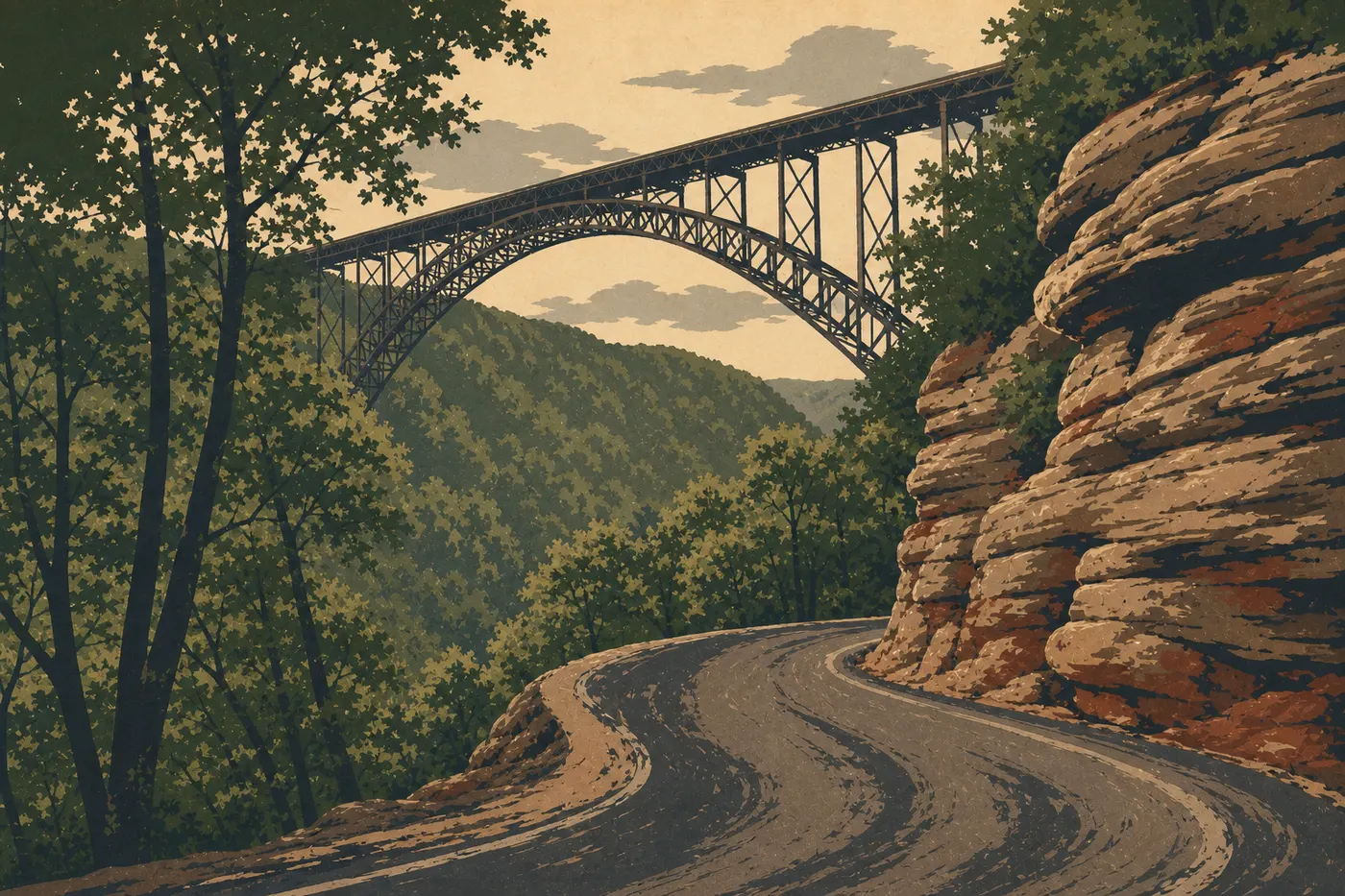
Getting Around New River Gorge: Access, Entrances, Shuttles, and Parking
New River Gorge is a car-oriented park. There are no entrance fees, no mandatory NPS shuttle, and no reservation required to enter, so you can drive around freely 24 hours a day, year-round. Here's the key thing to know: the park stretches more than 50 miles along the river, from Canyon Rim in the north to Sandstone in the south. You can't see it all in an hour's drive.
To plan your trip to the park, road routes, the nearest airports, and rental car options are covered in the New River Gorge access guide.
Park access points and which one to choose
New River Gorge has no entrance gates because the park is free and open around the clock. Instead, four areas organize the visit, each with a visitor center or a designated parking area.
Canyon Rim (north, near Fayetteville). This is the best starting point for a first visit. Canyon Rim Visitor Center sits along US-19, a few hundred feet from the bridge. The overlook at the bridge is a five-minute walk from the parking lot. Hours: 9 a.m. to 5 p.m. daily, closed on Thanksgiving, Christmas, and New Year's Day.
Grandview (north-central). Reach it from WV-9, east of the plateau. This scenic area is especially suited to families and hikers who want the views without descending into the gorge. Seasonal visitor center: Memorial Day through Labor Day, from late May to early September.
Thurmond (central). A historic railroad town reached by a narrow road from WV-25. Its seasonal visitor center follows the same schedule as Grandview. Choose it for the industrial atmosphere and the mining history of Appalachia.
Sandstone (south). The logical entry point if you're coming from Lewisburg or Interstate 64. Sandstone Visitor Center is open year-round from 9 a.m. to 5 p.m. Sandstone Falls, accessible on foot from the parking lot, is worth the detour.
For a first one-day visit, choose Canyon Rim. For two days or more, add Grandview for the views and Sandstone for the falls.
Getting around the park
By car
A car is the main way to get around New River Gorge. Public roads serve all the main areas, and nearly every trailhead has parking. NPS signs are clear on the main routes, including US-19, WV-16, and WV-9. Secondary roads down to the river, however, are often narrow and winding, with no guardrails. Follow the posted speed limits and slow down for hairpin turns. In the Appalachians, inattention has immediate consequences.
By shuttle
The NPS does not operate an internal shuttle at New River Gorge. Unlike Zion or Yosemite, no area is closed to private vehicles, so you don't need to leave your car behind to visit. Local operators offer shuttles for kayak or rafting trips, bringing you back from the launch point, but these are private services rather than a park-run visitor transportation system.
By bike and on foot
New River Gorge isn't designed for road biking. There are few dedicated bike paths, and mountain roads are shared with cars without bike infrastructure. Downhill biking and mountain biking are welcome on some forest trails, but a car is the practical choice for getting between areas. Hiking trails, on the other hand, are plentiful and well marked. The New River Gorge hiking trails are listed by difficulty and area.
Where to park: parking areas and lots
All park parking lots are free. There are no parking tags and no system for reserving a space.
Canyon Rim Visitor Center: large paved lot accessible to standard-size RVs. Be aware that on July and August weekends and during Bridge Day, held on the third Saturday in October, the lot is often full before 9:30 a.m. Arrive early. Busy periods at New River Gorge and the best times to avoid the crowds are detailed in the When to Visit guide.
Long Point Trailhead: smaller parking area on a forest road west of Canyon Rim. In summer, it regularly fills before 10 a.m. on weekends.
Grandview and Sandstone: parking areas sized for local crowds, rarely full outside Bridge Day.
Distances and drive times between areas
The park stretches more than 50 miles from north to south, but the roads don't follow the river in a straight line. Expect detours across the plateau and low-speed roads.
| Route | Approx. distance | Estimated time |
|---|---|---|
| Canyon Rim → Grandview | ~28 miles | ~45 min |
| Canyon Rim → Thurmond | ~22 miles | ~40 min |
| Canyon Rim → Sandstone | ~50 miles | ~1 hr 15 min |
| Grandview → Sandstone | ~37 miles | ~1 hr |
To plan the order of your visits around your interests, see the New River Gorge overview and the Itinerary guide.
Special cases: RVs, vans, accessibility, and pets
RVs and camper vans. The main routes, including US-19, WV-16, and WV-9, can handle standard-size vehicles. Secondary roads to the river, especially the road to Thurmond, are not recommended for larger vehicles because of their narrow pavement, tight turns, and limited opportunities to turn around. Check length and height restriction signs at the entrance to each secondary road before you proceed. Area-specific camping restrictions are covered in the New River Gorge RV guide.
Accessibility. Canyon Rim Visitor Center and its bridge overlook are wheelchair accessible. Visitor center parking lots meet ADA standards. Trails descending into the gorge, however, are technical and not suitable for people with limited mobility.
Pets. Leashed pets are allowed on most trails and in picnic areas. They are not allowed inside NPS buildings. In summer, check the temperature of sun-exposed surfaces. Appalachian shade helps, but open areas heat up quickly.
Practical transportation info: fuel, cell service, and apps
Fuel. There are no gas stations in the park. Fill up before you enter. Fayetteville to the north and Beckley to the south both have several stations. If you plan to drive down toward Thurmond or the river access points, half a tank won't last the day.
Cell service. The signal is decent on the plateau, along US-19 and at Canyon Rim, but often disappears in the bottom of the gorge. Don't count on Google Maps once you've headed down toward the river. The NPS app lets you download park maps for offline use, so do it before you leave your hotel or campground. A paper map is still the best backup.
Weather and apps. Weather conditions in the Appalachians change quickly. A storm can develop on the plateau in 20 minutes while the sun is shining in the bottom of the gorge. Check a mountain weather service such as Weather.gov from NOAA rather than a general-purpose app. July is both the hottest and wettest month, so always pack a light rain jacket.
Frequently asked questions
Is New River Gorge free?
Yes. New River Gorge National Park is completely free. There is no entrance fee at Canyon Rim or any other area, and parking is free as well.
Can you drive across the New River Gorge?
Yes. US-19 crosses the canyon on New River Gorge Bridge, a steel bridge that rises nearly 890 feet above the river. The crossing is open 24 hours a day and is one of the trip's memorable experiences in its own right.
Do you need a reservation for New River Gorge National Park?
No reservation is required to enter the park. Campgrounds, however, can be reserved through Recreation.gov, especially for July and August weekends and Bridge Day weekend in October.
Did Trump make New River Gorge a national park?
Yes. New River Gorge had been designated a National River since 1978. In December 2020, Congress passed the Great American Outdoors Act, which Donald Trump signed, elevating the site to National Park and Preserve status. It became the 63rd U.S. national park.