
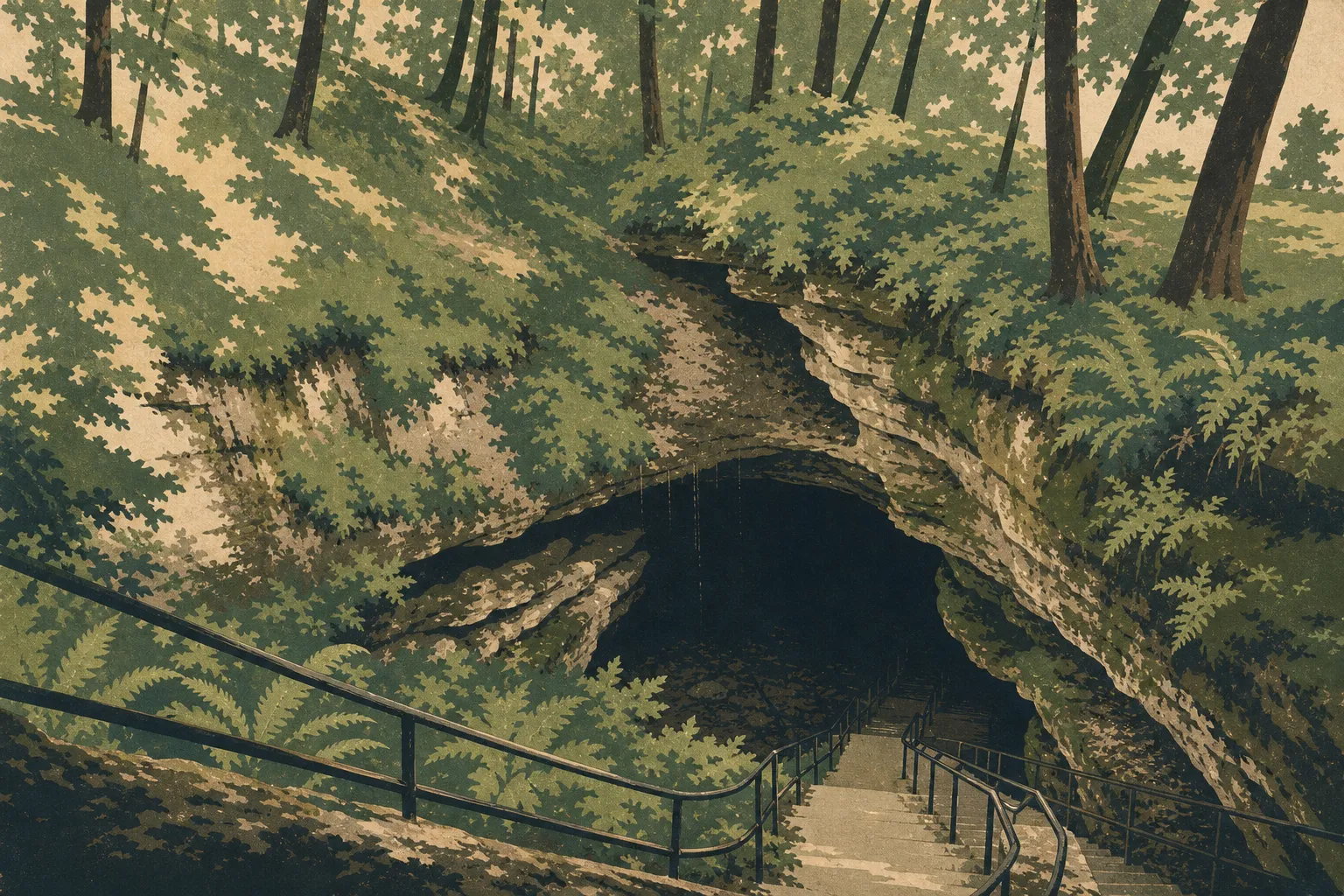
Mammoth Cave National Park: The Complete Visitor Guide
Beneath Kentucky's wooded hills lies the world's longest known cave system, with more than 398 miles of mapped passages and new sections still being added. Mammoth Cave is really two parks in one. Above ground, a quiet forest stretches along the Green River. Below it, a mineral labyrinth stays at 54°F year-round, in summer and winter alike.
The quick answer. The main way to experience Mammoth Cave is through its guided cave tours, the only way to enter the underground system. Plan on a full day to combine a guided tour with a few surface trails, or two days if you want to do several tours and spend time on the river. The park is in southern Kentucky, about a 1.5-hour drive from Louisville and Nashville. Park entry is free, but cave tours cost extra and should be reserved ahead of time.
This overview covers the essentials for planning your visit, then points you to each topic in detail, area by area and subject by subject. Follow the links as you read.
Mammoth Cave at a Glance: Where the Park Is and How to Get There
Mammoth Cave National Park is in south-central Kentucky, between the towns of Cave City and Brownsville. The park protects both the underground system and the hardwood forest above it, on either side of the Green River.
The main approach is via Interstate 65. From the north, coming from Louisville, take Exit 53, marked “Cave City Exit,” then follow KY-70. Once you're in the park, it becomes Mammoth Cave Parkway and takes you straight to the Visitor Center. From the south, coming from Nashville, follow the same basic route from Interstate 65. Here's a piece of practical advice repeated by the park itself: don't blindly follow your GPS, which has a bad habit of sending visitors onto secondary roads or toward a closed entrance. Follow the road signs and exit numbers instead.
The Visitor Center is the essential starting point. That's where the guided tours leave from and where you'll find the ticket desk. Plan to arrive early for your tour time.
Entrance Fees, Passes, and Reservations
Mammoth Cave National Park is free to enter. There are no entrance booths or entry fees, and the park is open 24 hours a day, even though services such as tours and the Visitor Center operate during daytime hours.
The cave itself, however, can only be visited on a guided tour, and those tours cost money. The price depends on the length and difficulty of the tour you choose. This is the key point: booking ahead is strongly recommended and often essential during the busy season, because popular tours can sell out several days or even weeks in advance. Reservations are made online before you arrive.
The America the Beautiful pass, which covers U.S. national parks, does not cover the cost of guided tours here because park entry is already free. It can, however, save you money elsewhere on your road trip.
For tour details, individual prices, and reservation policies, see our Fees & Passes page as well as our Practical Information, Rules & Safety page.
Reservations, Permits, and Rules to Follow
Reservations for Cave Tours
You can reserve all guided tours through recreation.gov. During the busy season, from May through September, morning time slots can sell out within hours of being released, which happens several weeks ahead of time. In the off-season, spots are sometimes available one day out, but it's better not to count on that when you're driving 62 miles or more to get there.
School and organized groups have a dedicated reservation channel on the NPS website and should contact it well in advance.
Cave Rules
Several rules apply without exception in the underground passages:
- Stay with your group: you can't leave your guide or explore a passage on your own.
- Leave nothing behind: don't throw anything in the cave, move rocks or limestone formations, or disturb any organisms.
- Closed-toe shoes are required: flip-flops, sandals, and open-toed shoes aren't allowed on any tour. Shoes with good traction are strongly recommended because the floors can be wet and slippery.
- White-Nose Syndrome protocol: this pathogenic fungus, Pseudogymnoascus destructans, has devastated bat populations in North America since the 2000s. Before entering the cave, make sure your shoes, backpack, and clothing haven't been worn in other caves. Park staff may ask you to disinfect your gear at the entrance. Take this seriously. Mammoth Cave's bat colony is one of the largest on the continent.
Camping and Backcountry
Surface hiking doesn't require a day hike permit. Backcountry camping, however, requires a free permit that you can pick up at the Visitor Center. Dispersed camping outside designated sites is prohibited throughout the park.
Getting Around Mammoth Cave
Once you're there, your car remains your base. It connects the Visitor Center, trailheads, campgrounds, and overlooks along the Green River. The distances within the park are modest, but the different areas are spread out on either side of the river.
One thing to know is that a small free ferry, the Green River Ferry, crosses the river and gives you access to the park's northern section and its wilder trails. Its hours and availability depend on water levels, so check before you rely on it to complete a loop.
Underground, things work differently. You can't move around freely. Each cave area has a specific guided tour, with its own entrance point and duration. You don't simply wander through Mammoth Cave. You follow a ranger.
How Much Time Do You Need to Visit Mammoth Cave?
A half day is enough for a short first cave tour and a surface trail if you're just passing through. We recommend a full day to do the park justice: take a morning guided tour, when early time slots are easiest to reserve, stop for lunch, then hike one or two trails in the afternoon.
With two days, you can do two different kinds of underground tours, such as a “historic” tour and one focused more on mineral formations, add a canoe trip on the Green River, and stay overnight to enjoy the quiet of the evening. Beyond that, the park is best suited to hikers and backcountry travelers, who will find enough to keep them busy for several days in the backcountry.
Plan your visit
What to See and Do at Mammoth Cave
The heart of a Mammoth Cave visit can be summed up in one sentence: you explore the cave on a guided tour, while you experience the surface on foot or on the water. Here are the three ways to do it.
Road trip journal · 3 areas
The Cave: Underground Guided Tours
This is the reason the park exists. Several guided tours cover the system, each with its own atmosphere.
The so-called historic tours follow passages explored since the 19th century, through broad stone corridors that tell the story of saltpeter mining and preserve the old signatures of the first visitors. They focus on the cave's grand mineral architecture and its human history.
Other tours lead to the most spectacular formations, including the area known as “Frozen Niagara,” a frozen stone waterfall, as well as the domes and dripstones where water carved out vertical chambers. These tours often involve many stairs.
One thing to keep in mind is that difficulty varies widely from one tour to another, from an accessible walk to strenuous outings with tight passages and low ceilings. Choose based on your fitness level and, for families, the ages of your children. And don't forget the constant 54°F temperature. Bring a light layer even in the middle of July.
The Surface: Forest, Trails, and Overlooks
Above the cave, the park unfolds into a hardwood forest crossed by trails, with overlooks of the Green River and a few geological curiosities on the surface, including sinkholes, springs, and small cave entrances. This is the park's quiet, free side, and it's worth exploring between guided tours or if you prefer to stay outdoors.
The Green River: Canoeing and Kayaking
The river running through the park is well suited to paddling. Renting a canoe or kayak to travel down the Green River gives you a different view of the park, following the current between wooded cliffs and sandbars. It's an ideal activity in the height of summer.
Explore the park
The Best Hikes at Mammoth Cave
Beyond the cave, Mammoth Cave has a network of surface trails that surprises visitors who come only for the underground experience. You'll find short, accessible loops near the Visitor Center, trails leading to dramatic sinkholes and springs, and backcountry reserved for well-equipped hikers north of the Green River.
Our Hiking page has the breakdown by difficulty, distances, elevation gains, and our favorite hikes.
The detailed guide Hiking in Mammoth Cave: the Best Trails for Every Skill Level Surface trails, backcountry hikes, and family walks in Mammoth Cave, with… Read the guide →Wildlife and Plants to Look For
Mammoth Cave's forest is home to typical wildlife of the western Appalachian region, including white-tailed deer, wild turkeys, raccoons, and a wide variety of birds and salamanders along the river. The park is known for its biological richness both above and below ground.
The cave has residents of its own, including bats and depigmented, blind cave fish and shrimp adapted to total darkness. These species are fragile. That's another reason strict rules govern cave tours, especially to limit the spread of White-Nose Syndrome among bats. Our Wildlife page covers the species in detail and the best times to see them.
The detailed guide Mammoth Cave Wildlife: Which Animals to See and Where to Find Them A practical guide to wildlife in Mammoth Cave National Park, from bats and cave… Read the guide →When to Visit Mammoth Cave
Kentucky has a humid, temperate climate. Summers are hot, around 86°F during the day, with humidity and possible thunderstorms. Winters are mild to cool, averaging around 41°F, with occasional snow or ice. Southern Kentucky, where the park is located, receives the state's highest precipitation, about 50 inches a year, especially in spring.
The good news is that you can visit the cave year-round, at a steady 54°F regardless of the weather outside. Spring and fall offer the best balance for combining the cave and surface, with pleasant temperatures and colorful forests. Summer is the busiest season, so reserve early. Winter is the quietest.
This page covers the essentials. For month-by-month details, see our When to Go page, and for complete climate data, see our Weather page. To pack properly and learn the safety rules, including what to wear in the cave, see our Practical Information, Rules & Safety page.
The detailed guide When to Visit Mammoth Cave: Best Times, Weather, and Seasons The best time to visit Mammoth Cave is April-May and September-October Read the guide →Where to Stay at Mammoth Cave
Staying in the park or just outside it saves valuable time in the morning, when the best tour slots go quickly.
Inside the park, The Lodge at Mammoth Cave offers traditional lodging just steps from the Visitor Center. The park also has developed campgrounds for tents and RVs, along with backcountry sites available with a permit. Around the park, the towns of Cave City and Park City have budget motels and chain hotels that work well for a stop along the road.
Keep in mind that camping is allowed only in designated campgrounds or at backcountry sites with a valid reservation or permit. No improvised dispersed camping.
Stay in the park
Around Mammoth Cave: Things to Do Nearby
Mammoth Cave fits easily into a Kentucky and neighboring Tennessee road trip. Cave City, at the park's doorstep, openly embraces its roadside-attraction atmosphere. Farther away, Bowling Green and the National Corvette Museum, Louisville and the bourbon trail, or Nashville in Tennessee can easily round out a trip.
To build a regional itinerary, use our Region and Road Trip pages, which place the park within a coherent loop. If you're traveling with kids, our Family Travel page sorts the attractions that work well for children from tours to avoid with young hikers. For meals, on-site options and recommended places nearby are collected on our Where to Eat page.
Our Take: Is Mammoth Cave Worth the Trip?
Yes, as long as you know what you're coming for. Mammoth Cave doesn't offer sweeping vistas like the American West. Its magic is underground, mineral, and historical. Descending into the world's longest known cave system, listening to a ranger tell two centuries of exploration in total silence, and feeling the constant 54°F temperature while it's 95°F outside is an experience that stays with you.
The park rewards visitors who book ahead and take the time to choose a tour that matches their fitness level. For a rushed traveler who does only a standard sightseeing tour, the “wow” factor will be more subtle. Our recommendation is to combine an underground tour with a surface trail or the Green River. You'll leave feeling that you've seen both sides of the park.
Frequently Asked Questions
How Long Is the Mammoth Cave System?
The Mammoth Cave system contains more than 398 miles of mapped passages, making it the longest known cave system in the world by a wide margin. New connections continue to be discovered, so the official length keeps increasing.
What Is the History of Mammoth Cave?
Mammoth Cave's history includes prehistoric Indigenous occupation, saltpeter mining in the 19th century, and the growth of tourism before the site became a national park in 1941. The Kentucky Cave Wars of the early 20th century, driven by rival owners competing to attract visitors, are part of local folklore.
How Long Do You Need to Visit Mammoth Cave?
Plan on a full day to experience Mammoth Cave properly, combining a guided cave tour with one or two surface trails. Two days let you do several underground tours and take a trip on the Green River. For details, see our Itinerary & Timing page.
Do You Need a Reservation to Visit Mammoth Cave?
Yes. Booking your guided cave tours is strongly recommended and often essential in summer because popular tours sell out several days in advance. Park entry itself remains free and doesn't require a reservation.
What Is the Best Time to Visit Mammoth Cave?
The best time to visit Mammoth Cave is spring or fall, when surface temperatures are comfortable and the forest is colorful. You can tour the cave year-round at a constant 54°F. See our When to Go page for month-by-month details.
What Should You Bring for a Cave Tour?
For a cave tour, bring a light layer for the constant 54°F temperature, closed-toe shoes with good traction, and water. Some tours involve many stairs and tight passages, so check the difficulty before booking, especially if you're traveling with children. Our complete advice is on the Practical Information, Rules & Safety page.
The American Parks shop
Bring Mammoth Cave home
Our park-inspired creations, made to order and shipped to your door.
Latest park news
- Mammoth Cave: Green River Ferry Out of Service Due to Low WaterGreen River Ferry service is suspended while the river stays too low. Here's what that changes as you plan your visit.
- Mammoth Cave: Elevator-Accessible Tour Suspended Until Further NoticeThe cave elevator is down, so the guided tour designed for visitors with limited mobility is currently unavailable at Mammoth Cave.