

Hawaiʻi Volcanoes National Park: The Complete Visitor Guide
Few parks let you place your hand, from a safe distance, on a planet that's still being made. At Hawaiʻi Volcanoes, some of the rock is only a few hours old. The park protects two volcanoes, Kīlauea and Mauna Loa, on the island of Hawaiʻi (the Big Island). You can explore it by car in one full day, or, better yet, over two days if you want to make it all the way to the ocean. Plan on a full day for the highlights around the summit of Kīlauea, and two days if you want to add Chain of Craters Road and a hike through a caldera.
During our visit, night caught up with us: when an eruption is underway, the orange glow from Halemaʻumaʻu Crater against the black sky is worth the trip by itself. Here's how to plan it all.
Hawaiʻi Volcanoes at a Glance: Where the Park Is and How to Get There
The park is on the island of Hawaiʻi, the largest and southernmost island in the chain. Don't confuse it with Oʻahu (Honolulu) or Maui. You reach it via Highway 11.
- From Hilo (east coast): about 30 miles southwest, or a 45-minute drive. This is the shortest route.
- From Kailua-Kona (west coast): about 96 miles southeast, so plan on 2 to 2.5 hours. An alternate 124-mile route goes through Waimea and Hilo.
The main entrance and visitor center sit near the summit of Kīlauea, at about 3,900 feet. The park is open 24/7, including holidays. A second area, the Kahuku Unit, farther south, is open only Thursday through Sunday from 8 a.m. to 4 p.m. It's closed Monday through Wednesday, so plan accordingly.
Entrance Fees, Passes, and Reservations
Your entrance fee is valid for seven days and is charged per vehicle, not per person. Current rates are:
- Private vehicle: $30
- Motorcycle: $25
- Pedestrian or bicyclist: $15 per person
You don't need a timed entry reservation, unlike at some parks on the mainland. Just show up and pay at the entrance. If your trip includes several U.S. national parks, the $80 America the Beautiful pass quickly pays for itself and covers admission here.
For details on passes, free admission, and required documents, see our Fees & Passes page. If you're collecting stamps, the visitor center has its own, too. See our Passport & Stamps page.
Reservations, Permits, and Rules to Follow
Entrance Reservations
You don't need a reservation to enter the park. Access is open at all hours because the park never closes. Campgrounds, however, should be reserved in advance through Recreation.gov, and sites fill quickly during the busy season.
Hiking Permits
Most trails don't require a permit. There are two exceptions:
Nāpau Trail (backcountry, caldera area): a permit is required, either from the VEOC or by reserving online. This is a 15-mile round-trip hike across active volcanic terrain. It's not for visitors without experience hiking in volcanic areas.
Mauna Loa Summit Trail: the climb to the 13,678-foot summit takes 3 to 4 days round-trip, with nights in a cabin. A backcountry permit is required. High-altitude experience, mountaineering gear, and good physical fitness are essential.
For the other trails, including Kīlauea Iki, Nāhuku, Crater Rim Trail, Devastation Trail, and Puʻu Loa Petroglyphs, no permit is needed. Just hit the trail.
Rules to Follow
These are the park's basic rules, with no exceptions:
- Never pick up or carry away rocks, lava, sand, or vegetation. Federal law applies, and park rangers issue citations. Hawaiian tradition connects this act with Pele's curse. Believe it or not, the prohibition is very real.
- Stay on marked trails at all times, especially around the caldera. The lava crust can hide cavities or areas of intense heat beneath your feet.
- Volcanic gases: don't linger in areas with fumaroles (SO₂, H₂S) if your eyes or throat become irritated or you have trouble breathing. People with asthma, pregnant visitors, and anyone with heart problems should check the day's alerts before entering the park.
- Pets: allowed only on paved roads and in parking lots, never on trails or inside buildings.
- Drones: prohibited throughout the park, without exception.
- Campfires: allowed only in designated campground fire rings.
Getting Around Hawaiʻi Volcanoes
There's no mandatory shuttle here. You explore in your own car, which is just as well because the distances inside the park are substantial. The park is organized around three roads and one detached unit.
- Crater Rim Drive partially circles the summit caldera of Kīlauea and reaches most overlooks and short trails.
- Chain of Craters Road descends from the summit to the ocean for about 19 miles, with no gas station or other supplies along the way. Fill up and bring water before you set out. The road ends at the coast, so you'll have to drive back up the same way.
- Mauna Loa Road climbs west into a quieter part of the park.
- The Kahuku Unit, about 25 miles south via Highway 11, is a separate visit and is open only Thursday through Sunday.
Road sections may close depending on volcanic activity or gas levels. Check conditions before you head out.
How Much Time Do You Need for Hawaiʻi Volcanoes?
Plan on at least one full day at Hawaiʻi Volcanoes, and ideally two days. One day is enough for the summit area of Kīlauea, including the steam vents, Kīlauea Iki, Nāhuku lava tube, and one or two overlooks. Two days let you drive all the way down Chain of Craters Road to Hōlei Sea Arch and the Puʻu Loa petroglyphs, with an evening set aside for the crater's glow.
If your schedule is tight, you can still spend a half-day focusing on the summit area, but you'll leave wishing you had more time. To build an hour-by-hour plan, our Itinerary & Duration page offers several formats.
Plan your visit
What to See and Do at Hawaiʻi Volcanoes
The park naturally breaks into four areas. Here's the big picture. Detailed trail information is on our Hikes and Things to Do pages.
Road trip journal · 4 areas
Kīlauea's Summit and Caldera
This is the park's beating heart and its most concentrated area. You can string together Steam Vents (fumaroles where infiltrated rainwater reemerges as steam) and Sulphur Banks, fields of yellow crystals that smell like rotten eggs. They're spectacular, but people with heart or breathing problems should avoid them because of the gases. The Uēkahuna and Kīlauea Overlook viewpoints look down into the caldera and Halemaʻumaʻu Crater, where recent eruptions have taken place.
Two signature hikes start here. The Kīlauea Iki Trail descends into a crater whose lava lake hardened in 1959, while the Crater Rim Trail follows the rim. Nāhuku (formerly Thurston Lava Tube) takes you through a tunnel carved by lava in a forest of tree ferns.
Chain of Craters Road, from the Summit to the Ocean
This scenic road drops 3,600 feet as it winds through old lava flows toward the black coastal cliffs. Along the way, Kealakomo Overlook opens onto a vast expanse of lava and the Pacific. Down below, the Puʻu Loa petroglyph trail leads to a field of more than 20,000 ancient Hawaiian carvings. You'll walk on a boardwalk, not on the carvings. At the very end, Hōlei Sea Arch rises from the waves.
Mauna Loa
This quieter area rewards visitors looking for solitude. The Kīpukapuaulu Trail crosses an “island” of old-growth forest spared by lava flows and rich in endemic birds. Mauna Loa Road leads to high-elevation trailheads for experienced, well-equipped hikers.
The Kahuku Unit
Separate from the rest of the park to the south, Kahuku unfolds across former pastures that have grown wild again, with the Palm Trail and Puʻu o Lokuana trails. A useful reminder: it's open only Thursday through Sunday, from 8 a.m. to 4 p.m.
Explore the park
The Best Hikes at Hawaiʻi Volcanoes
Hiking here means crossing landscapes found nowhere else: a crater floor, a lava tube, an ash desert, and an old-growth forest. Our must-dos are Kīlauea Iki Trail (a roughly 3.7-mile loop and the park's signature hike), Devastation Trail (short and accessible, across ash), Nāhuku for the lava tube, and Puʻu Loa for the petroglyphs.
Distances, elevation gains, durations, and difficulty levels are collected on our Hikes page, along with gear advice.
The detailed guide The Best Hikes in Hawaiʻi Volcanoes for Every Skill Level A practical guide to hiking in Hawaiʻi Volcanoes, from Kīlauea Iki and Crater… Read the guide →Wildlife and Plants to Look For
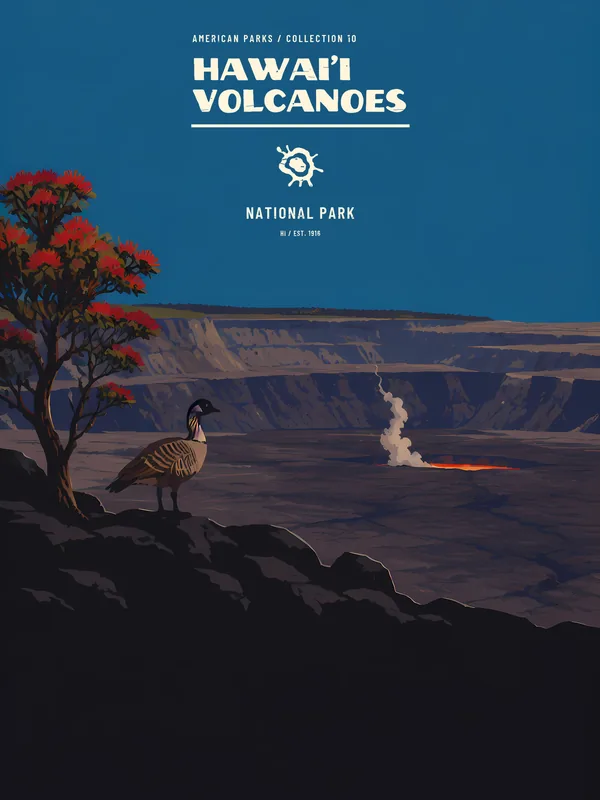
Don't look for bears or other large mammals. The Hawaiian Islands have never had them. The wildlife riches lie elsewhere, in the endemic birds you'll hear more often than see, such as the bright-red ʻapapane and ʻiʻiwi. The nēnē, Hawaiʻi's state bird, sometimes appears along the roads. Slow down because it's protected and endangered. As for plants, the hāpuʻu tree fern and ʻōhiʻa lehua tree colonize cooled lava, offering a living illustration of how life reclaims the rock.
Our Wildlife page explains which species to look for and when to spot them.
The detailed guide Hawaiʻi Volcanoes Wildlife: What Animals to See and Where to Find Them From nēnē to rare forest birds and the Hawaiian hoary bat, here's a guide to… Read the guide →When to Visit Hawaiʻi Volcanoes
You can visit the park year-round. Hawaiʻi doesn't have winter in the continental sense. But elevation changes everything. At the summit of Kīlauea, around 3,900 feet, temperatures are 13 to 14°F cooler than at sea level, and the weather is often cool, damp, and rainy in any season. By contrast, the coastal plain at the end of Chain of Craters Road is hot, dry, and windy, with passing showers. In practical terms, dress in layers and bring a rain jacket, even under the Kona sun.
For the best month for your plans, based on weather, crowds, and volcanic activity, see our When to Go page. For day-to-day and area-by-area conditions, see our Weather page.
The detailed guide When to Visit Hawaiʻi Volcanoes: Best Times, Weather, and Seasons The best times to visit Hawaiʻi Volcanoes, month-by-month weather, crowds,… Read the guide →Where to Stay at Hawaiʻi Volcanoes
There are three main options, from most comfortable to most basic:
- A historic lodge in the park, beside the caldera, so you can wake up facing the volcano. Rooms are limited, so book early.
- The town of Volcano, just outside the entrance, with B&Bs and rentals tucked among the ferns.
- Camping, in a tent or van, beneath some of the Pacific's starriest skies.
For the big picture, see our Where to Stay guide, plus the dedicated Hotels & Lodges, Camping, and RV Camping pages for your travel style.
Stay in the park
Around Hawaiʻi Volcanoes: Things to Do Nearby
The park fits into a larger Big Island road trip. To the east are Hilo and its waterfalls, including Rainbow Falls. To the south are Papakōlea's green sand beach and the southernmost point in the United States, Ka Lae. On the road to Kona, you'll find the coffee farms of the Kona District. Many visitors combine Hawaiʻi Volcanoes with the summit of Mauna Kea and its observatories.
To build the full loop, our Road Trips and Regions guides place the park in a broader Big Island itinerary.
Safety: Rules to Know Before You Go
An active volcanic park calls for a few nonnegotiable habits:
- Stay on trails and behind barriers. The ground may be hollow because of lava tubes, or drop away at the edge of a crater.
- Watch for vog, the haze created by volcanic gases, especially sulfur dioxide. It can worsen breathing and heart problems. Avoid fumarole areas if you're sensitive, pregnant, or traveling with young children.
- Never cross a closed area. Closures respond to activity in real time and can change from one day to the next.
- Fill up and bring water before driving Chain of Craters Road. There are no supplies along the 37-mile round trip.
Traveling with kids? Our Family Travel page sorts trails and activities by age and suitability.
Our Take: Is Hawaiʻi Volcanoes Worth the Trip?
Yes, without question, as long as you give it enough time. It's the one place on a Hawaiʻi trip where the main attraction isn't the beach but the Earth itself, in motion. The park isn't a frozen postcard. Depending on Kīlauea's activity, you may see a quiet caldera or an incandescent glow, and that uncertainty is part of what makes the visit special. Our only regret would be spending a half-day there between beach stops. Come for two days, stay at least one night, and let darkness fall over the crater.
Frequently Asked Questions
Which Hawaiian Island Is Best for Volcano Watching?
The island of Hawaiʻi (the Big Island) is the place to watch volcanoes because it is home to Hawaiʻi Volcanoes National Park and its two giants, Kīlauea and Mauna Loa. Current volcanic activity is concentrated here. Maui has the dormant volcano Haleakalā, which is spectacular but not currently active.
Where Are Hawaiʻi's Volcanoes Located?
Hawaiʻi's active volcanoes rise on the Big Island, in the southern part of the archipelago. Kīlauea and Mauna Loa are in Hawaiʻi Volcanoes National Park, accessible via Highway 11 from Hilo (45 minutes) or Kailua-Kona (2 to 2.5 hours).
Is Hawaiʻi Volcanoes National Park Open?
Hawaiʻi Volcanoes National Park is open 24/7, including holidays. Only the Kahuku Unit has restricted hours: Thursday through Sunday, from 8 a.m. to 4 p.m. Roads or areas may still close temporarily depending on volcanic activity and gas levels.
What Are the Best Hikes in Hawaiʻi Volcanoes National Park?
The hikes to put at the top of your list at Hawaiʻi Volcanoes National Park are Kīlauea Iki Trail, which descends into a crater and is about 3.7 miles long; Nāhuku lava tube; Devastation Trail, which is short and accessible; and the Puʻu Loa petroglyph trail. Our Hikes page provides distances, elevation gains, and difficulty levels.
The American Parks shop
Bring Hawaiʻi Volcanoes home
Our park-inspired creations, made to order and shipped to your door.
Latest park news
- Hawaiʻi Volcanoes: The Hōlei Sea Arch Has Collapsed into the PacificAs of October 1, 2026, the famous Hōlei Sea Arch is gone. Here's what it means for visiting the park's coast.
- Hawaiʻi Volcanoes: Keanakākoʻi Area Closed After a Surge in Kīlauea ActivityEarthquakes and volcanic unrest at Kīlauea's summit have closed the Keanakākoʻi area for safety, until further notice.
- Tropical Storm Nolo: Hawaiʻi Volcanoes National Park Closes Its GatesWith Tropical Storm Nolo closing in, Hawaiʻi Volcanoes National Park is shutting down all activities. Here's what to know before you go.