
Hawaiʻi Volcanoes with Kids: Things to Do and How to Plan Your Visit
Hawaiʻi Volcanoes National Park works well for families with kids as young as about 5 for most accessible activities. Younger children in strollers can enjoy several overlooks and Nāhuku lava tube without taking on a strenuous hike. The park's volcanic intensity, from the steaming caldera to the ʻōhiʻa forests, grabs kids' attention right away.
Why Visit Hawaiʻi Volcanoes with Kids
Geology isn't an abstract subject here. You can see it, hear it, and sometimes smell it. Kids watch steam rise from the ground, walk across an old lava flow, and enter a tunnel carved by molten rock. This isn't a museum you simply look at. It's a landscape to explore.
Other practical advantages for families:
- No dangerous wildlife in the safari sense: no venomous snakes, bears, or large land predators. Wildlife safety is much less demanding than in other American national parks.
- A range of environments in a small area: tropical forest, lava desert, and an ocean-battered coast. You can change scenery in 40 minutes by car without leaving the park.
- A strong Junior Ranger program with an educational booklet for several age groups.
- The park is open 24 hours a day, 7 days a week, so you can work around a toddler's nap or a teenager's energy level.
Is Hawaiʻi Volcanoes Good for Kids? What Age Should They Be?
Yes, as long as you match the activities to their age.
Under 3: the park remains stroller-friendly at the paved overlooks along Crater Rim Drive, Kīlauea Visitor Center, and the entrance to Nāhuku. Dirt trails aren't suitable for lightweight all-terrain strollers.
Ages 3 to 6: Devastation Trail (1.0 mile round-trip, flat, partly paved) and Steam Vents are perfect. Kids this age are naturally fascinated by the “smoking holes.”
Ages 7 to 12: this is the ideal age to complete Kīlauea Iki Trail (4.0 miles), go inside Nāhuku, and start the Junior Ranger booklet. They can carry their own backpack and handle the distance.
Teenagers: Nāpau Trail, the Puʻu Loa petroglyph trail, and Chain of Craters Road to Hōlei Sea Arch offer more demanding options. Even the most jaded teens tend to be absorbed by the active caldera.
One thing to keep in mind: volcanic gases, including vog and laze, can irritate the airways. Kids with asthma or other respiratory issues need extra attention. See the safety section below.
When to Visit with Kids (the Easiest Season for Families)
In general, April-May and September-October offer the best balance: fewer crowds than summer and comfortable temperatures at every elevation.
Hawaiʻi Volcanoes has unusual weather. The summit of Kīlauea reaches about 3,900 feet and can be cool, rainy, and windy any month of the year. The coastal area at the bottom of Chain of Craters Road is often hot, dry, and windy. Bring layers for everyone, whatever the season.
For month-by-month precipitation details and possible closures, see the guide to the best times to visit Hawaiʻi Volcanoes.
How Many Days to Plan for a Family Visit
At least 2 days, or 3 if you're coming from Kailua-Kona (a 2- to 2.5-hour drive from the west coast of the Big Island). From Hilo, the park is 45 minutes away. A full day trip is possible, but stressful with young kids.
A typical family itinerary:
- Day 1: Crater Rim Drive, Kīlauea Visitor Center, Steam Vents, Nāhuku, and Devastation Trail. Leave time for the Junior Ranger booklet.
- Day 2: Chain of Craters Road to Hōlei Sea Arch and the Puʻu Loa petroglyph trail. Have a picnic along the way.
- Optional Day 3: Kahuku Unit (open Thursday-Sunday, 8 a.m.-4 p.m.), with a different atmosphere and fewer visitors.
For a structured itinerary with options based on the number of days and your family's profile, see how to plan your days at Hawaiʻi Volcanoes.
Things to Do at Hawaiʻi Volcanoes with Kids: Our Top Picks
Here are the activities we recommend most for families, based on what really works with kids.
Kīlauea Visitor Center Make it your first stop. Rangers show a short film about Hawaiian volcanism, which is ideal for giving kids context before they head outside. This is also where you pick up the Junior Ranger booklet.
Steam Vents and Sulphur Banks Trail Steam rising from the ground in thick plumes impresses kids of every age. The sulfur has an unmistakable smell, so be ready for the question, “Why does it smell like rotten eggs?” Sulphur Banks Trail is a roughly 1.0-mile, nontechnical loop.
Nāhuku (Thurston Lava Tube) A 540-foot tunnel carved by an ancient lava river. The inside is lit, but it stays cool, so bring a jacket. Kids love the idea of walking inside a volcano. Tip: arrive early in the morning or late in the afternoon. This is the park's busiest spot.
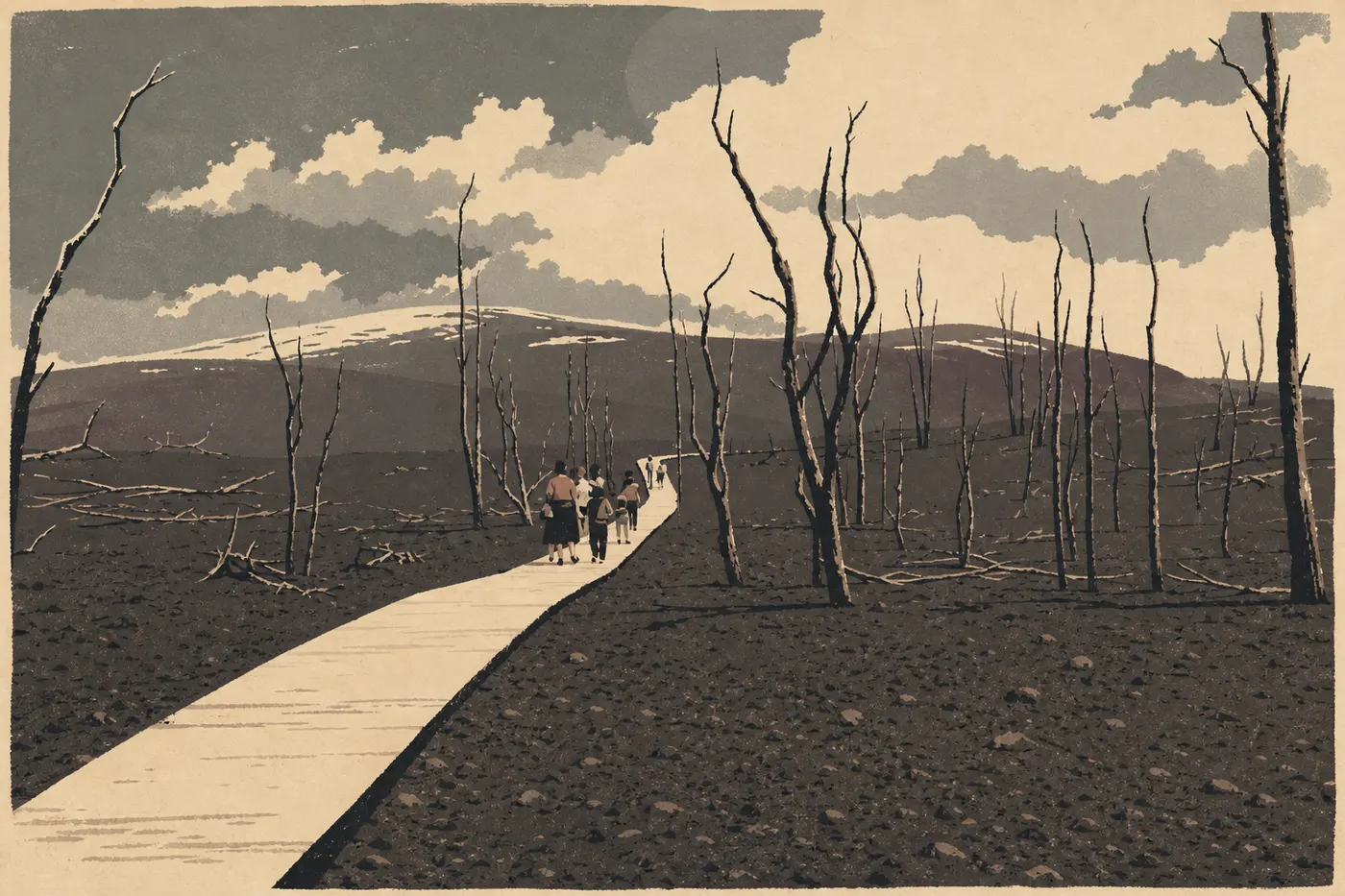
Devastation Trail A paved path through a cinder field left by the 1959 eruption. Kids look for Pele's hair, the delicate strands of solidified lava, in the bushes. The educational takeaway: this area returned to vegetation in just a few decades.
Kīlauea Iki Trail Best for kids 7 and older who are in good physical shape. The 4.0-mile loop descends into the Kīlauea Iki caldera, where the lava lake solidified after the 1959 eruption. Walking across a lava crust at 3,900 feet is an experience they won't forget.
Chain of Craters Road and Hōlei Sea Arch A 33-mile road descends from the summit to the ocean through lava fields. Stop at Kealakomo Overlook for views of the ocean and old flows. The road ends at Hōlei Sea Arch, a basalt arch sculpted by waves.
For a complete list of the park's points of interest, see the guide to things to do at Hawaiʻi Volcanoes.
Easy Family Hikes (Short, Little Elevation Gain, Stroller-Friendly)
| Trail | Distance | Elevation gain | Family difficulty | Notes |
|---|---|---|---|---|
| Sulphur Banks Trail | 1.0 mile round-trip | Negligible | Easy | Partly paved |
| Steam Vents overlook | < 0.3 mile | None | Very easy | Direct view, no trail |
| Devastation Trail | 1.0 mile round-trip | Flat | Easy | Stabilized path |
| Nāhuku (lava tube) | 0.2 mile one way | Slight | Easy | Lit, hat recommended |
| Puʻu Loa petroglyph trail | 1.6 miles round-trip | Minor | Moderate | Lava terrain, ages 6+ |
| Kīlauea Iki Trail | 4.0-mile loop | 400 feet | Strenuous | At least ages 7-8 |
None of these trails works for standard strollers, except for the paved overlooks along Crater Rim Drive. Use a hiking baby carrier for toddlers.
The Hawaiʻi Volcanoes hiking guide covers all the trails and current conditions.
The Junior Ranger Program
Hawaiʻi Volcanoes' Junior Ranger program is one of the most comprehensive in the national park system. Pick up the booklet for free at Kīlauea Visitor Center when you enter the park.
The booklet offers age-based activities (ages 5-7, 8-12, and 13 and up): field observations, drawings of geological formations, and questions about Hawaiian culture and volcanism. Allow 3 to 4 hours to complete it thoughtfully while visiting the park.
After completing the activities, your child meets with a ranger, who checks the work, asks a few questions, and presents the official badge. Some kids collect badges from every park they visit.
The program works for adults, too, with an “adult Junior Ranger” badge. It's a way to stay actively engaged with the visit instead of just taking pictures.
Safety with Kids
Hawaiʻi Volcanoes has specific hazards you won't find in other national parks. It takes ten minutes to review them in the ranger briefing at the entrance.
Volcanic gases (vog and laze) Vog, or volcanic smog, is a mix of sulfur dioxide and fine particles continuously released by Kīlauea. Concentrations can rise quickly at overlooks near the crater. The simple rule is this: if you smell a strong rotten-egg odor and your eyes sting, move away. Children with asthma and infants are more vulnerable. Check the air-quality alerts posted at the visitor center before setting out.
Laze forms when lava enters the ocean. The chemical reaction releases salt particles and hydrogen chloride. During coastal eruptive activity, rangers close the affected areas.
Lava terrain Solidified lava is sharp. Everyone, including adults, needs closed-toe shoes. No sandals or flip-flops. Kids tend to run across lava fields, but uneven ground and excessive speed are a recipe for scraped knees. Keep the pace calm.
Cliff edges and the coast Hōlei Sea Arch and the coastal cliffs along Chain of Craters Road don't have barriers for their entire length. Hold children's hands near the edges.
Coastal heat At the bottom of Chain of Craters Road, the heat can be intense, especially around midday. Bring plenty of water, a hat, and high-SPF sunscreen. Sun reflecting off the black lava significantly increases the perceived temperature.
Animals The land wildlife is harmless. Nēnē, protected Hawaiian geese, sometimes approach visitors looking for food. Don't feed them, and keep kids at a reasonable distance. Feral cats and pigs live in the park, too. Don't approach them.
For all safety rules and current alerts, check the notices at the visitor center near the park entrance.
Where to Stay with Kids (Inside and Around the Park)
Inside the park, Volcano House is the only lodge on the caldera rim. The hotel offers family rooms with direct views of Kīlauea Caldera. Book well in advance, especially in summer.
Camping: the park has two campgrounds, Nāmakanipaio (tents and cabins) and Kulanaokuaiki (tents only, farther out). Nāmakanipaio's cabins are often popular with families with young children because you don't have to put up and take down a tent in the evening rain.
Around the park, Volcano Village, 1.9 miles from the entrance, has several family-friendly B&Bs and cottages. Hilo, 45 minutes away, offers the widest range of lodging at every price point.
The Hawaiʻi Volcanoes lodging guide and the camping guide cover current prices and conditions.
Meals and Breaks with Kids
Food options inside the park are limited. Volcano House's Rim Restaurant serves full meals with caldera views. The menu is simple, but the view makes up for it. Expect to pay about $20 to $30 per adult.
The Kīlauea Visitor Center cafeteria, Volcano House Café, serves sandwiches, drinks, and snacks. It's convenient for a quick break without leaving the park.
It's better to pack a picnic before entering. Picnic tables are available at Nāmakanipaio and at several points along Chain of Craters Road. A cooler with sandwiches, fruit, and plenty of water remains the most practical option with kids.
Volcano Village has a few small restaurants and grocery stores where you can stock up before or after your visit. Hilo has many more options.
Our Where to Eat page lists nearby places.
Family Budget
Entrance fee: $30 per vehicle, valid for 7 consecutive days. Children under 15 always enter national parks for free.
America the Beautiful Pass: $80 per year. It covers the driver and all passengers in the vehicle, including children, at national parks and federal recreation sites nationwide. If you visit 3 or more parks during the year, the pass pays for itself. For a family road trip in Hawaiʻi with other parks on the itinerary, it's often the best option.
Children under 4 can participate in the Junior Ranger program for free, including the booklet and badge.
The National Park Fees & Passes page explains entrance fees and available passes.
Places to Combine with Hawaiʻi Volcanoes for a Family Trip
The Big Island offers several natural pairings with the park that can extend a family stay.
Punaluʻu Black Sand Beach (about 25 miles southeast of the park): a volcanic black-sand beach where green sea turtles come ashore to bask. The law requires visitors to keep their distance, at least 10 feet, but kids can still see the turtles up close. It's a 45-minute drive from the park entrance.
Hilo: 45 minutes away, the city offers the Lyman Museum, with geology and Hawaiian culture exhibits, Rainbow Falls, and local Saturday markets. It's a good option for a half-day break between park days.
Mauna Kea: the 13,796-foot summit isn't recommended for young children because of altitude sickness. The Maunakea Visitor Information Station at 9,186 feet is accessible and offers free stargazing evenings.
For multi-park combinations across the islands or a Big Island road trip, the Road Trip and Region sections offer ideas for planning your stay.
Is Hawaiʻi Volcanoes Worth It for a Family?
Yes, without hesitation, as long as you accept that this park is unlike any other. There aren't hourly geysers or a colorful canyon. Instead, there's an active volcano reshaping an island in real time, lava tubes to walk through, and Hawaiian culture reflected in every trail name. Kids who hike Kīlauea Iki at age 8 still remember it at 15. For families looking for an honest geological experience that's spectacular without being artificial, the park delivers on every front.
The only real limitation is the gas emissions and unpredictable weather at the summit. If your child has sensitive airways, monitor the daily alerts. Everyone else should fill their water bottles, lace up their trail shoes, and head out early.
Frequently Asked Questions
What can you do in Hawaiʻi with kids?
Hawaiʻi Volcanoes National Park is one of the first destinations to consider with kids on the Big Island: Nāhuku lava tube, Kīlauea's steam vents, the Junior Ranger program, and lava fields to explore. Pair it with Punaluʻu Black Sand Beach to see sea turtles.
Which Hawaiian island is best for kids?
The Big Island is often recommended for families looking for a powerful nature experience: the volcanoes national park, black-sand beaches, sea turtles, and plenty of open space. It's the largest island in the chain. Maui is better suited to families who prioritize beaches and resort comforts.
How much should a family budget for 10 days in Hawaiʻi?
The park entrance fee is $30 per vehicle, valid for 7 days. The $80 America the Beautiful Pass pays off if you visit several federal sites. The biggest expenses on a family trip to the Big Island are usually lodging and interisland flights from Honolulu or Maui if you're visiting several islands.
Which volcano in Hawaiʻi is best for kids?
Kīlauea, in Hawaiʻi Volcanoes National Park, is the most accessible volcano for families: drivable roads, marked trails, rangers on site, and an educational visitor center. It's one of the world's most active volcanoes, and you can see its features, including steam vents, the caldera, and lava tubes, without specialized equipment.
Is Hawaiʻi Volcanoes worth visiting with a family?
Hawaiʻi Volcanoes National Park is worth the trip for families with kids as young as 5 or 6. The combination of living geology, the Junior Ranger program, and trails for several ability levels makes the visit both educationally rich and physically accessible. Take extra care with gas emissions if your child has asthma.