
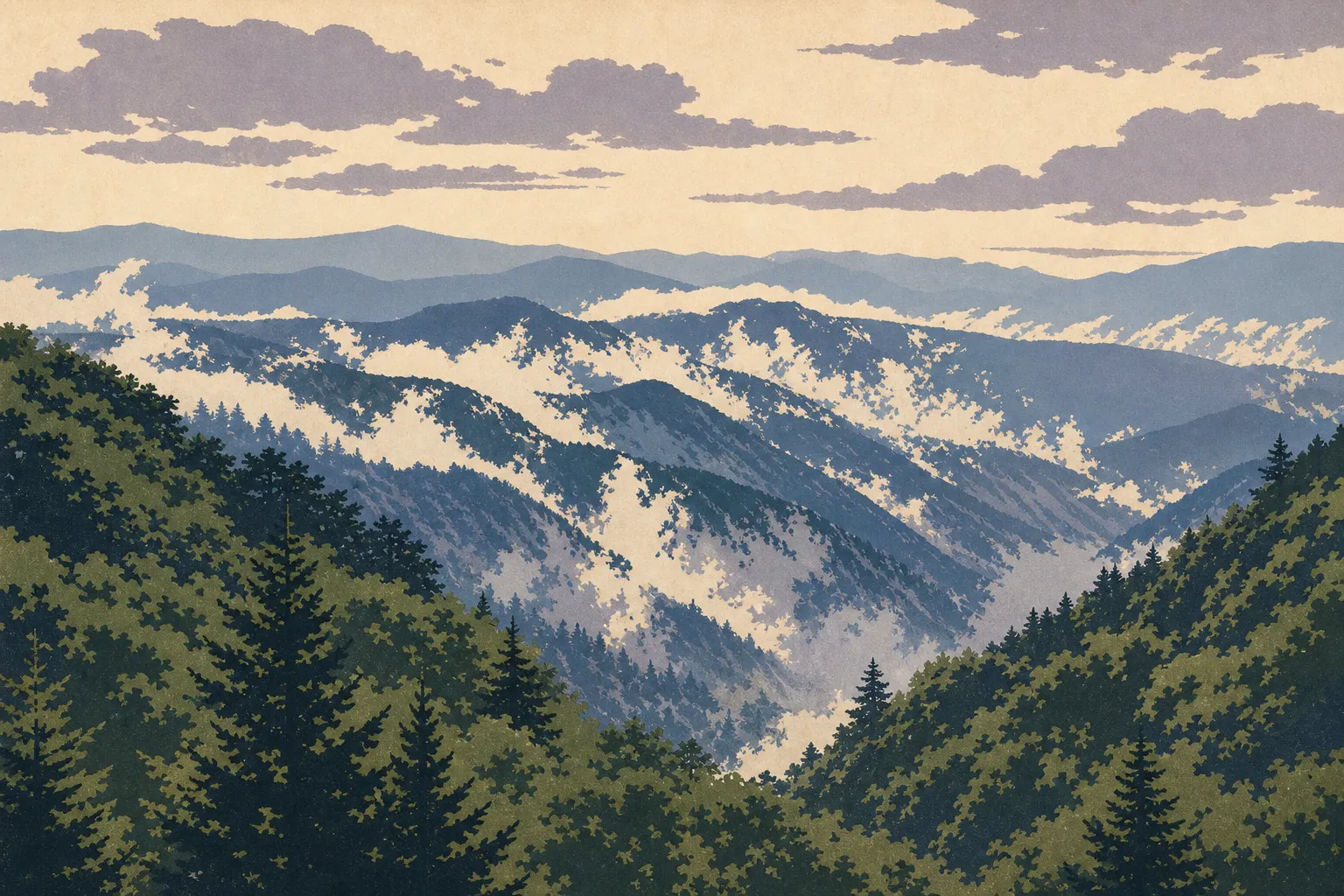
Great Smoky Mountains National Park: The Complete Visitor Guide
Straddling Tennessee and North Carolina, Great Smoky Mountains National Park protects a wild stretch of the Appalachians, those old, rounded mountains that mist wraps around almost every morning (hence “smoky”). It’s the most visited national park in the United States, with more than ten million visitors a year, and it has one feature that changes everything for a road trip: admission is free. Dense forests, black bears, preserved pioneer settlements, and scenic roads climbing as high as 6,644 feet. Here’s how to find your way around.
The quick answer. Plan on at least two full days for a first visit, ideally three. The park revolves around one central road, Newfound Gap Road, and several areas to explore one at a time (Cades Cove, Roaring Fork, Cataloochee, and Deep Creek). There’s no shuttle and no entrance fee, so you can drive freely. The tradeoff is the crowds, which you’ll manage best by starting early.
Great Smoky Mountains at a Glance: Where the Park Is and How to Get There
The park stretches along the border between Tennessee and North Carolina, in the southern Appalachians. Elevations range from about 876 feet in the valleys to 6,644 feet at Kuwohi, the park’s highest point (formerly Clingmans Dome, which reclaimed its Cherokee name in 2024). That elevation change matters. It creates a real mosaic of forests and climates within just a few miles as the crow flies.
Three main entrances organize access:
- Gatlinburg, Tennessee, to the north, the busiest gateway, followed by the tourist town of Gatlinburg and its neighbor Pigeon Forge (Dollywood).
- Townsend, Tennessee, to the northwest, the quietest entrance and the one closest to Cades Cove.
- Cherokee, North Carolina, to the south, on the side of the Eastern Band of Cherokee Indians and the starting point for the Blue Ridge Parkway.
The most convenient airport is in Knoxville, to the northwest. For detailed directions, distances from major Southeastern cities, and help choosing the best gateway for your route, see our Access & Transportation page.
Entrance Fees, Passes, and Reservations
The good news is that entering the park costs nothing. This free admission comes from a historic clause tied to the transfer of Newfound Gap Road, which prohibits charging a toll there. You don’t need an America the Beautiful pass to cross into the park.
Parking, however, has required a fee since 2023. You need to display a parking tag (the “Park It Forward” program) on your windshield whenever you park for more than a brief stop, no matter which area you’re visiting. Tag prices, validity periods, and sales locations change, so we keep them updated on our editorial Fees & Passes page. No entrance reservation is required, unlike at some other quota-managed parks.
Reservations, Permits, and Rules to Follow
Entering the park: You don’t need a reservation to access the park. You do need to reserve parking tags for heavily visited areas in advance through Recreation.gov, especially during the busy season.
Camping: The main campgrounds that accept reservations (Elkmont, Smokemont, and Cades Cove) can be booked through Recreation.gov up to six months ahead. During peak season, they fill up very quickly.
Backcountry: Every night in the wilderness requires a backcountry permit. The permit is free and available online or at visitor centers. Campsites are numbered and designated, so you can’t pitch your tent wherever you want.
Practical rules to remember:
- Pets are allowed only on paved roads and in campgrounds. They’re not allowed on trails.
- Drones are strictly prohibited throughout the park.
- Picking plants, mushrooms, or minerals is prohibited.
- Campfires are allowed only in designated fire rings at campgrounds.
- Food must be stored in the bear boxes available at campgrounds. Leaving food in a vehicle, even a locked one, can attract bears and earn you a fine.
Getting Around Great Smoky Mountains
There’s no mandatory shuttle system here. The car is king, and it determines how you’ll visit. The park’s backbone is Newfound Gap Road (US-441), which crosses the mountains from Gatlinburg to Cherokee via Newfound Gap. Like Little River Road and Laurel Creek Road, it stays open 24 hours a day, year-round, weather permitting. Snow and ice can close it temporarily in winter.
The secondary roads close seasonally. Clingmans Dome Road, for example, is closed for much of the winter. Think of the park as a series of areas, each at the end of its own road. Pick one or two per day instead of trying to string everything together. Watch the speed limits, which are often low (around 20 to 30 mph) and closely enforced by rangers.
Details on seasonal road openings, access conditions, and ways to avoid late-afternoon traffic are on our Getting Around page. If you’re traveling by van or RV, some narrow, winding roads aren’t suitable for large vehicles. We identify them on our RV page.
How Long Do You Need to Visit Great Smoky Mountains?
Two full days are enough for a first look: spend one day on the Newfound Gap Road route to Kuwohi and another at Cades Cove. With three days, add a quieter area (Cataloochee or Deep Creek) and a real hike. Beyond four days, you’re entering hiker territory, with the Appalachian Trail and remote waterfalls.
Our advice is not to underestimate driving times. Distances look short on the map, but slow roads and crowds make everything take longer. A Gatlinburg-to-Cades Cove round trip can take half a day during peak season. For a day-by-day plan based on a two-, three-, or four-day stay, head to our Itinerary & Length of Stay page.
Plan your visit
What to See and Do in Great Smoky Mountains
Explore the park area by area. Here’s how we’d divide it up, from easiest to wildest. Find full details on activities in each area on our Things to Do page.
Road trip journal · 5 areas
Newfound Gap Road and Kuwohi (Clingmans Dome)
This is the classic introductory route. The road climbs from temperate forest into high-elevation spruce-fir forest, with overlooks along the way and the scenic stop at Newfound Gap, where the Appalachian Trail crosses. A spur road then leads to Kuwohi, the park’s high point at 6,644 feet, topped by a spiral observation tower. On a clear day, the view takes in several states. In the mist, you’ll understand the park’s name.
Cades Cove
A broad green valley ringed by mountains and crossed by an approximately 11-mile one-way loop. This is the prime area for wildlife viewing (deer, wild turkeys, and, if you’re lucky, black bears) and for visiting preserved pioneer cabins, churches, and a mill. The downside is that the loop can turn into a traffic jam. Go early in the morning, or visit on days when it’s reserved for pedestrians and cyclists.
Roaring Fork and Gatlinburg
At Gatlinburg’s doorstep, Roaring Fork Motor Nature Trail is a short, one-way forest loop dotted with historic farmsteads, streams, and trailheads leading to waterfalls. It captures the park’s atmosphere just minutes from town.
Deep Creek
On the southern side, near Bryson City, this is the area for waterfalls and inner tubes. It’s the quintessential family spot, with three waterfalls reachable on foot and, in summer, the local tradition of tubing on the river.
Cataloochee
An isolated valley in North Carolina, reached by a narrow gravel road. People come for the quiet, historic buildings, and above all the herd of reintroduced elk, spectacular at sunrise and sunset.
Explore the park
The Best Hikes in Great Smoky Mountains
The park has hundreds of miles of trails, including about 71 miles of the Appalachian Trail along its border ridge. Three types stand out: easy waterfall walks (Laurel Falls and the Deep Creek waterfalls), demanding scenic climbs (Alum Cave to Mount Le Conte and Charlies Bunion from Newfound Gap), and ridge sections for experienced hikers. Every trail has its own seasonal, elevation-gain, and crowd-related considerations. We cover them, along with our favorites and the pitfalls to avoid, on our Hiking page.
The detailed guide Great Smoky Mountains Hiking: The Best Trails for Every Level The best Great Smoky Mountains trails by area and difficulty, with permits,… Read the guide →Wildlife and Plants to Look For
Great Smoky Mountains ranks among the richest ecosystems in the eastern United States. The star is the black bear. The park’s population is dense, and you could encounter one anywhere, including along the road. Keep your distance (at least 100 feet), never feed wildlife, and put away all food. Cades Cove and Cataloochee are also good places to see deer, wild turkeys, and elk.
As for plants, the park bursts into wildflowers in spring and turns red and gold in fall. In late May and early June, synchronous fireflies flash together for a few evenings in select areas. The event is so popular that access is handled through a lottery. We cover species to look for, viewing spots, and bear-safety rules on our Wildlife page.
The detailed guide Great Smoky Mountains Wildlife: Animals to See and Where to Find Them Black bears, elk, synchronous fireflies, and salamanders Read the guide →When to Visit Great Smoky Mountains
In short, come in fall (mid-October) for the colors, spring for wildflowers and swollen waterfalls, summer for cool temperatures at higher elevations and tubing, or winter for quiet and sometimes snow-covered ridges. Keep the elevation effect in mind. It can be 11 to 20°F cooler at the summit than in the valley, and clear skies below don’t guarantee clear skies above. Always bring a warm layer.
Our When to Go page details the calendar month by month, seasonal events (fall colors, fireflies, and closures), and our ideal timing. See our Weather page for forecasts by elevation.
The detailed guide When to Visit Great Smoky Mountains: Best Seasons and Months Best times to visit Great Smoky Mountains Read the guide →Where to Stay in Great Smoky Mountains
The park has only one lodging property, LeConte Lodge, perched at high elevation and accessible only on foot. Reserve it months in advance. Otherwise, you have two options: sleep in a tent or van at the park’s campgrounds, or stay in one of the gateway towns. Gatlinburg and Pigeon Forge on the Tennessee side offer hotels, cabins, and entertainment. Townsend is the quiet option. Cherokee and Bryson City open up the southern side.
We compare everything in detail on our Where to Stay page (the big picture), our Hotels & Lodges page (from the gateway towns to LeConte Lodge), and our Camping page (park campgrounds, reservations, and amenities).
Stay in the park
Around Great Smoky Mountains: Things to Do Nearby
The park fits easily into a larger Southeastern road trip. To the north, Gatlinburg and Pigeon Forge line up amusement parks and Dollywood. To the south, the Blue Ridge Parkway runs toward Asheville, a city known for breweries and Art Deco, along one of the country’s best-known scenic drives. The Cherokee reservation in Cherokee offers an introduction to the region’s Native American history. These stops naturally extend beyond the park into the Southeast regions and road trips. For a keepsake, pick up the park stamp to add to your NPS Passport & Stamps collection.
Our Take: Is Great Smoky Mountains Worth the Trip?
Yes, absolutely. You don’t come here for the jaw-dropping vertical scenery of the West, but for gentle, misty, living mountains where wildlife is everywhere and pioneer history feels tangible. Free admission makes the park easy to fit into an itinerary. The only real drawback is the crowds. Without a strategy (start early, avoid October weekends, and target outlying areas), you’ll spend more time in traffic than in nature. With good planning, it’s one of the highlights of a Southeastern road trip.
Frequently Asked Questions
What should you see in the Smoky Mountains?
In the Smoky Mountains, start with the scenic Newfound Gap Road and Kuwohi (formerly Clingmans Dome), then visit historic Cades Cove and its bears, Roaring Fork near Gatlinburg, the waterfalls of Deep Creek, and the elk of Cataloochee. The park breaks down into distinct areas, described on our Things to Do page.
How long do you need to visit Great Smoky Mountains?
You need at least two full days to see Great Smoky Mountains properly, and three for a comfortable stay that adds a hike and a remote area. Slow roads and crowds lengthen drives. Our Itinerary & Length of Stay page lays out a day-by-day plan.
How much does it cost to enter Great Smoky Mountains?
Admission to Great Smoky Mountains is free because of a historic clause prohibiting tolls on the road that crosses the park. Parking has required a fee since 2023 through a parking tag. Current prices are listed on our editorial Fees & Passes page.
What is the history of Great Smoky Mountains?
The history of Great Smoky Mountains includes the Cherokee people, who have lived here for centuries and whose name was restored to Kuwohi in 2024, as well as the pioneer settlers whose cabins, mills, and churches can still be visited at Cades Cove and Cataloochee. The park was officially established in 1934.
Is Great Smoky Mountains the most beautiful national park in the United States?
It’s hard to name the “most beautiful” national park in the United States because the landscapes are so different. The Smokies offer wooded, misty, intimate mountains that feel far removed from the canyons of the West. They are, at any rate, the country’s most visited national park, thanks to free admission and its location in the densely populated Southeast.
The American Parks shop
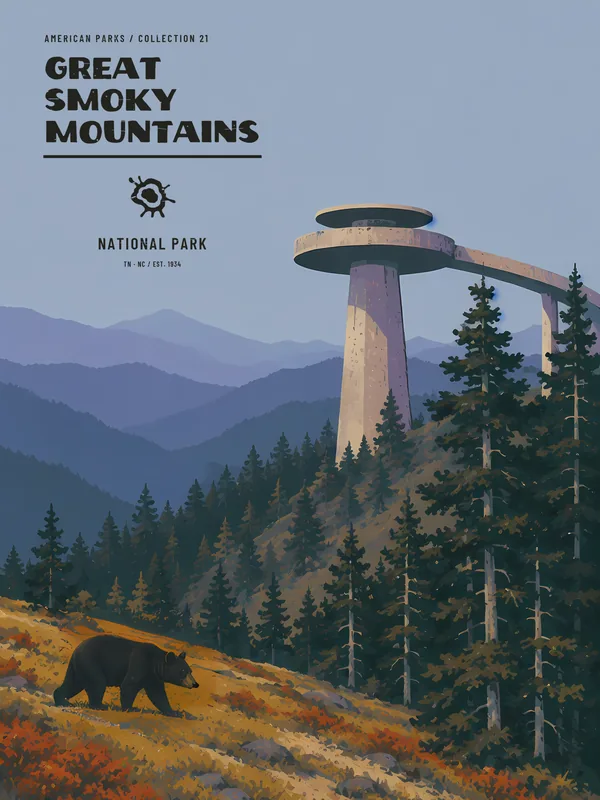
Bring Great Smoky Mountains home
Our park-inspired creations, made to order and shipped to your door.
Latest park news
- LeConte Lodge: Morning Closures October 6-9 for Helicopter FlightsFrom October 6 to 9, 2026, LeConte Lodge and its services close each morning from 9 a.m. to noon, though the summit trails stay open.
- Adaptive Hike on Porter's Creek Trail October 24, 2026A ranger-guided outing for visitors with limited mobility is offered in the Greenbrier section, by registration.
- Canyonlands: Hiker Missing at Horseshoe Canyon, Search UnderwayA 71-year-old hiker remains missing near the Horseshoe Canyon trailhead, in a remote stretch of Canyonlands, according to FOX 9 Minneapolis-St. Paul.