
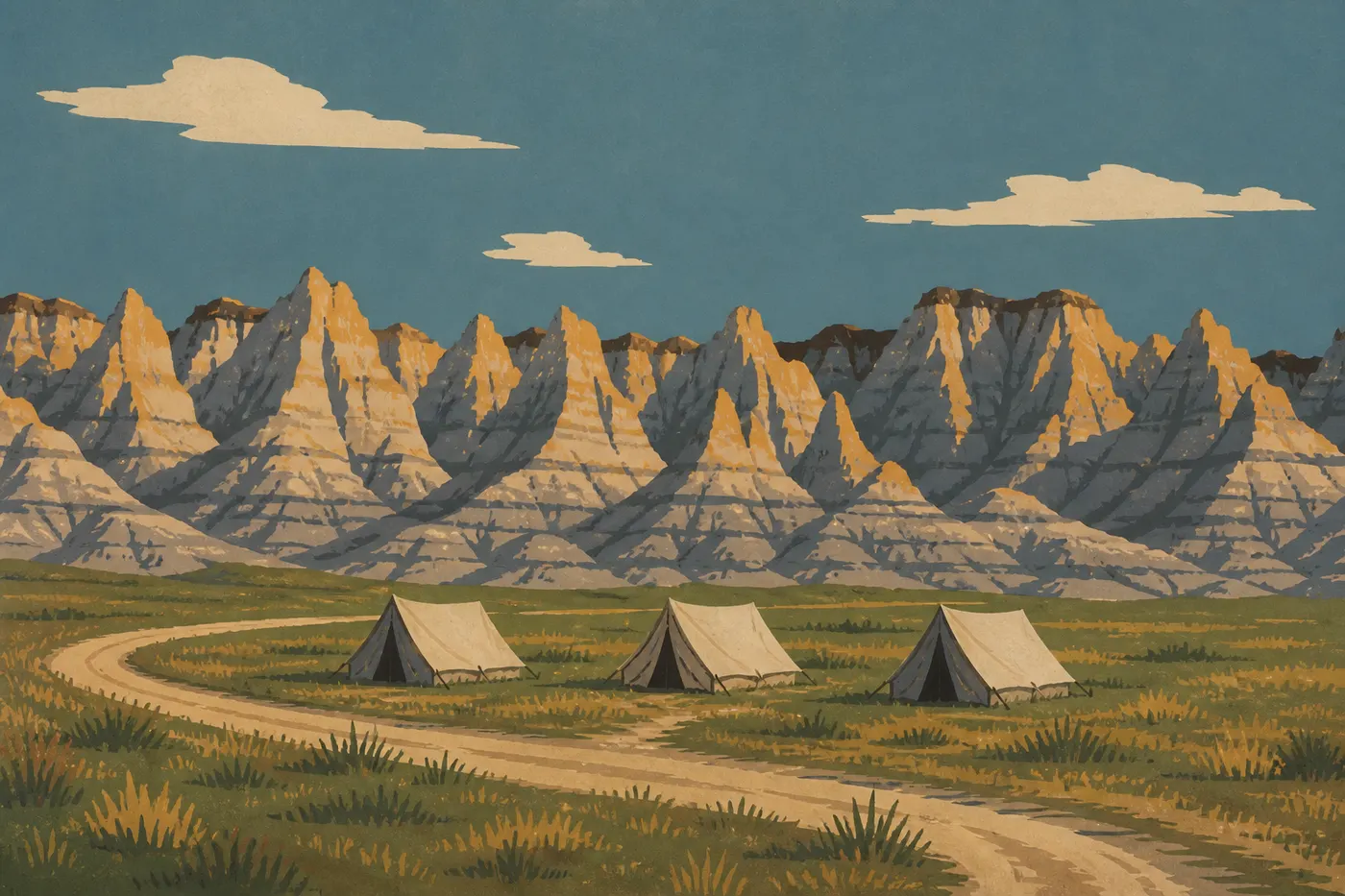
Visiting Badlands National Park by RV: Campgrounds, Rules, and Tips
Yes, you can visit Badlands National Park by RV, and it's one of the most flexible ways to explore these otherworldly geological formations. The good news is that there are no restrictive tunnels and no special permit to plan for. The number-one limitation? Water and electricity are scarce in the park. Only one campground offers electric hookups. Everywhere else, you'll need to be completely self-sufficient. Read on before you unfold the map.
Can you drive and camp in an RV at Badlands National Park?
Absolutely. Badlands Loop Road (SD Highway 240), the park's main scenic route, is open to all common RV sizes. The road winds through a landscape carved into pinnacles and ravines, with parking areas sized for standard vehicles. There are no low tunnels or hairpin turns, so driving remains manageable even in a mid-size rig.
The park is open year-round, though weather-related closures can happen. Winters are harsh, with up to 24 inches of snow over the season, while summer heat can approach 117°F during the hottest part of the day. Make sure your onboard heating or air-conditioning system can handle the conditions. Before you enter the park, America introduces you to its usual fees: admission costs $30 per private vehicle and is valid for 7 days. If you're visiting several parks during your road trip, the park's annual pass ($55) or the America the Beautiful pass, which covers all federal national parks, quickly pays for itself.
RV restrictions and regulated roads
Badlands National Park doesn't impose a universal length limit on Badlands Loop Road. However, several secondary roads, especially in the South Unit's Stronghold District, are reserved for light four-wheel-drive vehicles. Before heading out, stop at Ben Reifel Visitor Center near Interior or check real-time alerts on the NPS website.
Here are a few firm rules to remember:
- Parking: only in designated areas. Don't park your RV on the shoulder of Badlands Loop Road or outside marked spaces.
- Wildlife: bison, bighorn sheep, and coyotes regularly cross the road. Stay at least 100 feet away, and don't honk to “push” the herd along.
- Thunderstorms: summer storms can be violent and sudden, turning dirt roads impassable within minutes. If you're driving a heavy vehicle, stay off unpaved roads when the sky starts to darken.
Obey the posted speed limits throughout the park, especially near busy areas and overlooks. Look for the signs as soon as you enter.
The park's official campgrounds
The NPS manages two campgrounds with completely different setups.
Cedar Pass Campground
This is the main campground, just steps from Ben Reifel Visitor Center and Cedar Pass Lodge. It has sites with 50-amp electric hookups, which are especially valuable when nighttime temperatures fall outside the usual range. Reservations are made through Recreation.gov. During the busy season, from June through August, sites fill quickly, sometimes months ahead. Book as soon as the calendar opens, six months before your preferred date.
The campground has a dump station and a drinking-water spigot. Expect to pay about $30 per night for an electric site. That's an estimate, so check Recreation.gov before booking. The park's annual pass covers admission, not the campsite. Forgetting that detail can be expensive.
For early risers, Cedar Pass's location is hard to beat. You can watch the sunrise over the pink and ocher formations right from your window.
Sage Creek Campground
Sage Creek is the complete opposite. There are no hookups, no running water, and no reservations. Sites are first come, first served, along a gravel road in the Wilderness Unit, accessible from the Pinnacles entrance in the west. Very long vehicles should make sure their rig can handle the road before setting out. Ask at the visitor center about current conditions.
The payoff is real. You camp in the middle of open prairie, with bison herds sometimes grazing a few dozen yards away. At dawn, it's a sight I haven't seen anywhere else in South Dakota. Your RV must be fully self-contained here, with onboard water, gray- and black-water management, and a generator or solar panels. Camping is free, aside from the park entrance fee.
Dispersed camping and areas around Badlands National Park
Boondocking inside the park isn't allowed outside the two official campgrounds. Buffalo Gap National Grassland, which borders much of the park, is managed by the Bureau of Land Management (BLM) and allows dispersed camping under BLM rules, generally for 14 consecutive nights per area. Check which areas are authorized before settling in. Not all land bordering the park is BLM land.
The town of Wall, a few miles from the northeast entrance via I-90, has private campgrounds with full services. It's a good base for your first night or a convenient place to stock up on food and water before entering the park.
Dumping, water, and services (dump stations)
Cedar Pass's dump station is your main option inside the park, and it's available during the campground's operating season.
- Drinking water: available at Cedar Pass. Sage Creek has none, so fill up before heading there.
- Electricity: available only at Cedar Pass, with 50-amp hookups. Sage Creek requires complete self-sufficiency.
- Fuel and services: Wall and Interior have gas stations and a few RV-service providers. Don't leave Sage Creek with empty tanks.
Always carry enough water for at least 48 additional hours. Heat waves in Badlands National Park can be intense, and your consumption can climb quickly beyond your usual estimates.
Which campground is right for you?
You're traveling with family or a large vehicle: Cedar Pass is the clear choice. Electric hookups for air-conditioning, flush toilets, showers, and a visitor center within walking distance. Our guide to kid-friendly activities in Badlands National Park has more details.
You're looking for a full immersion in nature: choose Sage Creek. Check the road conditions and your level of self-sufficiency before setting out. The chance to be close to wildlife is unmatched.
You're traveling in the off-season, from October through May: Cedar Pass may be partially closed, so check NPS alerts. Our Badlands weather guide reviews conditions month by month to help you choose the right window.
Renting an RV to visit Badlands National Park
If you're flying in from abroad, you'll need to rent an RV after you arrive. Rapid City, about 75 miles west of the park along I-90, is the logical starting point. The airport (RAP) has flights from major U.S. hubs, and rental agencies operate there.
Here are the main categories to know:
- Class C, 20 to 25 feet: the best balance of self-sufficiency and maneuverability for Badlands National Park. It can access most parking areas and overlooks.
- Class A, 25 feet and up: maximum comfort, but check Sage Creek Road conditions before reserving one.
- Converted van or SUV: ideal for Sage Creek and BLM land, with less comfort but more freedom of movement.
Book 3 to 6 months ahead for the busy season. Major companies such as Cruise America and peer-to-peer platforms like Outdoorsy and RVShare offer pickups in Rapid City. Compare several quotes. Prices vary significantly depending on the season and vehicle size.
RVs, pets, budget, and reservations: what to know
Pets: dogs are allowed in the campgrounds but must be leashed at all times, with a leash less than 6 feet long. They're not allowed on trails or in wilderness areas. This often surprises visitors, so check the NPS pet rules before you leave.
Nightly budget: the $30-per-vehicle entrance fee covers everyone in the vehicle for 7 days. A site at Cedar Pass costs about $30 per night with an electric hookup. Sage Creek is free. For a full overview of expenses, our complete Badlands guide breaks costs down by category.
When to reserve: Cedar Pass reservations open on Recreation.gov six months ahead. July and August sites can disappear within the first few hours after reservations open. Off-season, sites are easier to find, but services may be reduced.
Our RV camping plan for Badlands National Park
Badlands National Park is easy to explore by RV as long as you plan for two things: water and electricity. For a 2- to 3-night stay, our recommendation is one night at Cedar Pass for hookups, a shower, and sunrise over the formations from your site, followed by a night at Sage Creek if your vehicle is self-contained and the road is passable. That gives you both experiences: comfort in the east and wilderness immersion farther out. Reserve Cedar Pass several months ahead, and keep Sage Creek as a last-minute option.
Frequently asked questions
Can I sleep in my car at Badlands National Park?
Sleeping in your car is allowed in the official campgrounds, Cedar Pass and Sage Creek, but not in overlook parking areas or outside designated zones. Outside a campground, no overnight camping is allowed within the park.
Can you drive through Badlands National Park in an RV?
Yes. You can cross Badlands National Park by RV via Badlands Loop Road (SD-240), a paved scenic route accessible to most RVs. It connects the northeast entrance at I-90, Exit 131, with the Cactus Flat exit, Exit 110.
What is a Badlands vehicle?
The name “Badlands” appears on some Ford models, including the Bronco and F-150 Badlands. It's an off-road trim level with no connection to the national park. To visit Badlands National Park in an RV, any standard-size rig will work.
Can you park an RV anywhere at Badlands National Park?
No. Parking is strictly limited to designated areas and spaces. Parking on the shoulder of Badlands Loop Road or outside marked zones is prohibited and can result in a fine.
How much does a campsite cost at Badlands National Park?
At Cedar Pass, expect to pay about $30 per night for a site with electric hookups. That's an estimate, so check Recreation.gov. Sage Creek is free, apart from the park entrance fee of $30 per vehicle, valid for 7 days.
What is the best time to visit Badlands National Park by RV?
Our When to Visit Badlands National Park guide reviews each month based on your priorities, including weather, crowds, and service availability.