
Zion Hiking Guide: Best Trails for Every Ability
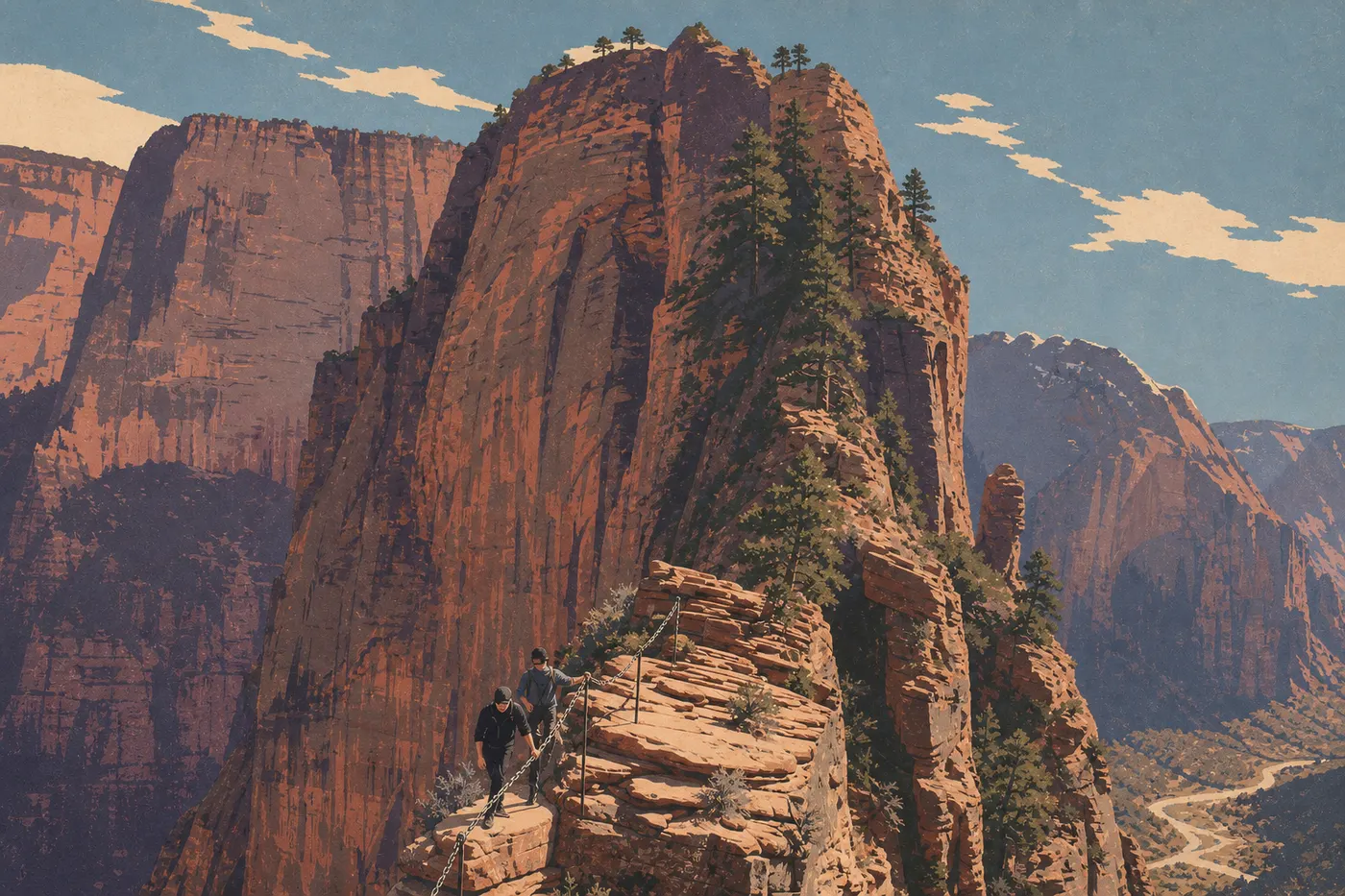
Everyone knows Zion's iconic hike: Angels Landing, the dizzying outcrop reached by climbing chains bolted into the rock. But since 2022, the trail has required a permit obtained through a lottery, and even without that restriction, it isn't for everyone. The good news is that the park has plenty of excellent alternatives. The Narrows, where you hike up the Virgin River between 1,000-foot walls, is an experience in its own right. Emerald Pools delivers memorable views without chains or extreme elevation gain. Canyon Overlook Trail can be completed in an hour and leaves you speechless.
Our selection covers every ability level and two distinct areas. For everything related to park conditions more broadly, our complete Zion guide is the place to start.
Getting Ready for Your Zion Hike
Permits and the Lottery
Almost all day hikes in Zion require no special permit: you enter the park and start walking. The major exception is the Angels Landing Trail, which requires a day hike permit obtained through an NPS lottery. There are two ways to get one: a seasonal lottery, which opens about three months before the season, and a walk-up lottery available the day before your hike. The permit costs about $6 per person, in addition to the park entrance fee of $35 per vehicle. The top-down version of The Narrows, starting at Chamberlain's Ranch, also requires a wilderness permit, which you can reserve through Recreation.gov. The bottom-up route from Riverside Walk is open without a permit.
Dogs
Dogs are allowed only on paved trails and Pa'rus Trail. They're prohibited on all dirt trails, including Emerald Pools, Angels Landing, and The Narrows. If you're traveling with a pet, arrange care for hiking days.
Water, Heat, and Flash Floods
In summer, the floor of Zion Canyon regularly climbs above 100°F. Plan on at least 2 liters of water per person per hour of hiking from June through August. Flash floods are another serious risk. Monsoon season runs from mid-July through mid-September, and a storm 19 miles upstream can trigger a flood in The Narrows with no visible warning at ground level. Always check NPS weather alerts before entering a narrow canyon. On exposed trails such as Angels Landing, starting before 7 a.m. helps you avoid both afternoon heat and the frequent summer thunderstorms.
Season
Spring, from March through May, and fall, from September through November, offer the best conditions, with mild temperatures and more manageable crowds. Winter is generally mild in the canyon, but some higher-elevation trails may be snowy or icy. Light traction devices are recommended from December through February. For a complete month-by-month overview, see the Zion seasonal calendar.
The Best Hikes, Area by Area
Zion Canyon: The Iconic Trails
Zion Canyon Scenic Drive, which follows the Virgin River for about 9 miles, concentrates most of the trailheads. From spring through fall, you can access it only by shuttle. See the Access section below.
Angels Landing 5.4 miles · 1,490 feet of elevation gain · 3 to 5 hours · difficult · round-trip · permit required
The trail starts at Grotto, shuttle stop No. 6, and first climbs Walter's Wiggles, 21 switchbacks cut into the rock in the early 20th century. You reach Scout Lookout, which is already impressive. The final 0.5 miles to the summit have chains anchored in the rock, and the route is exposed on both sides with no guardrails. From the summit, 1,490 feet above the canyon floor, the panorama is one of the park's most dramatic. Reserve your permit as soon as the seasonal lottery opens, since the next-day walk-up lottery is highly uncertain during peak season. Even with a permit in hand, take the first shuttle to avoid crowds on the chains.
The Narrows (bottom-up) 2.2 paved miles + up to 6.2 miles upstream · minimal elevation gain · 2 to 8 hours · moderate to strenuous · round-trip · no day-use permit required
Riverside Walk is a 2.2-mile paved trail accessible to strollers that follows the Virgin River from Temple of Sinawava, the shuttle's last stop. Beyond that point, the trail disappears and you walk directly in the river between walls reaching 1,000 feet high, narrowing in places to less than 20 feet. Go as far as you like, then turn around. Bring water shoes with quick-draining soles, since flip-flops won't stay secure on slippery cobbles, and carry a hiking pole to help counter the current. Outfitters in Springdale rent the full setup. Entry is strictly prohibited when a flood warning is in effect.
Emerald Pools 1.5 to 3.4 miles · 180 to 590 feet of elevation gain · 1 to 3 hours · easy to moderate · partial loop possible · no permit required
Three pools sit at different levels, and you can visit each one separately or link them together. Lower Emerald Pool, a 1.5-mile easy round-trip, leads to a 60-foot waterfall falling onto a fern-covered path. Middle Pool, about 2.5 miles, adds a moderate climb and a wilder setting. Upper Pool, 3.4 miles from the bottom, is often dry by late summer, but the view of the cliffs is still worth the trip. Start from Zion Lodge, shuttle stop No. 5. Temporary closures are possible because of rockfall risk, so check NPS alerts before setting out.
Canyon Overlook Trail 1.0 mile · 295 feet of elevation gain · 45 minutes to 1 hour · easy · round-trip · no permit required
Often underestimated by first-time visitors, this short trail leads to one of the park's most photogenic viewpoints over Pine Creek Canyon and the Great White Throne. The trail starts right at the east exit of Zion-Mount Carmel Tunnel and is accessible by car, with no shuttle required from this side of the park. Watch young children carefully near a few unguarded sections along the drop-offs.
Watchman Trail 3.3 miles · 367 feet of elevation gain · 2 hours · moderate · round-trip · no permit required
Start at the Visitor Center, with no shuttle needed. The trail climbs to a lower plateau and offers an unusual angle on the Watchman and Springdale Valley. There's no shade along the route, so bring water even in the cooler months. It's ideal in late afternoon, when low-angle light turns the cliffs orange.
Observation Point (via East Mesa Trail) 8.6 miles · 607 feet of elevation gain · 4 to 5 hours · moderate · round-trip · no permit required
Because of a landslide, the usual route from Weeping Rock is closed. Check the current status on the NPS website before planning this hike. The current access is via East Mesa Trailhead, outside the park, along a road from Zion Ponderosa Resort. You reach the plateau from above with little elevation gain, and the overlook provides a sweeping view down to Angels Landing and across the canyon. It's a solid option if you didn't get an Angels Landing permit but still want the high-country panorama.
Kolob Canyons: The Wild Northwest
About 37 miles from the main entrance, Kolob Canyons has its own entrance off I-15. The same America the Beautiful pass and entrance ticket are valid there. Few hikers make it this far, so the atmosphere is very different from the main canyon, with no shuttle service.
Taylor Creek Trail 5.1 miles · 450 feet of elevation gain · 3 to 4 hours · moderate · round-trip · no permit required
The trail follows the bed of Taylor Creek between strangely shaped cliffs. You pass two wooden pioneer cabins dating from the 1930s before reaching Double Arch Alcove, a sandstone alcove carved with two nested arches. Start from the parking area 2.8 miles from the Kolob entrance. The trail remains manageable in the off-season, when the main canyon is crowded.
Kolob Arch Trail 14.0 miles · about 1,300 feet of elevation gain · 6 to 8 hours · strenuous · round-trip · no permit required (backcountry camping requires a permit)
This one is for hikers comfortable with a long day. The trail starts at Lee Pass and follows La Verkin Creek through the canyon to Kolob Arch, whose span approaches 295 feet. There is no potable water along the route, so carry your entire day's supply. Backcountry camping is possible with a backcountry camping permit reserved through Recreation.gov.
Easy and Family-Friendly Hikes
Zion isn't all vertiginous trails. Here are four low-stress options:
- Riverside Walk: 2.2 miles, flat, paved, and stroller-friendly. It follows the Virgin River from Temple of Sinawava. In summer, kids love cooling their feet in the river at the entrance to The Narrows.
- Lower Emerald Pool: 1.5 miles with a slight uphill grade. The final waterfall impresses visitors of every age without excessive effort.
- Pa'rus Trail: 3.1 miles, paved and flat. It connects the Visitor Center with Canyon Junction and is open to bikes and dogs, making it the only trail in the park that allows both.
- Canyon Overlook Trail: 1.0 mile, with a few steps cut into the rock. Watch very young children carefully near the exposed sections.
Our Family page collects activities suitable for young children beyond hiking.
Strenuous Day Hikes
Looking for a full day with elevation gain and summit views? Three options stand out.
Angels Landing remains the benchmark for the combination of elevation gain, exposure, and views. The permit is the first hurdle: apply during the seasonal lottery, about three months before your trip, and don't rely exclusively on the walk-up lottery in July and August.
Observation Point via East Mesa offers the high-country panorama without chains or a lottery. The elevation gain is gentler, 607 feet versus 1,490 feet, but you'll need a vehicle to reach East Mesa Trailhead outside the park. Check the trail status with the NPS before planning your hike.
Kolob Arch makes for a genuinely athletic day, covering 14.0 miles round-trip. Start early so you can return to the parking area before the afternoon heat. It's ideal if you've already done the canyon classics and are looking for solitude.
For multi-day hikes such as Trans-Zion Trek and West Rim Trail with backcountry camping, reserve backcountry camping permits through Recreation.gov.
Access, Trailheads, and Parking
From spring through fall, private vehicles aren't allowed on Zion Canyon Scenic Drive. The park's free shuttle is the only way to reach the canyon trailheads during this period. It runs from about 6 a.m. to 10 p.m., with departures every 5 to 7 minutes during peak season, and serves nine stops from the Visitor Center to Temple of Sinawava. A town shuttle connects Springdale with the Visitor Center, which is convenient if you're staying outside the park.
In the off-season, from mid-November through early March, Scenic Drive is open to cars. The trailheads have small parking areas of their own, and they fill up quickly on weekends. The main parking area is at the Visitor Center.
Canyon Overlook Trail and the park's eastern trails are reached by car via UT-9 after Zion-Mount Carmel Tunnel. For Kolob Canyons, take I-15 and exit onto Kolob Canyons Road. There is no shuttle connection between the two areas.
To reach Zion from Las Vegas and understand the traffic rules in Zion-Mount Carmel Tunnel, the access options and parking in Springdale are covered in the dedicated guide.
When to Hike in Zion
Spring, from March through May, offers the best overall conditions, with mild temperatures, plenty of water in the river for The Narrows, and manageable crowds. Fall, from September through November, is just as pleasant, with significantly fewer visitors than in July and August.
Summer is still workable if you start before 8 a.m. and avoid exposed canyon sections in the middle of the day. Monsoon season, from mid-July through mid-September, means checking flood alerts every day before entering The Narrows or any enclosed canyon.
Winter brings a distinctive atmosphere, with snow on the red walls, and very few visitors, but higher-elevation trails may be snowy or icy. Light traction devices are recommended from December through February.
For month-by-month temperature and precipitation details, see the Zion weather forecast and climate guide and our When to Visit page.
Which Hike Is Right for You?
| Profile | Our recommendation |
|---|---|
| First visit, limited time | Canyon Overlook Trail (1 hour) + Lower Emerald Pool (1 hour) |
| Family with children | Riverside Walk + wading in the river at The Narrows |
| View seeker | Angels Landing (with a permit) or Observation Point via East Mesa |
| One-of-a-kind experience | The Narrows bottom-up (bring water gear) |
| Full athletic day | Kolob Arch Trail or Angels Landing + The Narrows over two days |
| Avoiding crowds | Taylor Creek Trail (Kolob Canyons) or Watchman Trail |
Frequently Asked Questions
What is the best hike in Zion?
The best hike in Zion depends on your ability and what you're looking for. Angels Landing is the most iconic choice for high-country views, and it requires a permit. The Narrows bottom-up is the most unusual experience, taking you up the Virgin River between 1,000-foot walls.
Is hiking in Zion difficult?
Difficulty varies widely in Zion. Trails such as Riverside Walk and Canyon Overlook Trail are accessible to everyone. Angels Landing, with 1,490 feet of elevation gain and exposed sections at high elevation, is rated difficult by the NPS and requires good balance and comfort with heights.
Is it safe to hike in Zion?
Hiking in Zion is safe when you follow a few practical rules: start before 8 a.m. in summer, carry at least 2 liters of water per hour in hot weather, check NPS flood alerts before entering The Narrows, and don't tackle the chains on Angels Landing unless you're comfortable with exposure.
Do you need a permit to day hike in Zion?
Most day hikes in Zion don't require a permit. The Angels Landing Trail is the only one that requires a day hike permit, obtained through the NPS lottery, either seasonal or walk-up the day before.
Are there easy, family-friendly hikes in Zion?
Zion has plenty of easy and enjoyable hikes, including Riverside Walk, a flat, stroller-accessible 2.2 miles; Lower Emerald Pool, 1.5 miles; and Pa'rus Trail, 3.1 miles and open to bikes and dogs. Our Family page covers all activities suitable for children.
Can you hike with a dog in Zion?
Dogs are allowed in Zion only on paved trails and Pa'rus Trail. They're prohibited on all dirt trails, including Emerald Pools, Angels Landing, and The Narrows.
When is the best time to hike in Zion?
The best time to hike in Zion is spring, from March through May, or fall, from September through November. For a month-by-month comparison, see our When to Visit page.
Are there loop hikes in Zion?
Complete loops are rare in Zion Canyon. Emerald Pools offers a partial-loop option, climbing on one trail and descending on another. Most major hikes, including Angels Landing, The Narrows, and Watchman, are out-and-back routes.
How do you reach Zion's trailheads?
From spring through fall, the park's free shuttle serves all the canyon trailheads. Private cars aren't allowed on Scenic Drive during this period. Reach Canyon Overlook and the eastern trails by car via UT-9. Our Access & Transportation page and the guide to getting around Zion cover all the options.
Which trails are best for wildlife viewing in Zion?
Mule deer frequent the canyon floor and can be seen early in the morning along Pa'rus Trail and near Zion Lodge. California condors often soar above Angels Landing and the ridgelines. Our Wildlife page lists the species found here and the best viewing areas by season.