
Getting Around Zion: Access, Entrances, Shuttles, and Parking
The quick answer: In Zion Canyon, you leave your car in the parking lot. Zion Canyon Scenic Drive is closed to private vehicles for most of the year, and the free shuttle is the only way to travel up the canyon. Elsewhere in the park, including Kolob Canyons and Kolob Terrace Road, you're free to drive.
How to Get to Zion
You'll need a car to reach Zion. There isn't regular public transportation from nearby towns. You'll find distances, departure airports, and route options in the Zion Access Guide.
The Park Entrances and Which One to Choose
Zion has three entrances. The main entrance is on the Springdale side, leading to Zion Canyon, the visitor center, and the shuttles. If you're crossing the park from east to west on UT-9, you'll go through the Zion-Mount Carmel Tunnel. Check vehicle restrictions before driving in with a large vehicle. For help choosing an entrance based on your itinerary, see the Zion Access Guide.
Getting Around the Park
By Car
You can drive freely on UT-9, which crosses the park from east to west. Watch your vehicle's dimensions at the Zion-Mount Carmel Tunnel. Large vehicles, including tall RVs, wide vans, and vehicles towing trailers, may need a paid special permit, and one lane must be temporarily closed while they pass. Check with the entrance station if your vehicle exceeds standard dimensions.
The Zion Canyon Scenic Drive, 4.3 miles north of the visitor center, is closed to private cars from around mid-March through mid-November. Outside that period, you can drive it in your own vehicle, usually in pleasantly quiet conditions.
By Shuttle
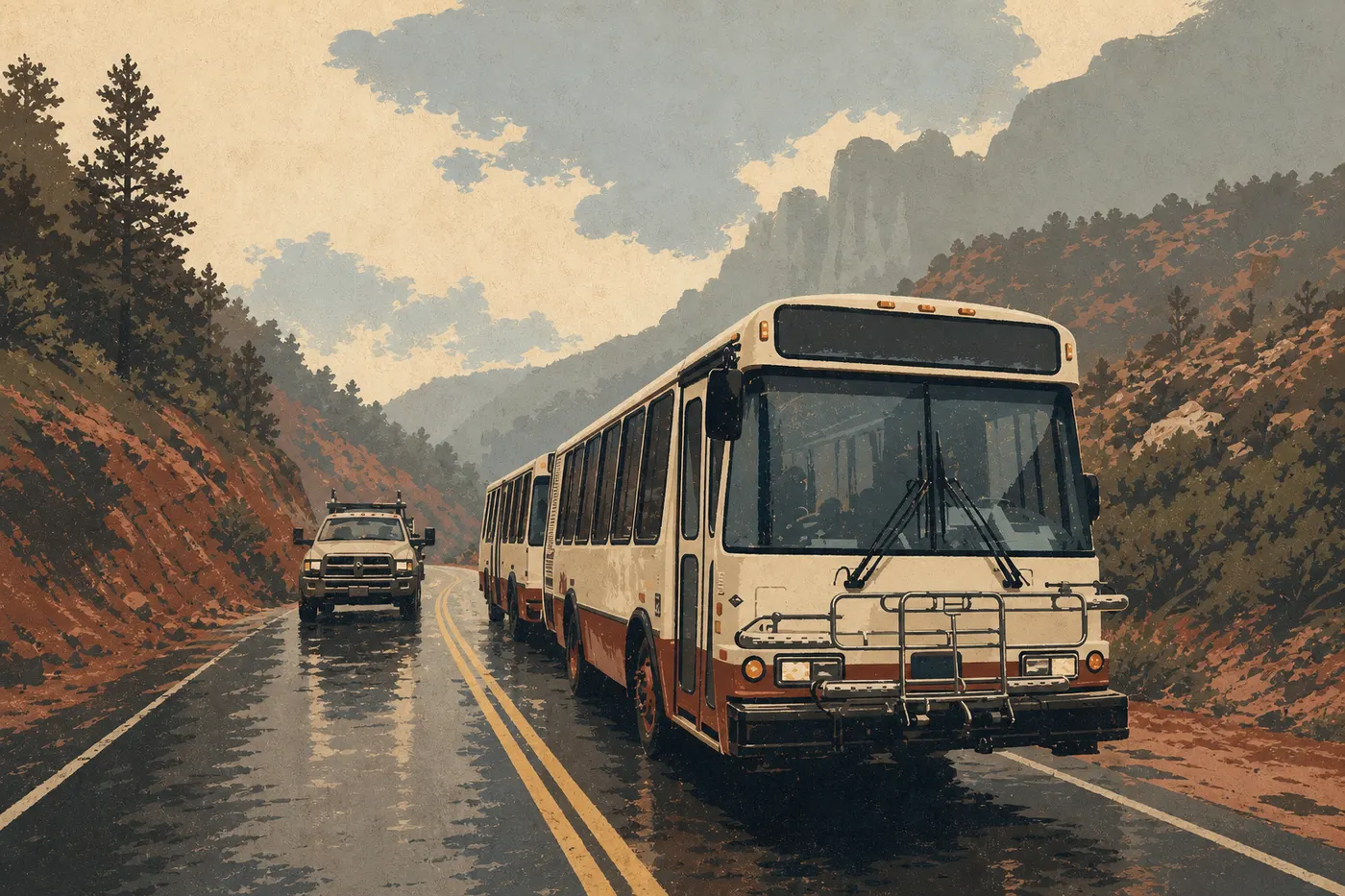
Shuttles are the backbone of transportation in Zion Canyon. Two routes run in parallel, and both are free.
The park shuttle, the Zion Canyon Shuttle, serves about ten stops between the visitor center and the Temple of Sinawava terminal, the trailhead for The Narrows. It runs all day during the high season, from dawn into the evening. Exact schedules vary by date and crowd levels, so check them at the park or in the NPS app before you leave.
The Springdale Shuttle connects the center of town with the park entrance. If you're staying in town or you've parked your car in Springdale, it's the natural connection to the park shuttle.
During a May visit, we waited less than ten minutes at 7 a.m. to board the first shuttle. By noon, the line stretched more than 160 feet. You get the idea.
By Bike
Bikes are allowed on all roads open to the public and on Pa'rus Trail, a paved trail a few miles long with very little elevation gain, between the visitor center and Canyon Junction. It's the only place in the park where bikes and dogs share the trail. You can rent bikes in Springdale, which is a good way to reach the entrance from your lodging without relying on the shuttles.
Where to Park
Parking is Zion's biggest headache during the high season.
The visitor center parking lot, at the south entrance, is the largest and most convenient. It usually fills before 9 a.m. in summer and as early as 8 a.m. in July and August. Arrive early or be prepared to look for a spot in town.
Springdale's parking lots are a solid alternative. Several public and private lots, some of them paid, are scattered throughout town. The Springdale Shuttle drops you right at the park entrance. Walking from some hotels in town to the entrance takes 15 to 20 minutes.
Watchman Campground, inside the park near the south entrance, has its own campsites. If you're camping there, your car stays at your site, and the shuttle stops are within walking distance. For details about campgrounds in the park, the Zion Camping Guide and the Zion Lodging Guide cover everything you need to know.
There is currently no parking permit system at Zion, such as a parking tag. The shuttle network serves as the park's traffic-management system instead.
Distances and Travel Times Between Areas
Zion Canyon is compact. From the visitor center to the Temple of Sinawava terminal, it's about 6.8 miles. Riding the shuttle from end to end without getting off takes about 45 minutes. Between consecutive stops, 5 to 10 minutes is usually enough.
Kolob Canyons is about 37 miles from the south entrance by road, roughly a 45-minute drive via I-15. There is no shuttle connection between the two areas, so you'll need a car to see both in the same day. You'll find realistic itineraries for different time frames in the Zion Itinerary. For an overview of distances, see the Zion Map.
Special Cases: RVs, Vans, Accessibility, and Pets
RVs and tall vans: The Zion-Mount Carmel Tunnel has vehicle-size restrictions. If your vehicle exceeds standard dimensions, you'll need a special permit, and traffic will be temporarily stopped while you pass through. Be sure to ask at the entrance before entering the tunnel. The Zion RV Camping Guide details suitable campsites and driving restrictions for large vehicles.
Accessibility: Shuttles have ramps and reserved spaces. The visitor center, Canyon Junction Bridge, and Pa'rus Trail are wheelchair accessible. Most major trails include sections with significant elevation gain or unpaved terrain. The Zion Family Visit Guide lists accessible points and alternatives for visitors with limited mobility.
Pets: Dogs are allowed in Zion only in a very limited area. They're permitted on Pa'rus Trail, paved roads, and in campgrounds, but prohibited on all other trails. Arrange pet care if you want to go hiking.
Practical Transportation Info: Fuel, Cell Service, and the App
Fuel: There are no gas stations inside the park. Fill up in Springdale or Hurricane, 20 minutes west, before entering. If you're arriving from the east on UT-9, the last gas station is in Mt. Carmel Junction, about 9 miles from the tunnel.
Cell service: Coverage is weak to nonexistent in Zion Canyon beyond the visitor center. Download offline maps, including Google Maps or Maps.me, and the official NPS map before entering. The visitor center's Wi-Fi works well enough for one last download before heading into the canyon.
NPS app: The official National Park Service app provides shuttle schedules, trail-closure alerts, and downloadable offline maps. We always install it before entering any major American national park.
Frequently Asked Questions
Where can you park at Zion National Park?
The main parking options at Zion are the visitor center parking lot, at the south entrance, and paid lots in Springdale. During the high season, the visitor center lot fills before 9 a.m. Park in town and take the free Springdale Shuttle to the entrance.
Can you visit Zion by car?
Yes. You can drive to the park and on UT-9, including through the Zion-Mount Carmel Tunnel. However, Zion Canyon Scenic Drive is closed to private cars from around mid-March through mid-November. During that period, the free shuttle is the only way to travel up the canyon.
How long do you need to visit Zion?
Two full days let you cover the highlights of Zion Canyon. You'll need another half-day to explore Kolob Canyons. The Zion Itinerary guide offers detailed plans for different paces.
How much is admission to Zion National Park?
Admission is $35 per vehicle, as of 2025. For entrance fees and annual passes, see the National Parks Fees & Passes page.
Is there cell service in Zion National Park?
Cell coverage is very limited in Zion Canyon beyond the visitor center. Download your maps and the NPS map for offline use before entering the park.