
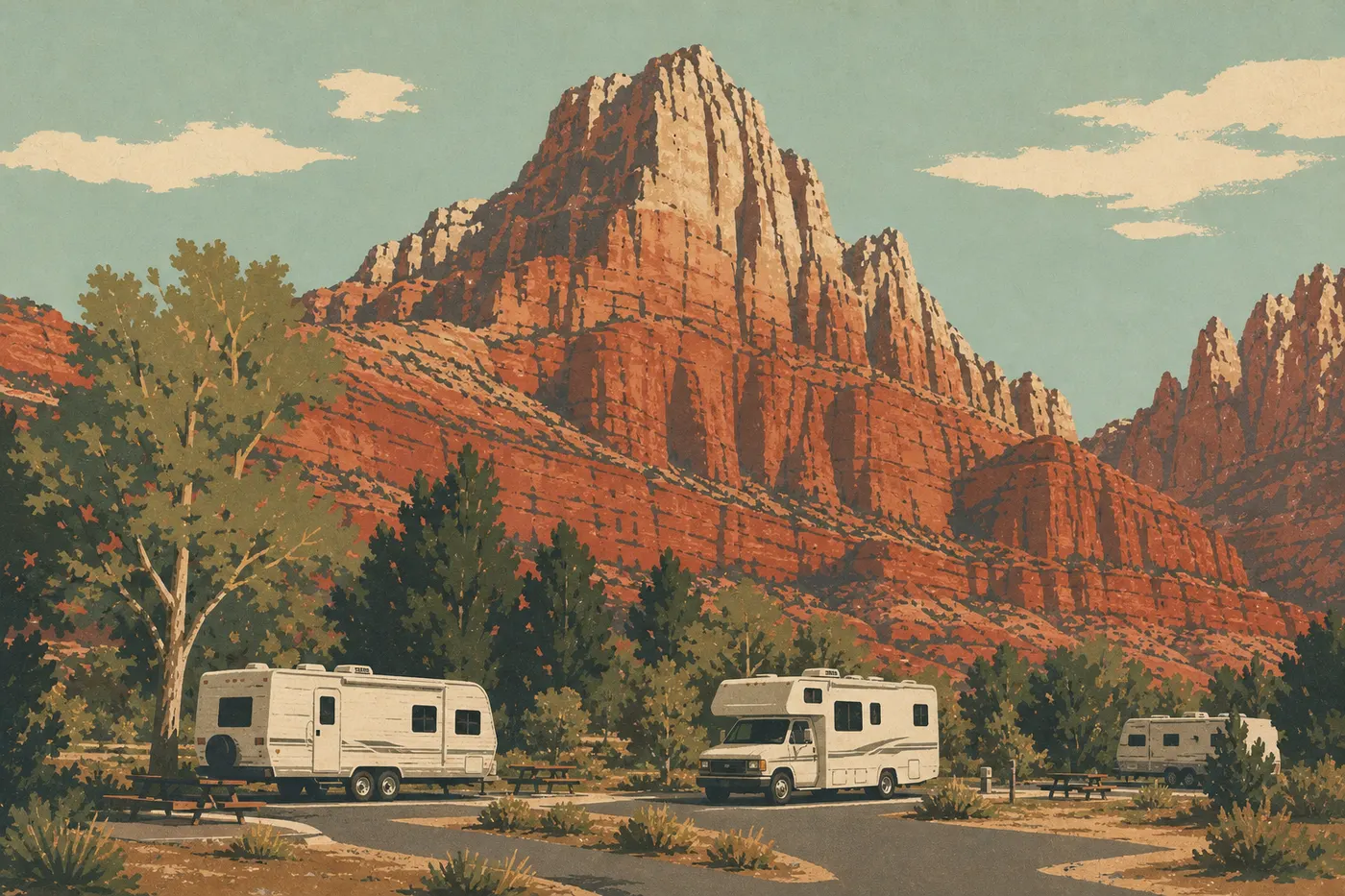
Zion by RV: Campgrounds, Rules, and Tips
The short answer: yes, you can camp by RV in Zion National Park. Watchman Campground, the park's main campground, accommodates RVs with electrical hookups. The biggest constraint is the Zion-Mount Carmel Tunnel, which has strict size restrictions. Even tighter rules take effect in 2026. Check your dimensions before you leave because they affect your entire trip plan.
Can You Drive and Camp in Zion by RV?
You reach Zion National Park by RV through the main entrance on the Springdale, Utah, side. Zion Canyon Scenic Drive, the road that follows the canyon to Temple of Sinawava, is closed to private vehicles for most of the year. You can only travel it on the park's free shuttles. Your RV therefore stays parked at Watchman Campground or the Visitor Center while you explore the canyon. Logistics are easy here. The shuttle stops are just a two-minute walk from the campground.
The other main route, the Zion-Mount Carmel Highway (SR-9), crosses the park from west to east and passes through the famous tunnel. This is where size restrictions come into play.
RV Restrictions and Regulated Roads
Zion-Mount Carmel Tunnel: Current Rules and New 2026 Measures
The Zion-Mount Carmel Tunnel is 1 mile long. Any vehicle more than 7 feet 10 inches wide or 11 feet 4 inches tall must obtain a paid tunnel permit and pass through under NPS escort, with traffic stopped in the opposite direction. You buy the permit at the park entrance station. It costs about $15.
Starting in 2026, the rules get stricter. RVs that exceed certain dimensions will be banned from the Mount Carmel Highway, regardless of whether they have a permit. If you're planning a trip for 2026 or later, be sure to check the official NPS alerts before finalizing your plans. A long Class A or a fifth-wheel may be barred from this corridor and, as a result, from much of the park's east side.
Other things to watch for:
- Kolob Terrace Road, which leads to Lava Point, is not recommended for long vehicles because of its tight turns and narrow road.
- Parking in Springdale is limited for large vehicles. Check the NPS website for approved parking areas before you arrive. RV spaces are limited.
The Park's Official Campgrounds
Zion has three official campgrounds. Only one is really set up for RVs.
Watchman Campground
The park's main campground is a few minutes' walk from the Visitor Center and shuttle stops. Watchman offers RV sites with 30-amp electrical hookups, as well as sites without hookups. The maximum length varies by site. Some accommodate vehicles up to 40 feet, while others are limited to 19 feet. When you book through recreation.gov, be sure to select a site that matches your vehicle's length.
- Reservations: Through recreation.gov, essential from March through November.
- Cost: About $20-$30 per night, depending on the site type.
- Season: Open year-round, though occasional winter closures are possible.
- On-site services: Restrooms, drinking water, and a dump station.
South Campground
Adjacent to Watchman, this campground is for tents and small vehicles. The sites are too short and there are no hookups, so RVs don't belong here. We're mentioning it to help you avoid booking the wrong campground.
Lava Point Campground
This primitive campground sits at 8,100 feet and is reached via Kolob Terrace Road. It has six sites, no hookups, and no running water. It's limited to small vehicles under 25 feet. The road requires a modest vehicle and careful driving around the turns. A camper van or pickup camper will do well here. A Class C or Class A will not.
Boondocking and Camping Areas Around Zion
Dispersed camping is prohibited inside the national park. However, the BLM lands surrounding Zion offer opportunities for free boondocking. Areas around Hurricane, Utah, and some roads on the Dixie National Forest side are popular with road-trippers in RVs. Rules vary by area and can change, so check current BLM restrictions and follow the signs on site.
For a semi-developed alternative, private campgrounds and RV parks are located in Springdale and La Verkin. They're convenient when Watchman is full, but they don't offer the park's wilderness setting. Our Where to Stay in Zion guide lists nearby accommodations to round out your plans, from lodges to campgrounds.
Dump Stations, Water, and Services
The dump station at Watchman Campground is reserved for campground guests. There is no dump station open to non-guests inside the park. Here are a few options nearby:
- RV parks in Springdale generally offer paid dump stations.
- Hurricane (22 miles west): a full-service hub with gas stations, supermarkets, and laundromats.
- Kanab (about 37 miles northeast): full RV services if you're taking SR-9 east.
Drinking water is available at Watchman and the Visitor Center. If you choose BLM boondocking, stock up before entering the area. There are no water sources in the dispersed camping zones.
Which Campground Is Right for You?
You have a large vehicle, such as a Class A, a long Class C, or a fifth-wheel: Watchman, with an electrical hookup site, is your only option inside the park. Book early through recreation.gov and specifically choose a site compatible with a 40-foot vehicle.
You have a small van or truck camper: Lava Point offers a completely different atmosphere. It's quiet and wild, away from the crowds in the main canyon. Keep the elevation in mind: at 8,100 feet, nights are cool even in midsummer.
You want to be as close as possible to the shuttles and canyon trails: Watchman is the clear choice. When I visited in the spring, I slept to the sound of the Virgin River, about 650 feet from the first shuttle stop. It's hard to find a more convenient base for getting out on the trails first thing in the morning.
You want a compromise between full services and a central location: Springdale's RV parks, with water, electricity, and sewer hookups, are worth considering when Watchman is full. Our complete Zion guide covers the park's surroundings to help you choose your base.
Renting an RV to Visit Zion
Zion is a great fit for a road trip in an RV, but your vehicle's size directly affects how freely you can move around the park.
- Class B, or camper van: The most flexible option in Zion. It passes through the tunnel without a problem, can reach Lava Point, and is easy to park. Ideal for two people.
- Class C, 16 to 26 feet: Comfortable for a family and still manageable in the tunnel, as long as you check your vehicle's dimensions before you leave.
- Class A, more than 30 feet: Impressive to maneuver through the canyons. The tunnel requires an escort permit, and starting in 2026 some routes will be closed to vehicles this size. Think carefully before you book.
Where to rent: Las Vegas, 2.5 hours away, is the classic starting point for Zion and has the biggest fleets, including Cruise America, Outdoorsy, and RVshare. Salt Lake City, 4.5 hours away, is an alternative if you're combining several parks in northern Utah. Rental rates vary widely by season, agency, and vehicle class, so get several quotes before you commit.
RVs, Pets, Budget, and Reservations: What to Know
Pets: Dogs are allowed in the park's campgrounds if they're kept on a leash no longer than 6 feet. They're not allowed on hiking trails or on the shuttles. In practice, your dog will stay at the campground or in the vehicle while you go out, so provide shade and water. Temperatures regularly top 100°F from June through August.
Nightly budget: Expect to pay $20-$30 at Watchman, depending on the site type, with or without a hookup. Park admission is $35 per vehicle, valid for 7 days, or $70 for an annual America the Beautiful pass if you're visiting several parks. The national Fees and Passes page provides an overview of entrance fees and passes.
Reservations: Zion is one of the most visited national parks in the United States. Watchman often fills up weeks in advance from March through October. Check recreation.gov at 8 a.m. Mountain Time on the day your date window opens. In the off-season, from November through February, your chances of finding a last-minute site improve considerably.
Seasons: Summers are hot, with valley temperatures above 100°F, and monsoon storms from mid-July through September can trigger sudden flash floods in the canyons. Spring and fall remain the best seasons for RV travel in Zion. For month-by-month details, see our Zion Weather page and our When to Visit Zion guide.
In Summary: Our Zion RV Plan
- Base: Watchman Campground, with an electrical hookup for large vehicles, booked through recreation.gov several weeks ahead.
- Vehicle size: Check your width, height, and length against the Zion-Mount Carmel Tunnel rules, which become more restrictive in 2026.
- Days in the park: Leave the RV at the campground or Visitor Center and take the free shuttle into the canyon.
- Services: A dump station at Watchman, plus water and supplies in Hurricane, 22 miles west, or in Springdale.
- Alternative: BLM boondocking around Hurricane for a wilder, free camping experience.
Frequently Asked Questions
Can you camp in Zion National Park by RV?
Yes, you can camp by RV in Zion. Watchman Campground accommodates RVs with electrical hookups. It's the only campground in the park that's truly suited to large vehicles.
Can you visit or drive through Zion by RV?
You can visit Zion by RV, but driving through the Zion-Mount Carmel Tunnel on SR-9 is subject to strict size restrictions. Vehicles more than 7 feet 10 inches wide or 11 feet 4 inches tall must obtain an escort permit. Starting in 2026, RVs that exceed certain dimensions will be banned from this road.
Can you park an RV anywhere in Zion?
No. Parking outside designated areas is prohibited in the park. RVs must park at official campgrounds or in NPS parking areas designated for them. Zion Canyon Scenic Drive is closed to private vehicles and reserved for shuttles.
Where are RVs prohibited in Zion?
RVs are prohibited on Zion Canyon Scenic Drive, where only shuttles are allowed. Large vehicles in the Zion-Mount Carmel Tunnel require a paid escort permit. Starting in 2026, vehicles exceeding the new regulatory dimensions will be banned from the Mount Carmel Highway.
Which campground should you choose for an RV trip to Zion?
For a standard RV, Watchman Campground is the obvious choice in the park. It offers electrical hookups, walkable shuttle access, and year-round operation. Lava Point Campground is suitable only for small vehicles under 25 feet.
Where can you sleep inside Zion National Park?
You can sleep in the park only at the three official campgrounds: Watchman, South, and Lava Point. Dispersed camping inside the national park is prohibited. BLM areas around Hurricane allow free boondocking.
How much does an RV site cost in Zion?
A site at Watchman Campground costs about $20-$30 per night, depending on the type, with or without an electrical hookup. Add the $35 park entrance fee per vehicle, valid for 7 days. For entrance fees and annual passes, see the National Parks Fees and Passes page.
What's the best time to visit Zion by RV?
The best time to visit Zion by RV is spring, from March through May, or fall, from September through November. Temperatures are pleasant and the risk of flooding is lower than in midsummer. Summer temperatures exceed 100°F, and monsoon storms from mid-July through September create flash-flood risks in the canyons. You'll find all the details in our When to Visit Zion guide.