
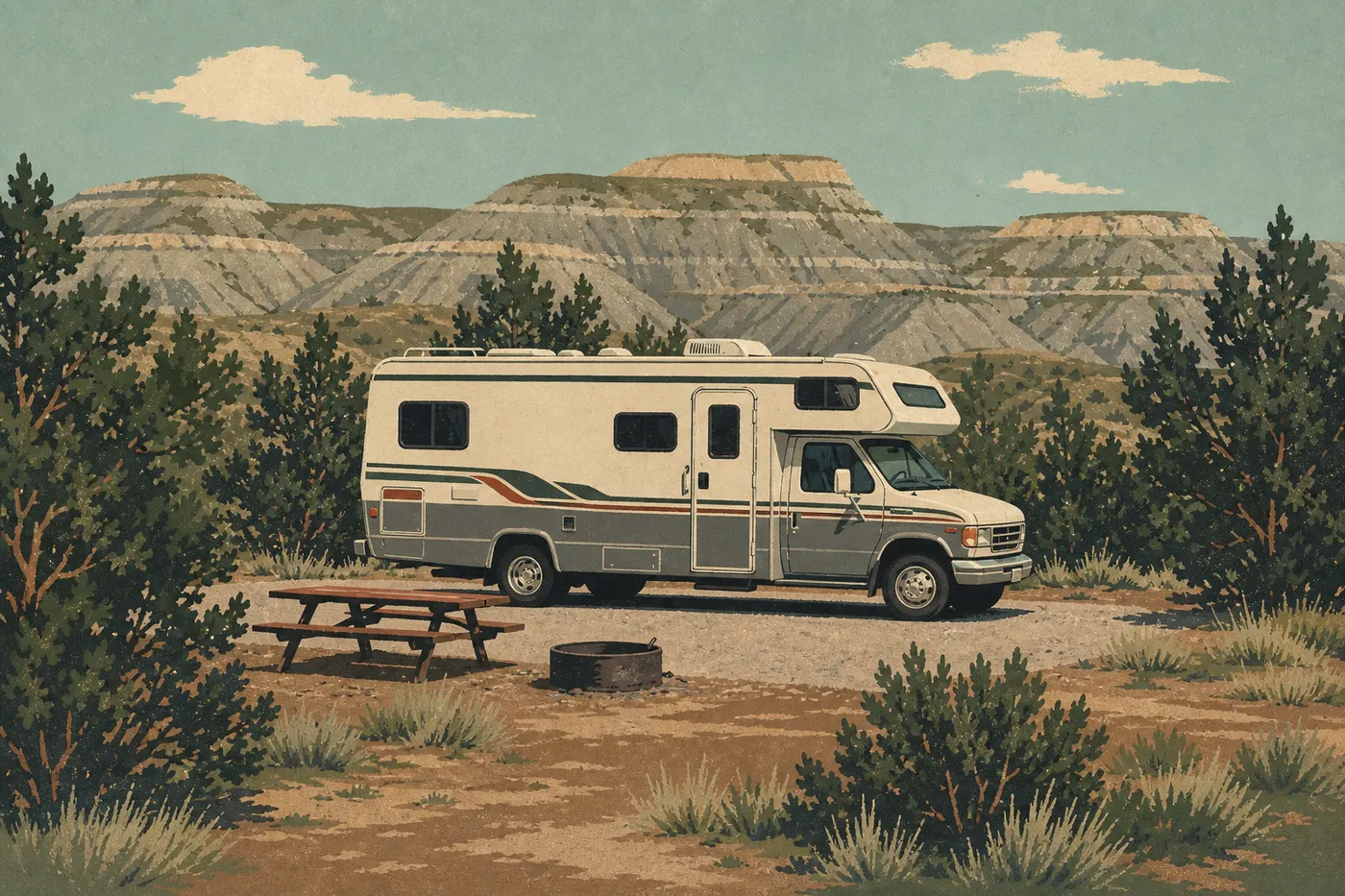
Theodore Roosevelt National Park by RV: Campgrounds, Rules & Tips
Theodore Roosevelt National Park welcomes RVs without restrictive tunnels or troublesome tolls. Yes, you can stay overnight in a motorhome or campervan here. Two official campgrounds, one in the South Unit at Medora and one in the North Unit, accept RVs. The main constraint is that there are few electric sites, and they fill early in summer. Reserve as soon as the booking window opens on Recreation.gov.
Can You Drive and Camp in an RV at Theodore Roosevelt?
Theodore Roosevelt is one of the northern parks you can still visit without battling crowds of several million people. The two main scenic roads, the South Unit's Scenic Loop Drive, about 28 miles around, and the North Unit Scenic Drive, 18 miles round-trip, are open to RVs. Traffic is light, the curves are broad, and the pullouts generally work for standard-size rigs.
The park is divided into three units. The South Unit, the most visited, opens onto Medora via exits 24 and 27 from Interstate 94. The North Unit is reached via Highway 85, about 70 miles north. The Elkhorn Ranch Unit, the park's third unit, is accessible only on foot or horseback from the Little Missouri River's banks. Bringing your RV there isn't an option.
The entrance fee is $30 per private vehicle, valid for 7 days. If you're visiting several parks on your road trip, check the National Parks Fees & Passes page, which explains entrance fees and annual passes.
RV Restrictions and Regulated Roads
The good news is that Theodore Roosevelt has neither a tunnel with height restrictions, such as the Zion-Mount Carmel Tunnel, nor a mountain road with hairpin turns. Conditions are much more relaxed than in the Southwest parks.
There are still a few things to check before you leave.
Maximum length per site. Cottonwood Campground in the South Unit accommodates vehicles up to about 35 feet on most sites. Juniper Campground in the North Unit has limits that vary by site. Recreation.gov lists the permitted length for each site, so check it when you book.
Parking areas along the scenic roads. Some Scenic Loop overlooks have short parking areas. If your rig is longer than 30 feet, including a motorhome and trailer, park at the park entrance and use a shuttle vehicle for your excursions.
The Elkhorn Ranch access road. The road to the Elkhorn Ranch Unit is unpaved and unsuitable for RVs. Save this outing for a smaller vehicle or a 4WD.
Winter closures. Some roads may close from November through April because of snow. The park stays open 24 hours a day year-round, but check current alerts on the NPS "Alerts" page before you hit the road.
The Park's Official Campgrounds
Cottonwood Campground (South Unit)
Cottonwood is the natural base camp for exploring the South Unit. It follows the Little Missouri River and offers 76 sites in all, about 20 of them with 30-amp electrical hookups. Some sites look directly out over the Badlands formations, so you'll be sleeping right in the scenery.
The typical rate is $14 to $22 per night, depending on the site type. Electric sites are reservable on Recreation.gov and go quickly from May through September. Non-hookup sites remain first-come, first-served outside the peak season.
Juniper Campground (North Unit)
The North Unit gets far fewer visitors than the South Unit. Its campground, Juniper, offers about 50 sites in a more secluded setting. Some sites accommodate RVs, and a few have electrical hookups. The closest place to restock is Watford City, about 12 miles away.
If you're looking for quiet and large bison herds without the crowds in Medora, Juniper is your camp.
Dispersed Camping and Areas Around Theodore Roosevelt (Boondocking)
The park itself doesn't allow camping outside designated sites. The Little Missouri National Grassland, which surrounds much of the park, is managed by the U.S. Forest Service. Boondocking is possible there on public land, subject to the usual limit of 14 consecutive nights in the same spot.
This is a practical option for RV travelers who want to stay several days without paying for a site every night. Some forest roads offer views of the Badlands that are nearly as striking as those in the park. The iOverlander and FreeCampsites.net apps list spots vetted by other travelers in the area. For broader geographic context, our Regions guide explains public lands in North Dakota.
Dump Stations, Water, and Services
The park has no gas station or full-service facilities within its boundaries. For dumping tanks and filling up with fresh water, you've got three practical options.
Medora in the South Unit: this very small town at the park entrance is well equipped for RV travelers. It has an accessible dump station, groceries, and propane.
Watford City in the North Unit: it's larger, with several gas stations and a private campground offering the usual services, including a dump station, water, and showers.
Dickinson: about 31 miles east of Medora, it's the closest town with a full range of services.
Fill your water and propane tanks before entering the park. Nights in the Badlands can be cool even in summer, and heating uses fuel.
Which Campground Should You Choose?
For scenery and proximity to the sights. Cottonwood in the South Unit offers direct access to the Scenic Loop, prairie dog towns, and the best views of the Badlands. Medora is just minutes away, which helps if you're traveling with family and want a convenient backup for supplies and services.
For solitude and wildlife. Juniper in the North Unit has large bison herds and far fewer visitors. You may wake up with a bison three yards from your awning, which is a change from the usual campground neighbors.
For families. Cottonwood is still the most convenient choice. The visitor center is open during the day, Medora is close by, and you can reach a grocery store and restaurant without getting back in the car.
Our Theodore Roosevelt lodging guide compares all the park's options, including cabins and traditional accommodations in Medora, for those who'd rather spend the night without driving afterward.
Renting an RV to Visit Theodore Roosevelt
If you're not arriving with your own vehicle, renting is a common option for this kind of Great Plains road trip. The best-located RV rental agencies are in Bismarck, North Dakota's capital, about 106 miles east of Medora, and Rapid City, South Dakota, at the gateway to Badlands National Park, about 186 miles south.
Here are three vehicle types to consider based on your itinerary:
Class C (18 to 26 feet). The best compromise for Theodore Roosevelt. It's easy to handle on the scenic roads, works at both campgrounds, and is comfortable for a family.
Class B (campervan). Even more nimble, it's ideal if you're combining the South Unit, the North Unit, and a stop at Badlands National Park in South Dakota on the same trip.
Class A (over 33 feet). It works on the main roads, but check the permitted length for each site before booking. Some Juniper sites in particular may be a problem.
Book your vehicle at least three months before summer, and make sure your contract covers dirt roads if you plan to explore the Grassland.
RVs and Pets, Budget, and Reservations: What to Know
Pets. Dogs are allowed in the campgrounds but must stay on a leash no longer than 6 feet, and they're not allowed on park trails. Plan to provide a shady spot inside your vehicle during hot hours.
Site budget. Expect to pay $14 to $22 per night, depending on the site type. The park entrance fee, $30 per private vehicle and valid for 7 days, is extra. The National Parks Fees & Passes page explains annual passes, which can be useful on a multi-park itinerary.
When to book. Cottonwood's electric sites fill very early between July and August. Recreation.gov opens reservations six months ahead. In May, June, or September, you'll find more availability and ideal temperatures. Our best time to visit Theodore Roosevelt guide breaks down the seasons based on your priorities, including wildlife, weather, and crowds.
Winter camping. The park is open 24 hours a day year-round. Temperatures can drop below -4°F in January. If you try an off-season trip, equip your vehicle for four-season conditions. Antifreeze for the water system is essential, and a combustion heater is recommended.
In Summary: Our Theodore Roosevelt RV Plan
Theodore Roosevelt is easy to explore by RV. There are no restrictive tunnels, both official campgrounds accommodate standard RVs, and the North Dakota Badlands are well worth the detour. Choose Cottonwood for comfort and easy access to the South Unit, or Juniper for a more authentic stay and the North Unit's bison. Reserve electric sites on Recreation.gov as soon as the booking window opens, six months ahead, stock up on water and propane in Medora, and leave an evening for the Scenic Loop at sunset. The Badlands formations take on colors that will have you wishing you'd stayed more than one night.
Our complete Theodore Roosevelt guide gives you an overview of the park so you can plan your trip from start to finish.
Frequently Asked Questions
Can you camp in a car in Theodore Roosevelt National Park?
Camping in a car at Theodore Roosevelt is allowed only in designated sites at the official campgrounds, Cottonwood in the South Unit and Juniper in the North Unit. You can't park and sleep just anywhere in the park.
Can you visit Theodore Roosevelt by RV?
Yes, you can easily visit Theodore Roosevelt by RV. The two main scenic roads are accessible to standard-size RVs, and both park campgrounds accommodate RVs. Maximum length varies by site, so check Recreation.gov when you book.
Where is Theodore Roosevelt's ranch in the park?
The historic Elkhorn Ranch, where the future president lived in the 19th century, makes up the park's third unit. It's accessible from the banks of the Little Missouri River via an unpaved road that RVs can't use. Get there in a smaller vehicle or on horseback. Only a few remnants remain at the site.
Can you camp at Theodore Roosevelt National Park in winter?
Winter camping at Theodore Roosevelt is possible. The park is open 24 hours a day year-round, with no seasonal closure. Some roads may temporarily close because of snow. Winter temperatures in the North Dakota Badlands regularly fall below -4°F, so four-season equipment, including a combustion heater, antifreeze for the water system, and jumper cables, is essential.