
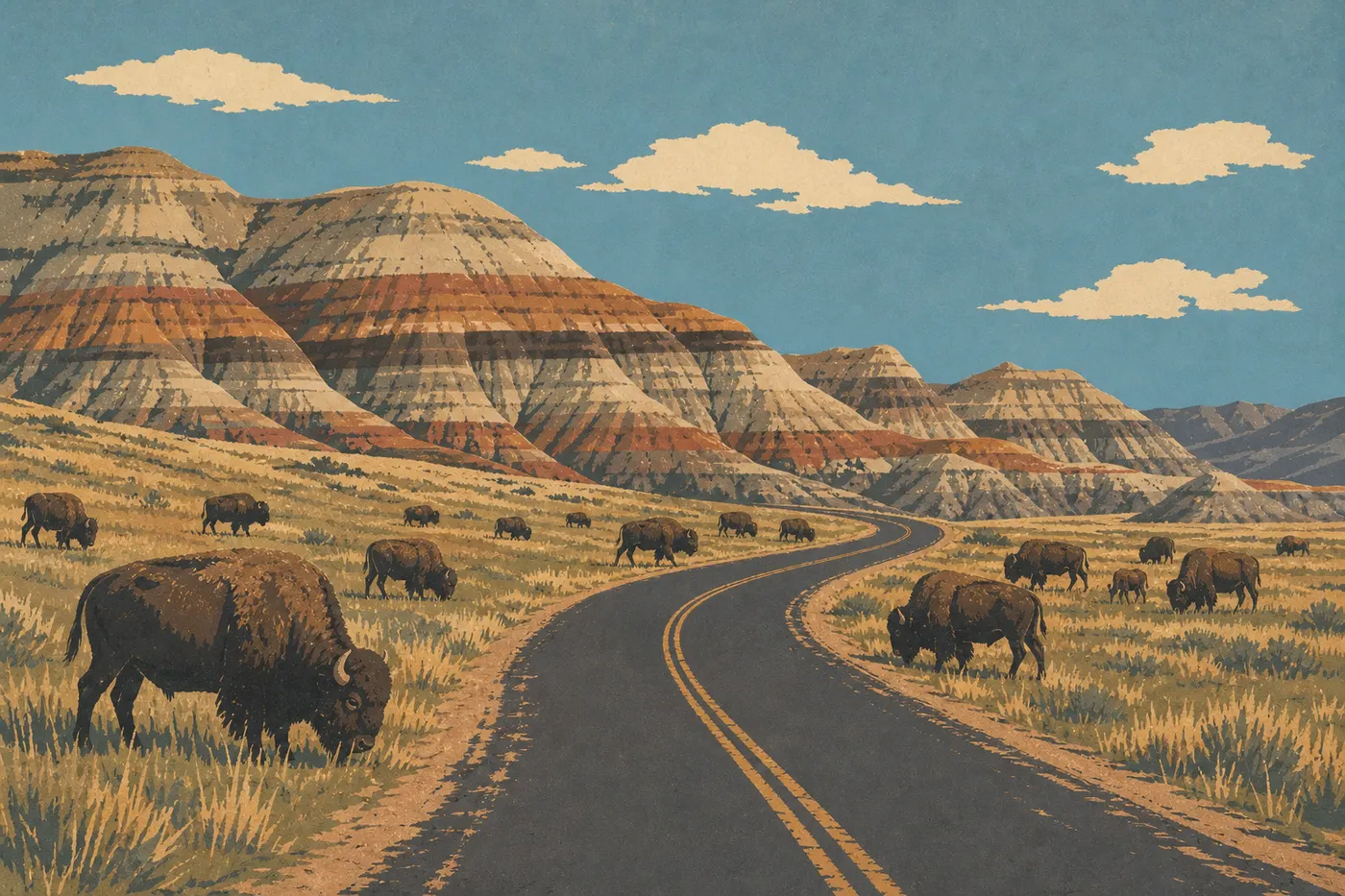
Theodore Roosevelt Itinerary: What to See in 1, 2, or 3 Days
Theodore Roosevelt is a park made up of three separate units in the heart of North Dakota's Badlands. Unlike Zion or Yellowstone, no shuttle connects the different areas, so you'll need a car and should sort out the logistics before you leave. For a well-rounded visit, two days cover the essentials (South Unit and North Unit); three days give you time to hike, watch wildlife without rushing, and make it out to the historic Elkhorn Ranch.
How Much Time Do You Need to Visit Theodore Roosevelt?
The park is divided into three distinct administrative units. The South Unit (entrance in Medora) is the busiest and easiest to access, right off I-94. The North Unit lies 70 miles north on Highway 85. The Elkhorn Ranch Unit is an isolated area between the two, accessible only by dirt road.
| Length | What you'll cover |
|---|---|
| 1 day | South Unit: scenic drive and Painted Canyon |
| 2 days | South Unit and North Unit |
| 3 days | South Unit, North Unit, Elkhorn Ranch, and hikes |
One day gives you a solid sense of the park. Two days let you experience Theodore Roosevelt in both of its moods. Three days is the pace we recommend if you have the flexibility.
Access, Entrances, and Getting Around the Park
South Unit: Enter from Medora (I-94, exits 24 and 27). The Painted Canyon Overlook (I-94 exit 32) is accessible for free without an entrance pass. North Unit: 70 miles north on Highway 85; allow two hours of driving from Medora. Elkhorn Ranch Unit: reached by about 12 miles of clay dirt road, which can become impassable in rainy weather. Ask at the Medora visitor center about road conditions before you leave. Getting around: there's no shuttle or public transportation, so you'll need a car to travel between the units. For detailed directions, the Theodore Roosevelt access guide covers each entrance.
Entrance fees are $30 per vehicle, $25 for a motorcycle, and $15 per person entering on foot or by bicycle. An annual park-specific pass costs $55. If you're visiting several national parks during your trip, the America the Beautiful pass pays for itself starting with the second park. For entrance fees and annual passes, see the national parks fees and passes page.
Theodore Roosevelt's Main Areas
The South Unit: Medora's Badlands
The South Unit is the park's lively core. It has the most accessible rock formations, the densest prairie dog towns, and most of the short trails. The Scenic Loop Drive (a 36-mile loop) runs through the entire area and takes two to three hours at a relaxed pace, including stops.
Here are the stops you shouldn't miss:
Painted Canyon Overlook. This overlook looks down over layers of red, ocher, and gray rock, streaked like a manuscript page. It's often visitors' first visual introduction to the Badlands, and it's rarely disappointing.
Buck Hill. At 2,400 feet above sea level, it's one of the highest points in the South Unit. The view takes in the entire area. On a clear day, you can make out the Little Missouri River winding through the valleys below.
Prairie Dog Town. The prairie dog colony along the Scenic Loop Drive is one of the easiest wildlife stops in North Dakota. These social rodents live in burrows, whistle to warn their colony, and let you watch them from close by. Plan on 20 minutes, though you'll probably spend 40.
Maltese Cross Cabin. This log cabin, displayed behind the Medora visitor center, is one of the two original cabins where Roosevelt slept during his years in Dakota. It gives the park's history a tangible setting.
The North Unit: Wide-Open Wilderness
The North Unit gets fewer visitors than the South Unit, and that's exactly what gives it its character. The scenery is different, with rock formations giving way more often to open prairie and cottonwood forests along the river. The scenic road (17 miles round-trip) ends at Oxbow Overlook, a terrace above the Little Missouri that's worth the drive on its own.
Cannonball Concretions. These sandstone spheres, shaped by erosion and ranging in size, are a geological curiosity found nowhere else in the park. They're just a few minutes' walk from the parking area.
River Bend Overlook. A high view of a bend in the Little Missouri, with the Badlands cliffs in the background. It's the North Unit's iconic photo spot.
Oxbow Overlook. The scenic road ends here. It's the place to be late in the day, when bison herds often head down toward the river.
Elkhorn Ranch: Roosevelt's Ranch
The Elkhorn Ranch Unit is the place most closely tied to the president's personal history. This is where he hunted, raised cattle, and, in his own writing, forged his character after the death of his first wife. Almost no buildings remain, just stone foundations and an untouched Badlands landscape. The visit is short, less than an hour on site, but the experience is rare and crowd-free.
Day-by-Day Itinerary
Day 1: South Unit and Medora's Badlands
Morning. Leave Medora early. The first few hours are cooler and best for wildlife. Stop at the visitor center for a paper map and the day's updates. Take the Scenic Loop Drive counterclockwise. You'll follow the river first, then gradually climb toward the overlooks.
Make your first stop Prairie Dog Town, when activity is highest. Continue to Buck Hill for the soft morning light on the Badlands.
Midday. Return to the visitor center and visit the Maltese Cross Cabin. Have lunch in Medora.
Afternoon. Get back on the Scenic Loop Drive to cover the remaining areas. Bison and pronghorns become more active as the heat fades. End the day at Painted Canyon Overlook, where the low light makes the rock layers glow red. It's a fine way to wrap up the day.
Evening. Stay overnight in Medora.
Day 2: North Unit, the Park at Its Wildest
Morning. Leave early for the drive. Allow two hours from Medora to the North Unit entrance via Highway 85. Stop in Watford City if you need gas or coffee. There isn't much along the road between the two.
Stop at the North Unit visitor center for the latest wildlife updates. Start down the scenic road, with your first stop at Cannonball Concretions.
Midday. Have a picnic at River Bend Overlook with a view of the Little Missouri. It's the kind of lunch you'll remember.
Afternoon. Continue to Oxbow Overlook. Hike the Little Mo Nature Trail (about 1.6 miles round-trip, an easy path along the valley floor) to follow the river up close. You have a real chance of seeing bison, elk, or wild horses in the late afternoon.
Evening. Return to Medora, or stay overnight in Watford City if you want to start the next day right in the North Unit.
Day 3: Elkhorn Ranch and Hikes (Optional)
Morning. If the weather is good and the road is passable, check the previous evening with the Medora visitor center and head for the Elkhorn Ranch Unit. The clay dirt road requires a vehicle with decent ground clearance and dry conditions. Once there, explore on your own: walk among the stone foundations with the river below and no other visitors in sight.
Afternoon. Return to the South Unit for any hikes you haven't done yet. The Petrified Forest Loop (17 miles, a full day for strong hikers) or shorter trails depending on your ability. Details for each trail, including difficulty, distance, and duration, are in the Theodore Roosevelt hiking guide.
Options for Different Trip Lengths
Express (1 day). South Unit only: the full Scenic Loop Drive, Painted Canyon Overlook, and Maltese Cross Cabin. You'll leave with a solid understanding of the Badlands and close-up wildlife sightings. It's not much, but it hangs together.
Classic (2 days). The itinerary above: South Unit on day one and North Unit on day two. For most visitors, it's the right balance of coverage and depth.
Regional Road Trip (3 days or more). Add Elkhorn Ranch, a hike away from the Scenic Drive, and, if you like, a detour to the Badlands of South Dakota, about five hours south by car. The two parks complement each other well: related landscapes, different atmospheres. Our Road Trip guide has the information you need to plan this multi-park loop.
Itinerary Map
The NPS offers an official Unigrid map as a free download on its website. It shows the three units, scenic roads, trailheads, and main points of interest. Pick up a paper copy at the Medora visitor center when you arrive. In western North Dakota, cell service is often nonexistent, and a map you can't pinch and zoom is worth its weight in gold. An annotated version showing the key stops along the Scenic Loop Drive is available on the Theodore Roosevelt map.
Where to Stay Along the Route
Medora is the only real service town near the South Unit. It has hotels, cabins, and campgrounds, with limited availability and corresponding prices in high season. Watford City makes a good base for the North Unit. Two campgrounds are open inside the park, Cottonwood in the South Unit and Juniper in the North Unit. They're a solid choice if you want to be close to wildlife at sunrise.
Complete lodging information, including booking logistics and price ranges, is in the Theodore Roosevelt lodging guide.
Extend Your Trip: What to See Around Theodore Roosevelt
Theodore Roosevelt fits naturally into a Great Plains road trip. The Badlands of South Dakota and Mount Rushmore are about five hours south by car, making a coherent one-week loop. To the east, Bismarck, the capital of North Dakota, has a few museums about Plains history and good lodging options. Our regional guide has information on these extensions and the roads connecting them.
The Ideal Itinerary for Your Time
One day. South Unit, Scenic Loop Drive, and Painted Canyon. You'll get Badlands scenery, bison, and prairie dogs.
Two days. Add the North Unit. You'll see the park in both of its forms: accessible and wild.
Three days. Take time to hike, make it out to Elkhorn Ranch, and sit in the Badlands without watching the clock. Theodore Roosevelt isn't a park to rush through. It's a park that rewards you for slowing down.
Frequently Asked Questions
How long does it take to drive around Theodore Roosevelt National Park?
The South Unit's Scenic Loop Drive (36 miles) takes two to three hours at a relaxed pace, including stops. To add the North Unit (17 miles round-trip, plus two hours of driving between the units), allow an additional day. A complete tour of the two main units therefore requires at least two days.
What is the best month to visit Theodore Roosevelt National Park?
The best month to visit Theodore Roosevelt depends on your priorities: May and June for spring colors after the rain, and September for fall light and bison herds in peak condition. July and August are the busiest months, with temperatures that can top 95°F in the Badlands. In winter, some roads may close after snowfall. The best times to visit Theodore Roosevelt guide covers conditions month by month.
Can you drive through Theodore Roosevelt National Park?
Yes, but the scenic roads in both units run inside the park and require a valid pass. Only Painted Canyon Overlook, accessible from I-94 exit 32, is free without entering the park. The standard entrance fee is $30 per vehicle.
Is Theodore Roosevelt National Park worth visiting?
Yes, especially if you're looking for a park that's less crowded than Yellowstone or Zion. Theodore Roosevelt offers striking Badlands scenery, abundant wildlife (bison, wild horses, elk, prairie dogs, and pronghorns), and a tangible historical dimension, all without the lines found at the biggest parks. It's a park that surprises you, often more than visitors expect.