
Lassen Volcanic with Kids: What to Do and How to Plan Your Visit
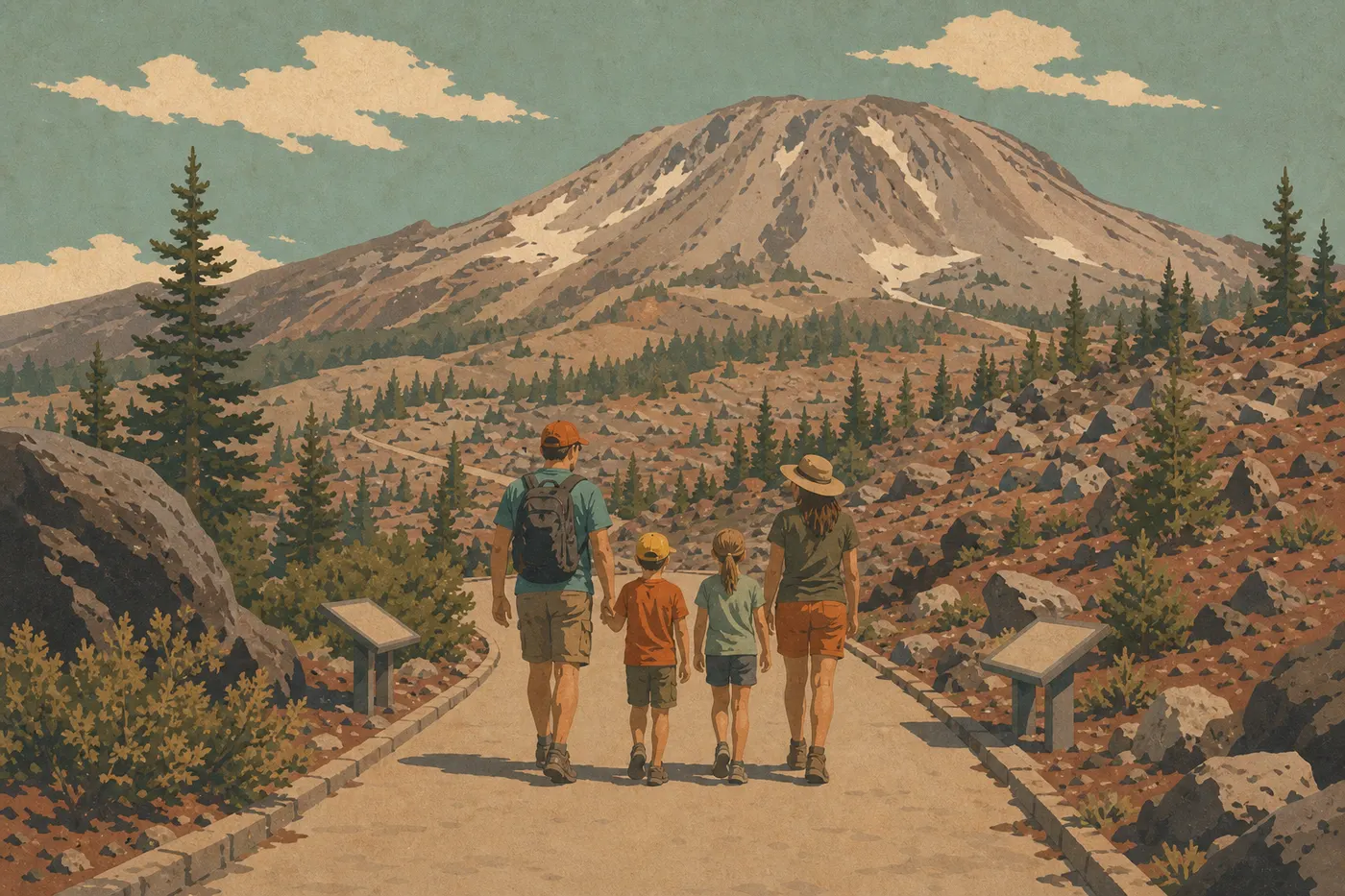
Lassen Volcanic works well for families with kids as young as 4 at the roadside sites, and from about 6 or 7 for the shorter trails. The park is compact, the volcanic features are tangible and dramatic, and the Junior Ranger program turns a visit into an educational adventure. Plan on two to three days between June and September, and you can explore without stress even with young children.
Why Visit Lassen Volcanic with Kids
This park gives kids something rare: active geology they can see, smell, and experience up close. You won't just look at a photo of a volcano here. You'll smell sulfur, hear hot springs bubbling, and watch steam rise from the fumaroles. It's tangible, immediate, and memorable, especially for kids who've touched on the subject in class.
Other practical advantages for families:
- The park gets far fewer visitors than Yosemite or Zion, so you can get around, find parking, and breathe easy.
- The main sites, including Bumpass Hell, Sulphur Works, and Manzanita Lake, line a single road, Highway 89. That makes it easy to adjust your plans to the family's energy level each day.
- Manzanita Lake offers swimming, fishing, and kayaking for a low-key afternoon.
Is Lassen Volcanic Good for Kids? What Age Can They Start?
The NPS doesn't set an official minimum age for Lassen Volcanic, but the geothermal areas require constant supervision.
Under 4. Babies and toddlers can visit the roadside sites, especially Sulphur Works, while being carried. Natural trails aren't stroller-friendly. Thermal areas are off-limits to children who might run around unsupervised.
Ages 4 to 6. The Manzanita Lake trail (1.6 miles, flat) and the roadside stops are a good fit. Simply seeing and smelling the volcanic features is enough to keep kids in this age group engaged.
Ages 6 to 9. The short trails to Bumpass Hell (3.1 miles) and Kings Creek Falls (3.1 miles) become manageable. This is also when the Junior Ranger program really starts to click.
Ages 10 and up. Kids in good physical shape can consider the Lassen Peak climb (about 5 miles round-trip, with 2,000 feet of elevation gain). The summit reaches 10,456 feet, so watch for signs of altitude sickness, including unusual fatigue and headaches.
When to Visit with Kids (The Easiest Season for Families)
The ideal window runs from late June to early September. Highway 89, the park's main route, stays closed by snow from around November through May. Outside that period, roads are clear, campgrounds are open, and trails are accessible.
In July and August, daytime temperatures average around 88°F, with cool nights around 50°F in the park. Bring layers for evenings at the campground.
September brings fewer visitors while keeping comfortable conditions. Above 6,560 feet, nights start to turn colder by mid-September.
For month-by-month information on snowpack, road openings, and precipitation, our When to Visit page breaks down the seasons in detail.
How Many Days Should You Plan for a Family Visit?
Two full days are enough to cover the highlights with kids, as long as you organize your visits by area.
Day 1 (north area): Manzanita Lake, including the lake loop and swimming, plus Hot Rock and Chaos Crags if the kids are up for it. Day 2 (south route): Sulphur Works, Bumpass Hell, and Kings Creek Falls.
A third day helps when you're traveling with children under 6, giving you time to go at their pace or finish the Junior Ranger booklet without rushing.
Our Itinerary and Trip Length page offers a structured family itinerary with driving times between each site.
What to Do at Lassen Volcanic with Kids: Our Picks
Here are the highlights we'd prioritize for families, from easiest to most demanding. For the complete list of activities and points of interest, our Things to Do page covers the entire park.
Sulphur Works. This geothermal site sits right by the parking area, with fumaroles and bubbling mud just a few yards away. You barely have to walk, and the sulfur smell is guaranteed to get a reaction. Allow 20 to 30 minutes.
Manzanita Lake. The circular lake, surrounded by mountains, is the park's place to unwind. The loop around the lake (1.6 miles, flat) works for all ages. The nearby area has a visitor center, a small grocery store, and a campground, making it the most convenient family base.
Bumpass Hell. The park's largest geothermal area is a plateau of hot springs, fumaroles, and boiling mud crossed by a wooden boardwalk over a 3.1-mile round trip. The scenery is striking. Kids as young as 6 or 7 can manage it with adult supervision.
Hot Rock. A house-sized block of cooled lava visible from the road. It's a quick stop, about 10 to 15 minutes, with a big visual payoff for kids.
Kings Creek Falls. The waterfall at the end of this 3.1-mile round-trip trail is the perfect reward for getting a child to keep walking. Wear sturdy, closed-toe hiking shoes.
Easy Family Hikes (Short Trails with Little Elevation Gain)
Manzanita Lake Loop (1.6 miles, flat, 1 hour). This is the only loop suitable for an all-terrain stroller. The ground around the lake is stable, and the mountain scenery is reflected in the water. It's ideal at the end of the day or as a warm-up.
Sulphur Works (on-site, 20 minutes). This is less a trail than an interpretive area right off the parking lot. It works for strollers and young children with an adult.
Bumpass Hell Trail (3.1 miles round-trip, 425 feet of elevation gain, 2 hours). Suitable from about age 6 or 7. The boardwalk keeps visitors a safe distance from the thermal areas. There's no water along the trail, so bring enough for the whole group. Closed-toe shoes are essential.
Kings Creek Falls Trail (3.1 miles round-trip, 590 feet of elevation gain, 2 hours). Suitable from about age 7 or 8. There are a few rocky sections on the descent to the waterfall. The falls are worth the effort for kids. Not suitable for strollers.
Terrace, Shadow, and Cliff Lakes (4 miles round-trip, moderate elevation gain). This outing is for families with kids ages 10 and up. Three lakes in succession and an open view of Lassen Peak make the effort worthwhile.
Our Hiking page gives the detailed profile for each trail, seasonal conditions, and gear recommendations.
The Junior Ranger Program
The Junior Ranger program is reason enough to visit an American national park with kids. At Lassen Volcanic, it works like this: kids pick up an activity booklet at the Manzanita Lake visitor center, complete it during their visit with field observations, drawings, and questions about volcanic geology and wildlife, then show their work to a ranger to receive an official badge.
There are several age levels. Booklets for ages 5 to 7, 8 to 12, and 13 and up cover the same themes with different levels of complexity. At Lassen Volcanic, the content focuses on volcanism and hydrothermal features, which fits perfectly with the sites you'll visit during the day.
Practical tip: pick up the booklet as soon as you arrive at the north entrance, plan your visits around the exercises, and save your meeting with the ranger for the end of your stay. Bring a pen because the booklet asks for written field observations.
The badge is free and included with park admission.
Safety with Kids
Lassen Volcanic's geothermal areas pose the main risks for families. These rules are nonnegotiable.
Thermal areas (Bumpass Hell, Sulphur Works, Devils Kitchen). Never leave marked trails or boardwalks. The ground around hot springs can hide boiling mud hotter than 194°F. Hold young children's hands in every section near active areas. There are no exceptions, not even for a closer look.
Steam and sulfur. Gas releases are harmless during brief exposure in the open air. If your children have asthma or sensitive airways, limit the time they spend directly in the steam plumes.
Altitude. Highway 89 rises above 8,858 feet at its highest point, and several trails approach or exceed 9,843 feet. Kids can feel the effects of altitude, including unusual fatigue, headaches, and nausea, even with no prior history. Offer water regularly, slow down, and return to the vehicle immediately if a child complains.
Wildlife. Black bears live in the park. Store all food in vehicle trunks or bear canisters, never in tents. Teach kids not to approach or feed wildlife, including the jays and squirrels that seem tame around campgrounds.
Sun and UV. Altitude increases sun exposure. Use at least SPF 50 sunscreen on kids, along with a wide-brimmed hat and sunglasses, even on cloudy days.
Our Lassen Volcanic guide covers park rules and emergency procedures in detail.
Where to Stay with Kids (In and Around the Park)
In the park. Manzanita Lake Campground is the default family base, with flush toilets, a nearby grocery store, direct access to the lake and trails, and other practical amenities. Reservations are essential in July and August through Recreation.gov. Butte Lake and Juniper Lake Campgrounds are more rustic, with no running water, and are better suited to families who are comfortable with primitive camping.
Nearby. Chester, the closest town to the south entrance (about 12 miles away), has affordable motels and basic services. Redding, about 50 miles west, offers a wider range of hotels for families who want to alternate between camping and a traditional room.
For a detailed selection with prices, our Where to Stay page and Camping page can help you choose based on your budget and preferred level of comfort.
Meals and Breaks with Kids
Food options inside the park are intentionally limited. The Manzanita Lake grocery store, Lassen Café & Gift, sells sandwiches, snacks, ice cream, and a few basic supplies for campers. There isn't really a restaurant in the park.
Our recommendation is to stock up in Redding or Chester before entering the park, then pack lunches for your days out. You'll find plenty of picnic tables near the main sites, including Manzanita Lake and Kings Creek Meadows.
For hikes, plan on at least 0.5 liters of water per hour per person, and more in summer and at high elevations. Potable water is available in the campground areas and at the visitor center, but not on the trails.
Chester has a few family-friendly restaurants for evenings after a day in the park. Our Where to Eat page lists options in and around Lassen Volcanic.
Family Budget
Park admission costs $30 per vehicle and is valid for 7 days, covering everyone inside at no extra charge. Children under 16 enter free.
If your road trip includes other national parks, the America the Beautiful pass ($80 per year) pays for itself after about three parks. It covers one vehicle and all its passengers throughout the U.S. federal recreation system.
Lassen Volcanic's own annual pass costs $55. The Junior Ranger program is included with admission, so the badge is free.
For admission prices and annual passes, see the National Park Fees and Passes page.
Places to Combine with Lassen Volcanic on a Family Trip
Lassen Volcanic fits well into a longer road trip through Northern California and southern Oregon.
Mount Shasta (about 1.5 hours west). The imposing 14,180-foot stratovolcano is visible from dozens of miles away. Nearby Shasta Lake offers swimming and water activities for families.
Crater Lake, Oregon (about 5 hours north). The caldera lake's deep blue water creates a striking contrast with Lassen's volcanic landscape. Plan on an extra night along the way.
Lake Tahoe (about 3 hours south). A natural transition from volcanic landscapes to a mountain beach destination to finish a Northern California road trip.
The Region and Road Trip sections lay out possible itineraries from Lassen Volcanic with kids, including distances and suggested stops.
Is Lassen Volcanic Worth Visiting with Kids?
Yes, especially for families with kids ages 6 or 7 and up. The park turns geology into a sensory experience. Kids don't just remember terms on a sign; they remember the smell of sulfur and the sight of gray mud bubbling at 194°F. Those are the kinds of visits that stick with them.
The much lower visitor numbers than at Yosemite or the Grand Canyon also change the experience. You can find parking without circling, walk without waiting, and explore at your own pace. For families used to crowded American destinations in summer, the contrast is noticeable.
Two well-organized days are enough to see the highlights. The logistics are simple, with one main road, clearly distributed sites, and a central campground at Manzanita Lake. If your road trip includes other parks, the America the Beautiful pass quickly makes the admission fee worthwhile.
For an overview before you start planning, our complete Lassen Volcanic guide brings all the topics together in one place.
Frequently Asked Questions
Is Lassen Volcanic suitable for kids?
Lassen Volcanic works well for families with children as young as 4 at the roadside sites, and from about 6 or 7 for short trails such as Bumpass Hell or Kings Creek Falls. Supervision is essential in every geothermal area. The Junior Ranger program is available for several age groups.
What is Lassen Volcanic National Park known for?
Lassen Volcanic is known for active volcanism and hydrothermal features, including mud pots, fumaroles, and hot springs. It's one of the few American parks with all four types of volcanoes: shield, composite, lava dome, and cinder cone. Lassen Peak's last major eruption took place in 1915.
Why is Lassen Volcanic National Park closed or partly inaccessible?
The most common partial closure affects the main road, Highway 89, which is blocked by snow from around November through May. The park remains open year-round, but access to the main sites is very limited in the off-season. Temporary closures can also occur for safety reasons, including weather, wildfires, or unusual volcanic activity.
What is the closest town to Lassen Volcanic National Park?
Chester is the closest town to the south entrance, about 12 miles away. Redding, about 50 miles west via Interstate 5, is the best-equipped larger city for families, with lodging, stores, and medical services.
Is Lassen Volcanic worth visiting with kids?
Lassen Volcanic is worth visiting if your kids are at least 6 or 7 and interested in natural phenomena. Two days are enough for the highlights, crowds are moderate, and the main sites are easy to reach. With the America the Beautiful pass, the admission cost compares well with the experience.
What would happen if Lassen Peak erupted?
Lassen Peak is an active volcano monitored around the clock by the USGS, the United States Geological Survey. If significant volcanic activity occurred, the NPS would evacuate the park and surrounding areas immediately. During a normal visit, no unusual activity is expected. The official NPS website and the NPS app publish volcanic alerts in real time.